Table of Contents
Some links on JAK Digital Hub are affiliate links, meaning we may earn a small commission at no extra cost to you. Read full disclaimer.
Better email automation software for ecommerce that converts – is not really about sending more emails. It is about sending the right message at the exact moment a shopper is most likely to buy, come back, or spend a little more.
I have seen stores obsess over templates while ignoring timing, segmentation, and automation logic, and that is usually where conversions get lost.
In this guide, I’ll help you sort through what actually matters, how these platforms work, which features move revenue, and how to choose software that fits your store today without trapping you in the wrong system later.
What Better Email Automation Software For Ecommerce Actually Means
Choosing software can feel overwhelming because most platforms promise the same things: automations, segmentation, templates, AI, analytics, and better conversions.
The real difference is how well the platform turns your customer data into useful actions.
What “Better” Really Looks Like For An Ecommerce Brand
A better platform is not just one with more features. It is one that makes profitable automation easier to build, easier to measure, and easier to improve.
For most ecommerce brands, “better” usually means four things working together:
- Customer Data That Updates Fast: Your platform should react to product views, cart activity, purchases, refunds, and browsing behavior without delay.
- Automation Depth: It should handle welcome series, cart recovery, browse abandonment, post-purchase follow-up, replenishment, win-back, and VIP flows without awkward workarounds.
- Segmentation That Feels Practical: You should be able to target people by behavior, order history, engagement, predicted intent, and product interest.
- Revenue Visibility: The tool should show which automations actually drove orders, not just opens and clicks.
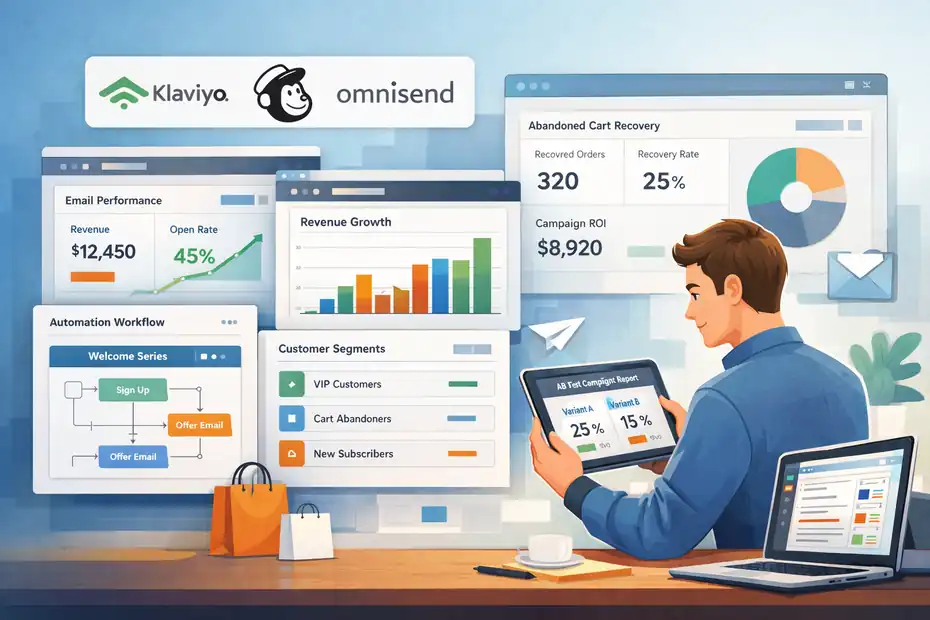
That last point matters more than many people realize. Klaviyo’s 2026 benchmarks separate campaign performance from flow performance and show why that matters: average campaign open rates sit around 31%, with top performers at 45.1%, while placed order rate averages around 0.16% for campaigns.
In other words, surface-level engagement is not the same as purchase intent.
I believe this is where many stores choose the wrong software. They buy a newsletter tool when what they actually need is a customer journey tool.
Why Ecommerce Automation Software Converts Better Than Basic Email Tools
Basic email platforms can send promotions. Better ecommerce automation platforms can respond to behavior.
Imagine you run a skincare store. One visitor checks a moisturizer twice, adds it to cart, leaves, comes back three days later, then buys a travel-size product instead. A basic platform might just keep sending general promos.
A better platform can trigger a browse email, suppress the cart series after purchase, cross-sell the full-size version, and then time replenishment based on expected usage.
That sequence feels small, but it adds up. Omnisend reports that one in three people who click on an automated email end up making a purchase, versus about one in 18 for scheduled campaigns. It also reports a $79 return for every $1 spent on its platform.
Those are vendor-reported numbers, so I would treat them as directional rather than universal, but they still reinforce a real pattern: automation usually outperforms one-off blasts because it captures intent when it is hottest.
The Biggest Misunderstanding: Software Does Not Fix Weak Strategy
This is the part I always come back to. Great software will not save a weak offer, poor list quality, unclear positioning, or boring creative.
You can buy the most advanced platform on the market and still get mediocre results if:
- Your Welcome Flow Has No Reason To Buy: A discount alone is not a full conversion strategy.
- Your Cart Emails Sound Generic: People need reassurance, urgency, and relevance.
- Your Segments Are Too Broad: Sending the same message to first-time browsers and repeat buyers is lazy targeting.
- Your Deliverability Is Slipping: The best automation in the world cannot work if inbox placement is weak.
So yes, software matters. But the better way to think about it is this: your platform should make smart strategy easier to execute at scale.
How Ecommerce Email Automation Software Works Behind The Scenes
Before you compare platforms, it helps to understand the engine. Once you know how automation software actually works, feature lists start making a lot more sense.
The Core System: Events, Segments, Triggers, And Flows
At its heart, ecommerce email automation software watches for customer actions and then decides what to do next.
The workflow usually looks like this:
- Event: A shopper viewed a product, started checkout, purchased, or became inactive.
- Condition: The platform checks rules such as country, order count, product category, or engagement level.
- Flow Trigger: That event starts an automation.
- Branching Logic: The system decides who gets which message and when.
- Measurement: Revenue, orders, clicks, unsubscribe rate, and time-to-purchase get tracked.
This sounds technical, but it is really just automated decision-making. Think of it like a store associate who remembers what each shopper did, what they bought before, and what message would make sense next.
The better the platform, the more precise that logic becomes. That precision is where conversions happen.
Why Integrations Matter More Than Templates
A lot of software comparisons overemphasize templates because templates are easy to demo. Integrations are what actually make the platform useful.
Your email software needs strong connections with your ecommerce stack, especially your storefront, product catalog, checkout events, discounting, review system, and sometimes subscription platform. If that data is incomplete or delayed, your automations become clumsy.
For example, Shopify’s own email product is attractive for simplicity and price. Shopify Email includes the first 10,000 emails per month free, with pricing starting at $1 per 1,000 emails after that. That can be very cost-effective for smaller stores.
But for brands that want more advanced behavior-based orchestration, broader ecosystem flexibility, or deeper lifecycle reporting, a more specialized automation platform may be a better fit.
My advice is simple: Do not judge a platform by how nice the editor looks. Judge it by the quality of the data flowing into the automations.
The Revenue Layer: Attribution, Reporting, And Decision-Making
You are not buying software to send email. You are buying software to influence revenue.
So reporting should answer practical questions like:
- Which flow drives the most first orders?
- Which segment has the highest repeat purchase rate?
- Which product categories respond best to replenishment timing?
- Where are people dropping off in the journey?
Mail volume and opens still have value, but revenue per recipient and order rate tell you more about business impact. Klaviyo’s benchmark reporting highlights revenue per recipient and order-rate comparisons by industry, which is useful because it keeps teams from celebrating vanity metrics.
In my experience, the best software helps you stop asking, “Did this email perform?” and start asking, “Did this automation change buying behavior?”
The Features That Actually Increase Conversions
This is where comparisons get useful. Many features sound impressive in demos, but only a smaller group consistently drives ecommerce performance.
Behavioral Segmentation That Goes Beyond Demographics
Demographic segmentation is fine, but ecommerce growth usually comes from behavior.
A better platform lets you segment people by:
- Viewed But Never Purchased
- Added To Cart But Did Not Start Checkout
- First-Time Buyer Within 30 Days
- Repeat Buyer With High Average Order Value
- Engaged Subscriber With No Purchase Yet
- Lapsed Buyer Who Used To Purchase Every 45 Days
That kind of targeting changes the tone and timing of your emails. A shopper who keeps visiting your best-selling shoe collection needs a different message from someone who bought once six months ago and never opened another email.
I suggest looking for software that makes these conditions easy to build without custom engineering. If your team needs a developer just to create a useful segment, the platform is probably fighting you.
Automation Flows That Match Real Buying Journeys
The highest-converting email programs are usually built on a small set of strong automations, not dozens of half-finished ones.
The essential flows are:
- Welcome Series: Turns new subscribers into first-time buyers.
- Abandoned Cart: Recovers shoppers who showed strong purchase intent.
- Browse Abandonment: Nudges visitors who explored but did not add to cart.
- Post-Purchase: Increases satisfaction, repeat orders, and reviews.
- Replenishment: Brings back buyers when they are likely running low.
- Win-Back: Re-engages customers before they disappear for good.
Omnisend’s benchmark content specifically notes that automated messages tend to convert at a far higher rate than scheduled campaigns, which lines up with what many operators see in practice.
If a platform makes those flows easy to customize, that is a major buying signal.
Deliverability, Testing, And Send Control
A platform can have great automation logic and still underperform if inbox placement is weak. Deliverability is one of those quiet features that matters a lot more than it gets credit for.
Look for software that supports:
- Smart Suppression: Avoid sending to chronically unengaged contacts.
- Send Time Optimization: Helps match delivery to engagement windows.
- Frequency Controls: Prevents over-emailing across multiple flows.
- A/B Testing: Subject lines, timing, incentive type, and content blocks.
- Domain Authentication Guidance: This protects sender reputation.
Mailchimp and Klaviyo both emphasize automation, reporting, and plan-based feature access, but their fit differs depending on whether you want broader general marketing functionality or tighter ecommerce event-driven depth.
My honest take is that most stores underuse testing. They test subject lines, but ignore more meaningful variables like delay timing, message angle, discount placement, and product recommendation logic.
Best Software Options And Who They Are Best For
There is no perfect platform for every store. The right choice depends on your catalog complexity, revenue stage, team skill, and how advanced you want your lifecycle marketing to become.
Klaviyo: Best For Data-Rich Lifecycle Marketing
Klaviyo is usually the first serious recommendation for growing ecommerce brands, and that is not random. It combines event-driven automation, strong segmentation, and ecommerce-focused reporting in a way that feels built for operators who care about revenue.
Its pricing page shows a free plan and paid email + SMS pricing starting around $20 per month in some markets, with plan structure tied to usage and features. Klaviyo also positions itself as a unified platform for customer data, email, SMS, and reporting.
Why it tends to work well:
- Strong Shopify Ecosystem Fit
- Deep Segmentation And Flow Logic
- Useful Benchmarking And Revenue Reporting
- Good For Mid-Market Growth
Where it can be frustrating:
- Costs Rise With List Growth
- Feature Depth Can Feel Heavy For Beginners
- You Need Strategy Discipline To Get Full Value
I usually recommend Klaviyo for brands that already have traction and want to build a real lifecycle program, not just a newsletter calendar.
Omnisend: Best For Ease Of Use With Strong Ecommerce Focus
Omnisend is a solid middle ground for brands that want ecommerce-specific functionality without feeling buried in complexity.
Its pricing page says all features are available on the free plan with usage limits, and paid plans start at $16 per month. The company also heavily emphasizes automation templates, ecommerce integrations, and strong ROI outcomes.
Why it stands out:
- Simple Onboarding For Smaller Teams
- Good Automation Coverage For Common Ecommerce Flows
- Competitive Entry Pricing
- Clear Ecommerce Positioning
Where it may be less ideal:
- Some advanced brands may outgrow its simpler feel
- Vendor-reported ROI claims should be validated against your own data
If you run a small to midsize store and want faster setup without giving up core ecommerce automations, Omnisend is very often worth serious consideration.
Shopify Email, Mailchimp, And Drip: Where They Fit
These are not interchangeable, even though they often appear in the same comparison lists.
Shopify Email is best when you want low-friction, low-cost sending inside the Shopify ecosystem. The first 10,000 emails per month are free, and after that pricing starts at $1 per 1,000 emails. That is hard to ignore on cost alone.
Mailchimp is still useful for brands that want a familiar email platform with broader marketing functionality. Its pricing starts around $13 per month on Shopify app listings, with higher tiers unlocking far more automation and targeting.
Drip positions itself as an ecommerce-focused automation platform for B2C brands selling physical or digital products, with an emphasis on segmentation and automation.
My simplified view:
- Shopify Email: Best for lean budgets and simpler needs.
- Mailchimp: Best for general email marketing teams that need ecommerce support, not ecommerce-first depth.
- Drip: Best for brands that want a lifecycle and CRM-style mindset around automation.
How To Choose The Right Platform For Your Store
This is the decision framework I would use if I were picking from scratch today. It keeps you from choosing based on hype or a flashy demo.
Start With Your Store Stage, Not The Biggest Brand Name
A 30-order-per-month store and a seven-figure catalog-heavy brand do not need the same software.
Use your current stage as the filter:
- Early Stage: Prioritize simplicity, core automations, and affordability.
- Growth Stage: Prioritize segmentation, product data, and revenue attribution.
- Advanced Stage: Prioritize custom logic, multi-channel orchestration, and operational efficiency.
I recommend thinking in terms of the next 12 to 18 months, not just the next 30 days. Switching platforms later can be painful, especially if your historical data, automations, and reporting structure become deeply embedded.
Compare Total Cost, Not Just Entry Pricing
A cheap platform can become expensive if you outgrow it quickly. A premium platform can become cost-effective if it lifts retention and repeat purchase rate enough.
Look at cost across:
- Subscriber Growth
- Monthly Send Volume
- SMS Add-Ons
- Advanced Reporting Access
- Onboarding Or Migration Services
- Team Time Needed To Operate It
For example, Omnisend starts at $16 per month on paid plans, Mailchimp’s entry pricing begins around $13 per month on the Shopify listing, and Shopify Email has very low sending costs for small lists. Klaviyo starts free and then scales upward with usage.
These are all reasonable entry points, but the real question is what happens after your audience and automations expand.
In my experience, the hidden cost is usually not the software bill. It is the opportunity cost of choosing a platform that limits your targeting or reporting.
Use A Practical Scorecard Before You Commit
Here is a simple way to compare options. Score each platform from 1 to 5 on:
- Ease Of Setup
- Shopify Or Ecommerce Integration Quality
- Segmentation Flexibility
- Flow Builder Depth
- Reporting And Attribution
- Deliverability Controls
- Scalability
- Cost At Your Expected List Size
Then weight the scores based on what matters most to your business.
For example, if you have a lean team, ease of setup might matter more than extreme customization. If you sell replenishable products, lifecycle timing and repeat-purchase automation should carry more weight.
This sounds basic, but it stops emotional buying. And honestly, emotional buying is how many brands end up migrating again a year later.
Step-By-Step Setup For A High-Converting Automation System
Once you choose the platform, the setup matters as much as the tool itself. Let me break down a smart setup sequence that works for most ecommerce stores.
Step 1: Clean Your Data And Connect The Right Sources
Before building flows, make sure your customer data is usable.
That means:
- Sync Product Catalog
- Sync Purchase Events
- Sync Checkout And Cart Events
- Import Existing Subscribers Correctly
- Remove Bad Or Inactive Contacts Where Appropriate
- Verify Consent Status
This step is boring, but it prevents a lot of future pain. If a product category is mislabeled or your purchase events do not pass correctly, your automations will misfire.
I always suggest auditing the basics before touching templates. Check whether new subscribers enter the right segment. Check whether purchases suppress cart emails. Check whether refund events affect follow-up logic. Small setup errors create weird customer experiences fast.
Step 2: Build Your Foundational Flows First
Do not try to launch 14 automations at once. Start with the flows that usually produce the fastest payoff.
Build these first:
- Welcome Flow: 3 to 5 emails introducing the brand, top products, proof, and first-order reason to buy.
- Cart Recovery Flow: 2 to 4 emails or messages focused on reminder, trust, objection handling, and urgency.
- Post-Purchase Flow: Order reassurance, product education, cross-sell timing, and review request.
- Win-Back Flow: A targeted sequence for customers drifting away.
That order matters because these flows map to the most valuable lifecycle stages: first conversion, recovery, retention, and reactivation.
A practical example: if you sell supplements, your post-purchase flow should not just say thank you. It should explain product usage, set expectation timing, answer common questions, and then trigger replenishment based on consumption window. That is how automation becomes useful, not just polite.
Step 3: Add Segmentation And Testing Layers
Once the core flows work, add intelligence rather than volume.
Start segmenting by:
- First-Time Vs Repeat Buyer
- High-AOV Vs Low-AOV Customer
- Category Interest
- Engaged Non-Buyers
- Recent Customers Excluded From Aggressive Promotions
Then run tests on variables that actually change outcomes:
- Delay Timing
- Discount Versus No Discount
- Social Proof Placement
- Product Recommendation Type
- Single-Product Versus Collection Layout
- Educational Versus Promotional Messaging
Klaviyo’s benchmark resources and best-practice content emphasize using engagement windows and smarter targeting to improve performance. That matches what I have seen in real stores: list quality and timing often matter more than prettier design.
Common Mistakes That Make Good Software Underperform
A lot of brands blame the platform when the real issue is execution. Here are the mistakes I see most often.
Sending Too Many Campaigns And Neglecting Automations
Campaigns feel urgent, visible, and easy to plan. Automations feel slower because they require setup. So teams keep sending blasts and never build the system.
That creates two problems. First, you leave money on the table because high-intent moments are not being captured automatically. Second, you train your list to expect constant promotions instead of relevant communication.
Given the gap between automated and scheduled email conversion that Omnisend reports, this is not a small mistake. It is usually one of the biggest revenue leaks in an ecommerce email program.
I would rather see a store with four excellent automations and fewer campaigns than 20 campaigns a month and no lifecycle depth.
Using Discounts As A Crutch
Discounts can help, but many brands use them like duct tape. Every welcome flow, cart sequence, win-back email, and broadcast becomes another coupon.
That creates shallow conversion behavior. People stop buying because they want the product and start waiting because they expect the discount.
A better approach is to mix incentives with:
- Trust Builders: Reviews, guarantees, shipping clarity.
- Decision Support: Sizing help, comparison guidance, ingredient or material details.
- Outcome Framing: What improves after purchase.
- Usage Education: Especially for complex or replenishable products.
In many categories, clarity converts nearly as well as discounts, and it protects margin.
Ignoring Deliverability And List Hygiene
This one sneaks up on stores. Open rates soften. Revenue dips. The team blames creative. But the real issue is often list fatigue or poor inbox placement.
Warning signs include:
- Falling open rates across all campaigns
- Rising unsubscribe or spam complaint rates
- Large inactive segments still receiving frequent email
- Weak engagement from acquisition-heavy lists
Mailchimp notes the scale of email volume globally and the continued growth of email as a channel, which also means inbox competition remains intense. With hundreds of billions of emails sent daily and projected growth continuing, staying relevant matters more than ever.
Advanced Optimization Strategies For More Revenue
Once the basics are live, this is where the real gains usually happen. Small refinements can produce outsized returns because they improve performance across traffic you are already generating.
Optimize For Revenue Per Recipient, Not Just Opens
Opens are useful, but they are a weak finish line. Revenue per recipient, order rate, and repeat purchase rate tell you much more.
A practical shift looks like this:
- Old Thinking: “This subject line got a 4% lift in opens.”
- Better Thinking: “This sequence variant increased placed orders by 18% from a high-intent segment.”
Klaviyo’s benchmark framework reinforces this by highlighting revenue and order metrics alongside engagement rates.
This matters because some emails that get fewer opens still make more money. That happens all the time when the subject line filters for serious buyers instead of curiosity clicks.
Build More Intent-Based Branching
A mature automation setup does not treat every shopper equally.
For example, a cart flow could split based on:
- Cart Value
- Product Category
- New Vs Returning Customer
- Discount Sensitivity
- Inventory Risk Or Sell-Through Pressure
Imagine two shoppers abandon cart. One has a $28 impulse accessory. The other has a $240 skincare bundle. Sending them the same sequence makes no sense. The first might need a quick reminder. The second may need proof, ingredients, shipping reassurance, and maybe a FAQ-style second email.
This is where better software earns its keep. More branching means more relevance, and more relevance usually means more conversion.
Layer In SMS Or Other Channels Carefully
Some platforms now bundle email with SMS and broader customer communication. Klaviyo positions itself as a unified channel platform, and Omnisend also emphasizes email plus SMS for ecommerce growth. Postscript, while more SMS-focused, highlights automation templates, subscriber acquisition tools, and Shopify-centered revenue use cases.
My opinion here is simple: add channels only when your email foundation is already working.
SMS can be powerful, but if your segmentation is sloppy in email, it will be sloppy in text too. Start with strong lifecycle logic, then expand channels where the economics make sense.
Scaling Your Email Automation Without Creating Chaos
As your store grows, complexity grows with it. More products, more segments, more offers, more edge cases. The challenge is scaling without turning your automation system into a mess nobody wants to manage.
Standardize Your Flow Architecture
The best teams create naming conventions, template systems, and documentation early.
That means:
- Consistent Flow Names
- Clear Trigger Rules
- Defined Suppression Logic
- Repeatable Reporting Cadence
- Documented Ownership Across Team Members
This might sound operational, but it protects performance. Once you have 12 to 20 active automations, confusion becomes expensive. Someone edits a flow, forgets a suppression rule, and suddenly recent buyers are getting the wrong message.
I recommend treating lifecycle marketing like product operations, not just creative work.
Create A Testing Calendar Instead Of Random Edits
Random optimization is one of the biggest hidden problems in growing ecommerce teams. Someone changes a subject line here, swaps a discount there, rewrites a CTA next week, and no one knows what caused the result.
A better approach is a simple testing calendar:
- Month 1: Welcome flow incentive test
- Month 2: Cart delay timing test
- Month 3: Post-purchase cross-sell timing
- Month 4: Win-back messaging angle
This gives you cleaner learning and better compounding improvements.
Know When To Upgrade Your Platform
Eventually, you may outgrow your current software. Signs include:
- You need workarounds for basic lifecycle flows
- Segmentation feels too limited
- Reporting cannot answer revenue questions
- Managing automations takes too much manual effort
- Your channel mix is expanding beyond what the platform handles well
That does not mean bigger is always better. It means your platform should match your operating model. The right software is the one that helps your team move faster without making the customer experience feel robotic.
Final Verdict: What To Look For In Better Email Automation Software For Ecommerce
If you are trying to choose better email automation software for ecommerce, I would focus less on shiny features and more on four practical questions.
- Can it use real customer behavior to trigger relevant messages?
- Can your team build and manage flows without constant friction?
- Can it show revenue impact clearly, not just engagement?
- Can it scale with your store over the next year or two?
For many growing Shopify brands, Klaviyo remains a strong choice because of its data depth, segmentation, and lifecycle reporting. Omnisend is a smart option for brands that want ecommerce-focused automation with easier setup and lower starting cost.
Shopify Email is compelling when cost and simplicity matter most. Mailchimp and Drip can make sense depending on whether you need broader marketing functionality or a more CRM-style automation mindset.
My honest advice is this: Pick the platform that supports your next level of marketing maturity, not just your current comfort zone. The software should help you build a smarter buying journey, not just send prettier emails.
When that happens, conversions improve because the experience improves. And that is usually the real difference between average email software and a system that genuinely helps an ecommerce brand grow.
FAQ
What is better email automation software for ecommerce?
Better email automation software for ecommerce helps you send targeted emails based on customer behavior like browsing, cart activity, and purchases. Instead of generic campaigns, it uses real-time data to trigger personalized messages that increase conversions, repeat purchases, and customer retention.
How does email automation improve ecommerce conversions?
Email automation improves conversions by sending the right message at the right time. For example, abandoned cart emails or post-purchase follow-ups target high-intent moments, which often leads to higher engagement and more sales compared to standard promotional campaigns.
Which features matter most in ecommerce email automation software?
The most important features include behavioral segmentation, automated flows, revenue tracking, and strong ecommerce integrations. These allow you to personalize messages, trigger emails based on actions, and measure actual sales impact instead of just opens or clicks.
Is email automation better than regular email campaigns?
Email automation is generally more effective than regular campaigns because it responds to customer actions in real time. While campaigns are useful for promotions, automated emails consistently generate higher conversion rates by targeting users when they are most likely to buy.
What is the best email automation strategy for ecommerce stores?
The best strategy focuses on core flows like welcome emails, cart recovery, post-purchase follow-ups, and win-back campaigns. These cover the full customer journey and help increase first-time conversions, repeat purchases, and long-term customer value.

Juxhin B is a digital marketing researcher and founder of JAK Digital Hub, specializing in email marketing software, marketing automation platforms, and digital growth tools. His work focuses on software testing, platform comparisons, and real-world performance analysis to help businesses choose the right marketing technology.
Related posts:
 AWeber Automation Limits You Didn’t Know Were Hurting Your Funnels
 Best Email Automation System That Scales Affordably
 Should You Upgrade Email Automation Platform For Scaling?
 Email Automation For Multiple Brands Compared
 Email Automation Tool With CRM Built In Ranked
 How To Switch Email Automation Software Safely Today