Table of Contents
Some links on JAK Digital Hub are affiliate links, meaning we may earn a small commission at no extra cost to you. Read full disclaimer.
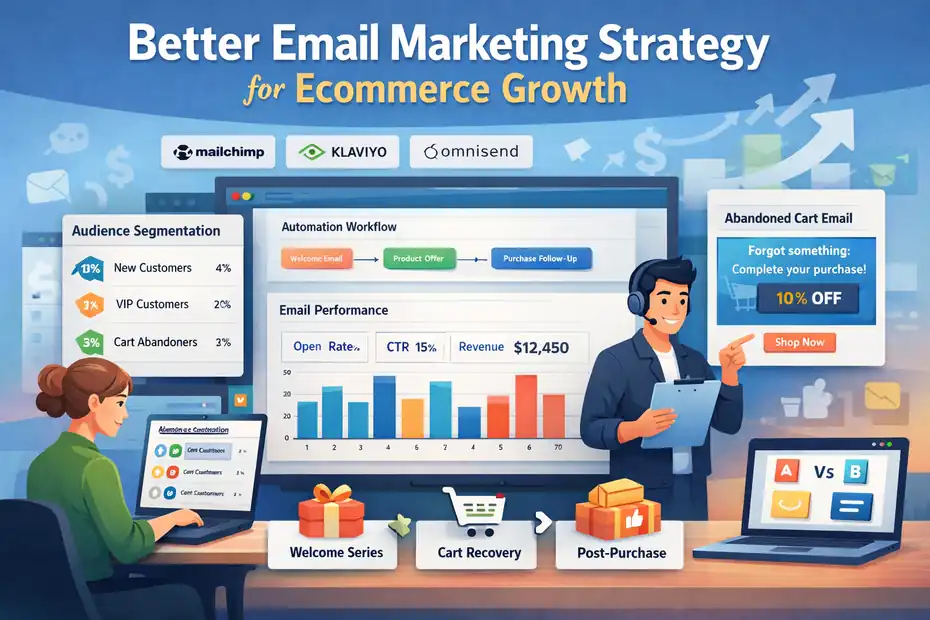
A better email marketing strategy for ecommerce often starts as a simple realization—you’re sending emails, but they’re not consistently driving the kind of growth you expected. Maybe some campaigns perform well, while others barely move the needle.
I’ve seen this happen with many stores, and the turning point usually comes when email stops being treated like occasional promotion and starts becoming a structured, customer-driven system.
When you align your emails with how people actually browse, consider, and buy, everything begins to click—conversions improve, repeat purchases grow, and your email channel finally feels like a reliable engine for ecommerce growth rather than a guessing game.
Understand What A Better Email Marketing Strategy For Ecommerce Actually Looks Like
A better email marketing strategy for ecommerce is not about sending more campaigns.
It is about sending the right message to the right shopper at the right point in the buying journey.
What “Better” Really Means In Ecommerce Email
Most stores do not have an email problem. They have a strategy problem.
I see this all the time. A brand sends one or two promotional emails each week, maybe a welcome email, maybe a cart reminder, and then wonders why revenue feels inconsistent. The issue is usually not effort. It is that the email program is built around the store’s calendar instead of the customer’s behavior.
A stronger strategy usually does three things well:
- It matches intent: New visitors get education, shoppers in carts get urgency, and existing customers get retention-focused offers.
- It protects margin: You do not rely on discounts to force every conversion.
- It compounds over time: Flows keep working even when you are not launching a campaign every day.
In my experience, this is the real shift. You stop treating email like a megaphone and start treating it like a system. That system should help you acquire, convert, retain, and reactivate customers without sounding like every other store in the inbox.
That matters because email still performs like a high-efficiency channel. Litmus says 35% of companies see an email ROI of 36:1 or more, and Shopify notes that 87% of marketers plan to maintain or increase their email marketing spend. That tells you email is still a serious growth lever, not a leftover channel.
Why Ecommerce Stores Need A System, Not Random Campaigns
Random campaigns create random revenue.
When your store depends only on blasts, every month starts at zero. You have to keep creating urgency, keep finding angles, and keep hoping people open. That gets exhausting fast, and it often trains your list to only buy when you shout “sale.”
A system works differently. It uses automated sequences for the predictable moments that happen in every store:
- Before first purchase: Welcome, browse interest, social proof, first-order nudge.
- During purchase consideration: Cart recovery, objection handling, product education.
- After purchase: Delivery support, review request, cross-sell, replenishment.
- After inactivity: Win-back and re-engagement.
This is where many ecommerce brands unlock real stability. Your campaign calendar still matters, but it sits on top of a foundation. That foundation is what keeps sales moving on the days you are not running a launch.
I believe this is the main difference between a store “doing email” and a store using email as a growth engine. One sends. The other orchestrates.
The Core Outcomes Your Strategy Should Improve
A better strategy should improve more than just revenue screenshots.
You want email to move the metrics that actually make an ecommerce business healthier. That usually includes list growth, first-purchase conversion rate, repeat purchase rate, average order value, and customer lifetime value. If those are not improving, your strategy may be busy, but it is not better.
A simple way to think about it is this:
- Acquisition: Turn more visitors into subscribers.
- Conversion: Turn more subscribers into first-time buyers.
- Retention: Turn more buyers into repeat customers.
- Recovery: Bring back carts, browsers, and inactive customers.
- Efficiency: Generate more revenue without increasing ad spend at the same pace.
Klaviyo’s ecommerce benchmark resource also highlights how valuable automated revenue can be. In its abandoned cart benchmarks, the highest revenue per recipient came from abandoned cart emails for stores with average order sizes above $200, reaching $14.14 per recipient.
That is a useful reminder that behavior-based flows are often where the easiest money lives.
Build The Foundation Before You Send More Emails
Before you worry about clever copy or fancy automation, you need the basics working.
This is the part many brands skip because it feels less exciting, but it is usually where performance starts.
Define Your Customer Journey First
If you do not know the path a customer takes from first visit to repeat order, your emails will always feel disconnected.
Start with the key stages:
- Stranger visits your store.
- Visitor joins your list.
- Subscriber browses products.
- Shopper adds to cart.
- Customer buys.
- Customer receives product.
- Customer either buys again or goes quiet.
Now ask yourself what that person needs at each stage. A first-time visitor may need trust. A browser may need clarity. A customer may need help using the product before they are ready for the next offer.
This sounds simple, but it changes everything. Instead of guessing what to send next, you are mapping messages to moments. That makes your email strategy feel relevant instead of repetitive.
Imagine you run a skincare store. A new subscriber should not get the same message as someone who bought a cleanser 20 days ago. One needs education and trust. The other may be ready for a moisturizer cross-sell or a replenishment reminder. Same brand, different stage, different email.
Set Up Basic Segmentation The Right Way
Segmentation is just grouping people by something meaningful. It does not need to be complicated to work.
I suggest starting with five practical segments:
- New subscribers with no purchase
- Engaged subscribers who clicked recently
- Cart abandoners
- First-time customers
- Lapsed customers
That alone gives you far more control than blasting everyone at once.
From there, add simple filters like product category interest, order count, average order value, and days since last purchase. These let you tailor offers without overbuilding your system. Many stores make segmentation too advanced too early. They create 25 audiences they barely use. That usually creates confusion, not growth.
A better approach is to build segments you will actually send to. Ask one question: “Would I change the email because this person belongs in this group?” If the answer is no, the segment probably does not matter yet.
From what I have seen, the most profitable segmentation is often boring on paper but powerful in practice: recency, purchase behavior, engagement, and category interest.
Clean Up Consent, Deliverability, And List Quality
You cannot build a better email marketing strategy for ecommerce on a weak list.
A lot of stores focus on subscriber count because it looks good. But list size means very little if the wrong people are on it, if permission is fuzzy, or if your emails land in promotions or spam more often than they should.
Here is the healthier mindset:
- Permission beats volume
- Engagement beats vanity
- Deliverability beats frequency
That means using clear opt-ins, avoiding bought lists, suppressing dead subscribers, and watching engagement signals. It also means reviewing your signup sources. A discount wheel may grow your list quickly, but it can also attract low-intent subscribers who never become customers.
Litmus reports that 58% of marketing teams send emails weekly or several times per week. That is useful context, but frequency only works when your list health can support it. Sending more to disengaged people is not strategy. It is pressure.
In most cases, I would rather see a smaller, cleaner list with better click quality than a giant list full of people who have not cared in six months.
Create A Smarter List Growth Strategy
You cannot improve email revenue long term if your subscriber growth is weak.
But you also do not want cheap leads who only joined for a one-time coupon and never buy again.
Use Signup Offers That Attract Buyers, Not Freebie Hunters
This is one of the biggest mistakes in ecommerce email.
A generic “10% off” popup can work, but it often becomes the lazy default. It trains visitors to wait for discounts, and it does not tell you much about what they actually want.
A smarter offer is one that qualifies interest. For example:
- Category-specific offer: “Get 10% off your first skincare routine”
- Educational incentive: “Take the fit quiz and get your personalized recommendation”
- Value-based offer: “Join for restock alerts, VIP drops, and first access”
These convert subscribers with more context. You are not just collecting emails. You are learning intent.
Imagine two stores selling coffee gear. One says, “Join our newsletter.” The other says, “Get our brew guide plus first access to grinder deals.” The second offer attracts people who are more likely to care, click, and buy.
I recommend treating list growth like customer acquisition, not form placement. The question is not “How do we get more emails?” It is “How do we attract more future customers?”
Place Forms Based On Buying Intent
Placement matters almost as much as the offer itself.
Most stores rely on a homepage popup and stop there. That leaves a lot of intent uncollected. Different pages signal different levels of buying readiness, so your signup forms should reflect that.
Useful placements often include:
- Homepage popup: Good for broad acquisition.
- Category pages: Good for interest-based signup.
- Product pages: Good for product-specific education or restock alerts.
- Cart page: Good for saving carts or capturing hesitant shoppers.
- Exit intent: Good for recovering visitors before they leave.
The key is matching the message to the page. A product page form should feel like help, not interruption. Something like “Want restock alerts and buyer tips for this product?” usually feels more natural than a generic newsletter request.
This is especially useful for stores with longer consideration cycles. Furniture, supplements, electronics, skincare, and higher-ticket fashion often benefit from context-driven capture because buyers need more confidence before purchasing.
Collect More Than An Email Address When It Helps
You do not need to ask for everything upfront. But in some cases, collecting one extra data point can dramatically improve follow-up.
That might be:
- Product category interest
- Gender or fit preference
- Skin concern
- Pet type
- Birthday month
- Shopping goal
The trick is to keep it friction-light. Do not turn a signup form into an application. Use either a one-click choice, a quiz-style step, or a progressive profile approach after signup.
This is where better ecommerce email strategy starts feeling more personal. Instead of sending one generic welcome sequence, you can tailor the journey based on what the subscriber actually cares about.
For many brands, that is the turning point. Relevance goes up, unsubscribe pressure goes down, and your flows start converting like they were written for real people instead of anonymous traffic.
Build The Automated Flows That Drive Most Ecommerce Revenue
This is where the real leverage lives. Campaigns are important, but automation usually creates the baseline revenue you can build on every month.
Welcome Flow: Turn Subscribers Into First-Time Customers
Your welcome flow is not just a greeting. It is your first conversion system.
A lot of brands waste this flow with a single discount email and a logo-heavy “nice to meet you” message. That leaves money on the table. A stronger sequence guides someone from curiosity to confidence.
A practical welcome flow usually includes:
- Email 1: Deliver the promise, set expectations, and make the brand feel clear.
- Email 2: Introduce bestsellers or category paths based on interest.
- Email 3: Address objections with reviews, FAQs, or guarantees.
- Email 4: Add urgency or a first-purchase incentive if needed.
The real job here is to answer, “Why should I buy from you instead of someone else?” That answer might be quality, taste, results, speed, sustainability, or fit. But it needs to be obvious.
When I review underperforming welcome flows, the problem is often not design. It is that the sequence talks about the brand without helping the shopper decide.
New subscribers care less about your origin story than most marketers hope. They care whether your product solves their problem and whether they can trust you.
Abandoned Cart Flow: Recover Revenue Without Begging
Cart recovery should feel helpful, not desperate.
Someone who added to cart is telling you they were close. Your job is to remove friction, not repeat “You forgot something” three times in a row.
A stronger abandoned cart sequence often follows this pattern:
- Email 1: Quick reminder with product image and direct return-to-cart link.
- Email 2: Objection handling like shipping clarity, returns, trust, or product benefits.
- Email 3: Light urgency, limited incentive, or social proof.
This works because most abandoned carts are not true forgetfulness. They are hesitation. The shopper may be comparing alternatives, checking budget, or waiting for reassurance.
Klaviyo’s ecommerce benchmark resource shows how meaningful these flows can be, with top abandoned cart revenue per recipient reaching $14.14 for stores with average order sizes above $200. That does not mean every brand should expect that number, but it does show why cart flow optimization deserves serious attention.
I suggest keeping discounts as the last lever, not the first. If you lead with offers too early, you may train shoppers to abandon on purpose.
Post-Purchase And Repeat Purchase Flows: Where Retention Happens
This is the most overlooked part of ecommerce email.
Many stores push hard for the first sale, then go quiet or send a generic thank-you message. That is a missed opportunity because the first purchase is often when trust is highest.
A strong post-purchase system can include:
- Order confirmation follow-up: Reassurance and support
- Education email: How to use, style, install, or get better results
- Review request: Timed after delivery and product experience
- Cross-sell email: Based on what complements the first purchase
- Replenishment email: Timed to expected usage cycle
- VIP or loyalty invitation: For customers showing repeat intent
Imagine you sell protein powder. A review request sent three days after delivery is too early. But a “how to get better mixing and flavor” email, followed later by a usage-based replenishment reminder, makes perfect sense.
This is how email moves from promotion to customer experience. And when that happens, repeat purchase revenue usually gets much easier to grow.
Plan Campaigns That Support Flows Instead Of Competing With Them
Automations handle predictable moments. Campaigns let you create momentum around launches, promotions, education, and brand storytelling. The mistake is treating campaigns like a substitute for strategy.
Choose Campaign Types Based On Intent
Not every campaign should sell the same way.
In my experience, ecommerce campaigns work better when you classify them by intent before writing them. That keeps your calendar balanced and stops every send from sounding like a clearance announcement.
A healthy mix usually includes:
- Promotional campaigns: Sales, bundles, seasonal pushes
- Product campaigns: Launches, restocks, new arrivals
- Educational campaigns: How-to content, buyer guidance, use cases
- Trust campaigns: Reviews, founder insights, customer stories
- Retention campaigns: Loyalty, referrals, repeat-order nudges
This gives your audience different reasons to stay subscribed. If every email screams “buy now,” opens and clicks may hold for a while, but brand trust gets thinner over time.
I believe the best campaign calendars feel commercially smart without becoming emotionally exhausting. That balance matters more than people think. You want people to feel informed and interested, not managed.
Build A Campaign Calendar Around The Business Cycle
A better email marketing strategy for ecommerce should mirror how your business actually sells.
That means looking at your buying patterns, product seasonality, inventory realities, and margin windows. A store with frequent product drops should plan differently than a store with evergreen replenishment. A fashion brand should not copy the calendar of a supplement brand.
Useful campaign anchors often include:
- Product launches
- Seasonal demand shifts
- Promotional windows
- Inventory pushes
- Content themes
- Customer milestones
Shopify cites an average email marketing budget of 7.8% of total marketing spend, and 87% of marketers say they plan to increase or maintain email investment. To me, that reinforces the idea that email deserves calendar-level planning, not last-minute leftovers after paid ads are set.
A practical monthly calendar often works better than trying to plan the entire year in one sitting. Give yourself structure, but leave room for inventory changes and performance feedback.
Write Campaigns That Sound Human And Convert
Good email copy in ecommerce is usually simpler than people expect.
You do not need to sound poetic. You need to sound useful, clear, and trustworthy. Most underperforming emails fail because they bury the point, not because the writer lacks creativity.
A strong campaign usually gets four things right:
- The subject line makes a clear promise.
- The opening tells the reader why this matters now.
- The body removes friction and highlights benefit.
- The call to action feels obvious.
I recommend writing as if you are explaining the offer to one customer who is interested but distracted. That mindset helps you cut fluff fast.
For example, a weak campaign says, “We are thrilled to announce our latest collection inspired by timeless craftsmanship.” A better one says, “Our new lightweight jackets are live, and they are built for spring weather without the bulk.”
Clear beats clever more often than many brands want to admit.
Choose Tools And Platforms Based On Strategy, Not Hype
Tools matter, but only after the strategy is clear. The right platform supports your model, your team size, and your data needs. The wrong one usually creates unnecessary cost or complexity.
What Your Email Platform Must Handle
Before comparing brands, define the capabilities you actually need.
For most ecommerce stores, the essentials are:
- Shopify or store-platform integration
- Customer segmentation
- Behavior-based automation
- Revenue attribution
- Template editing
- A/B testing
- Deliverability support
- Basic forms and popups
If you have a larger catalog or repeat-purchase model, you may also need predictive analytics, product recommendations, and stronger customer data handling.
This is why I do not love platform comparisons that only talk about interface or popularity. What matters is operational fit. A DTC brand with multiple flows, category segmentation, and retention goals will usually outgrow an entry-level setup faster than expected.
The best platform is not the one with the longest feature page. It is the one your team will actually use well.
Popular Options For Ecommerce Brands
There is no universal winner, but there are clear use cases.
Klaviyo is heavily ecommerce-focused and positions itself around unified customer data, automation, analytics, and multichannel messaging. Its official pricing page shows a free plan with up to 250 profiles and 500 email sends per month, while another official pricing page notes email and SMS starting at $20 per month.
Mailchimp is still widely used, especially by smaller businesses and teams that want a familiar interface. Its official pricing information shows a free tier for up to 250 contacts, and its marketing plans scale based on contacts and send limits, with automation features varying by plan.
For a simple mental model:
- Klaviyo: Often a better fit for ecommerce-first lifecycle marketing.
- Mailchimp: Often fine for simpler needs or earlier-stage operations.
- Native store email tools: Useful when budget is tight and automation needs are limited.
I suggest choosing the platform that matches the sophistication you will actually use in the next 12 months, not the one you hope to master someday.
Avoid Expensive Tool Mistakes Early
The most common platform mistake is paying for complexity before you need it.
A close second is choosing a cheaper platform, then realizing six months later that you cannot build the segmentation and automation your growth plan requires. Both mistakes are expensive in different ways.
A few practical rules help:
- Do not migrate just for aesthetics
- Do not pay enterprise pricing for beginner workflows
- Do not ignore integration quality
- Do not underestimate list-growth and contact-based pricing
This is especially important for ecommerce because pricing often scales with contacts, profiles, or send volume. If your list grows quickly but your engagement quality is weak, your software bill can rise faster than your revenue.
In my opinion, the smartest move is usually to map your must-have flows, core segments, expected list size, and reporting needs before you compare tools. That turns the decision from emotional to operational.
Measure What Actually Improves Ecommerce Growth
A better strategy should be measurable. Not perfectly, because attribution always has blind spots, but clearly enough that you know what is helping and what is wasting effort.
Focus On Revenue And Behavior, Not Vanity Metrics Alone
Open rate still has some directional value, but it is no longer a strong standalone truth signal. Privacy changes have made it noisier, and many teams already know that.
So yes, look at opens, but do not build your entire strategy around them.
The metrics that usually matter more are:
- Revenue per recipient
- Click rate
- Click-to-conversion rate
- Flow revenue
- Campaign revenue
- First-purchase rate
- Repeat purchase rate
- Unsubscribe and spam complaint rate
I like revenue per recipient because it balances list size with outcome. A campaign sent to fewer people can still be smarter if the economics are better.
This is also where segmentation proves its value. If a smaller, high-intent segment produces better revenue efficiency than a broad blast, that is not a weakness. That is the strategy working.
Build A Simple Ecommerce Email Dashboard
You do not need a giant reporting warehouse to make better decisions.
A basic dashboard reviewed weekly can be enough. I recommend tracking:
- Total email-attributed revenue
- Flow revenue vs campaign revenue
- Top-performing flows
- Top-performing campaigns
- List growth rate
- Unsubscribe rate
- Repeat purchase contribution
- Segment performance
Then review it with real questions:
- Which emails are driving first purchases?
- Which flows are underperforming by stage?
- Are campaigns increasing orders or just redistributing them?
- Are we attracting subscribers who become customers?
That last question matters a lot. A list can grow while quality falls. That is why list growth should always be paired with conversion quality.
Use Testing To Improve Strategy, Not Just Tactics
Testing is useful, but many brands test tiny details while ignoring bigger structural issues.
Changing a button color is fine. Testing whether a welcome flow should be three emails or five is usually more valuable. Testing a subject line is fine. Testing whether category-specific product blocks outperform generic bestsellers is often better.
I recommend prioritizing tests in this order:
- Offer
- Audience
- Sequence logic
- Message angle
- Creative format
- Subject line
That sequence reflects what usually moves results most. A stronger offer to the right audience beats a prettier email to the wrong audience almost every time.
From what I have seen, the biggest lifts often come from better relevance, not better decoration.
Fix The Common Mistakes That Hold Ecommerce Brands Back
Once you know the fundamentals, growth often comes from removing friction. A lot of ecommerce email underperformance is not mysterious. It is the result of a few very common mistakes.
Relying Too Much On Discounts
Discounting can drive sales, but overusing it weakens your brand and compresses your margins.
If every major email is a coupon, customers start learning the pattern. They delay. They compare less on value and more on timing. That can make your revenue look good in the short term while quietly hurting profitability.
A better approach is to use more persuasive levers before discounting:
- Product benefits
- Reviews and proof
- Bundles
- Urgency tied to stock or timing
- Education that reduces hesitation
Discounts still have a place. I am not against them. I just think they should be intentional. In most stores, they work best as one tool inside the strategy, not the strategy itself.
Sending The Same Message To Everyone
This mistake is so common because it is easy.
One campaign, one list, one CTA, done. But ecommerce shoppers are rarely in the same mindset at the same time. Some are ready now. Some are comparing. Some already bought. Some only care about one category.
When everyone gets the same email, relevance drops. And once relevance drops, everything else gets harder.
Even simple segmentation improves this. A repeat customer should not get a first-time buyer angle. A cart abandoner should not get a generic product launch email before their recovery sequence has finished. A subscriber who only clicks men’s products should not keep getting women’s promotions.
You do not need perfection. You need basic respect for context.
Ignoring Retention After The First Order
Many brands spend aggressively to win a first order, then barely communicate after it.
That is upside-down economics.
Acquisition costs are rarely getting easier, which means retention is one of the cleanest ways to protect growth. Email is especially good at this because it can support the customer before, during, and after product use.
This is why post-purchase strategy matters so much. The first order should begin a conversation, not end it.
I believe stores that win over time usually get this right: they do not just chase transactions. They build buying momentum.
Scale Your Email Strategy As The Store Grows
Once the basics are working, the next stage is not “send more.” It is making the system more precise, more profitable, and easier to operate.
Move From Basic Segments To Lifecycle Marketing
At the scaling stage, lifecycle thinking becomes more valuable than static list management.
Instead of just separating “buyers” and “non-buyers,” you begin building around stages like:
- New subscriber
- Engaged non-buyer
- First-time buyer
- Active repeat buyer
- VIP
- At-risk customer
- Lapsed customer
This lets you design journeys with better timing and stronger relevance. A VIP does not need the same incentives as a first-time customer. An at-risk customer may need a different message than someone who simply has a long replenishment cycle.
This is where a better email marketing strategy for ecommerce becomes a real retention system.
Personalize Based On Product Behavior And Value
As you scale, personalization should move beyond “Hi first name.”
The more useful forms of personalization are usually tied to:
- Product category interest
- Purchase frequency
- Average order value
- Replenishment timing
- Preferred collection or style
- Browsing behavior
For example, a customer who repeatedly buys premium haircare products should not receive the same cross-sell logic as a discount-sensitive first-time buyer. One may respond to a bundle or subscription angle. The other may need proof and reassurance.
This kind of personalization usually improves conversion because it reflects actual shopping behavior, not surface-level fields.
Create A Lean Process Your Team Can Maintain
This may sound less exciting than segmentation or automation, but it matters a lot.
A strategy that only works when one talented person manually holds it together is fragile. To scale well, you need naming conventions, a campaign workflow, QA steps, reporting cadence, and clear ownership.
Even a small team benefits from documenting:
- Flow purpose
- Entry rules
- Exit rules
- Delay timing
- Suppression logic
- Success metric
I have seen stores improve performance just by cleaning up operational chaos. Better process leads to fewer mistakes, faster testing, cleaner reporting, and more confidence in what is actually working.
Put It All Together Into A Practical Growth Plan
The real goal is not to collect tactics. It is to build a repeatable system that grows with your store.
A Simple 90-Day Roadmap
If I were improving an ecommerce email program from scratch, I would usually break it down like this:
- Days 1–30: Audit forms, segmentation, deliverability, welcome flow, cart flow, and post-purchase basics.
- Days 31–60: Improve list capture, clean the calendar, build smarter campaign planning, and add at least one retention flow.
- Days 61–90: Refine segmentation, test offers and messaging, improve reporting, and begin lifecycle-focused personalization.
That is enough to create meaningful movement without overwhelming the team.
The important part is sequence. Do not obsess over advanced personalization before your welcome flow works. Do not add more campaigns before you understand what your existing flows are doing. Do not chase complexity before your fundamentals are profitable.
What A Better Strategy Usually Looks Like In Practice
By this point, the shape should be clear.
A better email marketing strategy for ecommerce usually includes:
- Intent-based signup forms
- Clear foundational segments
- Strong welcome, cart, and post-purchase flows
- A balanced campaign calendar
- Measured use of discounts
- Revenue-focused reporting
- Ongoing testing tied to business goals
That is not flashy, but it is powerful. And more importantly, it is sustainable.
Final Thought
If you are trying to grow ecommerce revenue through email, I would focus less on sending more and more on building a system that respects timing, intent, and customer context.
That is where the gains usually come from. Not from one clever subject line. Not from one dramatic sale. From a strategy that makes each email feel more necessary, more relevant, and more aligned with how people actually buy.
When that happens, email stops being a channel you manage and starts becoming one of the most dependable growth assets in the business.
FAQ
What is a better email marketing strategy for ecommerce?
A better email marketing strategy for ecommerce focuses on sending personalized, behavior-based emails instead of generic campaigns. It uses automation, segmentation, and customer journey mapping to improve conversions, retention, and lifetime value while reducing reliance on constant discounts or mass email blasts.
How can ecommerce stores improve email conversion rates?
Ecommerce stores can improve email conversion rates by matching emails to customer intent, using clear messaging, and optimizing key flows like welcome and abandoned cart sequences. Personalization, strong product positioning, and removing buying friction are often more effective than simply offering discounts.
What are the most important email flows for ecommerce?
The most important email flows for ecommerce include welcome emails, abandoned cart reminders, and post-purchase sequences. These flows target high-intent moments and consistently generate revenue by guiding customers from interest to purchase and encouraging repeat buying behavior over time.
How often should ecommerce brands send email campaigns?
Ecommerce brands should send email campaigns based on audience engagement and business cycles rather than a fixed schedule. For many stores, one to three emails per week works well, as long as content remains relevant, valuable, and aligned with customer intent and shopping behavior.
Why is email marketing important for ecommerce growth?
Email marketing is important for ecommerce growth because it provides a direct communication channel that drives repeat purchases, improves customer retention, and increases lifetime value. Unlike paid ads, email allows brands to build long-term relationships and generate consistent revenue without rising acquisition costs.

Juxhin B is a digital marketing researcher and founder of JAK Digital Hub, specializing in email marketing software, marketing automation platforms, and digital growth tools. His work focuses on software testing, platform comparisons, and real-world performance analysis to help businesses choose the right marketing technology.
Related posts:
 Email Marketing Jobs For Startups Hiring Remote Talent
![An informative illustration about Email Automation Software Comparison For Ecommerce [Best]](https://jakdigitalhub.com/wp-content/uploads/2026/03/Email-Automation-Software-Comparison-For-Ecommerce-Best-120x120.webp "Email Automation Software Comparison For Ecommerce [Best] 4") Email Automation Software Comparison For Ecommerce [Best]
Email Automation Software Comparison For Ecommerce [Best]
 Email Leads Not Converting? Fix It With This Framework
 Email Leads Cost For 20K Contacts: What Should You Pay?
 Email Marketing Jobs For Solopreneurs That Scale Fast
 Email Marketing Jobs For Career Changers: Start A New Path