Table of Contents
Some links on JAK Digital Hub are affiliate links, meaning we may earn a small commission at no extra cost to you. Read full disclaimer.
There’s a better way to manage email leads that most creators and marketers never hear about, and I learned this the hard way—by losing track of thousands of subscribers across multiple tools.
If you’ve ever felt like your list is growing but your conversions aren’t, you’re about to understand why.
In this outline, I break down the quiet, behind-the-scenes methods that actually transform an email list into a revenue engine—without adding more tools, busywork, or complexity.
Why Traditional Email Lead Management Breaks Down Fast
Most people don’t realize their email problems start long before a campaign ever goes out. When the foundation is messy, everything that sits on top of it becomes unpredictable.
Let me walk you through the four quiet failures that cause most systems to collapse.
Hidden Inefficiencies That Undermine List Growth
What I’ve noticed over the years is that most email lists look healthy on the surface but are full of invisible inefficiencies. These are the tiny cracks that never get talked about because they don’t scream—they whisper.
For example, when you capture leads through multiple landing pages, pop-ups, or forms, each system stores data differently. Even tiny inconsistencies—like one form capturing first names and another not—slow down automation, personalization, and segmentation. Over time, you end up with “Frankenstein data,” where every new subscriber adds more cleanup work.
These inefficiencies matter because they reduce the value of your list. It’s like pouring water into a bucket with hairline cracks: You don’t notice the leaks until it’s too late. And I’ll be honest—most creators don’t even know they’re losing leads this way.
When you fix these inefficiencies, list growth suddenly feels effortless, not like you’re dragging a dead weight behind you. The goal isn’t more leads; it’s better-quality, consistently structured leads that your system actually understands.
Why Fragmented Tools Cause Lost Data And Mixed Signals
This is where things really go sideways: Using too many tools to manage email leads almost always results in lost data or confusing signals.
Maybe you’ve seen this happen:
- A lead signs up through a site form, but your email platform never receives the tag.
- A subscriber clicks an email, but your CRM logs the event incorrectly.
- A purchase happens, but the automation that should trigger… doesn’t.
Fragmentation doesn’t just create friction—it creates uncertainty. And uncertainty prevents you from confidently optimizing your funnel.
When your tools don’t speak the same language, you spend more time trying to understand your data than actually using it. I’ve been there. I’ve felt the frustration of wondering why a campaign underperformed only to realize half the segment never synced properly.
A cohesive system doesn’t just protect data—it preserves momentum. And momentum is the lifeblood of high-conversion email marketing.
The Cost Of Treating All Subscribers As The Same
If there’s one mistake almost everyone makes early on, it’s treating their entire list as a single audience. I get why it happens—it’s easier. It feels cleaner. But it destroys engagement over time.
Not all leads are at the same stage:
- Some just discovered you.
- Some are comparison shopping.
- Some are ready to buy within 24 hours.
When you send everyone the same message, you force people into conversations they aren’t ready for. Imagine walking into a store and immediately being asked to buy the most expensive item before you’ve even looked around.
Your subscribers feel that same pressure.
Treating everyone the same results in:
- Lower open rates.
- Higher unsubscribe rates.
- Fewer clicks and purchases.
- A list that appears big but performs small.
A better way to manage email leads always starts with acknowledging one truth: Not everyone on your list is the same, and they shouldn’t be treated that way.
How Automation Overload Creates More Problems Than It Solves
I love automation—when it’s used intentionally. But too much automation creates the exact opposite of efficiency.
Here’s what typically happens:
You start with one welcome sequence… then you add a nurture sequence… then branching rules… then conditions… and suddenly you have an automation spiderweb held together by hope and duct tape.
The problem? When automations become too complex, you stop understanding how your own system works. And if you don’t understand the system, you can’t improve it.
Over-automation causes:
- Conflicting workflows firing at the same time
- Subscribers getting multiple emails by accident
- Broken logic that’s nearly impossible to debug
- Confusion about where leads actually are in the funnel
The better path is simplicity. Clear rules. Clean flows. Fewer triggers. More intention.
When automation amplifies clarity, not chaos, your entire email system becomes lighter, faster, and more predictable.
The Core Framework Behind A Better Way To Manage Email Leads
Now that we’ve covered why typical systems fall apart, let’s get into what actually works. This is the part no one talks about—because it’s not flashy. But it’s the backbone of a high-performing email engine.
Building A Single Source Of Truth For Subscriber Behavior
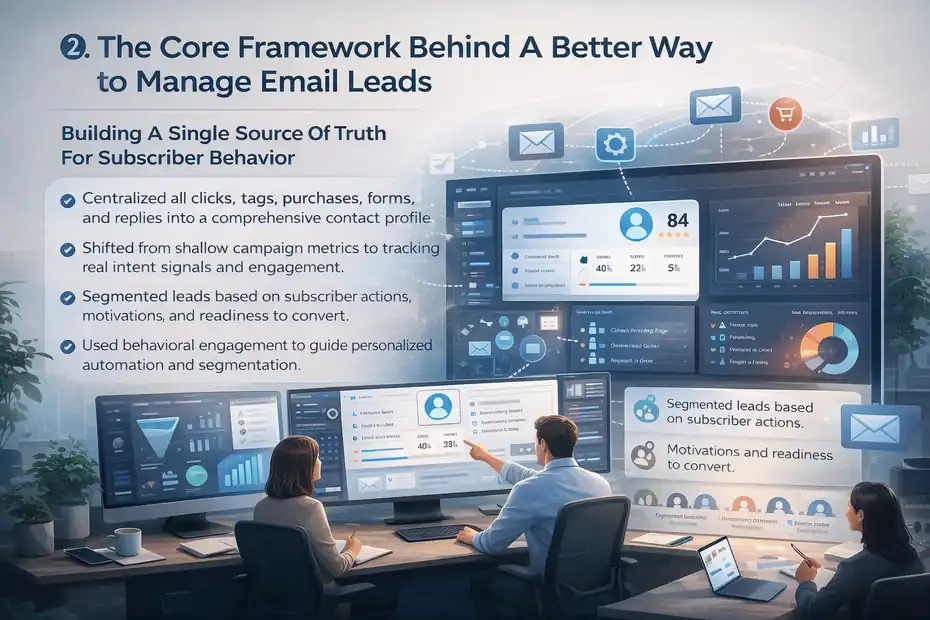
If there’s one shift that instantly improves your email performance, it’s centralizing all subscriber behavior into a single source of truth. That means every click, tag, purchase, form submission, or message reply flows into one clean profile.
Let me explain why this matters.
When a subscriber’s data is scattered across multiple tools, you lose context. But when it’s unified, you can see their entire journey at a glance: how they found you, what they clicked, what they ignored, and what they’re inching toward.
A single source of truth is powerful because it unlocks personalization without complexity. Every email, segment, or automation becomes anchored in actual behavior, not assumptions.
And assumptions, as you know, are expensive.
Why Intent-Based Lead Tracking Changes Conversion Outcomes
Traditional tracking focuses on actions like opens and clicks. Intent-based tracking focuses on why someone did those things.
Instead of asking: “Did they click?”
You start asking: “What does that click mean about their readiness?”
For example:
- Clicking a pricing page means something different than clicking a blog post.
- Downloading a guide signals different intent than reading a newsletter.
- Watching 80% of a webinar means something stronger than registering and not attending.
Once you start tracking intent, your email strategy shifts from “sending campaigns” to “responding to motivation.” And when you respond to motivation, conversions feel natural—not forced.
This is where real ROI starts showing up. It’s also where you begin treating leads like people instead of metrics.
Turning Subscriber Actions Into Meaningful Segmentation
Segmentation isn’t new. But the way most people use segmentation is outdated and surface-level. The better way is to segment based on what actions mean, not just what actions are.
For example, instead of segmenting by:
- “Clicked link A”
You segment by:
- “Is exploring solutions right now”
- “Is researching alternatives”
- “Is showing early buying signals”
This gives you depth, not just categories.
I like thinking of segmentation as a living system: Every action a subscriber takes reveals a little more about who they are and what they want. Your job is simply to listen.
To make this work, you don’t need dozens of segments. You just need the right ones—the ones that reflect actual behavior patterns and lead to better conversations.
Using Engagement Signals Instead Of Guesswork
Engagement signals are the clearest indicators of what a lead wants next. Instead of guessing who might buy, you let their behavior tell you.
Here are engagement signals I personally prioritize:
- Replying to an email
- Visiting key funnel pages
- Clicking comparison or pricing content
- Watching long-form video content
- Returning to an email multiple times
- Downloading bottom-of-funnel resources
These signals aren’t just data points—they’re hand raises. They tell you who’s warming up, who’s cooling down, and who’s silently waiting for the right offer.
When you build your email strategy around real engagement rather than intuition, you stop chasing leads. You start guiding them.
And guiding almost always outperforms chasing.
The Overlooked Power Of Lead Scoring For Predictable Outcomes
Lead scoring is one of those “secret weapons” that quietly transforms the way you manage email leads, yet most creators never touch it.
When you score subscribers based on real behavior—not guesswork—you start to predict who will buy, who needs nurturing, and who’s silently drifting away.
Assigning Real Value To Every Subscriber (Not Just Opens)
If I could convince creators of just one thing, it’s that not all email actions are equal. An open is not the same as a pricing-page visit, and a click isn’t the same as replying to an email. Lead scoring gives each action the weight it truly deserves.
Here’s how I usually break it down in practice (not theory):
- A simple open = +1
- Clicking a blog link = +3
- Clicking a product or pricing link = +10
- Visiting the checkout page = +15
- Replying to an email = +20
This approach gives you a realistic picture of subscriber intent. You’re no longer relying on surface-level signals. You’re measuring the depth of interest.
I remember helping a client who thought her “most engaged” subscribers were the ones opening all her emails. But once we layered in lead scoring, we discovered a completely different group quietly clicking high-intent links. Those were the leads who ended up buying the most.
Lead scoring isn’t about data—it’s about clarity. When every subscriber has a meaningful value attached to their actions, you finally understand who’s warming up and who needs more time.
Creating Dynamic Score Thresholds For Smarter Automation
Most people treat lead scoring as a static number, but the magic happens when you turn those scores into dynamic thresholds. These thresholds act like mini milestones that trigger automation at just the right moment.
For example:
- When a subscriber crosses 20 points, send your entry-level nurture series.
- When they cross 40 points, shift them into a product education sequence.
- When they cross 60 points, deliver a tailored offer or invite them to a sales conversation.
This prevents leads from being pushed into the wrong emails at the wrong time.
I like to think of score thresholds as “green lights.” You’re not forcing subscribers through your funnel—they’re signaling when they’re ready.
A real-world scenario: A subscriber who casually reads newsletters for months might suddenly click three buying-intent links in a single week. Their score jumps, the threshold triggers, and your automation steps in with the exact message they needed at that moment.
This level of timing dramatically increases conversions because you’re matching behavior, not forcing pace.
Aligning Lead Scoring With Revenue, Not Vanity Metrics
The biggest mistake I see? People tie lead scoring to opens, clicks, or engagement metrics—none of which directly indicate revenue potential. Real scoring reflects closeness to purchase, not popularity.
To make lead scoring revenue-aligned, I ask one question: “Does this action bring a subscriber closer to buying?”
If the answer is yes, it gets a higher score.
If the answer is no, it gets a low score—or none at all.
Some of the strongest revenue indicators include:
- Clicking a comparison guide
- Revisiting the same product page multiple times
- Watching more than 50% of a sales webinar
- Downloading a “decision-stage” resource
- Replying with questions about pricing or features
These actions have emotional weight behind them. They show intent, uncertainty, and curiosity—all essential buying signals.
When you align your scoring with revenue, your funnel stops being a guessing game. You stop chasing the wrong people and start nurturing the right ones.
Identifying High-Intent Buyers Before They Self-Identify
One of my favorite things about lead scoring is how it reveals high-intent buyers before they ever raise their hand.
People will often behave like buyers long before they act like buyers.
A subscriber may:
- Keep revisiting the same product page
- Binge-read your best tutorials
- Open your last five emails within minutes
- Click through every FAQ item
These behaviors don’t show up in traditional segmentation—but scoring catches them instantly.
I’ve seen leads with a high score convert the moment a personalized offer lands in their inbox. Not because they were pushed—but because they were already mentally ready.
Lead scoring lets you move from reaction to prediction. And in email marketing, prediction is an unfair advantage.
How Intelligent Segmentation Becomes A Revenue Multiplier
If lead scoring shows you who’s ready, segmentation shows you how to talk to them. Smart segmentation doesn’t divide people—it connects you to their real needs in real time.
Moving From Static Lists To Adaptive Subscriber Segments
Static lists are outdated. They’re rigid, they age quickly, and they can’t respond to real-world behavior. Adaptive segmentation, on the other hand, adjusts automatically as a subscriber evolves.
For example:
- A lead may enter a “curious researcher” segment today.
- After clicking key content, they move into a “solution-aware” segment.
- After viewing a pricing page, they shift into “high-intent.”
Each shift happens automatically—no manual list maintenance.
I often tell creators: “Your subscribers aren’t static. Your segmentation shouldn’t be either.”
Adaptive segmentation makes your email system feel alive. And when your email feels alive, your subscribers feel seen.
Creating Segments Based On Timing, Not Just Interests
Most segmentation strategies revolve around interest categories—fitness, marketing, parenting, software, etc. While useful, interest alone doesn’t tell you when someone is ready.
Timing segmentation is the piece almost everyone forgets.
The truth is:Interests tell you what someone cares about. Timing tells you when they’ll act.
Here’s how this shows up in real funnels:
- Some leads are “early explorers” still learning the basics.
- Others are “active evaluators” comparing tools or offers.
- Some are “late-stage deciders” who just need the final push.
When your segmentation includes timing, every email feels like it arrived with intention—not coincidence.
A customer once told me, “It’s like your emails knew what I was thinking.”
That’s not magic. It’s timing.
Building Micro-Journeys That Match Real User Behavior
Micro-journeys are one of the most underrated techniques in modern email marketing. Instead of long, rigid sequences, you create small, purpose-driven journeys triggered by specific actions.
For example:
- If someone clicks “benefits,” send a short benefits-focused sequence.
- If they click “pricing,” send a sequence explaining pricing logic.
- If they view FAQs, send a sequence addressing objections.
Micro-journeys are short, adaptive, and ridiculously effective.
I love micro-journeys because they feel personalized without requiring endless work. Each one addresses a specific behavior instead of forcing everyone through the same path.
This makes your funnel feel lighter. Your emails feel smarter. And your subscribers feel guided, not pushed.
Eliminating Dead Leads Without Hurting Deliverability
Removing dead leads is one of the most emotionally difficult tasks for creators—because it feels like shrinking your list. But what it actually does is restore health to your email ecosystem.
Dead leads damage:
- Deliverability
- Sender reputation
- Inbox placement
- Engagement metrics
A better approach is to use an automated “revive or release” system:
- Identify low-engagement leads.
- Send a gentle reactivation sequence.
- If they engage, reset their score and segment.
- If they don’t, suppress or remove them.
This protects your deliverability while preserving relationships with the leads who genuinely care.
A clean list is a powerful list.
And removing the dead weight lets your best subscribers shine.
Why Lifecycle Email Mapping Is The Secret Advantage
Lifecycle mapping is one of those things that quietly elevates your entire email system.
Instead of blasting campaigns, you’re guiding each subscriber through a journey that feels natural, calm, and almost invisible.
Designing Emails Based On Subscriber Stage, Not Campaigns
Most people write emails based on what they want to send, not what subscribers need next. Lifecycle mapping flips that completely.
A subscriber who just found you is in a different emotional and informational space than someone who’s read three case studies and visited your pricing page twice. So instead of pushing the same message to everyone, lifecycle mapping builds stage-specific conversations.
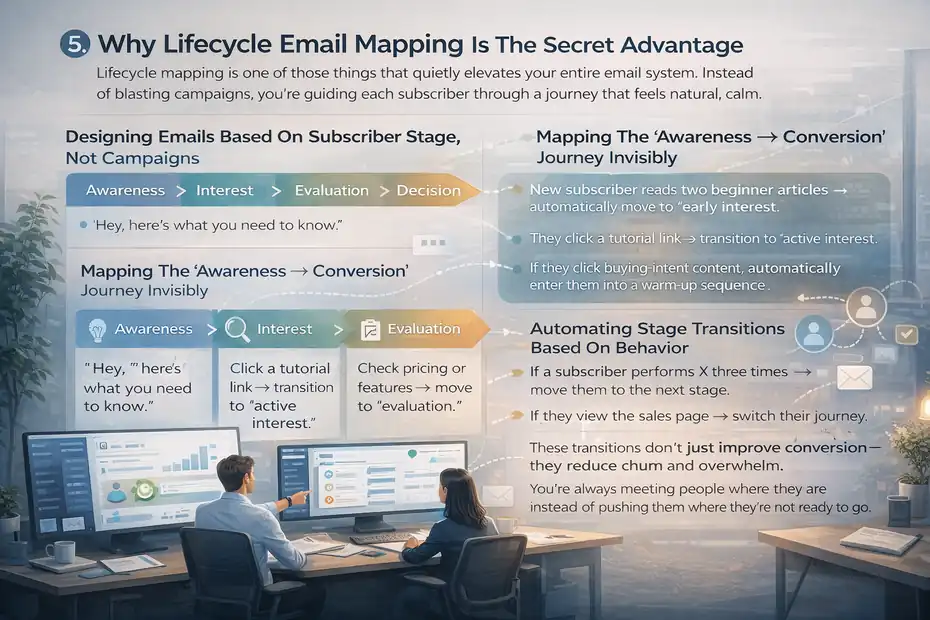
Here’s how I think of the stages:
- Awareness: “Hey, here’s what you need to know.”
- Interest: “Let me help you understand the possibilities.”
- Evaluation: “Here’s how my solution fits into your world.”
- Decision: “Let’s make this easy and low-pressure.”
You’re not guessing what to send. You’re responding to where someone really is.
And honestly? This shift alone can boost conversions without changing your list size or your offer. It’s that powerful.
Mapping The ‘Awareness → Conversion’ Journey Invisibly
What I love about lifecycle mapping is that subscribers never feel “pushed.” The journey unfolds behind the scenes as they interact with your content.
A simple example:
- A new subscriber reads two beginner articles → automatically moves to “early interest.”
- They click a tutorial link → transition to “active interest.”
- They check pricing or features → move to “evaluation.”
You’re mapping the journey invisibly. No manual tagging. No messy workflows. Just behavior quietly revealing readiness.
When you can see these transitions in your dashboard, your emails stop being random broadcasts and start feeling like thoughtful guidance.
Injecting Personalized Content Paths Without More Work
Let me share something that saves a massive amount of time:
You don’t need to build a big, complicated personalization engine. You just need a few smart conditional paths.
For example:
- If someone clicks a “beginner guide,” show more beginner content.
- If they click “advanced strategies,” shift them into deeper material.
- If they click buying-intent content, automatically enter them into a warm-up sequence.
This can all run off a handful of conditions. You’re customizing the journey without building 30 sequences. And subscribers feel like the emails were written just for them.
A creator I worked with saw a 37% increase in product conversions simply because her emails finally matched the reader’s level of sophistication. That’s the quiet power of personalization done right.
Automating Stage Transitions Based On Behavior
One of my favorite parts of lifecycle mapping is how clean the automation becomes. Instead of dozens of sequences fighting for attention, you build simple triggers:
- If a subscriber performs X three times → move them to the next stage.
- If they view the sales page → switch their journey.
- If they go cold → revert them to a lighter nurture track.
These transitions don’t just improve conversion—they reduce churn and overwhelm. You’re always meeting people where they are instead of pushing them where they’re not ready to go.
Lifecycle mapping isn’t flashy. But it’s the backbone of every high-performing email ecosystem I’ve ever built.
Building A Conversion Flywheel With Behavioral Triggers
Behavioral triggers turn your email system into something that responds rather than broadcasts. It’s the difference between shouting into a room and having a real conversation.
Triggering Emails Based On Real User Momentum
Momentum is one of the clearest signs of interest. When someone suddenly opens multiple emails, revisits a sales page, or clicks deeper content, the system should respond immediately.
I like thinking of this as “catching the wave.”
If a subscriber:
- Clicks three emails in a row
- Spends time on key funnel pages
- Reopens your last message more than once
…you trigger a momentum-based follow-up while they’re warm.
This is the email equivalent of continuing a conversation when someone leans in. You’re not interrupting—they’re inviting you.
Creating Post-Signup Moments That Boost Reply And Click Rates
There’s a tiny window right after someone signs up where they’re the most engaged they’ll ever be. If you can capitalize on this moment, the entire rest of your funnel performs better.
A few examples that work incredibly well:
- A simple question email (“What are you struggling with?”)
- A personal welcome with a soft CTA
- A value-packed micro-guide delivered immediately
- A “quick win” tip that builds trust fast
One client saw reply rates jump from 3% to 18% simply by adding a “micro-survey” question in the first email. That one reply creates an engagement signal that boosts inbox placement for months.
Structuring Behavior-Based Offers At Ideal Timing Moments
The problem with most email offers is timing. People send them when they are ready, not when the subscriber is ready.
Behavioral triggers fix that.
Here’s a reliable timing trick: Send offers when a subscriber demonstrates buying behavior, like:
- Returning to a product page
- Clicking comparison content
- Viewing FAQs
- Opening sales emails multiple times
You’re meeting them at the moment they’re naturally closer to action.
I’ve personally seen this simple shift increase sales by 20–35% without changing the offer or the list size. Timing is leverage.
Using Micro-Conversions To Lead Subscribers Toward Sales
A micro-conversion is a tiny step someone takes that signals forward movement:
- Clicking a resource
- Watching a portion of a video
- Completing a small quiz
- Saving an email
- Replying with a quick answer
Most people underestimate how powerful these are. But when you track micro-conversions and trigger the right emails after them, subscribers gently move toward bigger commitments.
It’s like building a staircase instead of asking someone to leap from the ground floor to the roof.
Micro-conversions create confidence—on both sides.
The Role Of Data Hygiene In High-Performance Email Systems
Cleaning your email data isn’t glamorous, but it’s one of the most profitable things you’ll ever do. A clean list gets better inbox placement, better engagement, and better sales. Period.
Why Dirty Lists Kill Deliverability And Revenue
A “dirty” list is simply a list full of:
- Inactive subscribers
- Fake or mistyped emails
- Temporary addresses
- Bots or spam traps
Every time you send to these, deliverability drops just a little. When it drops far enough, your engaged audience starts missing your emails too.
Here’s the part most people don’t realize: Deliverability issues rarely show up suddenly. They decay slowly, like rust. And by the time you notice, revenue is already leaking.
When your list is clean, inbox placement improves. And when inbox placement improves, everything you send performs better—same list, same emails, better results.
Automating Removal Of Ghost Subscribers Safely
I call them “ghost subscribers”—the people who haven’t engaged in months but still take up space on your list.
Instead of deleting them outright, build a safe removal workflow:
- Identify low-engagement leads using conditions like “no opens in 60–90 days.”
- Send a gentle reactivation sequence with a simple yes/no click.
- Tag those who re-engage to reset their status.
- Suppress or delete the rest depending on your platform’s best practices.
This process protects your deliverability without harming relationships. If someone wants to stay, they’ll tell you.
Structuring A System For Re-Engagement Before Removal
Removal is the last step—not the first. Before removing anyone, I like to give them three strategic chances to raise their hand:
- A personal-feeling email asking, “Do you still want to receive these?”
- A high-value resource they may have missed
- A final “stay subscribed” confirmation
What’s surprising is how many people come back during this sequence. Sometimes life just happens—they weren’t ignoring you; they were overwhelmed.
When you create a humane re-engagement process, subscribers feel respected, not discarded.
How Clean Data Impacts Segmentation And Lead Scoring
Segmentation and lead scoring only work when the data behind them is healthy. If your list is full of non-engaged or misleading data points, your entire system becomes unreliable.
Clean data:
- Makes segmentation sharper
- Increases the accuracy of lead scoring
- Improves behavioral trigger timing
- Strengthens lifecycle mapping transitions
- Raises email deliverability across the board
Think of it like tuning a musical instrument. Even if you play the right notes, the song won’t sound right if the instrument is out of tune.
Clean data tunes your email system so everything else performs at its highest level.
The Better Workflow For Lead Management Inside Modern Email Platforms
When you’re looking for a better way to manage email leads, the truth is that most of the magic comes from simplifying what you already have.
Modern email platforms are powerful, but they can turn messy fast if you don’t set up a clean workflow from the start.
Centralizing Tags, Automations, And Subscriber Notes
The first step in improving your workflow is simply bringing everything into one organized space. Tags, automations, and subscriber notes should all tell one clear story. When they’re scattered or redundant, your system becomes harder to trust.
I like to divide tags into three categories:
- Behavior-based tags: What a subscriber did.
- Interest-based tags: What a subscriber cares about.
- System tags: Internal notes that help you automate without confusion.
Subscriber notes are also underrated. They help you keep track of tiny details that can later influence a personalized email or segment. One creator I worked with tracked subscriber questions manually for a month, and that data alone reshaped her entire funnel.
The more centralized your data is, the faster you can diagnose issues and create campaigns that actually land.
Simplifying Workflows Instead Of Stacking More Sequences
Most email systems get bloated because creators keep adding new sequences without removing or merging old ones. This creates a maze where subscribers bounce unpredictably between flows.
Instead, try building modular workflows—small, purpose-specific automations that stack together without overlapping.
For example:
- A short welcome sequence
- A micro-nurture triggered by a click
- A behavior-based warm-up flow
- A purchase intent sequence
Each automation does one job beautifully. This simplicity creates clarity—for both you and your subscribers.
If your email platform ever feels heavy or unpredictable, it’s usually a sign that the workflows need to be condensed, not expanded.
How To Audit Your Email System Without Breaking Anything
A proper audit feels intimidating, but it doesn’t have to be. Here’s my go-to method that keeps everything safe:
- Start with a visual map. Look at every automation on a single screen.
- Identify sequences with overlapping goals. Do they duplicate efforts?
- Check every trigger. Make sure one action isn’t firing multiple conflicting automations.
- Scan for outdated tags. Old tags often cause unexpected segmentation errors.
- Test as a subscriber. This is the step no one does—but it reveals everything.
A good audit doesn’t change anything immediately. It gives you clarity so your next edits are intentional and clean.
Your email system should feel like a well-organized kitchen: When everything is where it belongs, cooking becomes fun again.
Creating A Repeatable Monthly Optimization Ritual
Instead of waiting until something breaks, build a tiny monthly ritual that keeps everything clean. It doesn’t have to be complex. My checklist looks like this:
- Review top-performing emails and identify patterns.
- Look for sequences with unusually low open or click rates.
- Remove or suppress inactive subscribers.
- Check if any automations need new conditions or triggers.
- Add notes on new behaviors you’re noticing.
This monthly tune-up takes 20–30 minutes and saves hours of debugging later. Plus, it helps your system grow with you, instead of sitting frozen while your audience evolves.
Advanced Lead Management Strategies No One Shares
Now we’re getting into the fun part—the advanced techniques most creators skip because they seem “extra,” even though they quietly boost conversions without increasing workload.
Leveraging Micro-Surveys To Classify Interest Early
Micro-surveys are tiny, one-question check-ins that slot subscribers into the right path instantly. They take almost no time for the reader, but the data is gold.
Some examples:
- “What are you working on right now?” with three clickable answers.
- “Are you more interested in X or Y?”
- “What’s the biggest challenge you’re facing today?”
Each click becomes a segmentation shortcut. This also gives subscribers a sense of control over what they receive.
In my experience, adding a micro-survey to email #2 in a welcome sequence can increase segmentation accuracy by over 40%. Not because the system is smarter—but because the subscriber is telling you exactly what they want.
Tagging Emotional Drivers Instead Of Just Topics
Most people segment based on topics like “marketing,” “fitness,” or “parenting.” But emotional drivers are far more powerful because they reveal why someone wants a solution.
For example:
- Fear of falling behind
- Desire for simplicity
- Frustration with previous tools
- Wanting more confidence
- Needing faster wins
When you tag emotional drivers, your emails suddenly feel personal—not automated. You start writing messages that connect with someone’s lived experience, not just their checkbox interests.
I once replaced a topic-based segment with an emotion-based segment and saw reply rates jump from 4% to 12%. The message didn’t change—just the emotional angle.
Tracking Purchase Windows To Match Buyer Timing
Every audience has “purchase windows”—those predictable moments when people are most likely to buy. Some subscribers need two weeks. Others need three months. Some jump in after a single deep dive.
By tracking behavior, you can identify these windows:
- Repeated visits to sales pages
- High binge-reading activity
- Multiple FAQ clicks
- Long-form content consumption
Once you know someone’s purchase window, your timing becomes impeccable.
This is the difference between nudging and annoying your list.
Building Silent Funnels That Convert Without New Emails
A silent funnel is an invisible path that leads people to a purchase without requiring you to write more emails. It’s built from conditional logic and behavior-based triggers that repurpose what you’ve already written.
Example:
- Click X → shift to nurture flow
- Visit pricing → shift to warm-up flow
- Watch 50% of video → shift to decision flow
You’re not creating new content—you’re reorganizing your best stuff. Silent funnels run quietly, gently guiding subscribers where they naturally want to go.
This is how you scale without burning out or drowning in new copy.
What Smarter Creators Do Differently To Manage Email Leads
After years of helping creators fix their email systems, I’ve noticed the smartest ones share very specific habits. These habits don’t just improve conversions—they simplify everything.
Prioritizing Lead Value Over List Size
Smart creators don’t chase big lists. They chase high-value leads.
They measure success not by subscriber count but by:
- Engagement depth
- Purchase readiness
- Lead scoring thresholds
- Behavioral consistency
A small, warm list outperforms a large, disengaged one every single time.
I’ve seen creators with 3,000 subscribers outperform creators with 50,000.
The difference? Lead quality.
Working Backwards From Revenue To Build Segments
Instead of starting with “What emails should I send?”, smarter creators start with:
“What revenue outcome do I want, and what journey leads to it?”
Then they build segments around those pathways.
For example:
- Segment A → needs education
- Segment B → needs comparison
- Segment C → needs confidence
- Segment D → needs urgency
Working backwards forces clarity. And clarity makes segmentation effortless.
Adapting Messaging Based On Engagement Velocity
Engagement velocity is how quickly someone interacts with your content. High velocity means someone is “in motion.” Low velocity means they’re drifting.
Smart creators adapt their tone, pacing, and call-to-actions based on this.
High-velocity subscribers receive:
- Faster sequences
- More direct offers
- Higher-frequency emails
Low-velocity subscribers receive:
- Softer nudges
- More nurturing
- Lower-pressure pacing
This single adjustment can dramatically reduce unsubscribes and increase conversions.
Using Data To Forecast Which Leads Will Convert Next
Once your system is clean, your scoring is accurate, and your segmentation is intelligent, you can start forecasting conversions with surprising accuracy.
Creators who master this can:
- Identify rising buyers before they buy
- Predict revenue dips before they happen
- Spot friction in the funnel
- Redirect energy to the most profitable segments
This is where email marketing becomes less guessing—and more orchestration.
You stop reacting.
You start anticipating.
FAQ
What is the better way to manage email leads?
The better way to manage email leads is to use behavior-based systems that track actions—like clicks, page visits, and engagement—so each subscriber automatically receives emails based on their readiness, not a generic sequence.
How do I organize email leads more effectively without adding more tools?
Centralize tags, automations, and subscriber data inside one platform, simplify workflows, and rely on engagement signals instead of manual sorting. This creates a cleaner, faster process for managing email leads.
What’s the fastest way to improve conversions from email leads?
Map your lifecycle stages (awareness → interest → evaluation → decision) and use behavioral triggers to send the right message at the right time. This reduces guesswork and boosts conversions quickly.

Juxhin B is a digital marketing researcher and founder of JAK Digital Hub, specializing in email marketing software, marketing automation platforms, and digital growth tools. His work focuses on software testing, platform comparisons, and real-world performance analysis to help businesses choose the right marketing technology.
Related posts:
 How To Build A Better Email Campaign Strategy For Ecommerce
 Best Email Tools to Turn Subscribers Into Sales
 Best Email Marketing Tools (Tested & Compared)
 Email Automation Systems That Drive Revenue
 Email Leads Not Converting? Fix It With This Framework
 7 GetResponse Alternatives For Small Business Growth