Table of Contents
Some links on JAK Digital Hub are affiliate links, meaning we may earn a small commission at no extra cost to you. Read full disclaimer.
Email automation platforms with advanced segmentation can completely change how your email marketing performs. Instead of blasting the same message to your entire list, you can send the right email to the right person at the exact moment they’re most likely to act.
If you’ve ever felt like your emails are getting ignored, low open rates are frustrating you, or conversions feel random, segmentation is usually the missing piece. The truth is, modern email marketing is no longer about sending newsletters — it’s about behavioral targeting, automated journeys, and data-driven personalization.
In this guide, I’ll walk you through the best email automation platform for advanced segmentation, how these tools actually work behind the scenes, how to set them up properly, and how to use segmentation strategies that dramatically increase open rates, clicks, and revenue.
Whether you run a blog, an ecommerce store, a SaaS product, or a content business, this guide will help you choose the right platform and implement segmentation the right way.
Why Advanced Segmentation Matters in Email Automation
Most email marketing problems come from sending generic messages. Advanced segmentation solves this by allowing you to group subscribers based on behavior, intent, and engagement.
Instead of thinking in terms of “one list,” modern email systems organize audiences into dynamic segments.
When segmentation is implemented properly, email becomes much more predictable and profitable.
Some typical results businesses see include:
- Open rates increasing 30–70%
- Click-through rates doubling
- Revenue per subscriber rising significantly
According to Campaign Monitor, segmented campaigns can generate 760% more revenue than non-segmented email blasts.
Let’s break down why.
Behavioral Targeting Changes Everything
Basic email marketing divides subscribers into simple groups like customers vs non-customers.
Advanced segmentation goes much deeper.
Modern email automation platforms track dozens of behavioral signals, including:
- Website pages visited
- Products viewed
- Previous purchases
- Email engagement history
- Downloaded resources
- Webinar attendance
- Cart abandonment
- Time since last activity
Imagine someone downloads a guide on “SEO for ecommerce.” Instead of sending them generic blog updates, the platform automatically places them into a high-intent ecommerce SEO segment.
From there, automated sequences can deliver targeted emails specifically about ecommerce traffic strategies.
This kind of targeting dramatically increases relevance. And relevance is what drives conversions.
Static Lists vs Dynamic Segments
One of the biggest shifts in modern email marketing is the move from static lists to dynamic segments.
Static lists require manual management. Once a subscriber is added, they stay there until you remove them.
Dynamic segments update automatically.
For example:
Segment rule example:
- Opened email in last 30 days
- Clicked product page
- Has not purchased
If someone purchases tomorrow, the system automatically removes them from that segment.
No manual work required.
This is why the best email automation platform for advanced segmentation focuses heavily on automation rules and behavioral triggers, not just contact lists.
Core Features to Look for in an Email Automation Platform
Before comparing tools, it helps to understand what actually defines a powerful segmentation platform.
Many email services claim automation features, but very few offer true advanced segmentation capabilities.
Here are the key features that matter most.
Behavioral Tracking and Event Triggers
The best segmentation tools track events in real time. These events act as automation triggers.
Common examples include:
- Visiting specific pages
- Purchasing a product
- Clicking a link
- Completing a form
- Watching a webinar
- Opening multiple emails
These triggers allow the system to launch automated workflows.
Example: If a subscriber clicks a link about affiliate marketing → automatically move them into an affiliate marketing segment → start an automated sequence promoting affiliate resources.
Without event tracking, segmentation becomes shallow.
Dynamic Segments and Tagging Systems
Modern email platforms rely on two main systems:
Tags
Tags label subscriber behavior or attributes.
Examples:
- downloaded_ebook
- interested_affiliate_marketing
- purchased_course
- webinar_attendee
Segments
Segments are rules built from tags and behaviors.
Example segment:
- Tag = interested_affiliate_marketing
- Clicked affiliate article
- No purchase yet
That segment becomes your high-intent affiliate marketing audience.
This system allows extremely precise targeting.
Visual Automation Builders
Automation complexity grows quickly. That’s why modern platforms include visual workflow builders.
These allow you to map automation like a flowchart.
Typical workflow example:
Subscriber downloads lead magnet
↓
Add tag: lead_seo
↓
Wait 1 day
↓
Send welcome email
↓
If link clicked → move to advanced segment
↓
Start targeted sales sequence
Visual automation tools make these journeys easy to manage.
Without them, automation becomes chaotic.
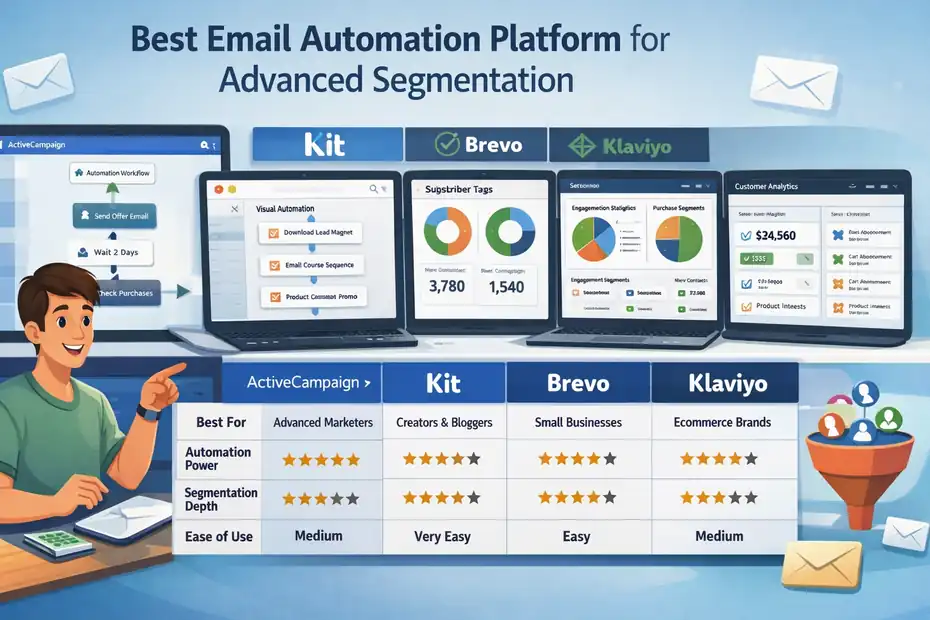
Best Email Automation Platform For Advanced Segmentation
Now let’s look at the platforms that actually deliver strong segmentation capabilities.
These tools are widely used by bloggers, ecommerce brands, SaaS companies, and digital marketers.
ActiveCampaign
For many marketers, ActiveCampaign is the gold standard for segmentation and automation.
It’s especially powerful for businesses that want extremely detailed targeting.
Key features include:
- Advanced conditional segmentation
- Deep automation workflows
- Behavioral tracking
- Predictive sending
- Website event tracking
- CRM integration
What makes ActiveCampaign stand out is its automation flexibility.
You can build complex segmentation conditions like:
If subscriber:
- visited pricing page
- opened last 3 emails
- did not purchase
→ send conversion sequence.
This type of targeting is difficult to replicate in simpler platforms.
Pricing starts around $29/month, depending on subscriber count.
From my experience, ActiveCampaign is ideal for:
- affiliate marketers
- SaaS companies
- advanced email marketers
- automation-heavy businesses
Kit (Formerly ConvertKit)
Kit is extremely popular among bloggers, creators, and digital product sellers.
It focuses on simplicity while still providing powerful segmentation tools.
Core features include:
- Tag-based segmentation
- Automated email sequences
- Subscriber behavior tracking
- Creator-focused automation
- Visual automation builder
Where Kit shines is creator workflows.
For example:
If a subscriber downloads a blogging checklist → automatically start a blogging email course → tag based on link clicks → promote relevant products.
Kit makes these workflows easy without overwhelming beginners.
Pricing typically starts around $15/month for smaller lists.
It’s ideal for:
- bloggers
- YouTubers
- course creators
- newsletter businesses
Brevo (formerly Sendinblue)
Brevo is an excellent choice for businesses that want both email automation and CRM capabilities.
It offers strong segmentation features combined with marketing automation tools.
Key capabilities include:
- advanced contact segmentation
- email + SMS automation
- transactional email
- behavioral workflows
- CRM integration
Brevo is especially strong for ecommerce brands that want to combine marketing automation with customer data.
Example workflow: Customer purchases product → tag purchase category → send cross-sell emails based on product interest.
Brevo also has competitive pricing for large lists.
Klaviyo
For ecommerce businesses, Klaviyo is often considered the best segmentation platform available.
It integrates deeply with ecommerce platforms and tracks detailed customer behavior.
Powerful features include:
- purchase-based segmentation
- product interest tracking
- predictive lifetime value
- abandoned cart automation
- dynamic product recommendations
Example segment:
Customers who:
- purchased in last 60 days
- spent over $200
- viewed new product category
This creates extremely high-value audiences.
If you run a Shopify or ecommerce store, Klaviyo is often the strongest option.
Email Automation Platform Comparison
| Platform | Best For | Automation Power | Segmentation Depth | Ease of Use |
|---|---|---|---|---|
| ActiveCampaign | Advanced marketers | Very High | Very High | Medium |
| Kit | Creators & bloggers | Medium | High | Very Easy |
| Brevo | Small businesses & CRM users | Medium | High | Easy |
| Klaviyo | Ecommerce brands | Very High | Very High | Medium |
How To Set Up Advanced Segmentation Step-By-Step
Choosing the right platform is only the beginning. The real value comes from how you structure segmentation.
Let me break down a practical setup strategy.
Step 1: Define Core Subscriber Categories
Start by identifying the major audience groups in your business.
For most businesses, these include:
- New subscribers
- Engaged readers
- Product prospects
- Customers
- Repeat customers
- Inactive subscribers
These categories form the foundation of segmentation. Once they’re defined, automation rules can move people between them.
Step 2: Track Key Behavioral Events
Next, identify the behaviors that indicate interest or buying intent.
Important behaviors usually include:
- Clicking product links
- Viewing sales pages
- Downloading resources
- Attending webinars
- Adding items to cart
- Watching product demos
Each behavior should trigger a tag or event. This data becomes the backbone of segmentation.
Step 3: Create Intent-Based Segments
Now you can build segments based on intent signals.
Example segments might include:
- Highly engaged subscribers
- People researching a specific product
- Subscribers interested in a specific topic
- Customers who bought a specific category
These segments allow targeted campaigns. Instead of sending one promotion to everyone, you send the right offer to the right audience.
Common Segmentation Mistakes to Avoid
Even with the best email automation platform for advanced segmentation, mistakes can limit results.
Here are the most common problems I see.
Over-Segmenting Too Early
Some marketers create dozens of segments before they even understand their audience.
This creates unnecessary complexity.
Start with a few high-value segments and expand gradually.
Ignoring Engagement Signals
Many marketers only track purchases.
But engagement signals like clicks, page visits, and downloads often predict buying intent earlier.
Tracking these signals dramatically improves targeting.
Sending Too Many Automations
Automation is powerful, but too many overlapping sequences can overwhelm subscribers.
From what I’ve seen, the best approach is:
- a core welcome sequence
- topic-based nurture sequences
- targeted promotional sequences
Keep the system clean.
Advanced Segmentation Strategies That Increase Revenue
Once the foundation is in place, advanced strategies can dramatically increase performance.
These techniques are used by high-performing email marketers.
Lifecycle Segmentation
Lifecycle segmentation targets subscribers based on where they are in the customer journey.
Typical lifecycle stages include:
- New subscriber
- Engaged reader
- Lead evaluating products
- First-time customer
- Repeat customer
- VIP customer
Each stage should receive different messaging.
For example:
New subscribers receive educational content, while repeat customers receive loyalty offers.
Interest-Based Segmentation
Subscribers often have different interests within the same niche. Interest segmentation groups people based on topics they engage with.
Example for a marketing blog:
- SEO
- affiliate marketing
- email marketing
- blogging
Each interest group receives relevant content.
This dramatically increases click rates.
Engagement Scoring
Some platforms include engagement scoring systems. These assign points based on actions.
Example scoring system:
- Email open = 1 point
- Link click = 3 points
- Product page visit = 5 points
Subscribers with high scores are more likely to convert.
These segments become ideal for promotions.
Scaling Email Automation With Advanced Segmentation
Once your system works, scaling becomes easier. Instead of sending more emails, you improve targeting.
Here are a few scaling strategies.
Build Topic-Based Automation Funnels
Create separate funnels for each major topic.
Example:
- SEO funnel
- Affiliate marketing funnel
- Blogging funnel
Each funnel nurtures a different interest group.
Personalize Promotions Based on Behavior
Instead of sending one launch campaign to your entire list, segment promotions based on behavior.
Example:
- Subscribers who clicked product links
- Subscribers who watched demo
- Subscribers who visited pricing page
Each group receives different messaging.
Re-Engagement Automation
Inactive subscribers hurt deliverability.
Create an automated re-engagement sequence.
Example flow:
Subscriber inactive for 90 days
↓
Send re-engagement email
↓
If no open → send final reminder
↓
Remove inactive subscriber
This keeps your list healthy.
Final Thoughts
Choosing the best email automation platform for advanced segmentation can dramatically improve your email marketing performance.
Instead of sending generic campaigns, segmentation allows you to deliver highly relevant messages that match subscriber behavior and interests.
If you’re just starting out, platforms like Kit or Brevo provide a strong balance between simplicity and automation.
If you want maximum automation power and deep segmentation, ActiveCampaign or Klaviyo are excellent choices.
But remember — tools alone don’t drive results.
The real power comes from:
- understanding your audience
- tracking meaningful behaviors
- building targeted automation journeys
When those pieces come together, email marketing becomes one of the most predictable growth channels in your business.
And in my experience, few marketing systems deliver ROI as consistently as well-segmented email automation.
FAQ
What is an email automation platform for advanced segmentation?
An email automation platform for advanced segmentation is a tool that automatically groups subscribers based on behavior, interests, and engagement. It allows businesses to send highly targeted emails instead of generic campaigns, improving open rates, clicks, and conversions.
Why is advanced segmentation important in email marketing?
Advanced segmentation improves email relevance by targeting subscribers based on behavior, purchase history, and engagement. This leads to higher open rates, better click-through rates, and stronger conversions compared to sending the same email to an entire list.
Which email automation platform is best for advanced segmentation?
ActiveCampaign, Kit, Brevo, and Klaviyo are among the best email automation platforms for advanced segmentation. These platforms offer behavioral tracking, tagging systems, and automation workflows that allow marketers to target subscribers with highly personalized campaigns.
How does advanced email segmentation increase conversions?
Advanced segmentation increases conversions by sending messages tailored to subscriber behavior and interests. When emails match what people are actively researching or buying, they are more likely to open, click, and complete a purchase.
How do you start using advanced segmentation in email automation?
Start by tracking subscriber behavior such as link clicks, page visits, and downloads. Then create segments based on these actions and build automated email sequences that send targeted content depending on subscriber interests and engagement levels.

Juxhin B is a digital marketing researcher and founder of JAK Digital Hub, specializing in email marketing software, marketing automation platforms, and digital growth tools. His work focuses on software testing, platform comparisons, and real-world performance analysis to help businesses choose the right marketing technology.