Table of Contents
Some links on JAK Digital Hub are affiliate links, meaning we may earn a small commission at no extra cost to you. Read full disclaimer.
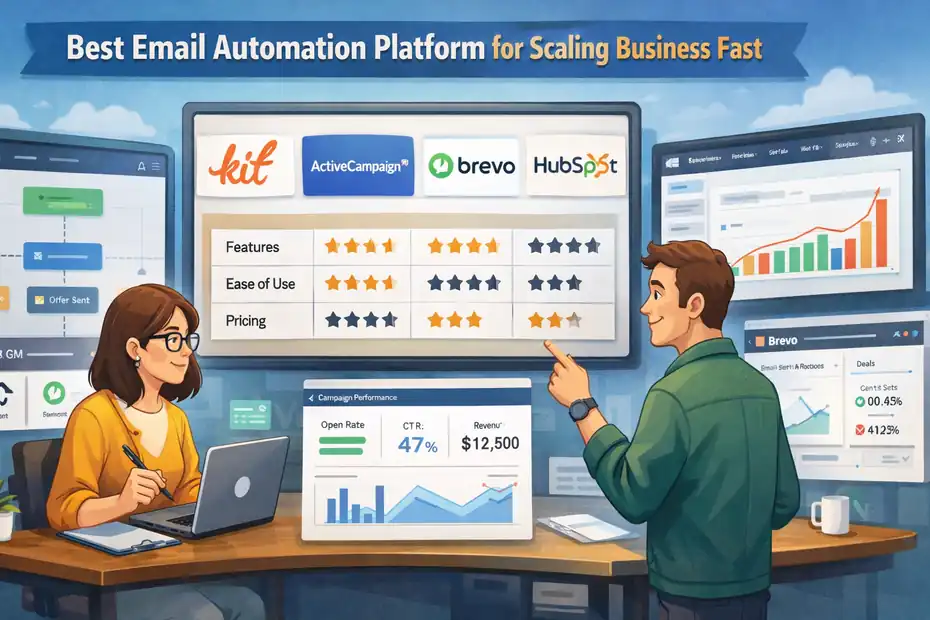
Choosing the right email automation platform for scaling business is one of the most important decisions you’ll make as your audience grows. When your email list reaches hundreds—or even thousands—of subscribers, manually sending campaigns simply doesn’t work anymore.
That’s where automation becomes a growth engine.
The right platform doesn’t just send emails. It segments subscribers, triggers personalized sequences, tracks behavior, and helps you convert leads into customers automatically. In many cases, businesses generate $36–$42 for every $1 spent on email marketing, according to research from the Data & Marketing Association (DMA).
But here’s the challenge: not every email platform is built for scaling. Some work great for beginners but collapse once your list grows. Others are powerful but overly complex or expensive for smaller teams.
In this guide, I’ll walk you through the best email automation platforms for scaling business fast in 2026, how they work, when to choose each one, and the specific features that actually matter when your business starts growing.
Why Choosing the Right Email Automation Platform Matters for Growth
As your audience grows, your email system becomes the backbone of your marketing infrastructure. The right platform doesn’t just deliver emails—it manages relationships, tracks customer behavior, and automates revenue.
When you pick the wrong platform, scaling becomes painful. Migrating lists, rebuilding automations, and fixing deliverability issues can slow your growth significantly.
Let’s break down what makes an email automation platform truly scalable.
Automation vs Manual Email Marketing
Manual email marketing might work when you have 50 subscribers. Once you hit 1,000+ contacts, it quickly becomes impossible to manage effectively.
An email automation platform for scaling business replaces manual work with behavior-based systems.
Here’s the difference in practice:
| Feature | Manual Email Marketing | Email Automation |
|---|---|---|
| Sending campaigns | Manual newsletters | Triggered sequences |
| Segmentation | Manual list filtering | Automatic behavior tracking |
| Lead nurturing | One-off emails | Automated email funnels |
| Customer journeys | Generic campaigns | Personalized experiences |
| Scaling ability | Limited | Highly scalable |
For example, imagine someone downloads a free guide on your website.
With automation:
- They instantly receive a welcome email.
- Two days later, they receive a helpful tutorial.
- Four days later, they receive a product offer.
This entire funnel runs 24/7 without manual work.
The Role of Email Automation in Business Scaling
In my experience, automation becomes essential the moment your business starts generating consistent leads.
Here’s what happens when you implement the right system:
- Leads are captured and nurtured automatically
- Customers receive targeted offers based on behavior
- Your marketing runs even while you sleep
Let me give you a realistic example.
Imagine you run an online course business and generate 20 new leads per day from your blog.
Without automation:
- You manually send emails
- Leads lose interest
- Sales drop
With automation:
- Every lead enters a 7-day email funnel
- Educational emails build trust
- The final email promotes your course
Even with a modest 3% conversion rate, that funnel could produce 18+ sales per month automatically.
That’s why the right platform matters so much.
Key Features to Look for in an Email Automation Platform
Before choosing a platform, it’s important to understand the features that actually help businesses scale. Not every tool offers the same level of automation, analytics, or deliverability.
Let’s break down the features that make the biggest difference.
Visual Automation Builders
A visual automation builder allows you to create workflows using drag-and-drop logic instead of complicated coding.
Instead of configuring dozens of rules manually, you build simple automation flows like:
Subscriber joins list → send welcome email → wait 2 days → send product recommendation.
Platforms like Kit, ActiveCampaign, and HubSpot are particularly strong in this area.
For example, a typical automation might include:
- Trigger: Subscriber downloads a lead magnet
- Action: Send welcome email
- Condition: If user clicks link → send product offer
- Delay: Wait 2 days
- Action: Send reminder email
Visual builders make it easy to see how the entire funnel works. When your business scales and you manage 20+ automations simultaneously, this becomes extremely important.
Advanced Segmentation and Personalization
Segmentation is what turns generic email marketing into high-converting campaigns.
Instead of sending the same email to everyone, modern platforms segment your audience based on behavior.
Examples of segmentation rules:
- Subscribers who opened the last campaign
- Customers who purchased a specific product
- Leads who clicked a pricing page
- Users inactive for 30+ days
Let me give you a simple scenario.
Imagine you run an ecommerce store selling fitness equipment.
Your email automation platform can automatically send:
- Yoga promotions to yoga customers
- Weightlifting offers to strength training buyers
- Beginner tips to new subscribers
According to Campaign Monitor, segmented campaigns can increase email revenue by up to 760% compared to generic campaigns.
That’s the power of personalization.
Integrations With Marketing and Ecommerce Tools
A scalable email automation platform should connect with the rest of your business tools.
This includes integrations with:
- Ecommerce platforms
- CRM systems
- landing page builders
- payment processors
- analytics tools
Common integrations include:
For example, if someone purchases a product on Shopify, your email system can automatically:
- Send a confirmation email
- Trigger an onboarding sequence
- Recommend related products
This level of automation removes massive amounts of manual work as your business grows.
Deliverability and Email Reputation
One of the biggest hidden factors in email marketing is deliverability.
Deliverability determines whether your email lands in the inbox or the spam folder.
High-quality email automation platforms invest heavily in:
- Dedicated sending infrastructure
- spam compliance
- sender reputation monitoring
- authentication protocols like SPF, DKIM, and DMARC
For growing businesses, this is critical.
Even a 5–10% drop in deliverability can significantly impact revenue.
Platforms like ActiveCampaign, Kit, and Brevo consistently maintain strong deliverability ratings in industry tests.
Best Email Automation Platforms for Scaling Business in 2026
Not all email tools are built the same. Some are better for creators, others for ecommerce, and some are designed specifically for large marketing teams.
Below are the platforms that consistently perform well for businesses that want to scale fast.
Kit (Best for Creators and Content Businesses)
Kit (formerly ConvertKit) has become one of the most popular automation tools for bloggers, course creators, and digital entrepreneurs.
What makes Kit powerful is its simplicity. It focuses heavily on automation and audience segmentation without overwhelming users with complicated features.
Key features:
- Visual automation builder
- Tag-based subscriber system
- Landing page builder
- Creator monetization tools
- Subscriber scoring and segmentation
One thing I personally like about Kit is how easy it is to build email funnels.
For example, you can create:
- Welcome sequences
- Lead magnet delivery funnels
- Product launch campaigns
- Evergreen sales sequences
Pricing typically starts around $15/month for small lists and scales with subscriber growth.
For content-driven businesses like blogging, courses, or newsletters, Kit is often the easiest platform to scale with.
ActiveCampaign (Best Advanced Automation Platform)
If you want extremely powerful automation, ActiveCampaign is one of the best tools available.
It’s essentially a combination of:
- Email automation
- CRM
- Sales automation
- Customer journey mapping
ActiveCampaign allows you to build complex automation systems with advanced triggers.
Examples include:
- Site tracking automation
- lead scoring
- behavioral triggers
- abandoned cart recovery
- predictive sending
Imagine someone visits your pricing page three times.
ActiveCampaign can automatically:
- Assign a higher lead score
- notify your sales team
- send a personalized email offer
This level of automation is why many SaaS companies and ecommerce stores rely on it.
Pricing usually starts around $29/month, but the advanced features justify the cost for growing businesses.
Brevo (Best Budget Automation Platform)
Brevo (formerly Sendinblue) is an excellent option for businesses that want automation without high costs.
Unlike many platforms that charge by subscribers, Brevo often charges based on email volume, which can be more affordable.
Key strengths include:
- Marketing automation workflows
- transactional emails
- SMS marketing
- CRM features
- landing page builder
For startups or small businesses that expect rapid growth, Brevo provides strong automation without large upfront costs.
Many ecommerce brands use Brevo for order confirmations, shipping notifications, and marketing campaigns all in one system.
Pricing typically begins around $25/month, depending on sending volume.
HubSpot Email Marketing (Best for Large Businesses)
For larger organizations, HubSpot offers one of the most comprehensive marketing ecosystems available.
It includes:
- email automation
- CRM
- sales pipelines
- marketing analytics
- customer service tools
HubSpot’s strength is customer lifecycle management.
Instead of just email automation, it helps you manage:
- lead generation
- lead nurturing
- customer onboarding
- retention campaigns
Large teams benefit from HubSpot because everything exists inside one platform.
However, it can be expensive.
Pricing can start around $50/month, but advanced automation tiers often cost significantly more.
Still, for companies running large marketing teams, HubSpot can be a powerful scaling platform.
How to Set Up an Email Automation System for Scaling
Choosing a platform is only the first step. The real power comes from building the right automation funnels.
Let me break down the basic system many businesses use to scale.
Step 1: Build Your Lead Capture System
Before automation works, you need a consistent way to capture leads.
Common lead generation methods include:
- Lead magnets (guides, templates, checklists)
- Webinar registrations
- Newsletter subscriptions
- Free trials
- discount offers
Example scenario:
A marketing blog offers a free SEO checklist.
When someone downloads it:
- Their email is added to the platform
- They enter a welcome automation
This creates a continuous flow of new leads.
Step 2: Create a Welcome Email Automation
The welcome sequence is often the highest-performing email funnel.
New subscribers are most engaged during the first few days after joining your list.
A simple welcome sequence might include:
- Email 1: Welcome + lead magnet delivery
- Email 2: Helpful educational content
- Email 3: Case study or success story
- Email 4: Product recommendation
From what I’ve seen, welcome emails often reach 50–70% open rates, which is much higher than regular campaigns.
This makes them perfect for introducing your brand and building trust quickly.
Step 3: Build Behavior-Based Automation
Behavior-based automation allows your system to react to subscriber actions.
Examples include:
- Link click triggers
- Website visits
- product purchases
- abandoned carts
Imagine someone clicks a link about email marketing tools.
Your system can automatically send:
- advanced tutorials
- case studies
- software recommendations
This makes your emails feel extremely relevant, which increases conversions.
Common Email Automation Mistakes That Slow Business Growth
Even with the best email automation platform for scaling business, mistakes can limit results.
Here are a few common ones I see frequently.
Overcomplicated Automation Funnels
Many marketers create automation systems that are far too complex.
Dozens of branches, triggers, and conditions can make funnels difficult to manage.
I usually recommend starting with just three automations:
- Welcome sequence
- Sales funnel
- Re-engagement campaign
Once those perform well, expand gradually.
Ignoring List Segmentation
Sending the same email to your entire list is one of the fastest ways to reduce engagement.
Subscribers want relevant content.
Even simple segmentation like:
- new subscribers
- active readers
- customers
can dramatically improve performance.
Not Monitoring Email Analytics
Email automation platforms provide powerful analytics dashboards.
Important metrics to track include:
- open rate
- click-through rate
- conversion rate
- unsubscribe rate
If open rates drop below 20–25%, it may indicate deliverability problems or weak subject lines.
Regular optimization is key.
Advanced Strategies for Scaling Email Automation
Once your automation system is working, you can expand it to drive even more revenue.
These strategies are commonly used by fast-growing businesses.
Implement Lifecycle Email Marketing
Lifecycle marketing targets customers at different stages of the buying journey.
Examples include:
- new subscriber onboarding
- post-purchase education
- upsell campaigns
- renewal reminders
This approach increases customer lifetime value, which is one of the most important growth metrics.
Use Predictive Email Sending
Some platforms like ActiveCampaign and HubSpot offer predictive sending.
This feature analyzes user behavior to determine the best time to send emails.
Instead of sending a campaign at 9 AM to everyone, the platform sends each email when the subscriber is most likely to open it.
This can increase open rates significantly.
Combine Email Automation With Retargeting Ads
One powerful scaling strategy is combining email marketing with retargeting ads.
Example system:
- Subscriber joins email list
- receives automated email sequence
- sees retargeting ads on Facebook or Google
This multi-channel approach keeps your brand visible and increases conversions.
Final Thoughts
Choosing the right email automation platform for scaling business can transform how your marketing works.
Instead of sending individual campaigns manually, you build automated systems that nurture leads, convert customers, and drive revenue around the clock.
If you’re just starting out, Kit or Brevo are excellent beginner-friendly platforms.
If you need advanced automation and CRM capabilities, ActiveCampaign or HubSpot offer powerful scaling tools.
The key is to start simple: build your lead capture system, create a welcome sequence, and gradually expand your automation as your audience grows.
Done correctly, email automation becomes one of the most reliable growth engines your business will ever have.
FAQ
What is an email automation platform for scaling business?
An email automation platform for scaling business is software that automatically sends targeted emails based on subscriber behavior. It helps businesses nurture leads, segment audiences, and trigger personalized email sequences without manual work, allowing marketing campaigns to run continuously while the business grows.
Which email automation platform is best for scaling a business fast?
The best email automation platform for scaling business depends on your needs. Platforms like Kit are ideal for creators, ActiveCampaign offers advanced automation features, Brevo provides budget-friendly automation, and HubSpot works well for larger teams needing CRM and marketing automation in one system.
How does email automation help grow a business?
Email automation helps businesses grow by sending personalized messages at the right time without manual effort. Automated welcome sequences, product recommendations, and follow-up emails nurture leads, improve engagement, and increase conversions, allowing businesses to scale their marketing without increasing workload.
When should a business start using email automation?
A business should start using an email automation platform as soon as it begins collecting leads. Even small lists benefit from welcome sequences and automated nurturing campaigns. Starting early builds strong relationships with subscribers and creates scalable marketing systems as the audience grows.
What features should an email automation platform include for scaling?
An email automation platform for scaling business should include visual automation builders, audience segmentation, behavior-based triggers, integrations with ecommerce and marketing tools, and reliable email deliverability. These features allow businesses to create personalized campaigns and manage growing subscriber lists efficiently.

Juxhin B is a digital marketing researcher and founder of JAK Digital Hub, specializing in email marketing software, marketing automation platforms, and digital growth tools. His work focuses on software testing, platform comparisons, and real-world performance analysis to help businesses choose the right marketing technology.
Related posts:
 Email Automation Tools for 100k Subscribers: Best Value Picks
 Email Automation Tools Cost for 20k Subscribers—Price Breakdown
 Best Email Automation Platform For Advanced Segmentation
 Cheaper Email Automation System For Growing List Fast
 Email Automation Software With Better Deliverability Ranked
 Best Email Tools Compared: 7 That Actually Convert