Table of Contents
Some links on JAK Digital Hub are affiliate links, meaning we may earn a small commission at no extra cost to you. Read full disclaimer.
Choosing the right email automation software for new ecommerce store growth is one of those decisions that feels small at first, then quietly shapes everything from your first sale to your repeat purchase rate.
I’ve seen new store owners overbuy, underbuy, and waste months rebuilding automations they could have set up properly from day one.
The good news is that you do not need a huge list, a big team, or enterprise tools to get this right. You need software that matches your stage, your store platform, and the kind of customer journey you want to build.
What New Ecommerce Stores Actually Need From Email Automation Software
A new store does not need the most advanced platform on the market.
It needs the platform that helps you capture subscribers, recover lost carts, welcome first-time visitors, and drive repeat purchases without creating a second full-time job.
Start With Revenue-Critical Automations
When most people search for the best email automation software for a new ecommerce store, they think they need dozens of workflows. In practice, you can get most of your early value from a small core set.
The highest-priority automations are usually welcome flow, cart abandonment, browse abandonment, post-purchase, and win-back. These flows cover the biggest moments in the customer lifecycle: interest, hesitation, first conversion, and repeat buying.
I suggest thinking in terms of “money left on the table.” A new subscriber who never gets a welcome email is a missed introduction. A cart abandoner who never gets a reminder is a missed recovery. A first-time customer who never hears from you again is a missed second order.
For many of us, this is where email stops being “newsletter software” and becomes a retention system. That distinction matters because retention is often what keeps a young store profitable when paid ads are unpredictable.
Prioritize Ease Of Setup Over Fancy Features
A lot of platforms now promise AI, omnichannel orchestration, advanced segmentation, predictive analytics, and cross-channel attribution. Those are useful later. Early on, simplicity wins.
You want a tool that lets you build and launch the basics in a few hours, not a few weeks. That means clear templates, a visual automation builder, native ecommerce integrations, signup forms, and reporting you can actually understand.
In my experience, beginner-friendly software usually beats feature-heavy software for the first 1,000 to 5,000 subscribers. A simpler platform that you fully use will outperform a powerful one you never finish setting up.
That is especially true when you are also handling product listings, customer service, shipping issues, and maybe your own social content. Your software should reduce friction, not become another project.
Know The Metrics That Matter Early
New stores often obsess over open rate because it is visible and easy to understand. The better early metrics are revenue per recipient, flow conversion rate, cart recovery rate, signup rate, and repeat purchase rate.
Email continues to be a high-ROI channel. Forbes Advisor notes email marketing generally delivers about $36 for every $1 spent, while Litmus reports many companies see ROI in the 10:1 to 36:1 range.
That does not mean every new store gets those results automatically. It means the channel is worth taking seriously from day one. A small list with good automations can outperform a much larger list that only receives occasional campaigns.
How To Choose The Right Platform Without Regretting It Later
The best platform is not the one with the longest features page. It is the one that fits your ecommerce stack, budget, and team capacity now while still giving you room to grow.
Match The Tool To Your Store Platform
Before comparing templates or pricing, check the ecommerce integration quality. This is the foundation of everything.
Your platform needs to pull in customer data, products, orders, cart activity, and ideally browsing behavior. Without that, your automation tool becomes a basic email sender instead of a real ecommerce retention platform.
Imagine you run a small skincare store on Shopify. You want to send one flow to people who viewed a moisturizer twice, another to customers who bought cleanser but not serum, and a reorder reminder 45 days after purchase. That only works smoothly when your email tool syncs rich store data reliably.
This is why ecommerce-focused tools usually beat general email platforms for online stores. They are designed around product feeds, order triggers, and purchase behavior rather than newsletter publishing alone.
Choose Based On Your Next 12 Months, Not Your Dream Business
I believe this is where a lot of founders go wrong. They buy software for the brand they hope to become, not the store they actually have.
Ask three practical questions. First, how many contacts do you expect in the next year? Second, will you personally manage email, or will someone else? Third, do you need deep segmentation yet, or just dependable automations and campaigns?
A platform that feels “too simple” today might still be perfect through your first 500 orders. On the other hand, a platform that looks cheap can become expensive fast if pricing jumps sharply with contact growth or key features are locked behind higher tiers.
The smarter move is to avoid both extremes: Do not underbuy so much that you outgrow the tool in three months, and do not overspend on complexity you will not touch.
Compare What Actually Affects Daily Use
Here is the short version of what matters most for a new store:
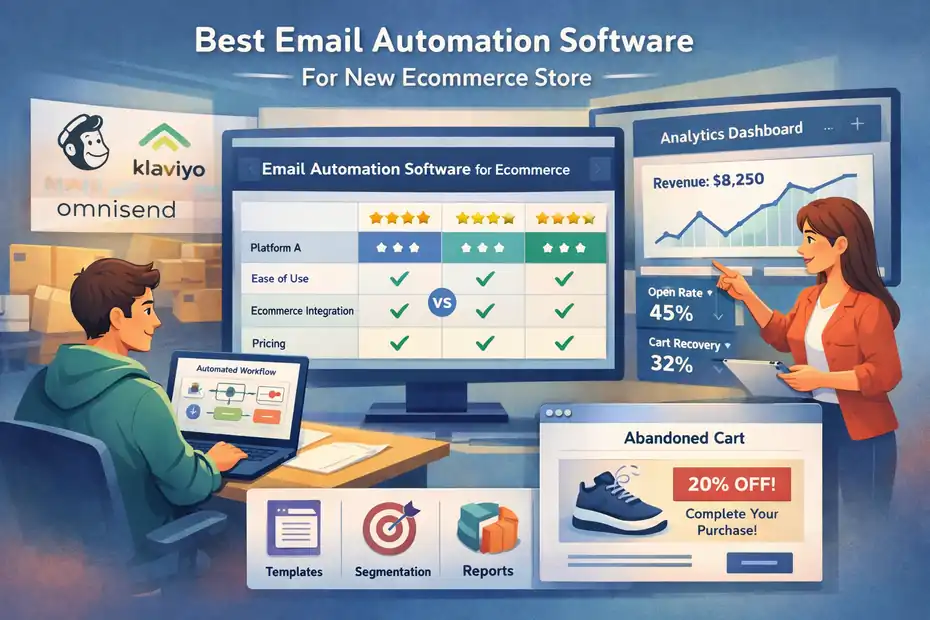
| Platform | Best Fit | Entry-Level Pricing Snapshot | Why It Stands Out |
|---|---|---|---|
| Klaviyo | Stores that want strong ecommerce depth early | Free plan available; paid email/SMS plans start around $20/month in some markets | Deep ecommerce segmentation, strong Shopify ecosystem, advanced growth path |
| Omnisend | New ecommerce brands wanting easy setup with ecommerce-native features | Free plan available; paid plans start at $16/month | Built for ecommerce, simple automation setup, good value for smaller stores |
| Mailchimp | Beginners who want a familiar general marketing platform | Free plan and tiered paid plans available; pricing varies by contacts/features | Broad brand familiarity, polished UI, growing ecommerce features |
| Shopify Email | Shopify-first stores wanting the simplest low-cost start | First 10,000 emails/month are free, then $1 per 1,000 emails | Extremely easy for Shopify merchants, low friction, low entry cost |
| Brevo | Budget-conscious stores needing flexibility beyond ecommerce | Pricing plans available with marketing and transactional options | Useful if you want broader communication tools at lower cost |
| Drip | Brands focused on lifecycle marketing and segmentation as they grow | Pricing page was not surfaced directly in my search, but Drip positions itself around B2C and ecommerce automation | Strong ecommerce lifecycle orientation, often attractive for serious retention work |
I would not choose only on price. I would choose on a mix of integration quality, automation depth, and how quickly you can launch revenue-generating flows.
Best Email Automation Software Options For A New Ecommerce Store
This is the part most people actually want: which platform should you choose? The honest answer is that there is no universal winner, but there are clear best-fit options.
Klaviyo Is Best For Stores That Want To Grow Into Advanced Retention
Klaviyo is one of the strongest choices if you know email and SMS will become a core growth channel, not just a side tool. Its appeal is depth. You can build detailed segments around product views, order history, expected next purchase date, and customer behavior across channels. Klaviyo’s pricing page shows a free plan, and its pricing materials also note paid email and SMS plans can start around $20 per month depending on market and configuration.
Where Klaviyo shines is not just automation creation. It is how far you can take personalization later. You can start with a simple welcome flow, then evolve into category-specific upsells, VIP targeting, replenishment reminders, review requests, and predictive retention campaigns.
That said, I do not think Klaviyo is automatically the best answer for every new store. If you are very early, the learning curve can feel heavier than lighter-weight tools. You need some willingness to learn segmentation properly.
My take is simple: Choose Klaviyo when you want fewer migration headaches later. If you expect serious store growth, want strong Shopify alignment, and care about long-term lifecycle marketing, it is one of the safest bets.
Omnisend Is Best For New Stores That Want Ecommerce Focus Without Overcomplication
Omnisend is a very strong option for beginners because it feels purpose-built for ecommerce without demanding advanced knowledge on day one. Its official pricing page says the Free plan includes all features, supports up to 500 emails per month, and paid plans start at $16 per month.
That matters more than it sounds. Many new store owners do not fail because the strategy is wrong. They fail because the tool is harder than expected, so flows never get finished. Omnisend reduces that risk.
I especially like it for stores that want core automations live fast: welcome, abandoned cart, order confirmations, and post-purchase follow-up. The platform also markets itself specifically toward Shopify, WooCommerce, and other ecommerce setups, which usually means less friction connecting store events and product data.
Omnisend also publishes a headline figure that its platform returns $79 for every $1 spent, though that is a vendor-reported performance claim and should be treated as directional rather than a guaranteed benchmark.
If you want my practical opinion, Omnisend is one of the best starting points for a new store owner who values speed, usability, and ecommerce-native workflows over maximum sophistication.
Mailchimp Is Best For Familiarity, Simplicity, And Broader Marketing Use
Mailchimp remains a recognizable option because a lot of people already know the brand, and its interface is approachable for beginners. Its official pricing pages show free and paid marketing plans, with features varying by tier and contact volume. Mailchimp also announced expanded data-driven ecommerce capabilities in February 2026.
Where Mailchimp fits best is when your needs are broader than ecommerce retention alone. Maybe you also care about basic landing pages, content emails, or a general-purpose marketing hub.
The tradeoff is that Mailchimp has historically felt more generalist than ecommerce-specialist. That does not mean it cannot work for stores. It can. It just means stores that want detailed product-driven automation often end up comparing it against more ecommerce-native platforms.
A realistic example: If you sell handmade home decor and want a clean tool for welcome emails, newsletters, product launches, and some basic automation, Mailchimp can be enough. But if you want advanced flows by product category, first-order discount usage, replenishment timing, and deep buyer segmentation, you may hit limits sooner.
I usually recommend Mailchimp when simplicity and familiarity matter more than deep ecommerce logic.
Shopify Email Is Best For The Leanest Possible Shopify Start
For Shopify merchants, Shopify Email is the simplest on-ramp. The official Shopify app listing says your first 10,000 emails each month are free, and then pricing starts at $1 per 1,000 emails.
That pricing model is attractive when you are just validating a store. You do not want another monthly bill if your catalog, traffic, and conversion rate are still being figured out.
The main advantage here is convenience. Product data already lives in Shopify, and the setup friction is low. That is useful when you want to launch quick campaigns, basic automations, and simple brand touchpoints without a deeper software stack.
The limitation is growth depth. For many stores, Shopify Email is a good starting tool, not necessarily the long-term destination. If your lifecycle marketing becomes more sophisticated, you may eventually want stronger segmentation, testing, or cross-channel automation elsewhere.
Still, I would not dismiss it. For a brand-new store with limited cash flow, simple software that actually gets used can be the smartest move.
The Best Choice By Store Stage, Budget, And Team Size
You do not need the “best overall” platform. You need the best one for your current reality. That usually comes down to stage, resources, and how much complexity you can realistically manage.
Best For A Solo Founder With Very Little Budget
If you are doing everything yourself and cash is tight, I would look first at Shopify Email if you are on Shopify, or Omnisend if you want more ecommerce-specific automation from the start.
The reason is simple: both reduce setup friction. A solo founder usually does not need advanced attribution dashboards before getting the welcome flow and cart recovery sequence working. You need software that helps you press publish.
This is also the stage where hidden complexity is expensive. Every hour spent wrestling with workflow logic is an hour not spent improving product pages, offers, or customer support.
My advice here is to value momentum over perfection. A simple welcome flow that introduces your brand story, best-sellers, and first-purchase incentive will usually beat a perfect but unfinished 12-email ecosystem.
Best For A New Store That Expects Fast Growth
If you are launching with a strong product, existing audience, influencer support, or paid traffic budget, I would lean toward Klaviyo or possibly Drip.
Why? Because fast growth exposes weak systems quickly. Once traffic ramps up, you want strong segmentation, easy branching logic, dynamic product recommendations, and clean customer data usage.
This is where “start cheap and migrate later” can backfire. Migration is not impossible, but it is annoying. Rebuilding flows, fixing list hygiene, redoing signup forms, and reconnecting events takes time. If you already know growth is likely, starting with a more scalable platform can save frustration.
I would still keep things simple at launch. Better software does not mean more emails. It means better control when your list, catalog, and purchase behavior get more complicated.
Best For A Small Team That Wants Balanced Capability
For a small in-house team, Omnisend often hits a sweet spot. It gives ecommerce-specific features without demanding the same operational maturity as some more advanced stacks. Its free plan with all features and lower entry pricing can make experimentation easier while the business is still finding its retention rhythm.
Mailchimp can also work for teams that want a more familiar marketing environment and do not need deep ecommerce automation logic right away. Brevo may appeal when budget flexibility and broader communication tools matter alongside email.
I suggest making the decision based on the workflows your team will actually maintain weekly. The “best” platform on paper is not the best platform if nobody wants to open it.
The Automations Every New Ecommerce Store Should Build First
Once you choose your software, the next question is what to build. This is where a lot of founders get distracted by edge cases and forget the obvious revenue wins.
Welcome Flow Should Do More Than Deliver A Discount
A welcome flow is usually your first impression after signup. Many stores waste it on one coupon email and nothing else.
A better approach is a short sequence that introduces your brand, reduces friction, and moves the customer toward first purchase. For example:
- Email 1: Brand introduction, what makes your product different, and any signup incentive.
- Email 2: Social proof, best-sellers, or product quiz guidance.
- Email 3: Objection handling, shipping details, FAQs, and a reminder to shop.
This is especially important for a new store because visitors do not know you yet. Trust matters more than clever copy. I suggest talking like a real person, showing your hero products early, and answering the silent questions buyers always have: Is this legit? Will it solve my problem? Can I trust delivery and returns?
Cart Abandonment Should Focus On Friction, Not Guilt
Cart recovery works best when you remove hesitation. New stores often write cart emails like a guilt trip. That is rarely the move.
Instead, address common blockers: shipping cost, product uncertainty, sizing, ingredients, compatibility, or delivery timing. If your product page leaves doubts, the abandoned cart email is your second chance to answer them.
A simple three-step sequence works well for many stores.
- Step 1: Send a reminder within a few hours.
- Step 2: Follow with product benefits or reviews.
- Step 3: Add urgency or a modest incentive only if needed.
I recommend saving the discount for later in the sequence, not leading with it. You do not want to train people to abandon the cart on purpose.
Post-Purchase And Win-Back Flows Drive Real Retention
A first purchase is not the finish line. It is the start of retention.
Your post-purchase flow should confirm the order, set expectations, reduce buyer anxiety, and guide the next step. Depending on your product, that next step could be usage tips, cross-sells, referrals, reviews, or a reorder reminder.
A win-back flow matters once enough time has passed without a repeat purchase. This timing depends on the product. A candle brand might wait 45 to 60 days. A supplement brand might trigger sooner. A furniture store would wait longer.
This is where product-specific thinking matters. Good automation is not just behavior-based. It is purchase-cycle aware. The closer your timing matches real customer behavior, the better your revenue and customer experience tend to be.
Common Mistakes That Make Good Software Feel Like Bad Software
A lot of platform complaints are really setup problems in disguise. The tool matters, but execution usually matters more.
Choosing Based Only On Price
Cheap software can become expensive when it costs you missed revenue, poor targeting, or a painful migration later. On the flip side, premium software can waste money if your store is too early to use its best features.
I suggest calculating value in terms of saved time and recovered sales, not just monthly subscription price. A platform that costs a bit more but recovers even a few extra carts may easily pay for itself.
This is why comparing software only by monthly fee gives an incomplete picture. You need to compare what that fee unlocks in real business outcomes.
Building Too Many Flows Too Early
This mistake is incredibly common. Founders build ten automations before optimizing one.
Start with the revenue-critical flows, then improve them. Test subject lines. Tighten timing. Add better objections handling. Improve product blocks. Review segment logic. You will usually get more lift from improving your main flows than from launching three extra niche workflows.
From what I’ve seen, a lean system of four strong flows beats a messy system of twelve weak ones.
Ignoring Deliverability And List Quality
Even the best email automation software for a new ecommerce store will underperform if your list quality is poor. Bad signup sources, purchased contacts, weak consent practices, and irrelevant targeting can hurt deliverability fast.
Keep your forms clear. Set expectations at signup. Remove disengaged contacts when appropriate. And do not confuse list size with list quality.
A smaller list of genuinely interested subscribers usually produces better revenue per send than a larger list filled with low-intent contacts. This is one of the least flashy truths in email marketing, and one of the most profitable.
How To Optimize Your Email Setup After The First 90 Days
Once the core automations are live, your job changes. Now it is less about launching and more about refinement.
Improve Segmentation Using Customer Behavior
After a few months, you should have enough data to go beyond “all subscribers” and “customers versus non-customers.”
Useful segments include first-time buyers, repeat buyers, high-AOV buyers, subscribers who clicked but never purchased, customers by category purchased, and customers nearing expected replenishment.
This is where stronger ecommerce platforms begin to pull ahead. Tools like Klaviyo and Omnisend emphasize segmentation and behavioral automation because ecommerce revenue often comes from sending fewer, more relevant emails rather than more emails overall.
In practical terms, segmentation lets you stop showing dog products to cat owners, or beginner skincare kits to customers who already bought the full routine.
Test Offers, Timing, And Flow Logic
Most stores test subject lines and stop there. I think that leaves too much upside untouched.
You can also test delay timing, number of emails in a flow, discount placement, product block order, social proof format, and CTA wording. A simple example: moving a cart reminder from 12 hours to 4 hours can change recovery rate because the purchase intent is still warm.
You do not need lab-grade experimentation. Just test one meaningful variable at a time and document the result. The goal is not perfection. It is gradual compounding.
Connect Email To Real Business Outcomes
The best optimization mindset is revenue-first. Not vanity-first.
That means looking at metrics like placed order rate, revenue per recipient, assisted revenue, repeat purchase rate, and unsubscribe spikes after certain flows. Open rate still matters as a signal, but it is not the finish line.
I believe every new store should get comfortable asking one question: which automated emails are actually generating profit? Once you start thinking that way, your software choice becomes easier too. You stop chasing shiny features and start valuing what clearly moves the business.
Final Recommendation: Which Email Automation Software Should You Pick?
If you want the simplest practical answer, here it is.
My Best Overall Pick For Most New Ecommerce Stores
For most new stores, I would put Omnisend near the top because it balances ecommerce-specific features, ease of use, and accessible pricing. Its official pricing page makes the entry point clear: a free plan with all features and paid plans starting at $16 per month.
That combination matters because new stores need real automation capability without getting buried in setup complexity. It gives you enough room to build serious lifecycle email while staying approachable.
If your goal is to get profitable automations live quickly, Omnisend is a very strong answer.
My Best Pick For Long-Term Growth And Deeper Segmentation
If you already know retention marketing will be a major growth lever, I would choose Klaviyo. The platform’s free option, advanced segmentation, and deeper ecommerce orientation make it a strong long-term choice, especially for Shopify-heavy brands and stores expecting faster growth.
It asks a bit more from you operationally, but it gives more back as your customer data becomes richer.
For founders who hate migrating tools later, this is probably the safest strategic choice.
My Best Pick For Ultra-Lean Shopify Beginners
If you are on Shopify and want to keep things as simple and inexpensive as possible, Shopify Email is hard to ignore. The first 10,000 emails per month are free, and after that pricing starts at $1 per 1,000 emails.
That is ideal when you are validating your offer and want to get basic email in place without another serious software commitment.
I would start there only if you truly want minimalism. If you already know you will care about advanced retention, it may be smarter to start with a more robust ecommerce platform.
Conclusion
The best email automation software for a new ecommerce store is not the one with the most features. It is the one that helps you launch the right automations fast, connect to your store cleanly, and grow without constant rebuilding.
For many new brands, Omnisend is the best balance. For faster-growing stores, Klaviyo is often the smarter long-term bet.
For ultra-lean Shopify setups, Shopify Email is a practical starting point. Pick the tool that matches your next stage, build the core flows first, and let your customer behavior guide everything after that.
FAQ
What is the best email automation software for a new ecommerce store?
The best email automation software for a new ecommerce store depends on your needs, but beginner-friendly platforms with ecommerce integrations and ready-made automation templates are ideal. Look for tools that support welcome emails, cart recovery, and post-purchase flows so you can start generating revenue quickly without complex setup.
How does email automation help a new ecommerce store grow?
Email automation helps a new ecommerce store grow by sending targeted messages based on customer behavior. It can recover abandoned carts, nurture new subscribers, and encourage repeat purchases. This creates consistent revenue without manual effort, making it one of the most effective early growth channels.
What features should I look for in email automation software?
You should look for features like ecommerce integration, automation workflows, segmentation, analytics, and customizable templates. These features allow you to send relevant emails at the right time. Easy setup and scalability are also important so the software grows with your store.
Is free email automation software enough for beginners?
Free email automation software can be enough for beginners if it includes basic automation flows and integrations. Many platforms offer free plans with limited sends or contacts. As your store grows, you may need to upgrade for advanced segmentation, higher limits, and better performance tracking.
When should I upgrade my email automation software?
You should upgrade your email automation software when your list grows, your automations become more complex, or you need better segmentation and analytics. If your current tool limits revenue opportunities or takes too long to manage, it is a clear sign you have outgrown it.

Juxhin B is a digital marketing researcher and founder of JAK Digital Hub, specializing in email marketing software, marketing automation platforms, and digital growth tools. His work focuses on software testing, platform comparisons, and real-world performance analysis to help businesses choose the right marketing technology.
Related posts:
![An informative illustration about Email Automation Software Comparison For Ecommerce [Best]](https://jakdigitalhub.com/wp-content/uploads/2026/03/Email-Automation-Software-Comparison-For-Ecommerce-Best-120x120.webp "Email Automation Software Comparison For Ecommerce [Best] 3") Email Automation Software Comparison For Ecommerce [Best]
Email Automation Software Comparison For Ecommerce [Best]
 Email Marketing Strategy for New Ecommerce Store Success
 Better Email Marketing Strategy for Ecommerce Growth
 Better Email Automation Software For Ecommerce That Converts
 Best Email Automation Tools Alternatives for Ecommerce That Boost ROI
 Best Email Automation Solution For Digital Products