Table of Contents
Some links on JAK Digital Hub are affiliate links, meaning we may earn a small commission at no extra cost to you. Read full disclaimer.
Email automation software for performance marketers has become one of the most powerful tools for turning traffic into revenue. Whether you’re running affiliate campaigns, scaling an ecommerce store, or generating leads for clients, automated email sequences can dramatically increase conversion rates while saving hours of manual work.
In my experience, performance marketers often focus heavily on ads, funnels, and landing pages—but email automation is where a large percentage of profit actually happens. A well-built automation system can follow up with leads instantly, nurture prospects for days or weeks, and recover lost sales automatically.
The challenge is choosing the right platform. Not all email tools are designed with performance marketing in mind. Some are built for newsletters or simple campaigns, while others provide advanced automation, segmentation, and analytics that serious marketers need.
In this guide, I’ll walk you through the best email automation software for performance marketers in 2026, how these platforms work, what features actually matter, and how to choose the right one for your business.
What Email Automation Software Does For Performance Marketers
Before comparing tools, it’s important to understand how email automation fits into performance marketing systems. At its core, email automation is about sending the right message to the right person at the right time without manual effort.
Performance marketers rely on automation because most revenue comes from follow-ups, segmentation, and behavioral triggers.
How Email Automation Actually Works
Email automation software runs on triggers and workflows. A trigger is an action a user takes that starts an automated sequence.
For example:
- Someone downloads a lead magnet
- A visitor abandons a shopping cart
- A subscriber clicks a link in an email
- A customer makes a purchase
Once that trigger happens, the automation workflow begins sending emails automatically.
Let me break down a simple example.
Imagine you’re running a lead generation funnel for a SaaS product:
- Step 1: A visitor signs up for a free guide
- Step 2: Email 1 sends immediately with the guide
- Step 3: Email 2 sends one day later with a case study
- Step 4: Email 3 sends three days later promoting the product
- Step 5: Email 4 sends with a limited-time offer
All of this happens automatically once the initial signup occurs.
From what I’ve seen, automated sequences often produce 3–5x more revenue per subscriber compared to one-off email campaigns because they respond to user behavior.
Why Performance Marketers Depend On Automation
Performance marketing focuses on measurable ROI. Email automation fits perfectly because every step can be tracked and optimized.
Here’s why most serious marketers prioritize automation:
- Higher conversion rates: Automated nurture sequences warm up leads before the sale.
- Revenue from existing traffic: Instead of constantly buying new traffic, email sequences extract more value from each visitor.
- Behavior-based targeting: Emails trigger based on actions, not guesswork.
- Scalable marketing: A sequence created once can generate revenue for years.
According to HubSpot research, automated email campaigns generate 320% more revenue than non-automated emails.
I’ve personally seen ecommerce brands increase revenue significantly just by adding abandoned cart automations and post-purchase sequences.
Features Performance Marketers Should Look For
Not all platforms offer the same automation capabilities. When evaluating email automation software for performance marketers, certain features make a massive difference.
Visual Automation Builders
One of the most important features is a visual automation builder.
This allows you to map out entire customer journeys with triggers, delays, conditions, and actions.
Instead of coding workflows manually, you can visually design automations like:
- Lead nurturing funnels
- Upsell sequences
- Abandoned cart recovery
- Webinar funnels
- Re-engagement campaigns
A visual builder helps you quickly understand the flow of your automations and makes it easier to scale complex campaigns.
From a practical standpoint, this matters because performance marketers often run dozens of sequences simultaneously.
Advanced Segmentation
Segmentation allows you to send different messages to different audiences.
For example:
- Leads vs customers
- High spenders vs new buyers
- Subscribers who clicked vs those who didn’t
- Users interested in specific products
Without segmentation, your emails become generic and conversion rates drop.
Good email automation platforms allow segmentation based on:
- Behavior
- purchase history
- tags
- engagement level
- funnel stage
In many cases, segmentation is what turns a basic email system into a high-performing marketing engine.
Revenue Tracking And Attribution
Performance marketers care about revenue, not just open rates.
The best email automation software tracks:
- Revenue per email
- Revenue per subscriber
- conversion rates
- customer lifetime value
- campaign attribution
This data allows you to identify which sequences generate the most profit.
For example, if one sequence generates $5 per subscriber and another generates $1, you know where to focus optimization efforts.
Best Email Automation Software For Performance Marketers
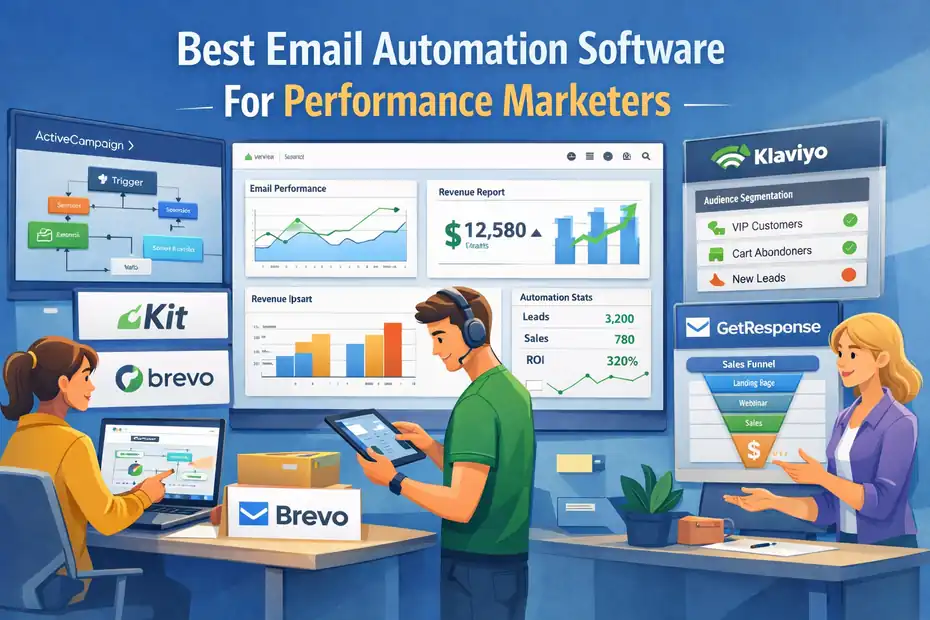
Now let’s look at the platforms that actually deliver the automation, analytics, and scalability performance marketers need.
1. ActiveCampaign
ActiveCampaign is widely considered one of the most powerful email automation platforms available today.
In my experience, it strikes an excellent balance between automation flexibility and usability.
Key Features
- Advanced visual automation builder
- Behavioral tracking and tagging
- powerful segmentation
- CRM integration
- predictive sending
- site tracking
ActiveCampaign allows you to build highly advanced workflows with conditions and logic branches.
For example:
- If subscriber clicks link → send upsell
- If subscriber ignores email → send reminder
- If subscriber purchases → remove from promo sequence
This level of logic allows marketers to create highly personalized funnels.
Pricing
ActiveCampaign pricing starts around:
| Plan | Monthly Cost |
|---|---|
| Starter | ~$29/month |
| Plus | ~$49/month |
| Professional | ~$149/month |
Most performance marketers use the Plus or Professional plans because they unlock advanced automation features.
Best For
ActiveCampaign is best for:
- affiliate marketers
- ecommerce brands
- SaaS funnels
- lead generation campaigns
If automation flexibility is your priority, this platform is one of the strongest options.
2. Kit (formerly ConvertKit)
Kit has become extremely popular among creators, bloggers, and affiliate marketers.
It focuses on simplicity while still offering strong automation capabilities.
Key Features
- visual automation builder
- tag-based segmentation
- landing pages and forms
- creator-focused integrations
- simple campaign builder
Unlike traditional list-based email tools, Kit uses a tag-based subscriber system, which makes segmentation much easier.
For example:
A subscriber might have tags like:
- affiliate-interest
- course-lead
- webinar-attendee
Your automations can then trigger emails based on these tags.
Pricing
Kit pricing typically starts around:
| Plan | Monthly Cost |
|---|---|
| Creator | ~$29/month |
| Creator Pro | ~$59/month |
Best For
Kit works particularly well for:
- bloggers
- affiliate marketers
- digital product creators
- newsletter monetization
If you want powerful automation without a complicated interface, Kit is a strong option.
3. Brevo (formerly Sendinblue)
Brevo has grown significantly over the past few years and is now a strong automation platform for businesses that need multi-channel marketing.
Key Features
- email automation workflows
- SMS marketing automation
- CRM tools
- advanced segmentation
- transactional emails
One unique advantage of Brevo is its ability to combine email automation and SMS marketing in the same workflows.
For example:
Email 1 → if unopened → send SMS reminder.
This can significantly improve conversion rates in certain campaigns.
Pricing
Brevo offers a generous free plan and affordable paid tiers.
| Plan | Monthly Cost |
|---|---|
| Free | Limited emails/day |
| Starter | ~$25/month |
| Business | ~$65/month |
Best For
Brevo is best suited for:
- small businesses
- ecommerce stores
- agencies
- multi-channel marketing funnels
4. Klaviyo
Klaviyo has become one of the leading email automation tools for ecommerce brands.
Its strength lies in deep ecommerce data integrations.
Key Features
- advanced ecommerce segmentation
- predictive analytics
- product recommendation emails
- dynamic personalization
- powerful reporting
Klaviyo connects directly with ecommerce platforms and tracks detailed purchase behavior.
For example, you can automatically send emails based on:
- products viewed
- cart abandonment
- purchase frequency
- predicted lifetime value
Pricing
Klaviyo pricing depends on subscriber count.
| Subscribers | Monthly Cost |
|---|---|
| Up to 500 | Free |
| 5,000 | ~$100 |
| 10,000 | ~$150 |
Best For
Klaviyo is ideal for:
- Shopify stores
- ecommerce brands
- product-based businesses
- retention marketing
If your revenue depends heavily on repeat purchases, Klaviyo is extremely powerful.
5. GetResponse
GetResponse combines email automation with landing pages, webinars, and marketing funnels.
For performance marketers who want an all-in-one platform, it can simplify the entire funnel process.
Key Features
- automation builder
- landing page builder
- webinar hosting
- conversion funnels
- ecommerce integrations
This means you can run the entire funnel from one platform.
Example funnel: Ad traffic → landing page → email sequence → webinar → product sale.
Pricing
GetResponse pricing begins around:
| Plan | Monthly Cost |
|---|---|
| Email Marketing | ~$19/month |
| Marketing Automation | ~$59/month |
| Ecommerce Marketing | ~$119/month |
Best For
GetResponse works well for:
- lead generation funnels
- webinar marketing
- info product launches
- affiliate campaigns
How To Choose The Right Email Automation Software
Choosing the best email automation software for performance marketers depends heavily on your marketing model.
Different platforms excel in different areas.
If You Run Affiliate Funnels
Affiliate marketers typically need:
- simple automation
- tagging systems
- landing page integrations
- broadcast emails
Platforms like Kit or ActiveCampaign usually work best.
If You Run Ecommerce Stores
Ecommerce businesses require:
- purchase tracking
- product-based segmentation
- cart abandonment workflows
- customer lifetime value tracking
Klaviyo is usually the strongest choice here.
If You Want An All-In-One Funnel Platform
If you prefer fewer tools and simpler setups, platforms that include landing pages and funnels can be useful.
GetResponse is often chosen for this reason.
Common Email Automation Mistakes Performance Marketers Make
Even the best email automation software won’t produce results if the strategy is flawed.
These are some mistakes I see frequently.
Overcomplicated Automation Funnels
Many marketers build extremely complex automation flows before validating their funnel.
In reality, a simple sequence often works better.
A strong starting structure is:
- welcome email
- value email
- case study
- product offer
- reminder
Once the sequence proves profitable, then you can add advanced segmentation and logic.
Ignoring List Hygiene
Email deliverability matters more than most people realize.
If your list contains inactive subscribers, open rates drop and emails may start landing in spam.
Good list hygiene includes:
- removing inactive subscribers
- re-engagement campaigns
- avoiding purchased lists
This helps maintain a strong sender reputation.
Focusing Only On Traffic Instead Of Monetization
Many marketers constantly chase more traffic while ignoring their email monetization.
Improving email sequences can dramatically increase revenue without spending more on ads.
For example: If your funnel converts at 1% and email automation increases it to 2%, you’ve effectively doubled your revenue.
Advanced Email Automation Strategies For Performance Marketers
Once your basic automation system is running, advanced strategies can dramatically increase performance.
Behavior-Based Sequences
Instead of sending the same sequence to everyone, behavior-based automations adapt to user actions.
Examples include:
- Click-based follow-ups
- Product interest tagging
- engagement scoring
This creates a much more personalized experience.
Revenue-Based Segmentation
High-value customers should receive different emails than casual subscribers.
For example:
VIP customers might receive:
- exclusive offers
- early product launches
- loyalty rewards
This approach often increases customer lifetime value.
Automated Upsell And Cross-Sell Funnels
Post-purchase automation is one of the most overlooked revenue opportunities.
Example flow: Purchase → thank-you email → product tutorial → upsell → cross-sell → loyalty offer
For ecommerce brands, these sequences often generate 20–30% of total email revenue.
Final Thoughts
Choosing the best email automation software for performance marketers isn’t about picking the most popular tool—it’s about selecting the platform that fits your business model and automation needs.
ActiveCampaign offers some of the most powerful automation capabilities available. Kit simplifies automation for creators and affiliate marketers. Brevo provides affordable multi-channel marketing. Klaviyo dominates ecommerce automation. And GetResponse works well for marketers who want an all-in-one funnel system.
From what I’ve seen, the real advantage comes from how you use automation—not just which tool you choose.
A well-designed email automation system can nurture leads, recover lost sales, increase customer lifetime value, and generate revenue around the clock.
And once it’s running, it becomes one of the most scalable assets in your entire marketing stack.
FAQ
What is email automation software for performance marketers?
Email automation software for performance marketers automatically sends targeted emails based on user behavior. It helps marketers nurture leads, recover lost sales, and increase conversions through automated sequences triggered by actions like sign-ups, clicks, or purchases.
Why do performance marketers use email automation software?
Performance marketers use email automation software to increase ROI from existing traffic. Automated sequences follow up with leads, segment audiences, and deliver personalized offers, which typically leads to higher conversions and improved customer lifetime value.
Which email automation software is best for performance marketers?
The best email automation software for performance marketers depends on the business model. ActiveCampaign offers powerful automation, Kit works well for creators and affiliates, Klaviyo is strong for ecommerce, Brevo supports multichannel campaigns, and GetResponse provides all-in-one marketing funnels.
How does email automation increase conversions?
Email automation increases conversions by sending the right message at the right time. Automated follow-ups nurture leads, recover abandoned carts, and deliver personalized offers based on behavior, which significantly improves engagement and purchase rates.
What features should performance marketers look for in email automation tools?
Performance marketers should prioritize visual automation builders, advanced segmentation, revenue tracking, behavioral triggers, and deliverability tools. These features help create targeted campaigns, track results accurately, and optimize email funnels for maximum revenue.

Juxhin B is a digital marketing researcher and founder of JAK Digital Hub, specializing in email marketing software, marketing automation platforms, and digital growth tools. His work focuses on software testing, platform comparisons, and real-world performance analysis to help businesses choose the right marketing technology.
Related posts:
 Best Email Automation Platform For Scaling Business Fast
 Best Email Automation Platform For Advanced Segmentation
 Email Automation Tool With Advanced Workflows: Top Picks
 Best Email Automation Solution For Digital Products
 Email Automation Tools for New Ecommerce Store: What to Start With
 Email Automation Tools Not Triggering? Fix the Issue Fast