Table of Contents
Some links on JAK Digital Hub are affiliate links, meaning we may earn a small commission at no extra cost to you. Read full disclaimer.
If you’re searching for email automation software for serious growth, you’re probably past the beginner stage. You don’t just want to send newsletters—you want systems that generate leads, nurture prospects, recover abandoned carts, and turn subscribers into customers automatically.
Email still delivers one of the highest marketing returns in digital marketing. According to data from the Data & Marketing Association, email marketing produces an average ROI of $42for every $1 spent. But that level of return doesn’t come from basic campaigns. It comes from automation workflows, behavioral triggers, segmentation, and lifecycle marketing.
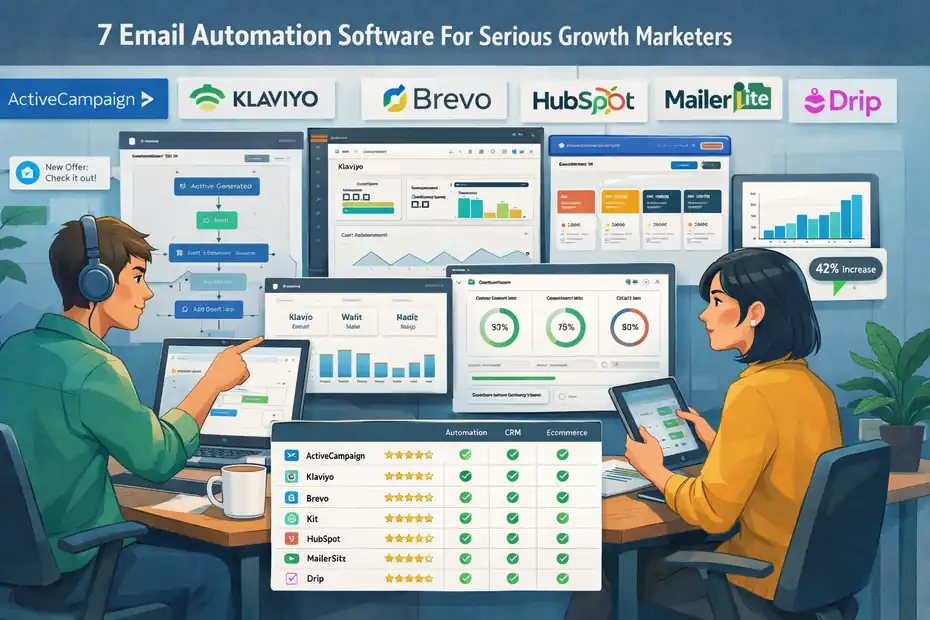
In this guide, I’ll walk you through 7 email automation software platforms built for serious growth marketers. These tools go beyond simple email sending. They help you build marketing systems that scale with your business.
You’ll learn:
- What each platform does best
- Who should actually use it
- Pricing and automation capabilities
- Real growth scenarios where it shines
Let’s dive in.
1. ActiveCampaign
For many growth marketers, ActiveCampaign sits right in the sweet spot between power and usability. It’s built specifically for automation-driven marketing.
Why ActiveCampaign Is Built for Automation-First Marketing
If your strategy relies heavily on automated funnels, ActiveCampaign is often one of the first platforms I recommend.
What makes it powerful is its visual automation builder. Instead of writing complicated logic, you literally drag and drop conditions like:
- If subscriber clicks link
- If contact visits pricing page
- If purchase happens
- If tag added or removed
This lets you build extremely advanced customer journeys.
For example, imagine you run a SaaS product:
- Step 1: User signs up for a free trial.
- Step 2: They automatically receive onboarding emails.
- Step 3: If they log in 3 times, they enter a “high intent” automation.
- Step 4: If they don’t log in, they receive re-engagement emails.
That entire flow can be automated visually.
From what I’ve seen working with marketing teams, this behavior-based automation is where real growth happens.
ActiveCampaign also includes:
- CRM integration for sales pipelines
- Lead scoring automation
- Website tracking
- Advanced segmentation
That combination makes it ideal for businesses that want email automation connected directly to their revenue pipeline.
Pricing, Growth Use Cases, and Limitations
ActiveCampaign pricing starts around $29/month, but most serious marketers move to higher tiers for full automation and CRM capabilities.
Typical growth scenarios where ActiveCampaign shines:
- SaaS onboarding automation
- Lead nurturing funnels
- Sales pipeline automation
- Webinar follow-up sequences
- High-converting lead magnets
One example I’ve personally seen: a B2B company built a 9-email nurturing sequence triggered by content downloads. Their conversion rate from lead to demo increased from 2.3% to 7.8% within 90 days.
That’s the power of automation done correctly.
The downside?
The platform has a learning curve. If you’re brand new to marketing automation, the system can feel overwhelming at first.
But for serious growth marketers, that complexity often becomes a huge advantage.
2. Klaviyo
When it comes to ecommerce automation, Klaviyo is often the first name that comes up.
Why Klaviyo Dominates Ecommerce Email Automation
Klaviyo was built specifically for data-driven ecommerce marketing.
Instead of just storing email addresses, it pulls in real customer behavior:
- Products viewed
- Cart activity
- Purchase history
- Order value
- Product categories
- Customer lifetime value
This allows extremely targeted automation.
For example:
- Cart Abandonment Flow
- Step 1: Customer adds product but leaves site.
- Step 2: Email reminder after 2 hours.
- Step 3: Second reminder with social proof.
- Step 4: Discount email after 24 hours.
These sequences alone can recover 10–20% of abandoned carts in many stores.
Another powerful automation is post-purchase cross-sell flows.
Imagine someone buys running shoes. Instead of sending generic emails, Klaviyo can trigger emails recommending:
- Running socks
- Fitness trackers
- Training programs
Because it understands product relationships.
This type of behavioral personalization is a major reason many Shopify brands scale revenue quickly using automated email flows.
Pricing and Real Ecommerce Growth Scenarios
Klaviyo’s pricing scales with list size. Small stores can start around $20/month, but larger ecommerce brands often spend hundreds per month.
The ROI usually justifies it.
Typical automation flows built in Klaviyo include:
- Welcome series
- Abandoned cart recovery
- Browse abandonment
- Post-purchase upsell
- VIP customer loyalty flows
One ecommerce brand case study reported that email automation generated 34% of total revenue once these flows were optimized.
In my experience, this happens when businesses stop thinking about email as a newsletter and start thinking about it as a revenue system.
If ecommerce is your main business model, Klaviyo is extremely hard to beat.
3. Brevo
Brevo (formerly Sendinblue) is a strong option for businesses that want automation plus multi-channel messaging.
What Makes Brevo Different From Other Automation Tools
Most email platforms focus only on email.
Brevo approaches automation differently by combining multiple communication channels inside one automation engine:
- Email automation
- SMS campaigns
- WhatsApp messaging
- Live chat
- CRM functionality
This allows businesses to build cross-channel marketing workflows.
Imagine a simple lead nurturing funnel:
- Step 1: User downloads a guide.
- Step 2: Automated welcome email is sent.
- Step 3: If unopened, SMS reminder after 24 hours.
- Step 4: If link clicked, lead moves into sales pipeline.
That type of workflow helps improve engagement dramatically.
Another benefit of Brevo is its transactional email infrastructure, which many SaaS companies rely on for sending things like:
- Password resets
- Account alerts
- Purchase confirmations
Combining marketing automation and transactional messaging inside one platform simplifies operations for growing businesses.
Pricing and Best Use Cases
Brevo is also one of the more cost-effective automation platforms.
The free plan allows up to 300 emails per day, which is helpful for startups testing automation systems.
Paid plans start around $25/month.
Best use cases include:
- SaaS onboarding sequences
- Startup lead generation
- Multi-channel messaging campaigns
- CRM-connected email marketing
I often recommend Brevo for founders who want serious automation without enterprise-level pricing.
It’s a surprisingly powerful system once you start building automation workflows.
4. Kit
For creators and content businesses, Kit is designed specifically for audience monetization.
Why Kit Is Built for Creator Businesses
Kit focuses on simplicity and monetization.
Instead of overwhelming users with dozens of features, the platform prioritizes tools creators actually use:
- Subscriber tagging
- Email sequences
- Landing pages
- Creator commerce tools
- Audience segmentation
The tagging system is especially powerful.
Instead of placing subscribers into separate lists, Kit organizes them with behavior-based tags.
For example:
- Subscriber downloads SEO guide → tag: SEO interest
- Subscriber buys course → tag: customer
- Subscriber clicks affiliate link → tag: affiliate interest
This allows you to send highly relevant emails without maintaining complicated lists.
If you run a blog, YouTube channel, or newsletter, this kind of segmentation makes monetization easier.
Pricing and Growth Scenarios
Kit offers a free plan for up to 1,000 subscribers, making it accessible for creators building their first audience.
Paid plans start around $29/month.
Typical automation systems built in Kit include:
- Lead magnet delivery
- Email course automation
- Affiliate promotion funnels
- Newsletter growth sequences
- Product launch campaigns
For example, a creator might build a 5-day email course that teaches a topic and then introduces a paid product.
This automated sequence can generate sales long after the initial setup.
In my experience, Kit works best when your business model revolves around:
- Content marketing
- Personal brands
- Courses
- Membership communities
It removes technical complexity so creators can focus on audience growth.
5. HubSpot
If you want enterprise-level automation and CRM integration, HubSpot is one of the most powerful marketing platforms available.
How HubSpot Connects Email Automation With Sales
HubSpot isn’t just an email marketing platform.
It’s a full marketing and sales ecosystem.
What makes it unique is how automation connects directly to CRM data.
For example:
- When a lead downloads a whitepaper, automation begins
- If the lead visits pricing pages multiple times, sales gets notified
- If the lead requests a demo, they move into a deal pipeline
This alignment between marketing and sales is extremely valuable for B2B businesses.
HubSpot automation can also trigger:
- Internal notifications for sales teams
- Lead scoring updates
- Pipeline changes
- Custom CRM actions
That means email automation becomes part of a full revenue engine, not just marketing campaigns.
Pricing and Who Should Use HubSpot
HubSpot’s pricing reflects its enterprise capabilities.
The platform includes:
- Free CRM
- Paid marketing automation tools
- Sales and service hubs
Marketing Hub plans often start around $800/month for serious automation features.
Because of that, HubSpot is typically used by:
- SaaS companies
- B2B service businesses
- Marketing agencies
- Large ecommerce brands
For teams that need deep CRM integration with marketing automation, HubSpot is often one of the strongest solutions available.
6. MailerLite
MailerLite is one of the best platforms for marketers who want powerful automation without complicated systems.
Why MailerLite Is a Strong Entry-Level Automation Platform
MailerLite strikes a great balance between simplicity and functionality.
The automation builder allows marketers to create sequences triggered by:
- Form submissions
- Link clicks
- Email opens
- Subscriber behavior
While it’s not as complex as enterprise platforms, it’s more than capable of running serious email funnels.
For example, a blogger could easily build:
- Step 1: Visitor downloads a lead magnet.
- Step 2: Welcome sequence begins.
- Step 3: Educational emails nurture the reader.
- Step 4: Promotional email introduces a paid course.
This type of funnel can generate consistent income from content traffic.
Another feature many marketers appreciate is the landing page builder, which allows you to create opt-in pages without needing a separate website builder.
For smaller teams or solo marketers, this simplicity saves a lot of time.
Pricing and Ideal Use Cases
MailerLite offers one of the most generous free plans available.
The free tier includes:
- Up to 1,000 subscribers
- Basic automation
- Landing pages
- Email campaigns
Paid plans start around $10–$20/month, depending on subscriber count.
Best use cases include:
- Bloggers growing an email list
- Freelancers building audiences
- Small online businesses
- Course creators
In many cases, businesses can run profitable automation funnels using MailerLite before ever needing to upgrade to more complex platforms.
7. Drip
Drip is another powerful platform designed specifically for ecommerce marketers.
Why Drip Focuses on Revenue Automation
Drip was built with a clear goal: help ecommerce brands increase revenue through automation.
It connects customer data from online stores and uses that data to trigger personalized marketing flows.
For example:
Customer buys a product → automation triggers a review request email.
Customer browses multiple items → automation sends product recommendations.
Customer hasn’t purchased in 60 days → win-back campaign begins.
Drip also supports dynamic content, meaning emails can automatically display different products depending on customer behavior.
This level of personalization can significantly increase engagement.
According to several ecommerce case studies, personalized email flows often produce 3–5x higher click-through rates compared to generic campaigns.
Pricing and When Drip Makes Sense
Drip pricing typically starts around $39/month for smaller subscriber lists.
The platform works best for:
- Shopify stores
- Direct-to-consumer brands
- Subscription ecommerce businesses
- Product recommendation campaigns
One ecommerce brand reported increasing email revenue by 42% after implementing automated cross-sell flows inside Drip.
That’s why many growth-focused ecommerce teams consider it one of the best automation platforms available.
How To Choose the Right Email Automation Software for Serious Growth
With so many options available, choosing the right email automation software for serious growth depends heavily on your business model.
Let me simplify it with a quick comparison.
| Platform | Best For | Strength |
|---|---|---|
| ActiveCampaign | Automation-driven marketing | Advanced workflows |
| Klaviyo | Ecommerce brands | Behavioral data |
| Brevo | Multi-channel marketing | Email + SMS automation |
| Kit | Creators and bloggers | Audience monetization |
| HubSpot | B2B and enterprise | CRM integration |
| MailerLite | Beginners and small businesses | Simplicity and cost |
| Drip | Ecommerce revenue automation | Personalization |
When I advise businesses on choosing platforms, I usually ask three questions:
- Do you sell products, services, or content?
- Do you need deep automation or simple funnels?
- Do you want CRM integration with sales teams?
Your answers to those questions usually make the best platform obvious.
Final Thoughts
Choosing the right email automation software for serious growth can completely change how your business scales.
Instead of sending emails manually, you build automated marketing systems that:
- Capture leads
- Nurture relationships
- Convert subscribers into customers
- Generate recurring revenue
From what I’ve seen working with marketing systems, the biggest difference between average email marketing and high-performing campaigns is automation depth.
Simple newsletters rarely drive major growth.
But well-designed automation funnels—especially those triggered by user behavior—can turn email into one of the most reliable revenue channels in your business.
If you’re just starting, tools like MailerLite or Kit can help you build your first automation systems.
If you’re scaling aggressively, platforms like ActiveCampaign, Klaviyo, or HubSpot give you the flexibility to build far more sophisticated growth engines.
And once those systems are running, email stops being just a marketing channel.
It becomes a predictable growth machine.
FAQ
What is email automation software for serious growth?
Email automation software for serious growth helps marketers create automated email sequences triggered by user behavior. These systems nurture leads, personalize communication, and convert subscribers into customers without manual sending.
Why do growth marketers use email automation software?
Growth marketers use email automation software to scale marketing efficiently. Automated workflows send targeted emails based on actions like signups, purchases, or page visits, helping businesses increase conversions while saving time.
What features should serious growth marketers look for in email automation software?
Serious growth marketers should look for advanced automation workflows, behavioral triggers, segmentation, analytics, and CRM integration. These features allow marketers to build personalized customer journeys that improve engagement and drive higher revenue.
Which businesses benefit most from email automation software?
Businesses that rely on lead generation, ecommerce sales, or audience monetization benefit most from email automation software. SaaS companies, online stores, bloggers, and digital creators use automation to nurture leads and increase lifetime customer value.
How does email automation improve marketing ROI?
Email automation improves ROI by sending the right message at the right time using behavioral triggers. Automated campaigns nurture prospects, recover abandoned carts, and promote products automatically, which increases conversions and reduces manual marketing work.

Juxhin B is a digital marketing researcher and founder of JAK Digital Hub, specializing in email marketing software, marketing automation platforms, and digital growth tools. His work focuses on software testing, platform comparisons, and real-world performance analysis to help businesses choose the right marketing technology.
Related posts:
 Email Automation Tool With Advanced Workflows: Top Picks
 Best Email Automation System That Scales Affordably
 Best Email Automation Platform For Scaling Business Fast
 Best Email Automation Tool For Affiliate Marketers
 Best Email Automation Software For Performance Marketers
 Email Automation For Multiple Brands Compared