Table of Contents
Some links on JAK Digital Hub are affiliate links, meaning we may earn a small commission at no extra cost to you. Read full disclaimer.
Finding the best email automation tool for high volume sending can feel overwhelming. When your email list grows into the tens or hundreds of thousands, the tools that worked early on suddenly struggle with deliverability, automation limits, or pricing.
I’ve seen this happen many times. A creator starts with a simple newsletter platform, grows their audience, and then realizes their system can’t reliably send large campaigns anymore. Emails land in spam, automation breaks, or the cost becomes unsustainable.
High-volume email sending requires a different approach. You need strong deliverability infrastructure, advanced automation, segmentation, and analytics that scale with your audience.
In this guide, I’ll walk you through the best email automation tools for high volume sending in 2026, how they work, how to choose the right platform, and what actually matters when you’re sending thousands (or millions) of emails per month.
What Is an Email Automation Tool for High Volume Sending?
An email automation tool for high volume sending is a platform designed to send large numbers of emails automatically while maintaining high deliverability and strong inbox placement.
These platforms handle the technical infrastructure behind email campaigns, including server management, IP reputation, bounce handling, and automation workflows.
Why High Volume Email Requires Specialized Infrastructure
Sending large email campaigns isn’t just about pressing “send.” Email providers like Gmail, Outlook, and Yahoo analyze sender behavior carefully.
When you send thousands of emails at once, several things happen behind the scenes:
- Email servers evaluate your sender reputation
- Spam filters analyze your content and sending patterns
- Mailbox providers check engagement rates
- Bounce and complaint rates impact future delivery
If your infrastructure isn’t optimized for scale, even legitimate campaigns can start landing in spam folders.
High-volume email platforms solve this problem by providing:
- Dedicated or shared sending IPs
- Automatic bounce and complaint management
- Deliverability monitoring
- Scalable sending architecture
- Advanced automation engines
According to data from Return Path, around 21% of marketing emails never reach the inbox, largely due to deliverability issues. That’s why the right platform matters once your email volume grows.
Key Features to Look For in a High Volume Email Automation Platform
Not every email marketing platform is built for scale. Some tools are excellent for small newsletters but struggle with enterprise-level sending.
When evaluating platforms, focus on these features:
- Dedicated sending infrastructure: Allows better control of sender reputation.
- Automation workflows: Enables automated sequences triggered by user actions.
- Advanced segmentation: Helps send targeted messages to improve engagement.
- Deliverability monitoring: Tracks inbox placement and spam complaints.
- API and integrations: Allows integration with ecommerce platforms, CRMs, and apps.
- Scalable pricing models: Supports millions of emails without exponential costs.
In my experience, deliverability tools and segmentation capabilities matter far more than flashy templates.
Best Email Automation Tools for High Volume Sending in 2026
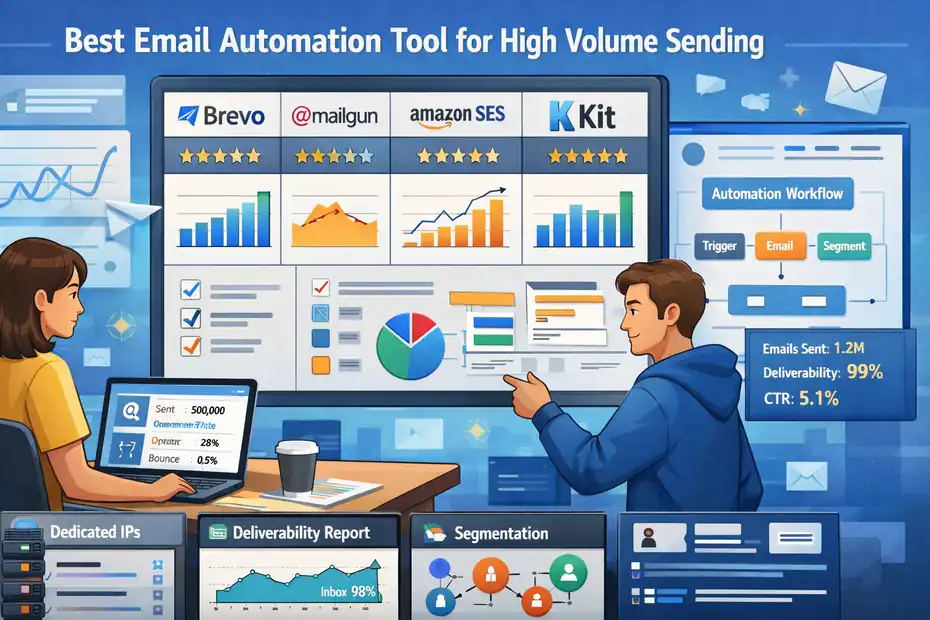
Several platforms dominate the high-volume email space because they combine automation, deliverability, and scalability. The best option depends on your business model and technical experience.
Brevo (Best Balance of Automation and Cost)
Brevo is one of the most flexible platforms for businesses sending high email volumes without enterprise-level budgets.
Originally known as Sendinblue, Brevo evolved into a full marketing automation platform with strong infrastructure.
What makes Brevo attractive for high-volume senders:
- SMTP infrastructure designed for large campaigns
- Advanced automation workflows
- CRM functionality built directly into the platform
- SMS and email automation in one system
- Strong European data compliance
One thing I appreciate about Brevo is its pricing based on email volume rather than subscriber count. This makes it particularly appealing for businesses with large lists but moderate sending frequency.
For example, if you run a blog with 100,000 subscribers but only send weekly campaigns, Brevo can be significantly cheaper than list-based pricing models.
It also supports:
- transactional emails
- marketing campaigns
- automation sequences
- API integrations
This makes it a solid all-around platform for scaling newsletters and marketing funnels.
Mailgun (Best for Developers and SaaS Platforms)
Mailgun focuses on transactional and high-volume sending infrastructure rather than traditional email marketing.
It’s widely used by SaaS companies and apps that need to send millions of automated emails such as:
- password resets
- notifications
- onboarding emails
- system alerts
The strength of Mailgun lies in its developer-friendly infrastructure and powerful API.
Key capabilities include:
- Advanced email routing
- Deliverability optimization
- Dedicated IP options
- High sending throughput
- Detailed analytics and logs
In practice, Mailgun works best when email automation is integrated directly into a product.
For example: Imagine you’re running a SaaS platform that sends onboarding emails to every new user and triggers behavioral emails based on activity. Mailgun allows your backend system to control these events precisely.
However, it’s not ideal for marketers who want drag-and-drop campaign builders or visual automation workflows.
Amazon SES (Best for Extremely High Email Volumes)
Amazon Simple Email Service (SES) is one of the most powerful and cost-efficient platforms for large-scale email sending.
It’s part of Amazon Web Services and is used by companies sending millions or even billions of emails per month.
Amazon SES is extremely affordable because pricing is based on email volume rather than marketing features.
Typical use cases include:
- SaaS notifications
- transactional emails
- large newsletters
- ecommerce automation
- product alerts
The main benefits include:
- extremely low sending cost
- highly scalable infrastructure
- strong deliverability
- flexible API integrations
However, SES comes with one major tradeoff.
It doesn’t provide built-in marketing tools like visual automation builders or campaign dashboards. Most businesses pair it with other systems that manage marketing workflows.
From what I’ve seen, SES works best for:
- tech companies
- large ecommerce platforms
- businesses with developer teams
For non-technical users, setup can feel intimidating.
Kit (Best for Creators and Newsletter Businesses)
Kit (formerly ConvertKit) is designed for creators, bloggers, and digital product businesses that rely heavily on email automation.
While it isn’t as infrastructure-focused as developer tools, it performs very well for high-engagement lists.
Kit focuses on:
- subscriber tagging
- automation sequences
- creator monetization
- email funnels
Where Kit shines is behavior-based automation.
You can trigger sequences based on:
- link clicks
- purchases
- subscriber tags
- signup forms
Imagine a creator selling an online course.
A reader joins the email list → receives a welcome sequence → clicks a course link → automatically enters a sales funnel.
This type of automation is extremely powerful for content creators and bloggers.
Kit also maintains strong deliverability by emphasizing subscriber engagement and list hygiene.
SendGrid (Best for Enterprise Email Automation)
SendGrid is one of the most widely used platforms for enterprise email infrastructure.
It combines marketing tools with high-volume email infrastructure.
Many companies rely on SendGrid for:
- transactional emails
- marketing campaigns
- customer lifecycle messaging
Key features include:
- email API
- automation workflows
- template builders
- analytics dashboards
- dedicated IP management
SendGrid is particularly popular among startups and SaaS companies because it balances developer control and marketing automation.
For example, a SaaS product might use:
- API emails for system notifications
- marketing automation for onboarding
- lifecycle campaigns for retention
SendGrid allows both teams to operate inside one platform.
Comparison of the Best High Volume Email Automation Tools
Choosing the right platform depends on your business model, technical resources, and sending volume.
Here’s a simplified comparison.
| Platform | Best For | Ease of Use | Automation | Scalability |
|---|---|---|---|---|
| Brevo | Marketing teams and small businesses | Easy | Advanced | High |
| Mailgun | Developers and SaaS platforms | Moderate | API-based | Very High |
| Amazon SES | Massive sending volume | Technical | Custom | Extremely High |
| Kit | Creators and bloggers | Very Easy | Strong | Moderate |
| SendGrid | SaaS and enterprises | Moderate | Advanced | Very High |
In my opinion, Brevo and SendGrid offer the best balance between automation and infrastructure for most businesses.
How to Choose the Best Email Automation Tool for High Volume Sending
Choosing a platform isn’t just about features. The right decision depends heavily on your business stage and email strategy.
Match the Platform to Your Sending Volume
One of the biggest mistakes I see is businesses choosing tools built for small newsletters.
As your email list grows, sending volume can increase dramatically.
Here’s a rough breakdown:
| Email Volume | Recommended Platform Type |
|---|---|
| Under 10,000 emails/month | Basic marketing platforms |
| 10,000–500,000 emails/month | Advanced marketing automation |
| 500,000+ emails/month | Infrastructure platforms |
If you’re sending hundreds of thousands of emails monthly, infrastructure becomes the main priority.
Evaluate Deliverability Support
Deliverability is arguably the most important factor in high-volume sending.
Even small deliverability improvements can dramatically impact revenue.
For example:
- A 2% inbox placement improvement on a list of 200,000 subscribers equals 4,000 more readers seeing your campaign.
Look for platforms that provide:
- sender reputation monitoring
- dedicated IP options
- spam complaint tracking
- bounce management
- deliverability insights
Platforms with strong deliverability support can significantly improve long-term email performance.
Consider Automation Capabilities
Automation becomes essential as your audience grows.
Manually sending campaigns to large lists quickly becomes inefficient.
Look for automation features such as:
- behavioral triggers
- event-based messaging
- conditional workflows
- segmentation rules
- dynamic content
These tools allow you to send personalized messages even when your audience reaches hundreds of thousands of subscribers.
Common Mistakes When Sending High Volume Emails
Even with the best platform, certain mistakes can destroy deliverability and engagement.
Sending Large Campaigns Without IP Warmup
IP warmup is the process of gradually increasing sending volume to build sender reputation.
If you suddenly send 200,000 emails from a new IP address, email providers may treat it as suspicious behavior.
Proper warmup usually involves:
- starting with small segments
- gradually increasing daily volume
- maintaining consistent sending patterns
Skipping this step is one of the fastest ways to trigger spam filters.
Ignoring Email List Hygiene
Large email lists naturally accumulate inactive subscribers.
Sending campaigns to inactive users lowers engagement rates, which signals spam filters.
Best practices include:
- removing inactive subscribers
- re-engagement campaigns
- monitoring bounce rates
- cleaning invalid addresses
In my experience, removing inactive subscribers can actually increase revenue because it improves deliverability.
Poor Segmentation and Generic Messaging
Sending the same email to every subscriber rarely works at scale.
Segmentation allows you to target messages based on:
- purchase behavior
- location
- engagement history
- signup source
For example, an ecommerce store might send:
- product recommendations
- abandoned cart emails
- loyalty rewards
Each message targets a specific segment, which dramatically improves open and conversion rates.
Advanced Strategies for Scaling Email Automation
Once your email infrastructure is stable, you can start optimizing for performance and revenue.
Behavioral Email Sequences
Behavior-based emails trigger automatically based on subscriber actions.
Examples include:
- welcome sequences
- abandoned cart reminders
- re-engagement campaigns
- product onboarding emails
These campaigns often outperform broadcast emails.
Some studies show automated emails generate up to 320% more revenue than standard campaigns.
Multi-Channel Marketing Automation
Email automation works even better when combined with other channels.
Modern marketing automation often includes:
- SMS notifications
- push notifications
- in-app messaging
- retargeting ads
Coordinating these channels creates a more consistent customer experience.
Data-Driven Email Optimization
The best high-volume email strategies rely heavily on analytics.
Important metrics include:
- open rate
- click-through rate
- conversion rate
- unsubscribe rate
- spam complaints
Tracking these metrics allows you to continuously improve campaigns.
For example, even a 1% increase in click-through rate can produce significant revenue gains when sending millions of emails.
Final Thoughts
Choosing the best email automation tool for high volume sending is ultimately about balancing infrastructure, automation, and deliverability.
If you’re a creator or blogger, platforms like Kit or Brevo can scale well while remaining easy to use.
If you’re running a SaaS platform or sending millions of transactional emails, tools like Mailgun, SendGrid, or Amazon SES provide the infrastructure needed for massive campaigns.
From what I’ve seen, the biggest long-term advantage comes from building a system that scales with your audience. The right email platform not only sends campaigns reliably but also supports automation, segmentation, and data-driven optimization.
When email becomes a core part of your business, investing in the right automation platform can dramatically increase engagement, conversions, and revenue.
FAQ
What is an email automation tool for high volume sending?
An email automation tool for high volume sending is a platform designed to send thousands or millions of emails automatically while maintaining strong deliverability. It manages infrastructure, sender reputation, automation workflows, and analytics to ensure campaigns reach inboxes reliably.
Why do businesses need a high volume email automation tool?
Businesses need a high volume email automation tool to send large campaigns without damaging deliverability. These platforms manage email servers, handle bounce processing, and optimize sending patterns so high-volume campaigns consistently reach subscribers’ inboxes.
Which email automation tool is best for sending large campaigns?
How many emails count as high volume sending?
High volume sending usually begins around 100,000 emails per month, though some businesses send millions. At this scale, deliverability monitoring, dedicated IP infrastructure, and automation systems become essential to maintain consistent inbox placement.
What features should a high volume email automation tool include?
A high volume email automation tool should include automation workflows, advanced segmentation, deliverability monitoring, bounce management, dedicated IP options, and detailed analytics to ensure campaigns reach inboxes and perform well at scale.

Juxhin B is a digital marketing researcher and founder of JAK Digital Hub, specializing in email marketing software, marketing automation platforms, and digital growth tools. His work focuses on software testing, platform comparisons, and real-world performance analysis to help businesses choose the right marketing technology.
Related posts:
 Best Email Automation Platform For Scaling Business Fast
 Email Automation Software With Better Deliverability Ranked
 Email Automation Tool With Advanced Workflows: Top Picks
 Best Email Automation Tool For Affiliate Marketers
 Best Email Automation Software For Performance Marketers
 7 Email Automation Software For Serious Growth Marketers