Table of Contents
Some links on JAK Digital Hub are affiliate links, meaning we may earn a small commission at no extra cost to you. Read full disclaimer.
Finding the best email automation tool for recurring revenue can completely change how a business grows. Instead of chasing every sale manually, you build systems that consistently bring customers back, nurture subscribers automatically, and convert interest into predictable income.
If you run a blog, SaaS product, membership site, course business, or even an ecommerce store, email automation is one of the most reliable revenue engines available. According to data from the Data & Marketing Association, email marketing generates an average return of $36 for every $1 spent. But here’s the part many people miss: that ROI usually comes from automation, not manual newsletters.
In this guide, I’ll walk you through the best email automation tools for recurring revenue, explain how these systems actually work, and show you how to build automated email sequences that keep generating income month after month.
Whether you’re just starting your list or already running campaigns, you’ll see how to turn email into a predictable revenue channel.
What an Email Automation Tool for Recurring Revenue Actually Does
An email automation tool for recurring revenue creates systems that send emails automatically based on user behavior, timing, or triggers.
Instead of writing and sending each email manually, you design automated workflows that run continuously in the background.
How Automated Email Systems Turn Subscribers Into Predictable Revenue
At a basic level, email automation works through triggers and sequences.
A trigger is an action someone takes, such as:
- Joining your email list
- Purchasing a product
- Visiting a pricing page
- Abandoning a cart
- Signing up for a free trial
Once the trigger happens, the system launches a pre-built sequence of emails designed to guide the subscriber toward a specific outcome.
For example, imagine someone signs up for a free guide on your website. Your automation might look like this:
- Email 1: Welcome and deliver the free resource
- Email 2: Share a useful strategy related to the topic
- Email 3: Introduce your product or course
- Email 4: Provide case studies or testimonials
- Email 5: Offer a limited-time promotion
Once this sequence is built, every new subscriber receives it automatically. That’s the core mechanism behind recurring revenue through email.
What I’ve noticed from working with many creators and small businesses is that most revenue actually comes from these automated funnels rather than regular broadcasts.
Key Features That Drive Recurring Revenue Automation
Not every email platform is designed to generate recurring revenue. The best email automation tools include specific capabilities that support long-term monetization.
These features usually include:
- Behavioral triggers that send emails based on actions users take
- Visual automation builders that map out complex workflows
- Segmentation systems that group subscribers by interests or purchases
- Conversion tracking to measure revenue generated from emails
- Integration with payment systems, membership platforms, or ecommerce stores
Advanced tools also offer predictive sending, dynamic content, and automated upsell flows.
From what I’ve seen, the difference between basic email marketing and true revenue automation comes down to how flexible the automation engine is.
Key Features to Look for in an Email Automation Tool for Recurring Revenue
Before choosing a platform, it helps to understand what features actually influence recurring revenue performance.
Many tools advertise automation, but only some provide the control needed to build full customer lifecycle funnels.
Advanced Automation Workflows and Behavioral Triggers
Automation workflows are the backbone of any email revenue system.
A strong platform allows you to create complex customer journeys triggered by specific behaviors.
Common triggers include:
- Subscriber joins your list
- Customer completes a purchase
- Trial expires
- Subscriber clicks a link
- Product usage milestone reached
These triggers allow you to create extremely targeted messaging.
For example, if someone starts a trial but never uses the product, the system can automatically send educational emails designed to activate them.
This type of automation is especially powerful for SaaS businesses and membership platforms because it helps reduce churn.
In my experience, behavioral triggers are where the real money is made. They allow you to send the right email at the exact moment someone is most likely to convert.
Segmentation and Personalization Capabilities
Segmentation means dividing your email list into groups based on behavior, interests, or purchase history.
Without segmentation, every subscriber receives the same messages. That usually results in lower engagement and fewer sales.
With segmentation, your emails can adapt to different audiences.
For example:
- New subscribers receive onboarding emails
- Existing customers receive upsell offers
- High-value customers receive loyalty rewards
Personalized emails perform significantly better. According to research from Campaign Monitor, segmented campaigns can drive up to 760% more revenue compared to generic email blasts.
Most high-performing email automation tools include dynamic fields that insert personal details such as names, past purchases, or recommended products.
This creates the feeling that each email was written specifically for the subscriber.
Analytics and Revenue Attribution
One of the most important features of an email automation tool for recurring revenue is the ability to measure results.
Without analytics, you won’t know which sequences are generating revenue and which ones are underperforming.
Key metrics to monitor include:
- Open rate
- Click-through rate
- Conversion rate
- Revenue per subscriber
- Lifetime customer value
Advanced platforms go even further by showing exactly how much revenue each automation sequence generates.
This allows you to optimize your email funnels like a real revenue engine.
For example, if one welcome sequence generates $4 per subscriber while another generates $1, you know where to focus optimization efforts.
Best Email Automation Tools for Recurring Revenue in 2026
Different tools serve different business models. Some are better for creators and bloggers, while others are built for ecommerce or SaaS companies.
Below are some of the most reliable platforms for building automated recurring revenue systems.
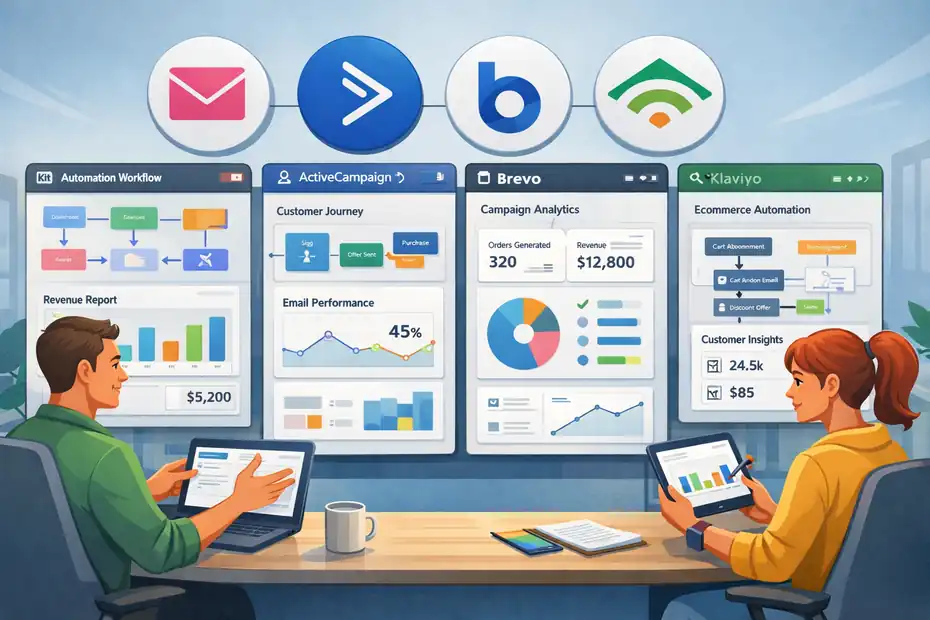
Kit
Kit is one of the most popular platforms for creators, bloggers, and digital product sellers.
What makes Kit powerful for recurring revenue is its automation-first design. The platform allows you to build sophisticated funnels without complicated technical setup.
Key strengths include:
- Visual automation builder
- Tag-based subscriber management
- Built-in landing pages
- Creator-focused email sequences
- Direct integrations with course platforms and membership systems
Many creators use Kit to sell digital products, coaching programs, or memberships.
One of the advantages I like about Kit is its simplicity. You can build automation funnels quickly without needing a complex marketing stack.
Pricing usually starts around $15–$29 per month depending on list size.
ActiveCampaign
ActiveCampaign is one of the most advanced email automation tools available.
It’s designed for businesses that want deep automation logic and customer lifecycle management.
Notable features include:
- Highly advanced workflow automation
- CRM integration
- Predictive sending and AI optimization
- Sales pipeline automation
- Customer experience tracking
ActiveCampaign works especially well for SaaS businesses, agencies, and subscription-based services.
If you want to create complex behavioral automation systems, this platform is one of the strongest options.
However, it has a steeper learning curve compared to simpler tools.
Pricing typically begins around $29 per month.
Brevo
Brevo is an excellent option for businesses looking for strong automation features at a more affordable price.
The platform combines email marketing, SMS marketing, CRM tools, and automation workflows into a single system.
Important features include:
- Visual automation builder
- Transactional email capabilities
- SMS marketing integration
- CRM-style contact management
- Ecommerce automation flows
Brevo is commonly used by ecommerce businesses and startups because it offers powerful automation without high pricing.
Another advantage is its scalable pricing model based on email volume rather than list size.
Klaviyo
Klaviyo is widely considered one of the best automation platforms for ecommerce businesses.
Its main advantage is deep integration with ecommerce platforms and advanced customer data analysis.
Key features include:
- Advanced segmentation based on purchase behavior
- Product recommendation automation
- Cart abandonment workflows
- Revenue attribution tracking
- Predictive customer analytics
Many Shopify stores rely heavily on Klaviyo to automate retention and repeat purchases.
If recurring revenue comes from repeat product purchases or subscription products, Klaviyo can be extremely powerful.
How to Set Up an Email Automation System for Recurring Revenue
Choosing the right tool is only the first step. The real impact comes from building automated revenue funnels.
Step 1: Create a Lead Capture System
Before automation can work, you need subscribers entering your system.
The most effective approach is offering a high-value lead magnet that solves a specific problem.
Examples include:
- Free guides
- Templates
- Email courses
- Checklists
- Free trials
Imagine a marketing blog offering a “50 High-Converting Email Templates” download.
When someone signs up, they enter your automation funnel automatically.
This simple entry point can generate thousands of new leads every month.
Step 2: Build a Welcome Automation Sequence
The welcome sequence is one of the highest-converting email funnels.
These emails introduce your brand, provide value, and build trust.
A strong welcome sequence might include:
- Email 1: Welcome and resource delivery
- Email 2: Your story and expertise
- Email 3: Educational content
- Email 4: Social proof or case studies
- Email 5: Product introduction
From what I’ve seen, welcome sequences often generate the majority of early sales.
Many marketers report conversion rates between 2% and 7% for automated welcome funnels.
Step 3: Add Upsell and Cross-Sell Automation
Recurring revenue increases dramatically when you add upsell and cross-sell automation.
These sequences target existing customers rather than new leads.
Examples include:
- Offering a premium plan upgrade
- Recommending related products
- Promoting membership tiers
- Offering annual subscriptions instead of monthly plans
Imagine a customer buys a $49 course.
Your automation could automatically promote:
- A $199 advanced course
- A $29 monthly membership
- A coaching package
These sequences run automatically every time someone buys.
Step 4: Implement Retention and Re-Engagement Emails
Recurring revenue depends heavily on retention.
Many businesses focus only on acquiring customers but forget to nurture existing ones.
Retention automations may include:
- Usage tips for products
- Educational content
- Community invitations
- Special loyalty offers
You can also create re-engagement sequences that target inactive subscribers.
For example, if someone hasn’t opened emails for 60 days, the system can automatically send a reactivation campaign.
Common Mistakes That Prevent Email Automation From Generating Revenue
Even with the best email automation tool for recurring revenue, certain mistakes can dramatically reduce results.
Sending Too Many Generic Emails
One of the biggest mistakes I see is sending the same emails to every subscriber.
When emails aren’t targeted, engagement drops quickly.
Instead, segment subscribers based on:
- Purchase behavior
- Engagement history
- Interests
- Customer lifecycle stage
Relevant messaging always performs better.
Overcomplicating Automation Too Early
Advanced automation can be powerful, but beginners sometimes build extremely complicated funnels that are difficult to manage.
A simple system often works best initially.
For example:
- One lead magnet
- One welcome sequence
- One core product promotion
Once this system performs well, additional automations can be added gradually.
Ignoring Email Analytics
Many marketers set up automation and never analyze performance.
This is a major missed opportunity.
Small improvements to subject lines, timing, or call-to-action wording can dramatically increase conversions.
Even a 1% improvement in conversion rate can significantly increase revenue over time.
Advanced Strategies to Maximize Recurring Revenue With Email Automation
Once your basic automation system is running, several advanced strategies can increase revenue significantly.
Lifecycle Email Funnels
Lifecycle automation targets subscribers at different stages of the customer journey.
Typical lifecycle stages include:
- New subscriber
- Engaged reader
- First-time customer
- Repeat customer
- Loyal advocate
Each stage receives tailored messaging designed to move them toward the next stage.
This approach dramatically improves customer lifetime value.
Subscription Upgrade Automation
If you run a membership site or SaaS product, upgrade automation can increase revenue without acquiring new customers.
For example:
- Monthly subscribers receive offers to upgrade to annual plans
- Basic plan users receive premium feature promotions
- Active users receive loyalty discounts
These automations increase revenue per user without increasing acquisition costs.
Behavior-Based Personalization
Modern email platforms allow you to customize emails based on user behavior.
Examples include:
- Recommending products based on browsing history
- Sending content based on past purchases
- Triggering emails after specific website actions
This level of personalization can significantly improve conversion rates.
Final Thoughts
Choosing the right email automation tool for recurring revenue is less about finding the most popular platform and more about building a reliable system that runs consistently.
Tools like Kit, ActiveCampaign, Brevo, and Klaviyo all offer powerful automation capabilities. The real difference comes from how you design your funnels and optimize them over time.
If you focus on building simple but effective automated sequences — welcome funnels, upsell automation, and retention emails — you’ll start creating systems that generate predictable income every month.
And once those systems are running, email becomes something incredibly powerful: a recurring revenue engine that works even while you sleep.
FAQ
What is an email automation tool for recurring revenue?
An email automation tool for recurring revenue is software that sends automated email sequences based on user actions. These systems nurture subscribers, promote offers, and encourage repeat purchases, helping businesses generate predictable monthly income.
How does email automation create recurring revenue?
Email automation creates recurring revenue by sending targeted messages triggered by subscriber behavior. Automated welcome sequences, upsell campaigns, and retention emails guide subscribers toward purchases and repeat subscriptions without requiring manual email sending.
Which businesses benefit most from email automation tools?
Businesses with subscription models, memberships, online courses, SaaS products, and ecommerce stores benefit most. Email automation helps them nurture leads, increase customer retention, and drive repeat purchases that generate consistent recurring revenue.
What features should an email automation tool include?
An email automation tool should include behavioral triggers, automation workflows, segmentation, analytics tracking, and integration with payment or ecommerce platforms. These features allow businesses to create personalized campaigns that convert subscribers into long-term customers.
Can beginners use email automation to generate recurring revenue?
Yes, beginners can use email automation by starting with simple sequences like welcome emails, product education emails, and promotional offers. Even basic automation funnels can consistently convert new subscribers into paying customers over time.

Juxhin B is a digital marketing researcher and founder of JAK Digital Hub, specializing in email marketing software, marketing automation platforms, and digital growth tools. His work focuses on software testing, platform comparisons, and real-world performance analysis to help businesses choose the right marketing technology.
Related posts:
 Is There Better Email Automation Software For Ecommerce?
 Email Automation Systems That Drive Revenue
 Email Automation Tools for New Ecommerce Store: What to Start With
 Email Automation Tools Not Triggering? Fix the Issue Fast
 Cheaper Email Automation System For Growing List Fast
 Email Automation Software With Better Deliverability Ranked