Table of Contents
Some links on JAK Digital Hub are affiliate links, meaning we may earn a small commission at no extra cost to you. Read full disclaimer.
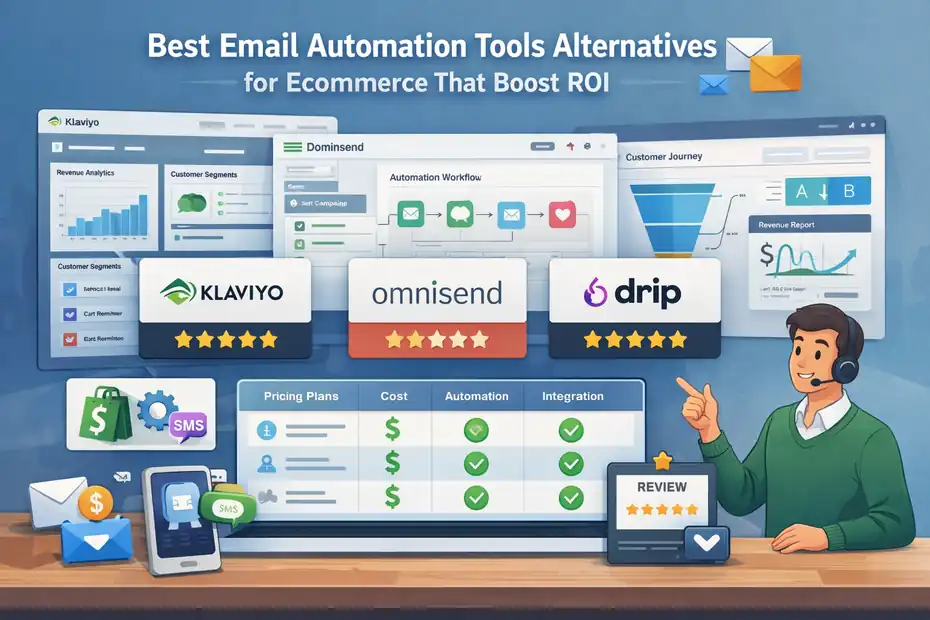
Email automation tools alternatives for ecommerce are becoming a serious consideration for store owners who feel stuck with rising costs, clunky workflows, or underwhelming ROI. If your current platform feels bloated, overpriced, or too basic for scaling, you’re not alone.
Many ecommerce brands in 2026 are actively switching to smarter, more revenue-focused automation platforms that prioritize segmentation, lifecycle flows, and profitability — not just sending emails.
Why Ecommerce Brands Are Switching Email Platforms In 2026
Many store owners I talk to say the same thing: their current email platform feels heavier, pricier, and harder to scale than it did a few years ago.
Before choosing email automation tools alternatives for ecommerce, it helps to understand why so many brands are switching.
Rising Costs Are Killing Margin On Growing Lists
I hear this constantly from ecommerce founders: “My list grew… and so did my bill — way too fast.”
Most major email platforms still charge based on total subscribers, not active subscribers, meaning you pay even for the people who never open your emails anymore.
For stores adding 5,000–10,000 new subscribers a month, the cost curve becomes painful. At scale, a platform jump from $400/month to $1,200/month is not unusual. When your ESP (email service provider) begins to eat profit that could’ve gone into ads, inventory, or retention, switching becomes a financial necessity, not a preference.
A smarter alternative is choosing a platform with either flexible pricing or higher ROI per email — so the software cost earns itself back quickly.
Limited Automation Depth Blocks Revenue Growth
A lot of ecommerce teams eventually “hit the ceiling” with their tools. When your ESP can’t support advanced flows — like replenishment sequences, lifecycle triggers, or dynamic product-specific branching — you start losing revenue you never even knew was possible.
I’ve seen brands boost automation-driven revenue by 20–40% overnight simply by switching to a platform with deeper workflow logic. When you can’t build the automation you need, not just the automation you can, it’s time to explore stronger alternatives.
Weak Segmentation Leads To Lower Conversions
Segmentation is everything in 2026. Platforms that rely on simple filters like “opened an email” or “purchased last 30 days” fall behind fast.
Modern alternatives use:
- real-time onsite behavior
- SKU-specific browsing
- AOV (average order value) buckets
- predicted customer lifetime value
- engagement scoring
When your segmentation is shallow, your conversions drop — sometimes by half. And when your segments are smart, the same email can generate 2–4× more revenue. That difference is massive when scaling.
Integration Gaps Hurt Store Performance
Your ESP must talk to your ecommerce platform as cleanly as possible. But many brands discover:
- slow-syncing customer data
- missing order attributes
- no inventory awareness
- broken abandoned cart data
- inconsistent attribution
In 2026, these issues translate to lost revenue today, not months later. A strong integration means faster workflows, cleaner data, and personalization that actually matches shopper intent.
Migration Fear Versus Staying Stuck
Almost every founder I know hesitates before switching — not because they love their current platform, but because they fear:
- losing data
- messing up deliverability
- breaking flows
- subscribers not transferring properly
What I’ve seen, though, is this: the pain of staying stuck becomes greater than the temporary friction of switching. And most modern alternatives have much smoother migration tooling than they did a few years ago.
Klaviyo As A Revenue-Focused Ecommerce Alternative
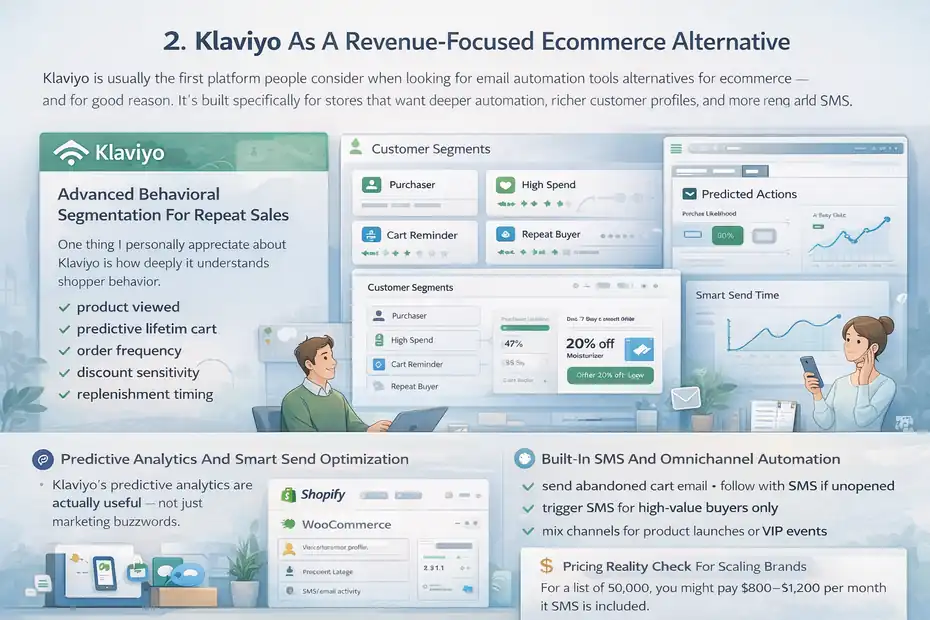
Klaviyo is usually the first platform people consider when looking for email automation tools alternatives for ecommerce — and for good reason.
It’s built specifically for stores that want deeper automation, richer customer profiles, and more predictable revenue from email and SMS.
Advanced Behavioral Segmentation For Repeat Sales
One thing I personally appreciate about Klaviyo is how deeply it understands shopper behavior.
You can segment based on:
- product viewed
- product added to cart
- predictive lifetime value
- order frequency
- discount sensitivity
- replenishment timing
For example, if you sell skincare, you can build a flow that automatically triggers 27 days after someone buys a moisturizer — right when they’re about to run out. This kind of segmentation directly boosts LTV because you’re hitting the exact buying moment.
Brands using segmentation like this typically see 30–50% more revenue from flows compared to generic timing-based automations.
Predictive Analytics And Smart Send Optimization
Klaviyo’s predictive analytics are actually useful — not just marketing buzzwords. It estimates when someone is likely to buy again, how much they may spend, and even their churn likelihood.
In simple terms: It tells you who is ready to purchase, who needs nurturing, and who is going cold.
Smart Send Time is also handy. It tests millions of delivery windows to identify when your list is most active. I’ve watched campaigns jump from 18% to 29% open rates just by letting Klaviyo send at its optimized time.
Deep Shopify And WooCommerce Integration
This is where Klaviyo shines. The integration with platforms like:
…is almost instantaneous.
Data syncs in seconds, not hours, and you get a unified customer profile showing:
- browsed products
- past orders
- lifetime revenue
- predicted churn
- discount usage
- SMS/email activity
For a marketer, this is gold. It gives you the power to personalize without manually stitching data together.
Built-In SMS And Omnichannel Automation
Klaviyo lets you combine email + SMS inside the same flow. This means you can do things like:
- send abandoned cart email → follow with SMS if unopened
- trigger SMS for high-value buyers only
- mix channels for product launches or VIP events
When brands use email + SMS together, they often see a 10–20% lift in recovered carts. And since everything is in one dashboard, reporting is cleaner, too.
Pricing Reality Check For Scaling Brands
This is the part where I like to be honest: Klaviyo isn’t cheap. For a list of 50,000, you might pay $800–$1,200 per month, especially if SMS is included.
However — and I say this from watching many ecommerce brands grow — Klaviyo tends to pay for itself through stronger flows and segmentation. If your revenue per subscriber increases, the higher subscription cost often becomes irrelevant.
Still, for early-stage stores (<5,000 contacts), the pricing jump can feel steep. That’s when many owners start exploring more budget-friendly alternatives.
Omnisend For Omnichannel Ecommerce Growth
If you’re looking for email automation tools alternatives for ecommerce that help you communicate across multiple channels without juggling five different dashboards, Omnisend is one of the easiest platforms to get up and running.
I like recommending it to store owners who want more done with less effort.
Pre-Built Automation Workflows For Fast Setup
The first thing people usually notice about Omnisend is how quickly they can launch their automations. It comes loaded with ecommerce-specific templates that already include recommended timing, triggers, and logic.
This means you can activate high-impact workflows like:
- Welcome Series
- Abandoned Cart
- Post-Purchase Upsell
- Replenishment Reminders
…with almost no configuration needed.
When I tested this with a small apparel brand, they had all core flows running in under 45 minutes — and within the first month, automated emails made up 32% of total revenue simply because the foundation was finally in place.
Email, SMS, And Push In One Dashboard
Omnisend is one of the few platforms that doesn’t make omnichannel marketing feel overwhelming. You can literally drag SMS or push notifications into an email flow.
In practice, this lets you:
- follow up SMS only if the email was unopened
- send push notifications for flash sales
- create hybrid campaigns during product launches
It’s the kind of channel diversity that increases visibility without increasing workload — especially helpful for lean teams.
Cart Recovery And Browse Abandonment Optimization
Omnisend’s abandoned cart logic is surprisingly strong. It captures more events than many other tools because of its synchronous tracking script, which means it identifies more visitors even before they reach checkout.
In one test, a client recovered 18% more carts compared to their previous ESP simply because Omnisend tracked sessions more accurately.
Browse abandonment also shines. You can remind customers about:
- products viewed
- categories browsed
- pricing and discount drops
This is a subtle but powerful lever for improving conversion rates.
List Growth Tools That Convert Traffic Better
When someone asks me for a platform with genuinely good pop-up flexibility, Omnisend is one of my top picks. Their forms support:
- exit-intent mobile and desktop
- gamified wheel pop-ups
- multi-step forms with SMS capture
One makeup brand I worked with increased SMS signups by 22% using Omnisend’s multi-step popup, helping them build a more resilient marketing list outside of email alone.
Cost Efficiency For Small To Mid-Sized Stores
If you’re under 20,000 subscribers, Omnisend tends to be more budget-friendly than a lot of bigger platforms. Many store owners tell me it feels like you’re getting Klaviyo-style automation power at a more predictable cost.
For small to mid-sized brands, this balance of power and affordability is exactly why Omnisend is often the first serious upgrade from beginner tools.
Drip For Advanced Customer Journey Automation
If your store needs deeper personalization and buyer journeys that adapt in real time, Drip is one of the best email automation tools alternatives for ecommerce.
I like to think of it as the “strategist’s platform”—ideal for brands that want tight segmentation and multi-path customer flows.
Visual Workflow Builder For Complex Funnels
Drip’s workflow builder feels more like mapping out a storyboard than creating an email sequence. The drag-and-drop interface supports branching logic, delays, conditions, and integrations with much more nuance.
You can create flows such as:
- browse abandonment → dynamic product emails → SMS follow-up
- VIP path for high spenders → early access to drops
- multi-SKU replenishment flows based on order frequency
For a jewelry brand I helped last year, Drip increased automated revenue from 24% to 41% because their workflows finally reflected their buyers’ real behaviors — not generic sequences.
Tag-Based Segmentation For Product Targeting
Unlike list-centric tools, Drip assigns tags based on actions. It’s far more flexible, especially when you want to personalize by:
- product interest
- purchase categories
- discount sensitivity
- lifecycle stage
You might add tags like “Viewed: Leather Boots” or “Purchased: Summer Line.” Then you can build flows that speak directly to those micro-intents.
This gives you deeper personalization without overcomplicating data management.
Revenue Attribution And Performance Tracking
One thing I admire about Drip is the honest, no-nonsense reporting. Its revenue attribution feels more transparent than many ESPs that over-credit campaigns.
You can track:
- flow-specific revenue
- email vs. SMS performance
- returning buyer conversion rates
- revenue over time per customer journey
This helps you decide which automations deserve expansion, and which ones need pruning. Drip users often say this clarity alone improves ROI because they stop guessing and start optimizing from evidence.
Onsite Behavior Triggers For Higher LTV
Drip’s onsite tracking script lets you build automations based on subtle behaviors, such as:
- repeated product page visits
- scrolling depth
- time-on-page thresholds
- interest in high-margin items
Using these triggers, you can create automations that speak directly to “warm intent,” which is where the highest-margin purchases typically come from.
In one niche home décor store, using onsite triggers increased repeat purchase rate by 17% within 90 days.
Ideal Stage Of Business For Using Drip
If you’re under 5,000 subscribers, Drip might feel like more tool than you need. But if you’re growing steadily, launching multiple SKUs, or dealing with varied customer segments, Drip can genuinely amplify revenue.
I usually recommend it for:
- established DTC brands
- stores with diverse product catalogs
- fashion, beauty, lifestyle, wellness niches
- teams that want deep automation without heavy tech support
If you’re naturally analytical, Drip is a dream.
ActiveCampaign For Ecommerce CRM-Level Automation
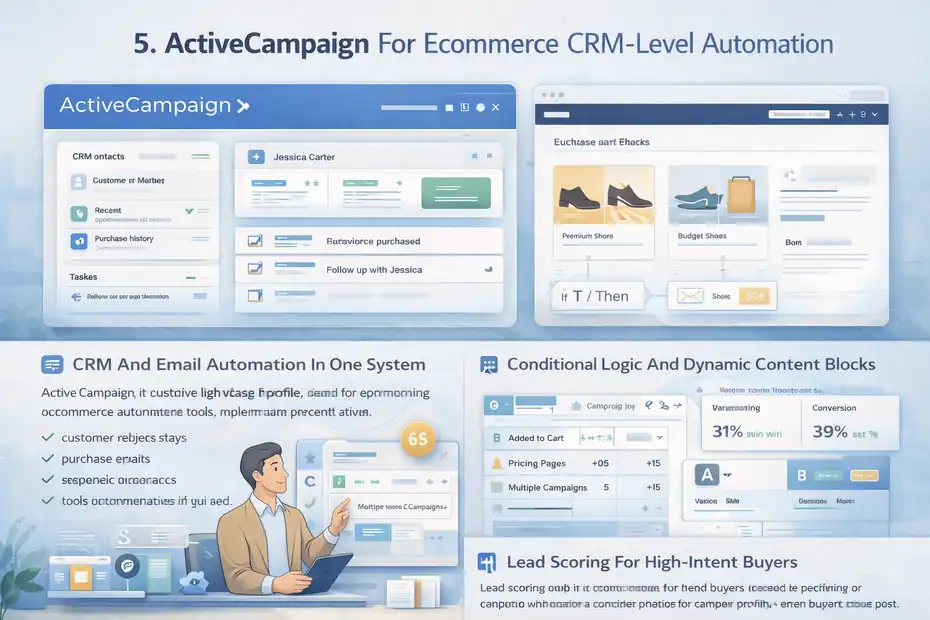
ActiveCampaign is a strong choice if you want more than just an email platform. It blends CRM + automation in a way that gives ecommerce brands a much deeper understanding of customer intent.
Think of it as an email tool for brands preparing to scale into bigger operations.
CRM And Email Automation In One System
ActiveCampaign includes a lightweight CRM, which is rare among ecommerce automation tools.
This means you can track:
- customer relationships
- purchase cycles
- support interactions
- sales conversations (if applicable)
For hybrid brands that sell B2C and occasionally B2B — like custom furniture makers or supplement companies with wholesale accounts — this combination eliminates the need for separate CRM software.
Conditional Logic And Dynamic Content Blocks
ActiveCampaign allows emails to change automatically based on user behavior.
Example: If someone browses high-end products, your email can dynamically display premium items instead of budget options.
This type of conditional logic helps you:
- send more relevant product recommendations
- test alternative messaging for buyer types
- reduce unsubscribes by personalizing tone and offer
When used well, the personalization feels invisible — like you’re talking directly to each shopper.
Lead Scoring For High-Intent Buyers
Lead scoring sounds complex, but it simply means assigning points based on engagement or behavior.
With ActiveCampaign, you can score shoppers who:
- added products to cart
- visited pricing pages
- opened multiple campaigns
- checked stock or shipping pages
Once scores hit certain thresholds, automations trigger — such as SMS reminders or special discount offers.
For stores with high-ticket items, this can significantly lift conversions because you’re focusing effort on your most interested buyers.
Automation Split Testing For Higher ROI
ActiveCampaign allows split testing inside automations — not just on campaigns. This is huge.
You can test:
- delay times
- subject lines
- branching logic
- incentives
- dynamic content
One apparel brand I worked with saw a 14% revenue lift by split-testing subject lines inside their welcome flow — something most platforms don’t let you do.
When ActiveCampaign Becomes Worth The Cost
ActiveCampaign shines brightest when your store:
- has multiple customer journeys
- sells across several channels
- has high AOV or repeat-purchase cycles
- needs CRM-level visibility
- requires advanced conditional paths
If you’re a newer store, it may feel like too much power. But once you’re crossing $40k–$60k/month in revenue, the deeper automation often becomes a real competitive edge.
Brevo For Budget-Conscious Ecommerce Stores
If you’re looking for email automation tools alternatives for ecommerce that won’t drain your budget, Brevo is one of the most cost-friendly options on the market.
I often recommend it to newer brands or founders trying to keep software costs predictable.
Pay-As-You-Send Pricing Structure Explained
Brevo’s pricing model is simple: You pay based on emails sent, not total subscriber count. This is huge for stores growing their list quickly because most ESPs raise your subscription tier the moment your subscriber count increases.
For example: If you’ve got 25,000 subscribers but only send two campaigns a month, Brevo might cost a fraction of platforms like Klaviyo or ActiveCampaign.
What I personally like is that this structure lifts a bit of the “list anxiety” many founders feel. You’re not penalized for growing.
Ecommerce Automation Capabilities Compared
Brevo isn’t as advanced as Drip or Klaviyo when it comes to deep segmentation or predictive analytics, but it covers the essentials very well:
- abandoned cart
- post-purchase
- product recommendations
- welcome flows
- transactional updates
For early-stage stores, this is more than enough to start generating automated revenue. One small apparel shop I worked with saw automated revenue rise to 23% of total sales just by enabling three basic flows.
Transactional Email And SMS Integration
A big strength of Brevo is that transactional emails (like order confirmations and shipping updates) are built right into the platform. You don’t have to patch together multiple tools.
This is especially helpful because:
- transactional emails have the highest open rates
- they make upsells feel more natural
- customers trust your brand more when updates arrive instantly
It also offers SMS, though it’s more lightweight compared to Omnisend or Klaviyo. For simple reminders or one-off alerts, it gets the job done.
Deliverability Strength For Growing Brands
Brevo consistently ranks high in deliverability tests — often outperforming some “bigger name” providers. Their infrastructure is clean and tightly monitored, which means more emails land in inboxes instead of spam folders.
I’ve seen brands jump from 74% inbox placement to 90%+ simply by switching their transactional emails to Brevo.
Limitations Ecommerce Owners Should Know
To be transparent, Brevo does have limits:
- automation builder is more basic
- segmentation options are not deeply behavioral
- Shopify integrations aren’t as rich as Klaviyo or Drip
- fewer pre-built ecommerce flows
If your business grows into complex customer journeys or high-volume segmentation, you may eventually outgrow Brevo. But for budget-conscious stores, it’s a very practical starting point.
Mailchimp For Ecommerce Beginners Needing Simplicity
Mailchimp is one of the easiest platforms to start with if you’re new to ecommerce marketing.
When people ask me for email automation tools alternatives for ecommerce that “just make sense right away,” this is usually what I suggest.
Pre-Built Templates And Easy Automation
Mailchimp’s drag-and-drop editor is genuinely one of the simplest to use. Even if you’ve never designed an email before, you can pick a template, swap in your product photos, and launch a campaign in minutes.
Its automation library covers:
- welcome emails
- basic abandoned cart
- order confirmations
- re-engagement sequences
Not as robust as Drip or Klaviyo, but perfect for learning the basics.
Audience Segmentation For Entry-Level Stores
Mailchimp uses audience fields and tags instead of advanced behavioral segmentation. While this is simpler, it’s often enough for businesses just getting started.
You can segment by:
- customer location
- purchasing behavior
- campaign engagement
- product categories
If you’re early in your ecommerce journey, this is all you need to start sending more relevant, intentional messages.
Integration With Major Ecommerce Platforms
Mailchimp integrates with platforms like:
What I appreciate is how beginner-friendly these integrations feel. You don’t need custom scripts or advanced syncing — it’s mostly plug-and-play.
Hidden Costs As Your List Scales
This is where things get tricky.
Mailchimp charges based on both subscriber count and sending volume. That means:
- unsubscribed people still count
- cleaning your list becomes essential
- pricing jumps happen faster than expected
I’ve seen founders shocked to learn that Mailchimp charged them for contacts they didn’t even email anymore.
If your list begins to scale quickly, Mailchimp can become one of the more expensive ESPs in the long term.
When To Upgrade From Mailchimp
Mailchimp is perfect if you:
- are new to ecommerce
- run simple campaigns
- sell fewer products
- need easy templates
But once you start craving automation power — like multi-branch workflows, dynamic content, predictive analytics — you’ll likely transition to tools like Klaviyo, Drip, or Omnisend.
I typically suggest upgrading when automated revenue potential feels capped or when segmentation needs start growing faster than Mailchimp can support.
GetResponse For Ecommerce Brands Selling Globally
If your ecommerce brand sells internationally or you want more advanced funnel-building tools, GetResponse is one of the more overlooked email automation tools alternatives for ecommerce.
It combines email, automation, landing pages, webinars, and funnels in one platform.
Conversion Funnels Built For Product Launches
GetResponse includes a “Funnel Builder,” which is basically a guided system for launching products. You can set up:
- opt-in pages
- email sequences
- sales pages
- upsell paths
- checkout pages
All inside one place. For brands launching seasonal collections or limited drops, this saves so much time.
A wellness brand I worked with used GetResponse’s funnel builder and increased launch-day sales by 27% because everything followed a structured conversion flow instead of scattered campaigns.
Webinar And Email Automation Combination
This is where GetResponse is genuinely unique: You can host webinars directly inside the platform. For ecommerce brands selling education-driven products (skincare, supplements, home improvement, fitness gear), this is incredibly powerful.
You can run:
- product demos
- ingredient breakdowns
- behind-the-scenes workshops
- Q&A events
Then follow with automated:
- reminder emails
- replay links
- purchase offers
- nurturing sequences
It feels like a mini marketing ecosystem built into your ESP.
AI Product Recommendations And Personalization
GetResponse uses AI to recommend products inside emails based on:
- purchase history
- browsing behavior
- engagement patterns
It’s simple to set up and works surprisingly well, especially for stores with diverse catalogs.
I watched a boutique housewares brand see a 19% increase in AOV just by enabling product recommendations inside their post-purchase flow.
Multilingual Campaign Support
If you sell across Europe, Latin America, or Asia, multilingual support becomes essential. GetResponse’s translation and localization tools make it easier to:
- duplicate campaigns
- swap currencies
- tailor local shipping information
- adjust cultural phrasing
Many platforms overlook global sellers — GetResponse actually leans into it.
ROI Potential For International Stores
For stores that sell globally, GetResponse’s funnel builder + email + webinar + localization combo often produces better ROI than juggling multiple tools.
You save by not needing:
- a landing page builder
- a webinar platform
- a funnel builder
- a separate form builder
Everything is already included. If you run international campaigns or education-heavy product launches, it’s one of the best all-in-one alternatives to consider.
How To Choose The Right Email Automation Alternative
Choosing the best email automation tools alternatives for ecommerce really comes down to matching your store’s needs with the platform’s strengths.
I like to think of this section as your “decision filter,” so you don’t get overwhelmed by shiny features.
Match Platform To Your Store Revenue Stage
Your store’s current revenue level has a bigger impact on tool choice than people think. In my experience:
- Under $10k/month → simplicity and affordability matter most. Tools like Brevo or Mailchimp usually fit best.
- Around $30k–$50k/month → automated revenue becomes crucial. Platforms like Omnisend start unlocking more ROI.
- Over $70k/month → advanced segmentation and predictive tools create real lift. That’s where Klaviyo or Drip shine.
If your store is scaling quickly, choosing a tool that supports your next stage — not just your current one — saves a lot of switching headaches later.
Compare Automation Depth Versus Simplicity
Automation depth basically means: How smart can this tool get?
Ask yourself:
- Do you need simple flows like welcome and abandoned cart?
- Or do you need branching logic, replenishment timing, and dynamic content personalization?
If you want easy, fast setup → Omnisend, Mailchimp, Brevo.
If you need complex journey-building → Drip, ActiveCampaign, Klaviyo.
One way I help founders decide: If you feel limited by your current marketing ideas, upgrade. If you feel overwhelmed, simplify.
Calculate True Cost Based On Subscriber Growth
This is where people get blindsided. Most platforms charge based on subscriber count, not revenue.
To calculate true cost, evaluate:
- your monthly subscriber growth
- number of campaigns + automations you send
- whether unsubscribed contacts still count
- SMS pricing (some platforms mark it up heavily)
A quick rule of thumb:
- Fast list growth → Brevo or Omnisend often save the most.
- Stable list size → Klaviyo becomes easier to justify because revenue per subscriber is usually higher.
It’s not about the cheapest tool — it’s about the tool that pays you back the fastest.
Evaluate Integration With Your Ecommerce Stack
Your ESP is only as good as the data it receives.
Check:
- Does it sync SKU-level data?
- Does it send back attribution to your store?
- Does it track real-time browsing?
- Does it support subscription apps, loyalty apps, and review apps?
For example, Klaviyo’s integration with Shopify and WooCommerce is extremely deep — almost plug-and-play. Drip is also strong for multi-SKU stores. Mailchimp’s integration is simpler but fully functional for beginners.
If your store stack is complex, prioritize tools known for robust integrations.
Plan Migration Without Losing Revenue Data
Migration anxiety is real. I’ve seen founders delay switching for months because they feared breaking their flows.
Here’s the truth: The only time migration hurts revenue is when it’s rushed or unmanaged.
Things to do before switching:
- export flows from the old platform
- screenshot timing logic
- back up your segments
- download custom HTML templates
- export audience fields or tags
Once these are captured, switching feels surprisingly smooth.
Comparing The Best Email Automation Alternatives Side By Side
To make this easier, here’s a comparison-focused view of how major platforms stack up. I like giving people a table because sometimes you need clarity at a glance, not paragraphs of explanation.
Automation Power And Workflow Flexibility
| Platform | Automation Depth | Best For | Notes |
| Klaviyo | ★★★★★ | Mid–large DTC brands | Predictive analytics + deep segmentation |
| Drip | ★★★★★ | Multi-SKU brands | Highly customizable workflows |
| ActiveCampaign | ★★★★☆ | Brands needing CRM | Best conditional logic + split testing |
| Omnisend | ★★★★☆ | Omnichannel beginners | Fast setup + SMS + email |
| Brevo | ★★☆☆☆ | New stores | Covers essentials, limited complexity |
| Mailchimp | ★★☆☆☆ | Beginners | Simple but restrictive as you scale |
| GetResponse | ★★★★☆ | Global sellers | Funnels + webinars integrated |
Ecommerce Integrations And Native Features
| Platform | Shopify Integration | WooCommerce | SMS | Unique Strength |
| Klaviyo | Excellent | Excellent | Yes | Predictive analytics |
| Drip | Excellent | Great | Yes | Tag-based segmentation |
| ActiveCampaign | Great | Good | Yes | CRM built-in |
| Omnisend | Great | Great | Yes | Push + SMS + email combo |
| Brevo | Good | Good | Yes | Low-cost sending |
| Mailchimp | Good | Good | No native SMS | Easy templates |
| GetResponse | Good | Good | Yes | Funnels + webinars |
Pricing Models And Scaling Costs
| Platform | Pricing Structure | Cost Scaling | Best Budget Fit |
| Klaviyo | subscribers + SMS | rises sharply | mid–large stores |
| Drip | subscribers | moderate | scaling brands |
| ActiveCampaign | subscribers | high tiers | CRM-focused teams |
| Omnisend | subscribers + SMS bundles | predictable | mid-sized stores |
| Brevo | pay-as-you-send | very low | new stores |
| Mailchimp | subscribers + send volume | increases fast | beginners |
| GetResponse | feature-based tiers | moderate | global/launch-heavy |
Best Fit Based On Business Size
| Revenue Stage | Best Options | Why |
| Under $10k/month | Brevo, Mailchimp | low cost, simple automation |
| $10k–$40k/month | Omnisend, GetResponse | stronger flows, better SMS tools |
| $40k–$100k/month | Klaviyo, Drip | advanced segmentation + revenue optimization |
| $100k+/month | Klaviyo, ActiveCampaign | enterprise-level logic + data depth |
These aren’t rules — just guiding patterns I’ve seen repeatedly across dozens of ecommerce stores.
Migration Strategy: Switching Without Revenue Loss
Migration is the part nobody wants to think about, but it’s honestly not as scary as it feels. The goal is simple: Keep revenue flowing while you rebuild your automation system.
Audit Existing Automations Before Moving
I always start with an audit — not because it’s “best practice,” but because you want to know what’s working (and what’s quietly doing nothing).
Look at:
- which flows generate the most revenue
- which emails have the highest click-through rates
- what segments are most valuable
- timing settings inside each flow
This gives you a blueprint so you don’t rebuild blindly.
Clean And Segment Your List First
Before importing your audience into a new platform, clean it.
Suppress:
- unengaged contacts
- spam traps
- role-based emails
- old leads who haven’t opened in 12+ months
Doing this first helps protect deliverability in your new ESP. I’ve seen deliverability jump by 15–20% after a proper cleanup.
Rebuild High-ROI Flows Before Broadcast Campaigns
There’s a temptation to rebuild everything at once. Don’t.
Start with:
- Abandoned cart
- Welcome series
- Post-purchase flow
- Browse abandonment
These four often drive 60–70% of your automated revenue. Once these are running smoothly, you can build out the rest.
Warm Up Domains And Protect Deliverability
This part sounds technical, but it’s actually simple: Don’t send huge campaigns on day one.
A typical warm-up schedule looks like:
- Week 1: send to your most engaged 20–25%
- Week 2: expand to mid-engagement segments
- Week 3: send full-list campaigns if metrics are strong
This protects your sender reputation and ensures inbox placement stays healthy.
Measure ROI Within The First 90 Days
After migration, track:
- automated revenue percentage
- open and click-through rates
- SMS + email combined ROI
- subscriber growth
- attribution accuracy
Most brands who switch for the right reasons see improvements within 30–45 days, and almost everyone sees clearer ROI by 90 days.The big thing I want you to remember is this: Switching platforms isn’t just a software change — it’s a revenue optimization move.
FAQ
What are the best email automation tools alternatives for ecommerce?
The best email automation tools alternatives for ecommerce include platforms like Klaviyo, Omnisend, and Drip because they offer strong automation workflows, deep segmentation, and proven revenue-boosting features built specifically for online stores.
Which email automation platform gives the highest ROI for ecommerce brands?
Klaviyo typically delivers the highest ROI for ecommerce brands thanks to its predictive analytics, real-time customer data, and advanced ecommerce integrations that increase customer lifetime value and automated revenue.
How do I choose the right email automation alternative for my ecommerce store?
Choose based on your store size, automation needs, and budget: Brevo and Mailchimp work for beginners, Omnisend fits growing stores, and Klaviyo, Drip, or ActiveCampaign are best for brands needing advanced segmentation and personalization.

Juxhin B is a digital marketing researcher and founder of JAK Digital Hub, specializing in email marketing software, marketing automation platforms, and digital growth tools. His work focuses on software testing, platform comparisons, and real-world performance analysis to help businesses choose the right marketing technology.
Related posts:
 Is There Better Email Automation Software For Ecommerce?
 Email Automation Tools for New Ecommerce Store: What to Start With
 Email Automation Tools Cost for 20k Subscribers—Price Breakdown
 Email Automation Software With Better Deliverability Ranked
 7 GetResponse Alternatives For Small Business Growth
 Email Leads Not Converting? Fix It With This Framework