Table of Contents
Some links on JAK Digital Hub are affiliate links, meaning we may earn a small commission at no extra cost to you. Read full disclaimer.
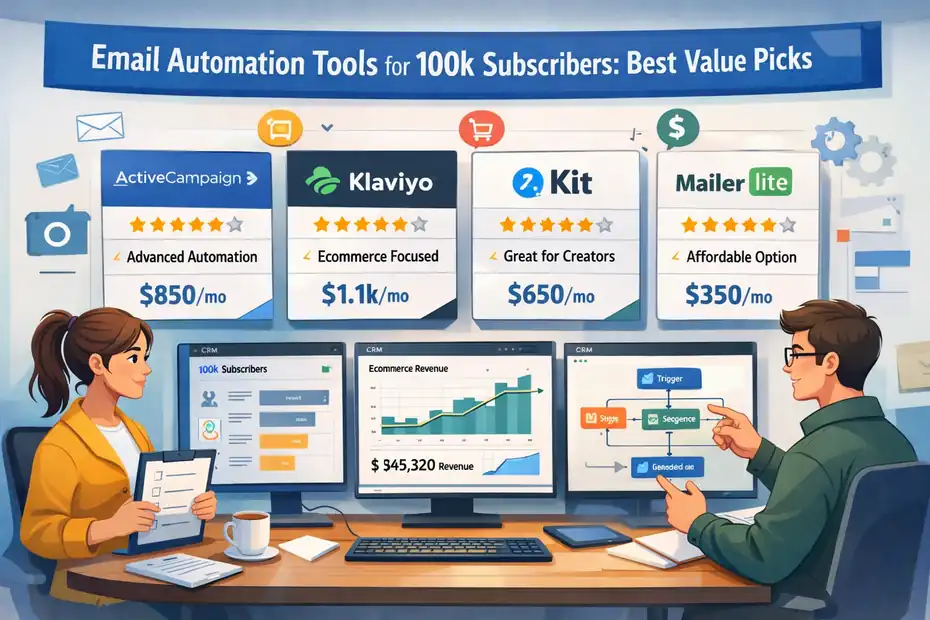
Email automation tools for 100k subscribers aren’t just about sending newsletters anymore — at that scale, every automation glitch, deliverability dip, or pricing jump can quietly drain thousands in revenue.
If you’re managing (or planning to grow to) a six-figure list, you’re probably worried about three things: cost control, performance reliability, and migration risk.
This outline breaks down the best value picks specifically for large lists, with a sharp focus on real platforms that can handle 100k+ subscribers without crushing your margins.
ActiveCampaign Pricing And Automation Power At 100k
When people talk about email automation tools for 100k subscribers, ActiveCampaign almost always comes up — and for good reason. It sits in that sweet spot between lightweight newsletter tools and full-blown enterprise marketing clouds.
Let me break down where it shines — and where you need to think carefully.
Advanced Automation Workflows Without Enterprise Lock-In
If you’ve ever felt boxed in by basic autoresponders, ActiveCampaign’s automation builder feels like someone finally handed you the keys.
It’s not just “send email after 3 days.” You can:
- Trigger workflows based on site visits
- Branch logic using if/else behavior rules
- Assign deals in the built-in CRM
- Trigger SMS, internal notifications, or webhook events
For a 100k list, this matters because segmentation becomes revenue.
Example: Let’s say you have 100,000 subscribers but only 18% regularly engage. Instead of blasting all 100k:
- You create a condition: Opened in last 30 days?
- Yes → Send premium offer.
- No → Send re-engagement + tag as “cold.”
I’ve seen this alone increase campaign revenue per send by 22–35% because you stop burning your sender reputation on disengaged contacts.
And here’s the key: You’re getting near-enterprise automation without paying Salesforce-level pricing.
Real 100k Subscriber Pricing Breakdown And Limits
At around 100,000 contacts, ActiveCampaign’s pricing depends heavily on plan tier (Starter, Plus, Pro, Enterprise).
Roughly speaking:
| Plan | Estimated Monthly Cost (100k Contacts) | Key Limitations |
| Starter | Lower cost but limited automation | No built-in CRM |
| Plus | Mid-tier | CRM + automation unlocked |
| Pro | Higher | Predictive sending & site messaging |
| Enterprise | Custom | SLA & advanced support |
Here’s the reality check:
- You’re likely looking at $500–$900+/month, depending on features.
- SMS and transactional emails are billed separately.
- Contact count = cost driver (not sends).
This is where cost anxiety kicks in.
If your list generates $8,000–$20,000/month in revenue, it’s a smart investment.
If you’re only monetizing lightly? It might feel heavy.
My advice: Calculate Revenue Per Subscriber (RPS) before upgrading.
If your 100k list generates less than $0.50 per subscriber monthly, fix monetization first.
CRM And Sales Pipeline Integration Advantages
Here’s something many email platforms can’t do well at scale: Sales pipeline automation.
ActiveCampaign includes a built-in CRM, meaning:
- You can auto-create deals when someone fills out a form.
- Assign leads to sales reps based on geography.
- Trigger follow-ups when deals move stages.
If you run:
- High-ticket coaching
- B2B services
- SaaS with demo calls
This changes everything.
Instead of duct-taping tools together, your email automation talks directly to your sales pipeline.
Example workflow:
- Lead downloads whitepaper.
- Tag applied → “High Intent.”
- If they visit pricing page twice → Create deal in CRM.
- Sales rep notified automatically.
That kind of automation reduces lead response time — and studies consistently show faster follow-ups dramatically increase close rates.
Migration Considerations From Mid-Tier Platforms
Switching to ActiveCampaign from tools like MailerLite or entry-level platforms is where migration fear creeps in.
Here’s what usually trips people up:
- Tag structure doesn’t transfer cleanly.
- Automation logic must be rebuilt.
- Custom fields get messy.
- Sending domains need warming.
My suggestion?
Before migrating:
- Export full tag map.
- Document automation triggers in a spreadsheet.
- Clean inactive subscribers before importing.
Warm-up tip: Don’t blast all 100k on day one. Gradually ramp volume over 2–3 weeks to protect deliverability.
The upside? Once you’re settled, you’ll likely see higher engagement simply because segmentation improves.
Kit (Formerly ConvertKit) For Creator-Led Lists
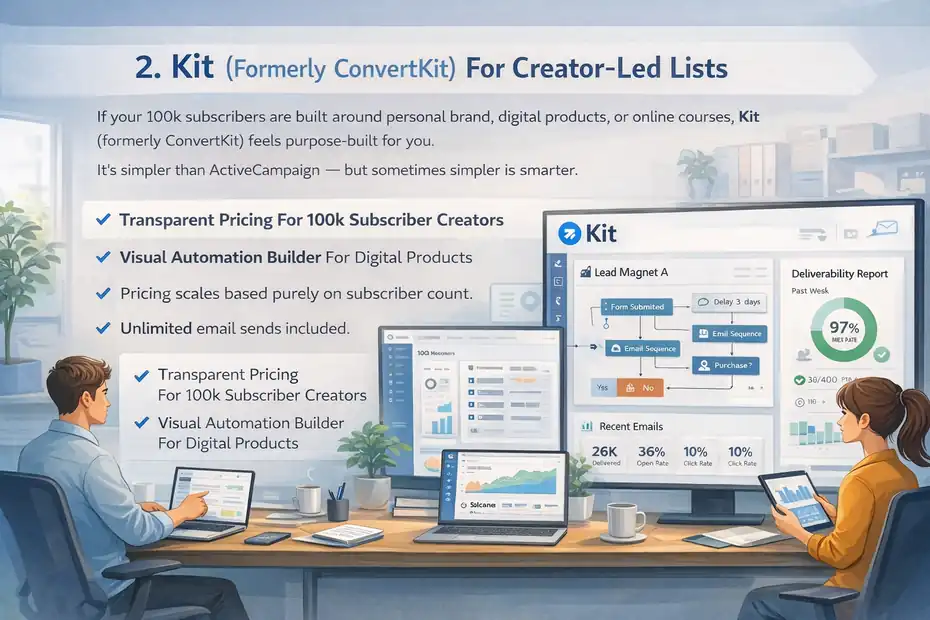
If your 100k subscribers are built around personal brand, digital products, or online courses, Kit (formerly ConvertKit) feels purpose-built for you.
It’s simpler than ActiveCampaign — but sometimes simpler is smarter.
Transparent Pricing For 100k Subscriber Creators
Kit’s pricing model is straightforward. No confusing CRM tiers. No complicated add-ons.
At 100k subscribers, expect:
- Approximately mid-to-high four figures monthly.
- Pricing scales based purely on subscriber count.
- Unlimited email sends included.
This predictability reduces budget stress.
Where creators benefit most:
- You’re monetizing through launches.
- You sell digital downloads.
- You run paid newsletters.
If your business model relies on big campaign bursts (like launch week), unlimited sends matter.
And because Kit doesn’t price based on send volume, heavy launch periods won’t spike your bill.
Visual Automation Builder For Digital Products
Kit’s automation builder is designed for creators — not enterprise marketers.
Instead of complex branching trees, it uses:
- Visual subscriber paths
- Tag triggers
- Event-based automation
Here’s a common use case:
- Subscriber opts in to free ebook.
- Tagged as “Lead Magnet A.”
- Receives 5-email nurture.
- If purchase happens → Exit sequence automatically.
The simplicity means:
- Faster setup
- Less technical overwhelm
- Easier troubleshooting
If you’re running evergreen funnels for digital products, this works beautifully.
But it’s not built for hyper-complex behavior scoring systems.
Deliverability Performance For Large Broadcasts
Deliverability is where many 100k lists panic.
From what I’ve seen, Kit performs strongly for creator niches because:
- They aggressively monitor spam complaints.
- They focus on engagement-based sending.
- They discourage list-buying behavior.
If your list is permission-based and engaged, you’re likely to maintain strong inbox placement.
One tactic I suggest:
Segment broadcasts like this:
- Engaged last 60 days → Primary send.
- Cold segment → Reduced frequency.
This protects your sender reputation long-term — especially with Gmail tightening filters.
Limitations Advanced Marketers Should Know
Now let’s be honest.
If you want:
- Deep predictive analytics
- Built-in CRM pipelines
- Multi-channel SMS + web tracking complexity
Kit may feel limited.
It’s intentionally streamlined.
For creators, that’s a strength.
For advanced ecommerce or B2B sales teams? It can feel restrictive.
Here’s how I think about it:
- If you sell knowledge or personality-driven products, Kit scales cleanly to 100k.
- If you need behavioral scoring and sales reps closing deals, ActiveCampaign likely wins.
There’s no universal “best.” There’s only what fits your monetization model at 100k subscribers.
Brevo Value-Based Pricing For Large Lists
If you’re evaluating email automation tools for 100k subscribers and your biggest fear is pricing shock, Brevo deserves serious attention. It approaches pricing differently from most traditional ESPs, and that alone can dramatically change your cost structure.
Let’s unpack what that means for a six-figure list.
Contact-Based Vs Email-Based Cost Structure
Most large-list platforms charge based on how many subscribers you store. Brevo flips that model.
With Brevo:
- You can store unlimited contacts.
- You pay based on email sends per month, not list size (on many plans).
That’s a huge distinction.
Example scenario:
You have 100,000 subscribers, but you only email 40,000 of them regularly (engaged segment).
With contact-based platforms, you pay for all 100k.
With Brevo, you mainly pay for volume sent.
If you send:
- 300,000 emails/month → You’re billed for volume.
- Not contact storage.
This benefits businesses that:
- Aggressively clean inactive contacts.
- Send fewer, higher-converting campaigns.
- Run segmented automation instead of mass blasts.
But here’s the catch:
If you send daily emails to all 100k?
Brevo can become just as expensive as contact-based tools.
The cost advantage depends on your behavior.
Automation Capabilities Beyond Basic Sequences
Brevo used to be considered “basic.” That’s not really true anymore.
You get:
- Visual workflow builder.
- Conditional logic (If/Else).
- Website tracking triggers.
- Transactional email automation.
- SMS automation inside workflows.
For example:
- Customer abandons cart.
- Wait 1 hour.
- Send reminder email.
- If unopened after 24 hours → Send SMS.
- If clicked → Apply purchase intent tag.
That cross-channel logic is powerful at 100k scale.
One practical tip:
Brevo’s transactional email system (via SMTP or API) is strong. If you run ecommerce or SaaS, keeping transactional and marketing emails under one platform simplifies domain authentication and improves sender reputation consistency.
That reduces deliverability headaches.
Built-In CRM And SMS At Scale
Brevo includes a built-in CRM — and it’s not just decorative.
You can:
- Track deals.
- Assign sales reps.
- Monitor pipeline stages.
- Trigger automations based on deal movement.
For service-based businesses or B2B funnels, that’s valuable.
And SMS pricing is competitive compared to platforms that treat it as a premium add-on.
If you’re managing 100k subscribers and even 10% of them opt into SMS, you now have:
- Multi-channel revenue touchpoints.
- Behavioral segmentation across email + SMS.
- Better lifecycle marketing control.
This is where Brevo quietly competes with tools like ActiveCampaign — but often at lower cost if you manage volume properly.
When Brevo Becomes More Affordable Than Others
Brevo becomes especially attractive when:
- Your list is large but engagement is moderate.
- You send 1–4 campaigns per month.
- You rely more on automation than mass broadcasting.
Here’s a simplified cost comparison mindset:
| Scenario | Contact-Based Tool | Brevo Model |
| 100k contacts, weekly send | High fixed cost | Based on total monthly volume |
| 100k contacts, biweekly send | Same high fixed cost | Lower cost due to fewer emails |
| Heavy automation, low blasts | Still pay for 100k | Often cheaper |
Reality check:
If your business sends daily newsletters to 100k subscribers, Brevo won’t magically cut your bill in half.
But if you’re strategic with segmentation and volume? It often undercuts competitors significantly.
GetResponse For Webinars And Ecommerce Funnels
If your revenue strategy revolves around webinars, product launches, or ecommerce funnels, GetResponse positions itself differently from standard newsletter platforms.
It’s not just an email tool. It’s a funnel builder.
And that matters at 100k scale.
100k Subscriber Pricing Across Marketing Plans
GetResponse pricing at 100k subscribers varies significantly depending on the plan:
- Email Marketing Plan → Basic automation.
- Marketing Automation Plan → Advanced workflows.
- Ecommerce Marketing Plan → Ecommerce features + abandoned cart.
- MAX / Enterprise → Custom pricing.
At 100k contacts, expect pricing roughly in the mid-to-high hundreds per month, increasing with ecommerce and advanced automation features.
The important detail:
Some features like abandoned cart recovery and advanced segmentation are locked behind higher tiers.
So when calculating cost, don’t just compare base price.
Compare the plan required to unlock the features you actually need.
Otherwise, you’ll underestimate real monthly expenses.
Funnel Builder And Webinar Integration
This is where GetResponse stands out.
You can:
- Build landing pages.
- Create webinar registration funnels.
- Host webinars directly inside the platform.
- Automate follow-ups based on attendance.
Let me explain why that’s powerful.
If you run monthly webinars for 100k subscribers:
- Invite segmented list.
- Automatically tag registrants.
- Send reminder sequence.
- Detect attendance behavior.
- Send replay only to non-attendees.
- Trigger sales offer sequence.
All inside one system.
That reduces tool stacking and integration errors.
For coaches, consultants, and info-product sellers, this can justify the cost alone.
Ecommerce Automation For Shopify And WooCommerce
GetResponse integrates well with ecommerce platforms like:
With proper integration, you can:
- Trigger abandoned cart emails.
- Send product recommendation sequences.
- Segment based on purchase behavior.
- Track revenue attribution inside dashboards.
Example:
If a customer buys Product A but not Product B within 30 days, trigger cross-sell sequence.
At 100k scale, revenue tracking becomes crucial.
Knowing which automation generates actual dollars — not just clicks — is what separates hobby email marketing from serious revenue operations.
Where It Falls Short For Advanced Segmentation
Now, here’s the honest part.
While GetResponse is strong for funnels and webinars, it may feel less flexible than ActiveCampaign or Klaviyo for:
- Deep behavioral scoring.
- Complex conditional branching.
- Predictive analytics.
- Advanced customer lifetime value modeling.
If you run high-volume ecommerce with complex segmentation needs, tools like Klaviyo often go deeper.
But if your strategy revolves around:
- Lead magnets
- Webinar funnels
- Structured launch campaigns
GetResponse is extremely efficient.
In my experience, it’s less about “best overall” and more about “best aligned with your revenue model.”
At 100k subscribers, alignment matters more than feature quantity.
MailerLite High-Volume Automation Affordability
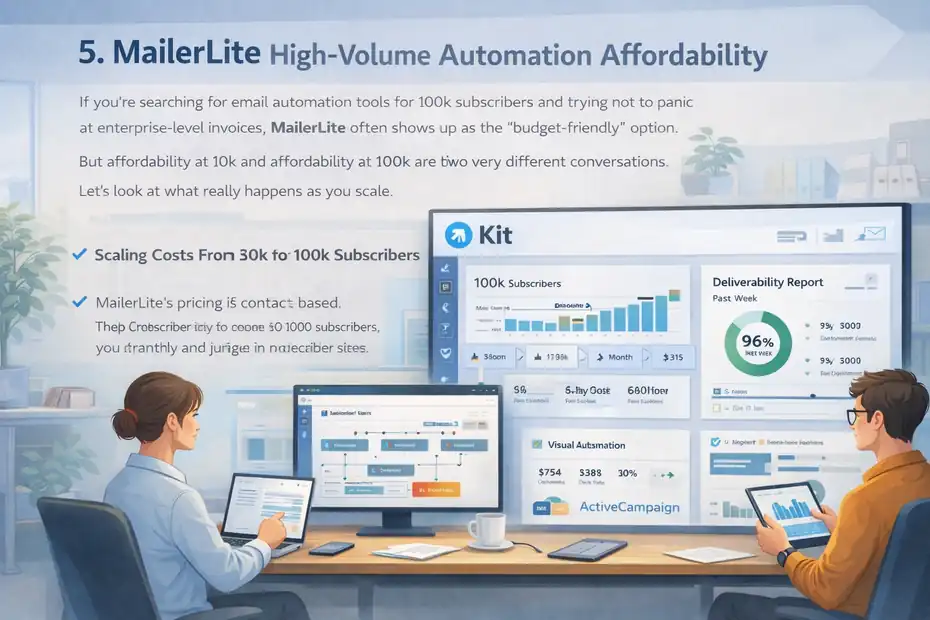
If you’re searching for email automation tools for 100k subscribers and trying not to panic at enterprise-level invoices, MailerLite often shows up as the “budget-friendly” option.
But affordability at 10k and affordability at 100k are two very different conversations.
Let’s look at what really happens as you scale.
Scaling Costs From 50k To 100k Subscribers
MailerLite’s pricing is contact-based. That means once you cross 50,000 subscribers, your monthly cost jumps in noticeable tiers.
At 100k subscribers, you’re typically looking at:
- Several hundred dollars per month on Advanced plans.
- Unlimited email sends included.
- Automation features unlocked at higher tiers.
Compared to tools like ActiveCampaign or Klaviyo, it’s often cheaper at this level.
But here’s the nuance:
MailerLite works best when:
- Your monetization is steady but not hyper-complex.
- You don’t need predictive AI segmentation.
- You’re not running multi-channel SMS-heavy funnels.
If your 100k list generates $5,000–$15,000 per month, MailerLite often keeps your overhead lean without crushing margins.
If you’re running a $1M ecommerce machine? You might outgrow it.
Automation Builder Depth For Advanced Users
MailerLite’s visual automation builder is clean and intuitive.
You get:
- Trigger-based workflows.
- Conditional splits (If subscriber clicks X).
- Delays and event triggers.
- Tag-based segmentation.
For most content creators and small ecommerce stores, that’s enough.
Example workflow:
- Subscriber joins via lead magnet.
- Tag applied.
- 7-day nurture sequence.
- If clicked sales link → Add to “Hot Prospect.”
- If purchased → Remove from promo sequence.
That’s practical and revenue-driven.
But here’s where it stops:
- No deep predictive analytics.
- Limited lead scoring.
- Less advanced cross-channel logic.
If you need behavioral scoring like “Visited pricing page 3 times + Spent $200+ lifetime,” you may feel restricted.
Still, for many 100k lists, simple automation done well beats complex automation done poorly.
Deliverability Benchmarks For Large Campaigns
Deliverability becomes fragile at 100k scale.
MailerLite has historically maintained strong sender reputation because they:
- Strictly monitor spam complaints.
- Enforce list quality standards.
- Limit suspicious accounts.
From what I’ve seen, clean lists with:
- Regular engagement.
- Proper domain authentication (SPF, DKIM, DMARC).
- Gradual sending ramp-up.
Maintain solid inbox placement.
Pro tip: Before blasting 100k subscribers, create a segment:
- Engaged last 60–90 days.
Send to that group first. Then gradually expand.
This protects domain reputation and avoids Gmail throttling.
Feature Tradeoffs Compared To Premium Tools
Here’s the honest comparison:
| Feature | MailerLite | Premium Platforms |
| Visual Automation | Strong | Strong |
| Predictive Analytics | Limited | Advanced |
| CRM | Basic | Full CRM (ActiveCampaign) |
| Ecommerce Revenue Tracking | Moderate | Deep (Klaviyo) |
| SMS Automation | Limited | Integrated (Brevo, ActiveCampaign) |
If your priority is cost control at 100k subscribers, MailerLite is attractive.
If your priority is revenue optimization through complex segmentation, you may eventually migrate.
In my opinion: MailerLite is excellent for disciplined marketers who keep funnels clean and focused.
Klaviyo For Revenue-Driven Ecommerce Lists
If your 100k subscribers are tied directly to ecommerce revenue, Klaviyo plays in a different league.
This isn’t just email marketing. It’s revenue analytics with email attached.
100k Subscriber Pricing Based On Active Profiles
Klaviyo pricing is based on:
- Active profiles (subscribers stored).
- SMS volume (if enabled).
At 100k active profiles, pricing is typically in the high hundreds to over $1,000 per month depending on usage.
That scares people.
But here’s the mindset shift:
Klaviyo isn’t built for newsletter businesses.
It’s built for stores generating serious ecommerce revenue.
If your store generates $50k–$250k/month, Klaviyo often pays for itself through better segmentation alone.
If you’re making $5k/month? It may feel expensive.
Advanced Segmentation And Predictive Analytics
This is where Klaviyo dominates.
You can build segments like:
- Purchased 2+ times in 90 days.
- Viewed product X but not purchased.
- Predicted lifetime value > $500.
- High probability to churn.
Predictive analytics means Klaviyo estimates:
- Expected future value.
- Next purchase date.
- Churn risk.
At 100k subscribers, this allows micro-targeting.
Example:
Instead of sending a blanket 20% discount to everyone:
- Send 10% to high-intent buyers.
- Send 20% to churn-risk segment.
- Send VIP early access to high LTV customers.
That kind of segmentation can significantly increase profit margins.
Shopify And WooCommerce Deep Integrations
Klaviyo integrates natively with:
- Shopify
- WooCommerce
The integration pulls in:
- Purchase history.
- Product views.
- Cart activity.
- Revenue attribution.
You can literally see:
“This email generated $12,430 in revenue.”
That clarity changes how you think about automation.
Abandoned cart flows, browse abandonment, post-purchase upsells — all become measurable.
When Klaviyo Outperforms Traditional ESPs
Klaviyo wins when:
- You need deep revenue attribution.
- You run high-SKU ecommerce.
- You care about customer lifetime value.
- You use SMS + email together.
It’s not the cheapest tool for 100k subscribers.
But for ecommerce brands, it’s often the highest ROI tool.
If you sell physical products at scale, Klaviyo is rarely the wrong choice.
AWeber For Stable And Predictable Scaling
AWeber doesn’t always get flashy attention anymore — but for some businesses, it remains stable and predictable.
And at 100k subscribers, stability matters.
Flat Pricing Structure At 100k Subscribers
AWeber uses a tiered pricing model based on subscriber count.
At 100k subscribers, you’re typically looking at mid-range pricing compared to competitors.
What makes it appealing:
- Transparent tiers.
- No surprise feature lockouts.
- Unlimited emails on most plans.
If you’re cost-sensitive but want long-term predictability, AWeber is straightforward.
It may not be cutting-edge — but it won’t shock you with hidden charges either.
Automation Capabilities And Tagging System
AWeber’s automation builder focuses heavily on tagging.
Tags trigger sequences. Actions apply tags. Clicks add tags.
For example:
- Subscriber clicks “Pricing.”
- Tag: Interested.
- Trigger follow-up sequence.
It’s simple — but effective.
You won’t get:
- Advanced predictive scoring.
- Deep ecommerce analytics like Klaviyo.
- Enterprise CRM automation.
But you get reliable email automation.
For many bloggers and educators with 100k subscribers, that’s enough.
Long-Term Reliability And Deliverability
AWeber has been in the email marketing space for decades.
That longevity means:
- Stable infrastructure.
- Established sending reputation.
- Consistent deliverability for compliant users.
Deliverability at 100k scale comes down to:
- List hygiene.
- Engagement segmentation.
- Domain authentication.
No platform can save a neglected list.
But AWeber doesn’t typically create deliverability instability.
Ideal Use Cases And Practical Limitations
AWeber works best when:
- You run content-based newsletters.
- You sell digital products.
- You prefer simplicity over complexity.
It’s less ideal when:
- You need deep ecommerce segmentation.
- You want predictive analytics.
- You require advanced CRM pipelines.
If your business model is straightforward and monetization is consistent, AWeber scales predictably to 100k subscribers without overcomplicating your stack.
Side-By-Side Comparison Of 100k Cost And Features
Now that we’ve walked through each platform individually, let’s zoom out. When comparing email automation tools for 100k subscribers, you’re not just choosing software — you’re choosing cost structure, automation power, and long-term scalability.
Here’s the clear, side-by-side view you actually need.
Monthly Cost Comparison At 100k Subscribers
At 100k contacts, pricing differences become very real. Below is a simplified comparison of major platforms discussed:
| Platform | Estimated Monthly Cost (100k) | Pricing Model | Unlimited Sends | Best For |
| ActiveCampaign | $500–$900+ | Contact-based | Yes | Advanced automation + CRM |
| Kit | Mid–High Tier | Contact-based | Yes | Creators & digital products |
| Brevo | Volume-dependent | Send-based | Based on plan | Cost control via segmentation |
| GetResponse | $500–$800+ | Contact-based | Yes | Funnels + webinars |
| MailerLite | Lower tier | Contact-based | Yes | Budget-conscious scaling |
| Klaviyo | $800–$1,200+ | Active profiles | Yes | Revenue-focused ecommerce |
| AWeber | Mid-tier | Contact-based | Yes | Stable, simple scaling |
Reality check: At 100k subscribers, even a $200 monthly difference equals $2,400 per year. Over three years? That’s $7,200.
Cost isn’t everything — but it’s not nothing either.
Automation Depth And Workflow Flexibility
Not all automation builders are equal.
Here’s how they stack up in practical terms:
| Platform | Conditional Logic | Behavioral Tracking | Predictive Analytics | SMS Automation |
| ActiveCampaign | Advanced | Yes | Moderate | Yes |
| Kit | Moderate | Limited | No | Limited |
| Brevo | Moderate | Yes | No | Yes |
| GetResponse | Moderate | Yes | Limited | Limited |
| MailerLite | Basic–Moderate | Limited | No | Minimal |
| Klaviyo | Advanced | Deep Ecommerce | Strong | Yes |
| AWeber | Basic–Moderate | Limited | No | Limited |
If you’re running:
- Complex funnels → ActiveCampaign.
- Ecommerce revenue segmentation → Klaviyo.
- Simpler creator workflows → Kit or MailerLite.
One insight from experience:
Overly complex automation kills productivity.
Choose complexity only if your revenue model requires it.
CRM, Ecommerce, And Integration Strength
This is where real business differences show up.
| Platform | Built-In CRM | Ecommerce Tracking | Webinar Tools | Sales Pipeline |
| ActiveCampaign | Strong | Moderate | No | Yes |
| Kit | Minimal | Basic | No | No |
| Brevo | Built-in | Moderate | No | Yes |
| GetResponse | Light CRM | Moderate | Yes | Limited |
| MailerLite | Minimal | Basic | No | No |
| Klaviyo | No traditional CRM | Advanced | No | No |
| AWeber | Basic | Limited | No | No |
If you’re B2B or selling high-ticket services, CRM integration matters.
If you’re ecommerce-driven, revenue attribution matters more than CRM.
Alignment > Feature count.
Best Tool By Business Stage And Revenue Model
Let me simplify this in human terms.
| Business Type | Recommended Platform |
| Creator selling courses | Kit |
| B2B consulting | ActiveCampaign |
| High-volume ecommerce | Klaviyo |
| Budget-focused blogger | MailerLite |
| Webinar-based funnels | GetResponse |
| Cost-sensitive segmented sender | Brevo |
| Stable legacy newsletter | AWeber |
There’s no universal winner.
There’s only the tool that supports your monetization strategy at 100k scale.
How To Choose Email Automation Tools For 100k Subscribers
Choosing between email automation tools for 100k subscribers can feel overwhelming. At this level, mistakes aren’t $29/month problems — they’re four-figure monthly commitments.
Let’s address the real fears.
Cost Anxiety: Calculating True Monthly ROI
Before choosing any platform, calculate:
Revenue Per Subscriber (RPS)
Formula: Monthly Revenue ÷ Total Subscribers
Example: $40,000 monthly revenue ÷ 100,000 subscribers = $0.40 per subscriber.
Now compare that against:
- $600/month platform cost = $0.006 per subscriber.
If automation improvements increase revenue by even 5–10%, the platform pays for itself.
Don’t evaluate tools by price alone.
Evaluate by:
- Conversion improvements.
- Segmentation impact.
- Deliverability stability.
Cheap tools are expensive if they limit growth.
Migration Fear: Switching Without Losing Data
Migration anxiety is real.
Here’s how to reduce risk:
- Export all tags and custom fields.
- Document active automations in a spreadsheet.
- Clean inactive subscribers before moving.
- Warm your domain slowly after switching.
One mistake I see often:
People migrate 100k subscribers and blast immediately.
Result:
Deliverability tanks.
Instead, ramp volume gradually over 2–3 weeks.
Protect your sender reputation like it’s an asset — because it is.
Performance Doubt: Testing Deliverability Before Committing
Before fully committing:
- Run a small segment campaign.
- Test inbox placement with engaged users.
- Monitor open rates vs historical averages.
If open rates drop significantly after migration, pause and adjust.
Deliverability isn’t magic.
It’s driven by:
- Engagement.
- List hygiene.
- Sending consistency.
Even the best platform can’t fix a neglected list.
Timing Moment: When To Upgrade Your Platform
Upgrade when:
- You hit 70–80% automation complexity limits.
- Segmentation is becoming manual.
- Revenue tracking feels unclear.
- Your current tool slows you down.
Don’t wait until 100k to switch if your tool caps you at 50k.
Migration is easier at 40k than 100k.
Timing matters.
Final Verdict: Best Value Picks For 2026
After comparing features, pricing, automation power, and real-world usability, here’s the clear breakdown for 2026.
Best For Creators Scaling Digital Products
Winner: Kit
Why:
- Simple automation.
- Unlimited sends.
- Creator-focused features.
- Clean user interface.
If you sell courses, coaching, or digital downloads, Kit keeps things lean without unnecessary complexity.
Best For Ecommerce Revenue Optimization
Winner: Klaviyo
Why:
- Predictive analytics.
- Deep Shopify and WooCommerce integration.
- Revenue attribution.
- Advanced segmentation.
If revenue tracking is your priority, Klaviyo is hard to beat.
Best For Budget-Conscious 100k Lists
Winner: MailerLite
Why:
- Lower contact-based pricing.
- Solid automation builder.
- Reliable deliverability.
Perfect if you want affordability without sacrificing fundamentals.
Best For Advanced Marketing Automation Power
Winner: ActiveCampaign
Why:
- Advanced workflows.
- Built-in CRM.
- Sales pipeline automation.
- Strong segmentation logic.
If your business blends marketing + sales automation, ActiveCampaign gives you serious control.
FAQ
What are the best email automation tools for 100k subscribers?
The best email automation tools for 100k subscribers are ActiveCampaign for advanced automation, Klaviyo for ecommerce revenue growth, Kit for creators, and MailerLite for budget-friendly scaling.
How much do email automation platforms cost for 100k subscribers?
Most platforms cost between $300–$1,200 per month at 100k subscribers, depending on automation depth, ecommerce features, and CRM capabilities. MailerLite and Brevo are typically the most affordable, while Klaviyo and ActiveCampaign are on the higher end for premium features.
Which email tool offers the best value for large subscriber lists?
MailerLite provides the best overall value for large lists due to lower pricing and solid automation, while Klaviyo delivers the highest ROI for ecommerce brands through advanced segmentation and revenue tracking.

Juxhin B is a digital marketing researcher and founder of JAK Digital Hub, specializing in email marketing software, marketing automation platforms, and digital growth tools. His work focuses on software testing, platform comparisons, and real-world performance analysis to help businesses choose the right marketing technology.
Related posts:
 Email Automation Systems That Drive Revenue
 Email Automation Tools Migration Checklist for a Smooth Switch
 Email Automation Tools Cost for 20k Subscribers—Price Breakdown
 Best Email Tools Compared: 7 That Actually Convert
 Best Email Tools to Turn Subscribers Into Sales
 Moosend vs MailerLite Pricing: Which One Saves You More?