Table of Contents
Some links on JAK Digital Hub are affiliate links, meaning we may earn a small commission at no extra cost to you. Read full disclaimer.
When you’re trying to understand the email leads cost for 20k contacts, it’s easy to feel unsure about what a “fair price” looks like—especially because every email marketing provider structures pricing differently.
I’ve helped a lot of creators and businesses navigate this decision, and I’ve seen firsthand how wildly costs can swing depending on the platform, features, and revenue goals.
So in this guide, I’ll break down exactly what you should expect to pay, where hidden fees show up, and which companies offer the strongest value at this list size.
Understanding Email Leads Cost For 20K Contacts In 2026
Before you decide what you should pay for managing 20K subscribers, it helps to understand the different pricing forces at play.
Most people only look at the sticker price, but there are layers beneath it that can significantly change your total cost.
Factors That Influence Pricing Across Email Platforms
Every email platform prices differently, but in my experience there are five variables that move the cost the most: automation complexity, email volume, contact count, support level, and add-on fees.
Some providers charge heavily for automation, while others limit how many emails you can send each month. These differences matter because at a 20K-contact scale, even a small variance—like $5 per thousand emails—can add up quickly.
What I’ve seen is that businesses often underestimate how much automation they’ll use. When you start building advanced sequences like abandoned cart flows, tagging workflows, or conditional logic funnels, your platform can bump you into a higher plan.
The platforms know this, which is why many reserve their best features for mid-tier or premium pricing.
How List Size Impacts Monthly And Annual Billing
Most email service providers (ESPs) use a tiered model where you pay based on the number of contacts you store—not the number you actually email. That means if you’re sitting at exactly 20K subscribers, even a seasonal spike can automatically bump you into the 25K tier without warning.
If you’re budgeting annual contracts, the difference between 20K and 25K contacts can be anywhere from $120 to more than $600 per year depending on the ESP.
My suggestion: Keep at least a 5–10% buffer in your budget so you’re not surprised if your list grows faster than expected.
Why 20K Contacts Is A Common Pricing Threshold For SaaS Providers
SaaS companies like email platforms tend to design their tiers around key usage milestones. Twenty thousand contacts is significant because it’s the point where most users shift from casual email marketing to revenue-driving automation.
This is when businesses start implementing segmentation, A/B testing, behavioral triggers, and revenue attribution.
The moment you cross into the “serious marketing” territory, platforms know your switching cost goes up—so this tier often has the most dramatic pricing jump.
Typical CPM And Lead Acquisition Costs At This Subscriber Volume
To fill 20K contacts, most businesses spend anywhere from $0.80–$4.00 per lead, depending on the channel. That means a full list like this could cost $16K–$80K to acquire.
This is why protecting deliverability and cost efficiency becomes so important—you’re not just paying an email bill; you’re safeguarding one of your most expensive assets.
CPM (cost per thousand emails sent) varies by provider, but typical ranges fall between $0.40–$2.50 when broken down. Higher-end platforms charge more because they focus on deliverability, analytics, and enterprise-level support.
Hidden Cost Variables Businesses Often Miss At The 20K Level
Here are the “surprise charges” I see people get hit with most:
- Overages for sending too many monthly emails.
- Extra seats for team members—some platforms quietly charge $10–$30 per user.
- API or integration fees for e-commerce setups.
- Deliverability add-ons like dedicated IP addresses.
- List hygiene services if your bounce rate spikes.
These little line items can easily turn a $120/month bill into $200+ without you realizing why.
Pricing Breakdown From Top Email Providers For 20K Contacts
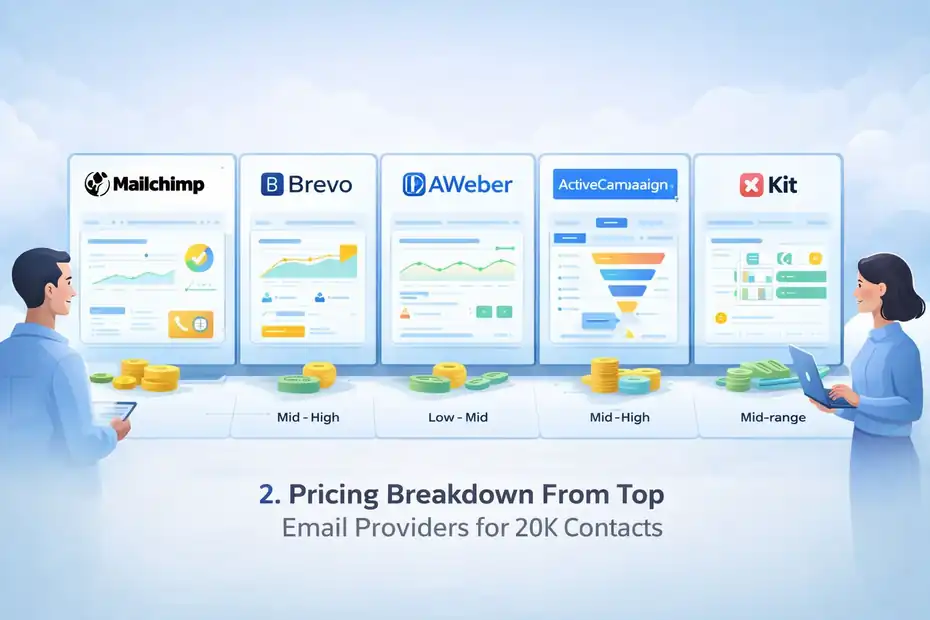
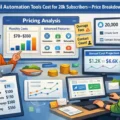
Here’s where we look at the real numbers. Pricing fluctuates, but the comparisons below reflect the most current 2026 data.
My goal here is to give you a clear sense of how each platform treats a 20K-subscriber tier.
Cost Structure Of Mailchimp At The 20K List Tier
Mailchimp is one of the most recognizable names in the email world, but it’s also one of the pricier options at this size. At the 20K tier, plans usually land in a range that makes you question whether you’re paying for the brand name or the actual features.
What I personally find is that Mailchimp’s cost rises fast once you add automation workflows or want multivariate testing. Even removing inactive subscribers doesn’t drop you to a cheaper plan instantly—they charge based on stored contacts, not engaged users.
This is great for simplicity, but not so great for your budget.
Total Monthly And Annual Costs Using Brevo
Brevo (formerly Sendinblue) does things differently by charging for email sends, not contact count. That’s why a lot of budget-conscious businesses move here once they hit 20K subscribers. If you don’t send many campaigns, you can keep your monthly bill surprisingly low.
But the trade-off: If your business sends frequent emails or runs multiple automation sequences, you can use up your monthly quota fast. And when you cross that threshold, the per-email cost jumps. That’s the part I encourage people to model before choosing Brevo.
What 20K Subscribers Cost With AWeber
AWeber most often appeals to small businesses and bloggers who want simplicity without overpaying. At 20K contacts, their pricing usually remains accessible compared to Mailchimp or ActiveCampaign.
What I appreciate about AWeber is their straightforwardness: Unlimited email sends, solid deliverability, and no complicated add-on fees. But if you’re someone who relies heavily on deep automation or CRM-style pipelines, the platform can feel limiting.
Pricing Expectations For 20K Contacts On ActiveCampaign
ActiveCampaign is known for powerful automation, and at 20K subscribers, that’s both a blessing and a cost driver. Their plans tend to climb quickly once you add features like:
- SMS messaging
- Lead scoring
- Advanced split automation
- Site tracking
In my experience, businesses that make full use of automation workflows often find ActiveCampaign worth the price. But if you only send newsletters and simple sequences, the platform can be overkill at this list size.
How Much 20K Contacts Cost Using Kit
Kit (formerly ConvertKit) targets creators, authors, and educators—anyone building a personal brand. At the 20K tier, the pricing is generally mid-range, sitting comfortably between budget platforms like Brevo and powerhouse suites like ActiveCampaign.
What I think Kit gets right is ease of use. Tagging, segmentation, automations—they’re all clean and intuitive. But Kit can get pricey if you run multiple audiences, because they count every subscriber across every list, even duplicates.
Comparison Table: Estimated Costs For 20K Contacts (2026)
These ranges reflect typical pricing at the 20K tier. Exact pricing varies by plan and features.
| Email Platform | Pricing Model | Estimated Monthly Cost (20K Contacts) | Strengths | Considerations |
| Mailchimp | Contact-based | Mid–High | Brand reputation, templates, ecommerce | Can get expensive fast |
| Brevo | Email-send based | Low–Mid | Affordable, SMS built-in | Heavy senders pay more |
| AWeber | Contact-based | Low–Mid | Simple, unlimited sends | Limited advanced automation |
| ActiveCampaign | Feature-based tiers | Mid–High | Automation, CRM tools | Steeper learning curve |
| Kit | Contact-based | Mid-range | Creator-focused tools, ease of use | Duplicate subscribers count separately |
Comparing Feature Value Vs. Actual Cost At 20K Contacts
Once you cross 20K subscribers, the pricing you see on each provider’s website stops telling the full story. What really determines your total spend is how deeply you use the platform—especially automation, tagging, and advanced reporting.
Let me walk you through the areas where costs quietly increase so you can avoid surprises.
Evaluating Automation Limits And Advanced Segmentation Costs
Automation is where most people underestimate their costs. Platforms often give you basic sequences at lower tiers, but once you start stacking automations—like a welcome series, product onboarding, and abandoned cart flows—you’ll usually get pushed into a higher plan.
In my experience, the biggest bump happens when you need branching logic (like “If user clicks this, then send X, else send Y”). This type of automation moves you into the pro-level plans on platforms like Mailchimp and ActiveCampaign.
If you’re someone who relies heavily on segmentation (such as filtering subscribers by actions, purchase history, or website behavior), expect a higher price. These features require more data processing, and ESPs charge for that computing power.
How Subscriber Tagging And Custom Fields Affect Total Spend
Tagging sounds so simple: You label a subscriber with “ebook-download” or “interested-in-product-A.” But the more tags you add, the more data your platform stores—and several ESPs count this toward your usage limits.
Custom fields (like birthday, membership tier, or product type) also get expensive because they increase your database size. Kit, for example, handles tagging beautifully, but if you over-tag users across multiple audiences, you may pay for the same subscriber twice.
Here’s my personal rule: If you can replace five tags with one “master tag” or custom field, do it. It keeps your data clean and your bill lower.
When Additional User Seats And Team Access Raise Pricing
This is the sneakiest cost of all. Many teams don’t realize that adding one copywriter and one analyst to the account can easily increase their monthly bill by $20–$60.
Mailchimp and ActiveCampaign are the biggest culprits here, because they price based on user access levels. If you’re a solo creator, no big deal. But if you’re a growing business, these add-ons can accumulate faster than you think.
My advice: Give team members limited permissions unless they absolutely need admin access. Most platforms let you downgrade roles at no cost.
Differences In Reporting, Deliverability Tools, And Contact Scanning Fees
Reporting looks simple on the surface—open rates, click rates—until you want deeper insights. Revenue attribution, predictive analytics, or geo-tracking often require premium tiers.
Deliverability tools (like inbox placement insights or dedicated IP addresses) also add cost. If your list is near 20K contacts, these tools can dramatically help your deliverability, but they’re rarely included in basic plans.
Finally, contact scanning fees—charged when your platform flags bounces, invalid emails, or spam traps—can surprise you. Brevo and AWeber tend to be more forgiving, while some enterprise-heavy platforms charge per scan.
Realistic Budget Ranges For Email Leads At The 20K Threshold
Let’s talk real numbers. When you’re managing 20K email contacts, the right budget isn’t about finding the cheapest platform—it’s about balancing cost with performance.
Different types of businesses have different needs, so what’s “fair” really depends on your model.
The Typical Monthly And Annual Spend For Small Businesses
Most small businesses I’ve worked with end up paying $40–$220 per month at the 20K tier. The wide range comes down to features: If you just send newsletters, you’re safely at the lower end. But if you need advanced automation, expect to pay more.
Here’s a real example: A boutique café newsletter I consulted for used AWeber, sent only two campaigns per month, and paid roughly $70 monthly. But a local gym with multiple automations and unique workflows on ActiveCampaign paid closer to $180.
This difference is entirely feature-driven.
Pricing Expectations For Ecommerce Companies At 20K Contacts
Ecommerce businesses usually pay more because they rely heavily on automation—think abandoned cart sequences, upsell flows, and personalized product recommendations. These features often require mid-tier or premium plans.
A realistic ecommerce budget for 20K leads is $150–$350 per month, especially if you want:
- Site tracking
- Purchase-triggered automations
- Dynamic product blocks
If you run a store-making $30K/month, this investment usually pays itself back within a week of automated flows firing properly.
Costs For Coaches, Bloggers, And Creators Managing 20K Email Leads
Creators tend to need strong tagging and segmentation, especially if they run multiple funnels or digital products. Kit is a popular choice here because of its clean tagging system.
Most creators I’ve supported pay between $60–$160 per month, depending on:
- Number of digital funnels
- Frequency of launches
- How often they purge inactive subscribers
One creator I worked with saved $480/year simply by pruning 4K inactive contacts, which dropped them into a lower billing tier. Their revenue didn’t change—but their profit margin did.
When Paying More Actually Reduces Long-Term CAC And Churn
Here’s a counterintuitive truth: Sometimes the “expensive” plan is cheaper in the long run.
If your platform gives you:
- Higher deliverability
- Better segmentation
- More accurate analytics
- Stronger automation
…your conversion rates improve. Even a small bump—say a 2% increase in automation-driven sales—can produce thousands more per year.
I’ve seen businesses double their ROI simply by switching to a platform with stronger automation logic. So when you evaluate the email leads cost for 20K contacts, look at revenue impact, not just monthly fees.
How Lead Quality Impacts The True Cost Of Managing 20K Contacts
It’s tempting to think of all leads as equal—but in reality, lead quality determines how much your email list actually costs you.
A list full of unengaged subscribers drives up your expenses while lowering deliverability.
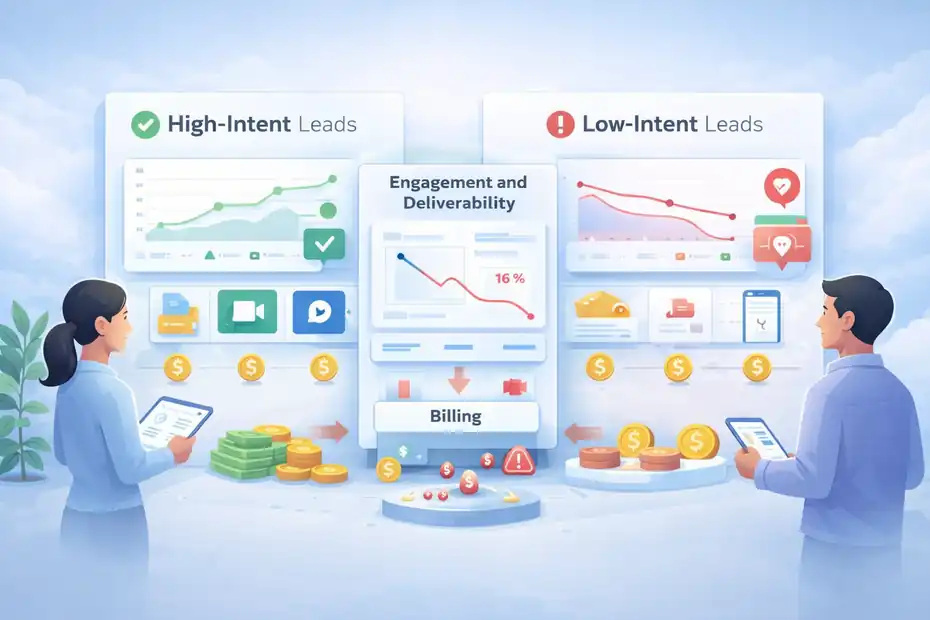
Cost Difference Between High-Intent And Low-Intent Lead Sources
High-intent leads—like those who download a guide or join a webinar—tend to convert better and stay engaged longer. They cost more to acquire, but the long-term value is higher.
Low-intent leads—like sweepstakes entrants or low-quality paid traffic—are cheaper upfront but hurt your metrics.
For example: A Shopify store I helped once added 7,000 sweepstakes leads. Within two months, their open rates dropped from 38% to 16%. Their ESP flagged them for “low engagement,” forcing them into a deliverability review. Cheap leads ended up costing them more in remediation fees and lost revenue.
How Engagement Rates Affect Deliverability And ESP Billing
Your engagement rate isn’t just a vanity metric—it’s how ESPs judge your sending reputation. If your open rates fall below certain thresholds, they may:
- Restrict your sending
- Enforce list cleaning
- Increase scanning fees
- Downgrade deliverability
The worst part? You end up paying for subscribers who are actively hurting your performance.
My rule of thumb: If someone hasn’t opened in 90 days, put them in a re-engagement sequence. If they don’t respond, remove them.
Why Pruning Inactive Leads Can Reduce Your 20K List Costs
Cleaning your list is one of the easiest ways to cut your email bill with zero downside. Removing deadweight subscribers reduces your total contact count, which directly reduces your cost if you’re near a tier threshold.
If you’re paying for 20K contacts but only 14K engage, you’re literally burning money every month. Most platforms don’t reward you for keeping large but inactive lists—they only charge for stored contacts.
I’ve seen clients drop to a lower pricing tier within minutes of a proper cleanup.
The ROI Gap Between Paid Traffic Leads And Organic List Growth
Organic leads—from SEO, YouTube, blogs, referrals, or social content—typically have the highest long-term ROI because their acquisition cost is low and intent is naturally higher.
Paid traffic leads can scale faster, but quality varies wildly depending on the funnel. If you’re buying leads at $1.50 each, a 20K list represents $30K of investment. At that level, even small improvements to quality dramatically reduce your overall cost.
The key is balance: You want a mix of organic and paid growth so you’re not overspending on lead volume that doesn’t convert.
How To Reduce Email Marketing Costs Without Losing Performance
If the email leads cost for 20K contacts is starting to feel too heavy on your budget, you’re not alone. Many businesses reach this list size and suddenly see their ESP bills jump.
The good news is that you can cut costs without sacrificing performance—I’ve done this with clients many times, and it works surprisingly well.
Switching From Premium Providers To Leaner Platforms Without Risk
Switching platforms used to feel risky—kind of like moving houses and hoping nothing breaks. But most modern ESPs now offer migration tools and done-for-you imports.
If you’re on a premium platform like ActiveCampaign or Mailchimp and paying more than $200/month at 20K subscribers, moving to a leaner provider such as MailerLite or Brevo can instantly cut your bill by 30–50%.
My personal checklist for safe migrations:
- Export all automations as diagrams or screenshots.
- Rebuild your most essential flows first.
- Run both ESPs in parallel for 10–14 days.
- Update your domain authentication (SPF, DKIM, DMARC).
If you do these steps, the risk drops dramatically.
Using Automation To Lower CPA And Ongoing Lead Nurture Costs
Automation isn’t just a feature—it’s a cost saver when done right. By automating onboarding sequences, product pitches, or nurture series, you reduce the need for constant manual campaigns.
A scenario from a coaching business I helped: We built a 5-email onboarding sequence that automatically converted new leads into a paid workshop. That sequence alone added $5K–$7K/month in revenue and completely offset their ESP bill.
And here’s the truth most people miss: Strong automation lowers your cost per acquisition (CPA) because every lead has a higher chance of converting.
Auditing Contact Hygiene To Lower ESP Billing Tiers
I always recommend a quarterly “hygiene audit”—basically a spring cleaning for your list. ESPs charge based on stored contacts, so if you’re paying for 20K contacts but only 13K are engaged, you’re wasting money.
Tools like contact scoring, engagement tagging, and bounce filtering help you:
- Remove inactive subscribers
- Identify spam traps
- Stop paying for cold leads
After running this audit, one of my clients dropped their Mailchimp bill from $179/month down to $109/month—without losing a single valuable contact.
Avoiding Overpaying For Features You Aren’t Actively Using
Many users unknowingly pay for features they never touch. For example:
- CRM pipelines
- SMS credits
- Predictive analytics
- Advanced multivariate testing
If you’re not using these at least once per month, downgrade your plan. I’ve seen businesses save $600–$1,200 per year just by switching from a “Pro” plan to a mid-tier plan and nothing changed in their performance.
Best Alternatives If Your 20K Email Leads Cost Is Too High
If your current ESP is eating your budget, you have solid alternatives.
Each option fits a different type of business model, so the right choice depends on your sending frequency, automation needs, and how much you want to scale.
Choosing Cost-Friendly Options Like MailerLite
MailerLite is one of my favorite recommendations for anyone who wants modern tools without the modern price tag. Their 20K pricing is usually far lower than Mailchimp or ActiveCampaign, and the interface feels refreshingly clean.
What I personally love:
- Drag-and-drop automation builder
- Solid deliverability
- Very fair pricing
- No hidden “extra seat” fees
If you’re a blogger, coach, or small business owner, MailerLite gives you 90% of what premium platforms offer at 40–60% of the cost.
When Businesses Should Move To GetResponse
GetResponse is great when you want a hybrid platform that offers email marketing plus:
- Webinars
- Funnels
- Landing pages
- Automated customer journeys
It’s ideal for businesses that want a “marketing suite” instead of just an ESP. E-commerce brands especially benefit from GetResponse’s abandoned cart features and product-based segmentation.
From what I’ve seen, businesses moving from Mailchimp to GetResponse usually cut their bill by 20–30% while gaining more automation flexibility.
Why Some Brands Shift To SendGrid For High-Volume Sending
SendGrid is a developer-friendly platform that excels at sending large volumes of transactional or bulk promotional emails. If you’re sending daily blast campaigns or running a SaaS product that triggers a lot of system emails, this option can dramatically lower your costs.
But here’s the catch: SendGrid isn’t built for deep automations or tagging like ActiveCampaign or Kit. It shines when you just need fast, reliable sending at scale.
Migrating To ConvertKit Creator Network For Audience Building
Even though ConvertKit rebranded to Kit, the Creator Network remains a strong growth tool for creators. It allows you to exchange audience recommendations with other creators, which helps offset your lead acquisition costs.
This is especially powerful if you’re a:
- Newsletter writer
- Coach or course creator
- Podcaster
- Niche influencer
I’ve seen creators add 2K–5K subscribers per month purely through Creator Network referrals—without paying for ads. And when your email leads cost for 20K contacts is rising, free organic growth is priceless.
Determining A Fair Price For Your Email Leads Cost For 20K Contacts
Now that we’ve covered alternatives and cost-saving tactics, let’s figure out what you should actually pay.
A fair price isn’t universal—it depends on your goals, your revenue, and how you use your list.
Identifying Your Maximum Acceptable Cost Per Lead (CPL)
Your CPL tells you how much you can afford to spend acquiring each subscriber. The formula is simple:
Maximum CPL = (Average customer value × conversion rate) − operating costs
For example: If a new subscriber is worth $50 to you over their lifetime, and your funnel converts 3% of subscribers into buyers, your max CPL is $1.50.
Knowing this makes evaluating ESP pricing much clearer because you can directly compare cost vs. expected return.
Matching Your ESP Plan To Revenue Goals And Funnel Structure
Ask yourself: Is my email platform supporting the way I actually make money?
If your revenue relies on:
- Automated funnels
- Behavioral triggers
- Abandoned cart flows
…then downgrading too far can hurt your income.
But if you only send newsletters, you may be overpaying for features you don’t need. Your ESP should match your funnel—not the other way around.
When Upgrading Vs. Downgrading Makes Sense At 20K Subscribers
Upgrade when:
- You’re hitting automation limits
- You need advanced segmentation
- Deliverability becomes an issue
- You’re scaling faster than expected
Downgrade when:
- You’re barely using your automations
- Your bill feels disconnected from your ROI
- Your open rates or engagement don’t justify the spend
- You’re paying for audience features you never touch
A good rule: If a feature doesn’t increase revenue within 90 days, it shouldn’t influence your pricing tier.
Creating A Cost Model That Predicts 12-Month ROI
I always encourage businesses to build a simple 12-month email ROI model. It keeps you grounded and prevents emotional decisions based on a single month’s bill.
Your model should include:
- ESP subscription cost
- Lead acquisition costs
- Expected list growth
- Open rate and click-through assumptions
- Conversion projections from automations and launches
When you plug everything in, you’ll often find that a slightly higher ESP cost delivers a dramatically higher return.
To make it easy, here’s a quick example table:
| Metric | Value Example |
| List size | 20,000 contacts |
| Monthly ESP cost | $120 |
| Average revenue per subscriber per month | $0.40 |
| Monthly revenue from email | $8,000 |
| Net monthly ROI | $7,880 |
Suddenly, a $120 bill doesn’t feel so bad, right?
FAQ
What is the average email leads cost for 20K contacts?
The average email leads cost for 20K contacts typically ranges from $40–$220 per month, depending on your email service provider, automation needs, and sending volume.
How much should I pay per lead to build a 20K contact list?
Most businesses pay $0.80–$4.00 per lead, meaning a 20K list may cost $16,000–$80,000 to acquire, depending on traffic quality and conversion rates.
How can I lower my email leads cost for 20K contacts without losing performance?
You can reduce costs by switching to a leaner ESP, cleaning inactive subscribers to drop billing tiers, and using automation to improve conversions so each lead generates more revenue.

Juxhin B is a digital marketing researcher and founder of JAK Digital Hub, specializing in email marketing software, marketing automation platforms, and digital growth tools. His work focuses on software testing, platform comparisons, and real-world performance analysis to help businesses choose the right marketing technology.
Related posts:
 Best Email Marketing Tools (Tested & Compared)
 How To Build A Better Email Campaign Strategy For Ecommerce
 Email Leads Not Converting? Fix It With This Framework
 The Better Way To Manage Email Leads No One Talks About
 Email Automation Tools Cost for 20k Subscribers—Price Breakdown
 Cheaper Email Automation System For Growing List Fast