Table of Contents
Some links on JAK Digital Hub are affiliate links, meaning we may earn a small commission at no extra cost to you. Read full disclaimer.
Email marketing jobs for marketing assistants are becoming one of the most accessible ways to break into digital marketing today.
If you already handle basic marketing tasks like scheduling campaigns, organizing contact lists, or supporting content teams, email marketing can quickly turn into a specialized skill that increases your value and salary.
I’ve seen many assistants transition from simple newsletter scheduling to managing full automation funnels within a year.
In this guide, I’ll walk you through the best roles available, what they actually involve day-to-day, the skills employers look for, and how you can grow these positions into higher-paying marketing careers.
Why Email Marketing Is a Strong Career Path for Marketing Assistants
Email marketing sits at the center of digital marketing strategy, which makes it a natural specialization for assistants already supporting marketing teams. Most assistants already touch email campaigns in some form, even if it’s just formatting newsletters or uploading subscriber lists.
What many people don’t realize is that email marketing is one of the highest ROI channels in marketing. According to Litmus research, email marketing generates an average return of $36 for every $1 spent. Because of that, companies constantly need people who can help execute and manage campaigns.
For marketing assistants, this creates an opportunity. Instead of remaining a general assistant handling random tasks, you can become the person responsible for email campaigns, automation, segmentation, and performance tracking.
From what I’ve seen across marketing teams, email marketing often becomes the first specialization assistants grow into because the learning curve is manageable but the impact is measurable.
Why Companies Hire Marketing Assistants for Email Marketing
Email marketing involves many operational tasks that require organization and attention to detail. Marketing assistants are already trained for that kind of work.
Typical reasons companies assign email marketing responsibilities to assistants include:
- Campaign preparation: Preparing newsletters, promotions, and product updates before they are scheduled.
- Subscriber list management: Importing contacts, cleaning lists, and organizing segments.
- Content formatting: Ensuring emails display properly across devices.
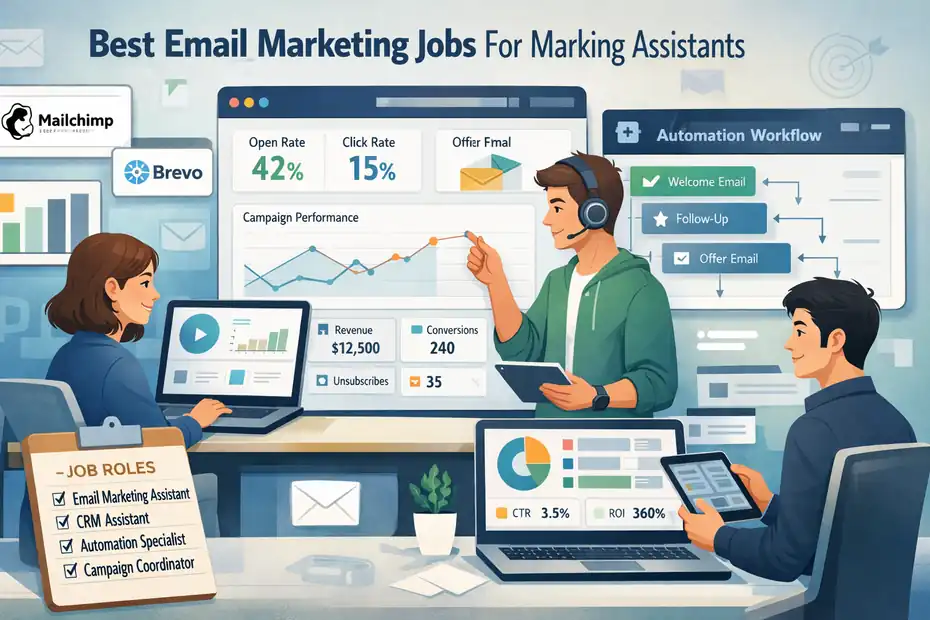
- Performance tracking: Reporting open rates, click rates, and conversions.
- Automation support: Maintaining welcome sequences and drip campaigns.
For example, imagine you’re working at a small ecommerce brand. The marketing manager handles strategy, but they need someone to build campaigns, upload product images, test links, and schedule the send time. That operational responsibility usually lands on a marketing assistant.
Over time, assistants who consistently manage those tasks often become email marketing specialists or CRM managers.
Why Email Marketing Skills Increase Salary Potential
Not all marketing assistant roles pay the same. Assistants who develop specialized skills tend to earn significantly more.
Email marketing is particularly valuable because it directly impacts revenue. When an email campaign drives sales, management can clearly see the results.
Here’s how the career progression often works:
| Role | Typical Responsibilities | Career Impact |
|---|---|---|
| Marketing Assistant | Upload campaigns, organize contact lists | Entry level exposure |
| Email Marketing Assistant | Build campaigns, segment audiences | Specialized skill |
| Email Marketing Specialist | Manage automation and reporting | Mid-level role |
| Lifecycle Marketing Manager | Design full customer journeys | Senior strategy role |
I’ve personally seen assistants double their salary within two years by focusing on lifecycle marketing and automation.
The key difference is that specialized assistants move from simply helping campaigns to directly influencing revenue.
Most Common Email Marketing Jobs for Marketing Assistants
Not all email-related jobs carry the same title. Many companies use different names for similar responsibilities, so it helps to understand the roles behind the titles.
If you’re searching job boards, these are the positions most commonly available to marketing assistants.
Email Marketing Assistant
This is the most direct role for someone transitioning from a general marketing assistant position.
An email marketing assistant typically supports the marketing team by building and scheduling campaigns. The work is operational but also gives you exposure to strategy.
Typical responsibilities include:
- Creating and formatting newsletters
- Uploading subscriber lists
- Segmenting audiences based on behavior
- Testing email links and design
- Scheduling campaigns
- Monitoring campaign performance
For example, imagine a SaaS company sending weekly product updates. The marketing manager writes the email copy, but the assistant builds the email inside the platform, adds images, checks formatting on mobile devices, and schedules the send.
In many companies, assistants in this role begin learning about segmentation and automation, which are the foundations of advanced email marketing.
CRM Marketing Assistant
CRM stands for customer relationship management. In this role, the focus shifts from individual email campaigns to managing customer data and lifecycle communication.
Instead of just sending newsletters, you help manage how customers move through the marketing funnel.
Typical tasks include:
- Organizing customer data
- Managing email automation sequences
- Monitoring customer behavior triggers
- Updating contact segmentation
- Supporting retention campaigns
For example, when someone signs up for a free trial, a CRM assistant might help maintain the automated onboarding sequence that educates the user over the next 7 days.
This role exposes you to lifecycle marketing, which is one of the fastest growing areas in digital marketing.
Marketing Automation Assistant
Marketing automation focuses on automated email flows triggered by user actions.
This role is slightly more technical but still accessible for assistants who enjoy systems and workflows.
Responsibilities often include:
- Setting up automated workflows
- Managing drip campaigns
- Monitoring triggered emails
- Updating automation logic
- Testing automation paths
Imagine someone downloading a free guide from a website. Instead of sending emails manually, an automation system triggers a sequence that delivers the guide, sends follow-up tips, and eventually offers a product.
Automation assistants maintain and optimize these workflows.
These skills are highly valuable because automation systems can directly influence conversions and revenue.
Email Campaign Coordinator
Campaign coordinators focus on executing large campaigns involving multiple emails.
These roles often appear in agencies or ecommerce companies running frequent promotions.
Typical responsibilities include:
- Coordinating campaign schedules
- Managing multiple campaign drafts
- Ensuring content approval timelines
- Monitoring campaign launches
- Reporting campaign performance
For example, during Black Friday, an ecommerce company might send ten different promotional emails across a week. A campaign coordinator ensures each email launches on time and matches the campaign schedule.
This role requires strong organization and communication skills.
Core Skills You Need for Email Marketing Jobs
Many marketing assistants worry they need advanced technical skills before applying for email marketing roles. In reality, most companies hire assistants based on practical abilities and attention to detail.
Let me break down the skills that actually matter.
Email Campaign Creation
The most basic skill is building and formatting emails.
This includes tasks like:
- Formatting text and images
- Adding buttons and links
- Previewing emails across devices
- Testing deliverability
- Scheduling campaigns
You don’t need design experience, but you should understand how email layouts work.
For example, many emails follow a simple structure:
- Header or hero image
- Short introduction
- Main offer or announcement
- Call-to-action button
- Supporting information
If you can build campaigns following that structure, you already meet the requirements for many entry-level email marketing jobs.
Audience Segmentation
Segmentation means sending emails to specific groups instead of the entire list.
This improves engagement because subscribers receive more relevant messages.
Common segmentation categories include:
- New subscribers
- Active customers
- Inactive users
- Past buyers
- Trial users
- VIP customers
For example, a clothing store might send a discount email only to customers who purchased in the last 60 days.
Learning segmentation helps you move beyond simple newsletter scheduling and into performance-driven marketing.
Email Performance Tracking
Companies rely on data to evaluate email campaigns.
Marketing assistants are often responsible for reporting metrics such as:
- Open rate
- Click-through rate
- Conversion rate
- Unsubscribe rate
- Revenue per email
Understanding these metrics helps you identify what works and what needs improvement.
For example, if a campaign has a strong open rate but low clicks, the subject line worked but the email content didn’t persuade readers to act.
Assistants who learn to interpret these metrics often become valuable to marketing managers.
Email Marketing Tools Marketing Assistants Should Learn
While strategy matters, most email marketing jobs require familiarity with a few major platforms. Learning one or two tools can significantly increase your chances of getting hired.
Here are the platforms most commonly used by marketing teams.
Mailchimp
Mailchimp remains one of the most beginner-friendly email marketing platforms.
Many startups and small businesses use it because it combines email marketing, automation, and basic CRM features in a simple interface.
Marketing assistants often use Mailchimp for:
- Building campaigns with drag-and-drop editors
- Segmenting subscriber lists
- Scheduling newsletters
- Setting up welcome sequences
- Viewing campaign analytics
If you’re just starting out, learning Mailchimp gives you practical experience that translates well to other platforms.
Brevo
Brevo (formerly Sendinblue) is widely used by ecommerce and SaaS companies that want more advanced automation.
Marketing assistants working with Brevo often handle:
- Marketing automation workflows
- Transactional emails
- Contact segmentation
- Performance analytics
- SMS campaign coordination
Brevo is especially useful for assistants interested in marketing automation roles.
Kit
Kit is commonly used by creators, bloggers, and digital product businesses.
Assistants working with creators or content businesses might manage:
- Newsletter campaigns
- Subscriber tagging
- Automated course funnels
- Broadcast emails
- Landing page integrations
Because Kit focuses heavily on creators, assistants in this environment often learn audience growth strategies as well.
HubSpot
HubSpot is more advanced and typically used by larger marketing teams.
Assistants working with HubSpot may help with:
- Lifecycle email automation
- CRM contact management
- Marketing funnel tracking
- Lead scoring
- Reporting dashboards
While HubSpot can look intimidating at first, assistants who learn it often become strong candidates for higher-level CRM roles.
How to Get Your First Email Marketing Job as a Marketing Assistant
Breaking into email marketing doesn’t always require a new job title. In many cases, you can grow into the role within your current position.
Let me show you the path that works for many assistants.
Step 1: Volunteer for Email Tasks
If you already work in marketing, the fastest way to learn email marketing is by volunteering to support campaigns.
For example, you might offer to:
- Upload subscriber lists
- Format newsletters
- Test links before sending
- Organize campaign schedules
- Monitor campaign reports
These tasks may seem simple, but they give you hands-on experience with the email system.
In my experience, managers are usually happy to delegate these responsibilities because email campaigns involve repetitive work.
Step 2: Build Small Email Campaign Projects
If you don’t currently work with email marketing, you can still build experience through small personal projects.
For example:
- Start a simple newsletter about a topic you enjoy
- Create a welcome email sequence
- Test subject line variations
- Track subscriber growth
This type of project demonstrates initiative and practical knowledge during interviews.
Hiring managers often care more about proof of experience than formal certifications.
Step 3: Learn Basic Email Automation
Automation is one of the fastest ways to increase your value in email marketing.
Start by learning how simple automated sequences work:
- Welcome sequences
- Lead magnet delivery
- Abandoned cart reminders
- Re-engagement emails
- Customer onboarding sequences
Understanding how automated workflows operate will immediately separate you from other entry-level candidates.
Common Mistakes Marketing Assistants Make in Email Marketing
Email marketing looks simple on the surface, but beginners often make mistakes that affect campaign performance.
Learning these early will help you stand out.
Mistake 1: Sending the Same Email to Everyone
One of the biggest beginner mistakes is sending the exact same email to an entire subscriber list.
Different subscribers have different relationships with the brand.
For example:
- New subscribers need introductions
- Active customers want promotions
- Inactive users need re-engagement
Sending targeted emails increases engagement and reduces unsubscribe rates.
Mistake 2: Ignoring Mobile Optimization
More than 60 percent of emails are opened on mobile devices.
If an email looks great on desktop but breaks on a phone, engagement drops dramatically.
Always test emails on multiple screen sizes before sending.
This includes checking:
- Image sizes
- Button placement
- Text readability
- Loading speed
A small formatting issue can dramatically impact click rates.
Mistake 3: Overloading Emails with Content
Many assistants try to include too much information in one email.
The most effective emails usually focus on a single goal.
Examples include:
- Promoting one product
- Delivering one educational tip
- Announcing one event
- Sharing one piece of content
When emails try to do too many things, readers often ignore them.
Advanced Email Marketing Career Paths
Once you gain experience managing campaigns and automation, email marketing opens doors to several higher-level marketing roles.
These positions combine strategy, analytics, and customer experience management.
Lifecycle Marketing Manager
Lifecycle marketing focuses on guiding customers through every stage of their journey with a brand.
This includes:
- Onboarding new users
- Encouraging product adoption
- Retaining existing customers
- Re-engaging inactive users
Lifecycle marketers design automated email journeys that respond to user behavior.
For example, if a user signs up but doesn’t complete onboarding, the system sends educational emails to help them succeed.
This role combines email marketing with product marketing and data analysis.
CRM Marketing Manager
CRM managers focus heavily on customer data and segmentation.
Instead of simply sending emails, they design strategies based on behavioral insights.
Typical responsibilities include:
- Customer segmentation analysis
- Loyalty campaigns
- retention strategies
- revenue tracking
- customer lifecycle optimization
CRM managers often collaborate closely with product and analytics teams.
Marketing Automation Specialist
Automation specialists build complex systems that send personalized messages based on customer behavior.
Examples include:
- Abandoned cart recovery flows
- personalized product recommendations
- automated onboarding journeys
- behavior-triggered promotions
Automation roles require technical thinking, but they are highly valued because automated campaigns generate consistent revenue.
Many marketing assistants eventually transition into these roles after gaining hands-on experience with automation systems.
Final Thoughts
Email marketing jobs for marketing assistants offer one of the clearest paths from entry-level marketing work to specialized, higher-paying roles. The barrier to entry is relatively low, but the upside is significant if you continue developing your skills.
In my experience, assistants who focus on email marketing learn faster than those who remain generalists. Campaign execution teaches you copywriting, analytics, customer psychology, and marketing automation all at once.
If you start by helping with campaigns, learning segmentation, and experimenting with simple automation workflows, you’ll quickly build a skill set that many companies actively need.
And once you understand how email marketing drives revenue, you’re no longer just supporting marketing campaigns. You’re directly influencing business growth, which is where real career opportunities start to open.
FAQ
What are email marketing jobs for marketing assistants?
Email marketing jobs for marketing assistants involve supporting campaign creation, managing subscriber lists, scheduling emails, and tracking performance metrics. These roles help marketing teams execute newsletters, promotional emails, and automated sequences that drive customer engagement and sales.
Do marketing assistants need experience to work in email marketing?
Most entry-level email marketing jobs for marketing assistants do not require advanced experience. Basic skills like campaign formatting, list management, and email scheduling are usually enough to start, while automation and segmentation skills develop over time.
What skills are required for email marketing jobs for marketing assistants?
Key skills include email campaign creation, audience segmentation, performance tracking, attention to detail, and basic marketing analytics. Understanding how to test emails, analyze open rates, and manage subscriber lists is highly valuable.
How much do email marketing assistants earn?
Email marketing assistants typically earn between $40,000 and $65,000 per year depending on experience, industry, and location. Assistants who develop automation, CRM management, and segmentation skills often transition into higher-paying marketing specialist roles.
How can a marketing assistant start working in email marketing?
Marketing assistants can start by helping with newsletter scheduling, subscriber list organization, and campaign testing. Building small email campaigns, learning automation basics, and understanding performance metrics can quickly lead to dedicated email marketing roles.

Juxhin B is a digital marketing researcher and founder of JAK Digital Hub, specializing in email marketing software, marketing automation platforms, and digital growth tools. His work focuses on software testing, platform comparisons, and real-world performance analysis to help businesses choose the right marketing technology.
Related posts:
 Email Marketing Jobs For Content Marketers Hiring Now
 Email Marketing Jobs For Startups Hiring Remote Talent
 Email Leads Not Converting? Fix It With This Framework
 Email Leads Cost For 20K Contacts: What Should You Pay?
 Best Email Automation Platform For Advanced Segmentation
 Email Marketing Jobs For Solopreneurs That Scale Fast