Table of Contents
Some links on JAK Digital Hub are affiliate links, meaning we may earn a small commission at no extra cost to you. Read full disclaimer.
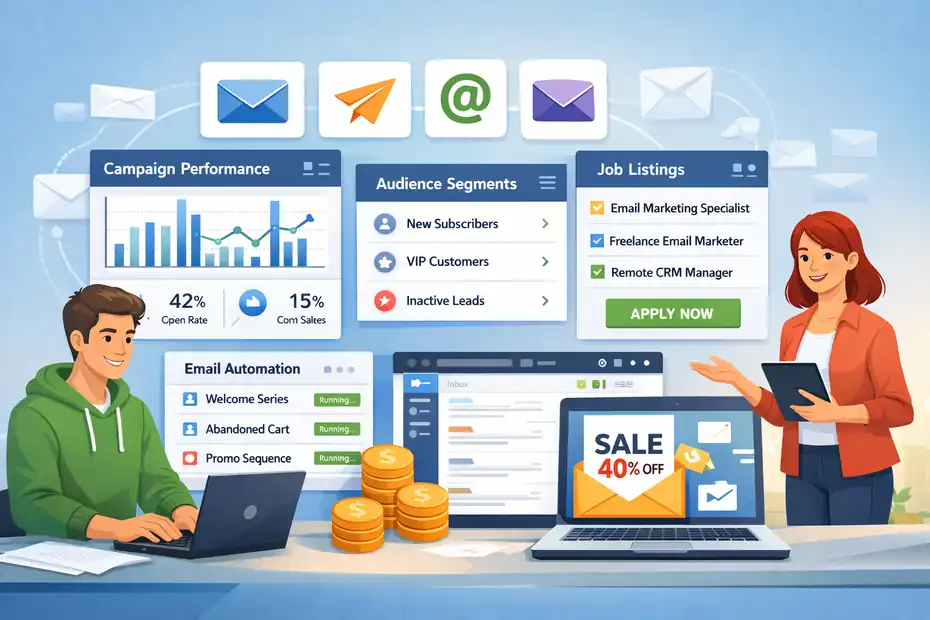
Email marketing jobs for small business are becoming one of the fastest-growing opportunities in digital marketing. Small companies everywhere are realizing that email consistently delivers one of the highest returns on investment—often generating around $36–$40 for every $1 spent according to multiple industry reports.
Because of that, many small businesses are actively hiring people who can write emails, manage subscriber lists, and automate campaigns that turn readers into customers.
The good news? You don’t need a marketing degree to get started. If you understand customer psychology, basic email tools, and how to write persuasive messages, you can build a reliable freelance career or even land a remote role with a growing company.
Why Small Businesses Are Hiring Email Marketing Specialists in 2026
Small businesses rely heavily on direct customer relationships. Email marketing helps them build those relationships without expensive advertising, which is why demand for email marketing talent continues to rise.
The ROI Advantage That Drives Small Business Hiring
For most small businesses, marketing budgets are tight. Paid advertising can work, but it often requires constant spending to maintain results. Email marketing works differently.
Once someone joins an email list, the business can communicate with them repeatedly without paying per click.
This creates several major advantages:
- Higher long-term ROI: Email marketing consistently delivers one of the highest marketing returns compared to social ads or search ads.
- Direct ownership of the audience: Unlike social media platforms where algorithms control visibility, email lists belong to the business.
- Higher conversion rates: Email subscribers have already shown interest, which means they are more likely to buy.
Because of these advantages, small businesses increasingly treat email as their primary revenue channel.
Imagine a small ecommerce brand selling skincare products. Instead of relying entirely on ads, they build a list of 20,000 subscribers. Every time they launch a product, a simple email campaign can generate thousands of dollars in revenue.
That’s why businesses now actively look for people who can manage their email systems.
The Types of Businesses Currently Hiring Email Marketers
One interesting trend in 2026 is that email marketing jobs are no longer limited to large companies. Small businesses across many industries now rely on email.
Some of the most common industries hiring include:
- Ecommerce brands
- Online course creators
- Coaches and consultants
- SaaS startups
- Local service businesses
- Agencies managing multiple clients
Many of these companies operate online-first, meaning they prefer remote contractors or freelancers instead of full-time office employees.
From what I’ve seen, small businesses often prefer hiring specialists instead of general marketers. Someone who can focus entirely on email campaigns can drive measurable results quickly.
This creates a big opportunity for anyone willing to learn the craft.
What Email Marketing Jobs for Small Business Actually Involve
Before applying for roles, it helps to understand what small business owners actually expect from an email marketer.
Most of these jobs focus on generating revenue from an existing audience.
Writing Promotional and Sales Email Campaigns
One of the most common responsibilities in email marketing jobs for small business is writing promotional emails.
These emails promote:
- Products
- Services
- Discounts
- Launches
- Seasonal offers
But successful promotional emails don’t feel like advertisements. They feel like conversations.
For example, a fitness coach might send an email with the subject line:
“The mistake I made when trying to lose my first 10 pounds.”
The email tells a story, provides value, and eventually introduces the coach’s program.
This style of email marketing—often called story-based selling—works extremely well for small businesses because it builds trust while still driving sales.
A skilled email marketer understands how to structure these messages:
- Hook the reader with a relatable problem
- Tell a short story or provide insight
- Introduce the product naturally
- Provide a clear call to action
In my experience, small businesses care far more about conversion rates than fancy design.
Simple text emails often outperform complex templates.
Creating Automated Email Sequences That Run Sales
Automation is where email marketing becomes powerful.
Instead of manually sending every message, businesses create automated sequences that run in the background.
These sequences activate when someone performs an action such as:
- Signing up for a newsletter
- Downloading a guide
- Purchasing a product
- Abandoning a shopping cart
Common automated sequences include:
Welcome Sequence: Introduces new subscribers to the brand and builds trust.
Sales Funnel Sequence: Educates subscribers and leads them toward purchasing a product.
Abandoned Cart Emails: Remind customers to complete their purchase.
Post-Purchase Follow-Ups: Encourage repeat purchases or upsells.
For example, a small ecommerce store might generate 20–30% of its revenue from automated email flows alone.
Once built properly, these sequences continue generating revenue for months or even years.
That’s why businesses highly value email marketers who understand automation strategy.
Managing Email Lists and Audience Segmentation
Email lists are not all the same. A subscriber who joined yesterday should not receive the same emails as someone who purchased three times.
That’s where segmentation comes in.
Segmentation means organizing subscribers into groups based on behavior or interests.
Examples include:
- New subscribers
- Past buyers
- VIP customers
- Inactive subscribers
- Customers interested in specific products
Segmented campaigns can dramatically increase performance.
In fact, some marketing studies show segmented email campaigns can increase revenue by over 700% compared to non-segmented campaigns.
Small businesses often hire email marketers specifically to manage segmentation because it improves targeting and prevents list fatigue.
Skills You Need to Get Email Marketing Jobs for Small Business
You don’t need a formal marketing degree to succeed in email marketing. What matters most is practical skill.
Let me break down the capabilities that actually help people get hired.
Copywriting Skills That Drive Conversions
Email marketing is largely about writing.
But not just writing—it’s about writing that persuades people to take action.
Strong email copywriting includes:
- Writing compelling subject lines
- Using storytelling to build interest
- Understanding customer pain points
- Structuring emails for readability
- Creating strong calls to action
For example, compare these two subject lines:
Generic: “New Product Available”
Conversion-focused: “I almost didn’t release this product…”
The second creates curiosity, which increases open rates.
In my experience, businesses care more about results than credentials. If you can demonstrate that your emails increase open rates or sales, you become extremely valuable.
Understanding Customer Psychology and Buyer Intent
One skill that separates beginner email marketers from professionals is understanding why people buy.
Small businesses depend heavily on emotional triggers such as:
- Trust
- Scarcity
- Social proof
- Curiosity
- Urgency
For example, a limited-time promotion works because it triggers fear of missing out.
But if every email uses urgency, customers eventually ignore it.
Good email marketers balance psychology with authenticity.
This often means:
- educating before selling
- telling relatable stories
- addressing customer objections
When you understand buyer psychology, writing effective emails becomes much easier.
Basic Analytics and Campaign Optimization
Email marketing is measurable. Every campaign produces data.
The most important metrics include:
| Metric | What It Shows |
|---|---|
| Open Rate | Percentage of people who open the email |
| Click Rate | Percentage who click a link |
| Conversion Rate | Percentage who complete a purchase |
| Unsubscribe Rate | How many people leave the list |
Small businesses expect email marketers to analyze these metrics and improve campaigns over time.
For example:
- If open rates are low → improve subject lines.
- If click rates are low → improve email structure.
- If conversions are low → adjust the offer.
Optimization is an ongoing process.
The best email marketers constantly test new ideas.
Tools Small Businesses Use for Email Marketing Jobs
Most email marketing jobs require working inside specific email platforms. These tools handle subscriber lists, automation, and campaign analytics.
Popular Email Marketing Platforms Used by Small Businesses
Several platforms dominate the small business email marketing ecosystem.
Here are some of the most common ones:
| Platform | Best For | Pricing Model |
|---|---|---|
| Kit | Creators and digital product businesses | Subscriber-based |
| Brevo | Small businesses and ecommerce | Email volume pricing |
| Mailchimp | Beginners and small companies | Tiered plans |
| ActiveCampaign | Advanced automation | Subscriber-based |
| Klaviyo | Ecommerce brands | Revenue-based automation |
Each platform handles similar tasks:
- Building email lists
- Designing campaigns
- Automating sequences
- Tracking performance
If you learn one platform well, it becomes easier to adapt to others.
For beginners, I often suggest starting with Kit because its automation system is simple and powerful.
Automation and Workflow Tools Email Marketers Use
Beyond basic campaigns, email marketers also work with automation workflows.
Automation tools allow you to:
- Trigger emails based on behavior
- Segment users automatically
- Create conditional email paths
- Score leads based on engagement
For example, an automation workflow might look like this:
Subscriber downloads guide → welcome email sent → wait two days → send educational email → if subscriber clicks link → send sales offer.
This system turns email into a scalable marketing engine.
Many small businesses rely heavily on automation because it allows them to operate with small teams.
How to Find Email Marketing Jobs for Small Business
Finding email marketing work is often easier than people expect, especially if you approach it strategically.
Many small businesses don’t even advertise these roles publicly.
Freelance Platforms Where Small Businesses Hire Email Marketers
Freelancing platforms remain one of the fastest ways to land your first email marketing job.
Popular platforms include:
Small businesses use these platforms when they need help quickly.
Typical projects include:
- Writing sales emails
- Setting up automated sequences
- Improving open rates
- Migrating email platforms
One effective strategy is starting with a small project such as writing a 5-email welcome sequence.
Once the business sees results, they often extend the contract.
Many freelance email marketers build long-term client relationships this way.
Remote Job Boards That List Email Marketing Roles
If you prefer stable work instead of freelancing, remote job boards often list email marketing positions.
Some of the best places to check include:
- Remote marketing job boards
- Startup hiring platforms
- Marketing-specific job communities
These roles may include titles like:
- Email Marketing Specialist
- Lifecycle Marketing Manager
- CRM Marketing Specialist
- Marketing Automation Manager
In many cases, small businesses prefer remote employees because it reduces operational costs.
This makes email marketing one of the most location-independent careers in digital marketing.
Common Mistakes Beginners Make in Email Marketing Jobs
Many beginners struggle in their first email marketing roles, not because they lack ability but because they misunderstand what businesses actually need.
Avoiding a few common mistakes can dramatically improve your success.
Focusing on Design Instead of Conversions
Many beginners spend hours designing visually complex emails.
But here’s the reality: plain text emails often outperform design-heavy campaigns.
Why?
Because they feel more personal.
Subscribers are more likely to read an email that looks like a message from a person rather than a corporate advertisement.
Small businesses usually prioritize:
- clear messaging
- compelling offers
- persuasive storytelling
Design is helpful, but it rarely determines whether a campaign succeeds.
Ignoring List Segmentation
Another common mistake is sending the same email to everyone.
Imagine receiving a beginner tutorial after already purchasing the product.
That experience feels irrelevant and frustrating.
Segmentation solves this problem by tailoring messages to specific audiences.
Even simple segmentation can improve results dramatically.
For example:
New subscribers receive educational content.
Past customers receive loyalty offers.
Inactive users receive re-engagement campaigns.
Segmentation keeps emails relevant.
And relevance keeps subscribers engaged.
How to Scale Your Career in Email Marketing
Once you land your first email marketing job, the real opportunity begins.
Email marketing skills are extremely scalable.
Moving From Freelancer to Email Marketing Consultant
Many freelancers eventually transition into consulting roles.
Instead of charging per email, consultants charge for strategy and revenue optimization.
For example:
A freelancer might charge $150 for writing an email.
But a consultant might charge $2,000 to design a complete sales automation system.
The difference comes from understanding the bigger picture.
Consultants focus on:
- customer lifecycle strategy
- automation funnels
- retention campaigns
- revenue optimization
This shift significantly increases income potential.
Building a Niche Expertise That Increases Your Value
One of the fastest ways to grow your career is specializing in a niche.
For example:
- Ecommerce email marketing
- SaaS lifecycle campaigns
- Creator newsletter monetization
- Course launch sequences
Specialization allows you to develop deep expertise.
Businesses often prefer specialists because they already understand the industry.
If you become known as “the ecommerce email automation expert,” you can command higher rates and attract better clients.
Final Thoughts
Email marketing jobs for small business offer one of the most accessible and scalable careers in digital marketing today. Companies everywhere need people who understand how to communicate with customers, automate campaigns, and turn subscribers into buyers.
The best part is that this field rewards practical skill more than formal credentials. If you learn copywriting, understand customer psychology, and practice building email sequences, you can quickly become valuable to small businesses.
Start small, experiment, and build a portfolio of real campaigns. From what I’ve seen, once businesses realize you can generate revenue through email, they rarely want to let you go.
FAQ
What are email marketing jobs for small business?
Email marketing jobs for small business involve creating email campaigns, writing promotional emails, managing subscriber lists, and building automated sequences that help businesses convert subscribers into paying customers.
Do small businesses hire freelance email marketers?
Yes, many small businesses hire freelance email marketers to manage campaigns, write sales emails, and build automation sequences because it is more affordable than hiring a full-time marketing team.
What skills are needed for email marketing jobs for small business?
The most important skills include email copywriting, understanding customer psychology, list segmentation, campaign analytics, and creating automated email sequences that generate consistent sales.
Where can beginners find email marketing jobs for small business?
Beginners often find email marketing jobs on freelance platforms, remote job boards, and startup hiring sites where small businesses look for specialists to manage email campaigns and automation.
How much can you earn from email marketing jobs for small business?
Income varies based on experience and project scope. Freelancers may earn $100–$500 per campaign, while experienced email marketing specialists or consultants can earn several thousand dollars per month per client.

Juxhin B is a digital marketing researcher and founder of JAK Digital Hub, specializing in email marketing software, marketing automation platforms, and digital growth tools. His work focuses on software testing, platform comparisons, and real-world performance analysis to help businesses choose the right marketing technology.
Related posts:
 Email Marketing Jobs Remote Part Time That Pay Well
 Email Marketing Jobs For Side Hustle That Pay Monthly
 Email Marketing Jobs For Solopreneurs That Scale Fast
 Email Marketing Jobs For Startups Hiring Remote Talent
 Email Leads Not Converting? Fix It With This Framework
 Email Leads Cost For 20K Contacts: What Should You Pay?