Table of Contents
Some links on JAK Digital Hub are affiliate links, meaning we may earn a small commission at no extra cost to you. Read full disclaimer.
An email marketing strategy for 100k subscribers looks simple from the outside, but once you reach that size, small mistakes get expensive fast. One weak segment, one sloppy send schedule, or one deliverability issue can quietly drag down revenue across your entire list.
I’ve seen brands assume bigger lists automatically mean better results, when in reality scale only helps if your system is disciplined.
The good news is that 100,000 subscribers is a powerful size. With the right structure, you can turn that list into a predictable growth channel instead of a messy broadcasting machine.
What Changes When Your List Reaches 100K
Once you hit six figures, email stops being a “send a campaign and hope” channel. At this size, your strategy has to behave more like an operating system.
Why 100K Subscribers Is A Different Game
At 10,000 subscribers, you can still get away with broad messaging and manual cleanup. At 100,000, every weakness multiplies. A low-engagement segment is no longer a minor issue. It can affect inbox placement, reporting clarity, and campaign profitability across the whole program.
- Scale exposes hidden problems: A 2% drop in clicks on a 5,000-person list is annoying. On 100,000 subscribers, it can mean thousands of missed visits and lost conversions.
- Deliverability becomes strategic: Google’s sender rules for bulk senders apply when you send roughly 5,000 or more messages to personal Gmail accounts in 24 hours, which means a 100K list is firmly in bulk-sender territory. Authentication, easy unsubscribing, and spam-rate control are now baseline requirements, not technical extras.
- Relevance beats frequency: The fastest way to hurt a large list is to treat everyone the same.
In my experience, the mindset shift matters most: you are not “emailing a list.” You are managing multiple audiences with different intent, timing, and value.
What A Scalable Strategy Actually Looks Like
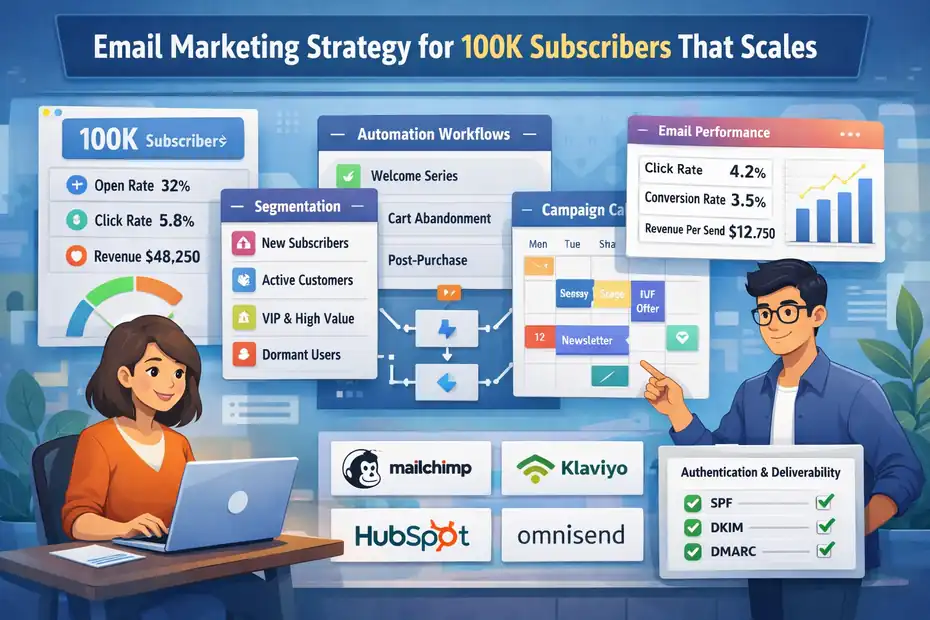
A scalable email marketing strategy for 100k subscribers is built around control. You need clear segmentation, send rules, suppression logic, automation coverage, and measurement that goes deeper than opens.
Think of it like this:
- Campaigns create moments: launches, promotions, announcements, newsletters.
- Automations create consistency: welcome, nurture, browse, cart, post-purchase, win-back.
- Segmentation protects relevance: active buyers should not receive the same pressure as cold subscribers.
- Rules protect the channel: frequency caps, engagement filters, and sunsetting rules stop over-mailing.
Email still delivers unusually strong returns compared with many channels. Litmus reports that many companies see email ROI between 10:1 and 36:1, and its broader ROI guidance still highlights email as one of the highest-return marketing channels. But those returns usually come from disciplined programs, not random blasts.
Build The Right Foundation Before You Send More Email
Before you optimize content, flows, or revenue targets, make sure the base layer is solid. At 100K subscribers, weak infrastructure creates expensive confusion.
Clean Up Deliverability And Technical Setup First
If your technical setup is shaky, better copy will not save you. This is the part many teams skip because it feels boring. I would not skip it.
- Step 1: Authenticate your domain. Bulk senders to Gmail need proper authentication, including SPF and DKIM, and Google also points bulk senders toward DMARC alignment and easy one-click unsubscribe expectations.
- Step 2: Separate sending reputation where possible. If your platform supports dedicated sending domains or IP reputation management, use them carefully. This is especially useful when transactional and promotional mail need cleaner separation.
- Step 3: Monitor complaint and bounce patterns. A list this size can hide quality issues for weeks if nobody checks segment-level spam or bounce behavior.
A practical example: if 18,000 old leads have not clicked in 10 months, continuing to hit them every week can make your whole program look weaker to inbox providers.
Fix List Hygiene Before Scaling Campaigns
More subscribers does not mean more real opportunity. Some portion of a 100K list is usually dead weight.
- Healthy list growth is not just acquisition. It is acquisition plus pruning.
- Inactive subscribers need rules. Define what “inactive” means for your business. That might be 90 days without opens and clicks, or 180 days without site activity or purchases.
- Sunset politely. Run re-engagement campaigns, then suppress non-responders.
Mailchimp’s benchmark data shows average open rates vary significantly by industry, with an overall benchmark around the mid-30% range, which is exactly why inactive names can distort what “normal” performance looks like.
A bloated list often makes marketers think they have a content problem when they actually have a hygiene problem.
Segment The List So Scale Does Not Kill Relevance
Segmentation is where a scalable strategy starts to feel smart. Without it, 100K subscribers quickly becomes 100K opportunities to annoy the wrong person.
Segment By Behavior First, Not Demographics Alone
A lot of teams overbuild persona slides and underbuild behavior segments. Behavior is usually the stronger signal because it reflects what people are doing right now.
I suggest starting with five practical groups:
- New subscribers: Joined recently and need orientation.
- Active non-buyers: Open and click, but have not converted.
- Recent customers: Need onboarding, support, and cross-sell logic.
- Loyal or high-value customers: Deserve exclusives, early access, and lower-friction selling.
- Dormant subscribers: Need reactivation or removal.
This structure is simple enough to run and strong enough to improve relevance quickly. It also prevents a common mistake: sending heavy promotional pressure to people who barely know your brand.
Add Engagement And Intent Layers
Once your base segments are working, add intent signals. This is where the strategy becomes more profitable.
- Engagement layer: 30-day, 60-day, and 90-day engaged groups.
- Interest layer: Category or topic preference based on clicks, page views, or purchases.
- Value layer: Average order value, repeat purchase count, or lead score.
- Stage layer: Prospect, first-time customer, repeat customer, at-risk customer.
Imagine you run a skincare brand. One subscriber clicks only acne content, another clicks only anti-aging products, and a third buys replenishment items every 45 days. Sending all three the same weekend campaign is lazy marketing. The list is big enough now that you can afford better logic.
Klaviyo’s benchmark reporting, built on very large data samples, reinforces the value of stronger engagement management by showing meaningful differences across industries in open rate, click rate, and revenue per recipient.
Design A Sending Calendar That Protects Revenue And Deliverability
At 100K subscribers, volume discipline matters as much as content quality. You do not need to send more just because you can.
Create A Weekly Send Structure With Clear Roles
Your calendar should tell each email what job it has. Too many large lists send campaigns that overlap, compete, or fatigue the same audience.
A simple structure might look like this:
- Email 1: Value-led newsletter with education, insight, or curated content.
- Email 2: Revenue campaign tied to an offer, launch, or seasonal angle.
- Email 3: Segment-specific email focused on one behavior or interest cluster.
- Automation layer: Always-on flows triggered by subscriber actions.
The point is not the exact number. The point is intentional spacing. A newsletter should not accidentally cannibalize a launch campaign. A win-back sequence should not collide with heavy promo sends.
Use Frequency Caps And Send Priority Rules
This is one of the most overlooked parts of a scalable email marketing strategy for 100k subscribers. Not every subscriber should receive every eligible message.
- Set a weekly cap: For example, no more than three promotional emails per seven days for most subscribers.
- Set exceptions: VIP buyers or highly engaged readers may tolerate more.
- Prioritize triggered emails over broad campaigns: Cart or browse intent usually deserves priority because it reflects immediate behavior.
- Suppress overlapping audiences: Someone in a post-purchase onboarding flow usually does not need the same sales push as a cold lead.
I believe frequency is less about “How many emails can we send?” and more about “How many useful messages can this segment tolerate before value drops?”
Use Automation To Carry More Of The Load
If your strategy depends mostly on campaigns, it will eventually break under its own weight. Large lists scale best when automations handle the predictable work.
Build The Core Flows First
Most brands do not need dozens of flows to win. They need a handful of flows that actually match customer behavior.
Start with these core automations:
- Welcome series: Introduce the brand, set expectations, and guide the first conversion.
- Browse or product interest flow: Follow up on viewed categories or products.
- Cart abandonment flow: Recover high-intent prospects.
- Post-purchase flow: Confirm the purchase, reduce buyer friction, and introduce the next action.
- Win-back flow: Re-engage customers or subscribers before they go fully cold.
This is where a lot of revenue hides. HubSpot cites standard ecommerce revenue-per-email ranges and notes that automated emails can outperform standard campaigns significantly on a per-email basis.
That matches what many operators see in practice: automations send less volume but produce more intent-aligned revenue.
Make Each Flow Smarter Instead Of Longer
Longer does not automatically mean better. Smarter usually wins.
- Welcome flow: Give one core promise per email instead of dumping everything at once.
- Cart flow: Address hesitation, not just urgency.
- Post-purchase flow: Help the customer succeed with the product before pushing the next sale.
- Win-back flow: Offer a reason to care, not just a discount.
Here is a realistic example. A coffee subscription brand might use:
- welcome email one for brand story,
- email two for roast matching,
- email three for social proof,
- email four for a first-order push.
That sequence usually beats a generic “10% off, still interested?” approach because it builds confidence before pressure.
Measure The Metrics That Actually Matter At 100K
At six figures, vanity metrics can waste months of decision-making. You need a measurement system that reflects revenue quality, not just activity.
Stop Judging Success By Opens Alone
Open rate still has directional value, but it is not enough to steer a large program. Privacy changes, image loading behavior, and inbox variation all reduce its usefulness when used alone.
Look at a tighter scorecard:
- Delivered rate: Are emails actually reaching inboxes?
- Click rate and click-to-open rate: Are people acting, not just opening?
- Conversion rate: Are clicks turning into the outcome you want?
- Revenue per recipient: How much value did this send generate across the eligible audience?
- Unsubscribe and complaint rate: Are you trading short-term wins for long-term damage?
Omnisend reported 2024 ecommerce email open rates at 26.6%, with campaign click rates around 1.22%, while click-to-conversion efficiency improved. Meanwhile, other benchmark providers show much higher averages in different ecosystems and industries.
The takeaway is not to obsess over one benchmark. It is to compare your segments against themselves over time.
Use Segment-Level Reporting, Not Global Averages
This is where many teams get fooled. A global dashboard can hide a lot of pain.
Track performance by:
- subscriber age,
- engagement level,
- acquisition source,
- product interest,
- customer stage,
- and campaign type.
For example, if your welcome flow converts well but newsletter clicks are dropping, the answer is not “email is underperforming.” The answer is probably content-market fit inside one message type.
I recommend building a monthly report that answers three questions:
- Which segments became stronger?
- Which sends created fatigue?
- Which automations generated outsized revenue per recipient?
That kind of reporting leads to better decisions than broad averages ever will.
Avoid The Common Mistakes That Break Large Email Programs
Most large-list problems are not advanced problems. They are basic mistakes repeated at scale.
Sending Too Broadly, Too Often, Too Soon
This is the classic failure pattern. Teams grow the list, add more promotions, and assume volume equals maturity. It does not.
Common issues include:
- emailing unengaged subscribers too aggressively,
- stacking multiple offers in the same week without audience control,
- forcing every campaign to the full list,
- and reusing subject-line tactics that spike opens but hurt trust.
Google’s bulk-sender requirements also make it clear that easy unsubscribing and complaint control are no longer optional behaviors for large senders. If your strategy traps people instead of helping them leave cleanly, your performance usually gets worse anyway.
Confusing More Content With Better Content
I’ve seen email calendars that look impressive in meetings and underperform in reality. More sends, more templates, and more ideas do not fix weak message discipline.
A strong email usually does three things well:
- it reaches the right segment,
- at the right moment,
- with one clear job.
That sounds almost too simple, but simplicity scales. Overloaded emails often confuse readers. They also make testing harder because you cannot tell what actually caused the result.
A practical rule I like: Each email should have one primary conversion goal. If you cannot explain the email’s job in one sentence, it is probably trying to do too much.
Optimize And Scale Without Burning Out Your Audience
Once the basics are stable, growth comes from compounding improvements. This is where disciplined testing matters.
Run Tests That Matter To Revenue, Not Just Curiosity
At 100K subscribers, you likely have enough volume to test properly. That does not mean every test is worth running.
Prioritize tests in this order:
- Audience: Who receives the message?
- Offer: What value is being presented?
- Timing: When does the message arrive?
- Creative angle: What story or framing carries the email?
- Subject line: Helpful, but not the whole game.
Subject lines are fine to test, but they are often the most overrated lever. I would much rather improve segmentation or offer-message match first.
Use Personalization Carefully
Personalization helps when it increases relevance. It hurts when it becomes gimmicky.
Useful personalization includes:
- recommended products based on actual behavior,
- content based on category interest,
- replenishment timing based on usage windows,
- loyalty messaging based on customer stage.
Litmus has also published examples where dynamic content and live personalization produced meaningful click and conversion lifts in specific brand cases. That does not mean every brand needs flashy dynamic blocks. It means the right personalized experience can outperform generic broadcasting when it reflects real customer context.
My advice is simple: personalize the decision, not just the greeting. “Hi Sarah” is not strategy. Relevant timing and content is.
Choose Tools And Infrastructure That Support Growth
Tools should support the strategy, not define it. Still, at 100K subscribers, your platform choices do matter because operational friction gets expensive.
What Your Email Platform Must Handle At This Size
When comparing platforms or evaluating whether you have outgrown your current one, focus on core capabilities:
- Segmentation depth: Can you build fast behavioral audiences without hacks?
- Automation flexibility: Can flows branch intelligently by event, value, or engagement?
- Deliverability controls: Can you manage suppression, authentication, and sender reputation properly?
- Reporting quality: Can you see revenue per recipient, flow performance, and audience trends clearly?
- Integration strength: Can your ecommerce, CRM, and analytics systems pass usable data into email?
For ecommerce-focused teams, platforms with stronger event-based segmentation often outperform simpler newsletter-first tools. For B2B or publisher models, CRM alignment and lifecycle logic may matter more than catalog personalization.
Think In Terms Of Operational Cost, Not Just Subscription Cost
A cheaper platform can become expensive if it creates manual work or weak segmentation. A pricier platform can pay for itself if it improves targeting, automation, and reporting enough to lift revenue.
Klaviyo, Mailchimp, HubSpot, and similar platforms all appear in market conversations because they serve different maturity levels and use cases. Their benchmark and analytics content also highlights how much performance varies by industry and setup.
In practice, I would evaluate tools using one question: does this platform make it easier to send fewer, smarter emails to better-defined audiences? If the answer is no, it is probably not helping you scale.
Build A Simple 90-Day Plan To Improve Results
A great strategy becomes useful only when it turns into execution. You do not need a giant transformation project to improve a 100K-subscriber program. You need focused sequencing.
Days 1 To 30: Stabilize The Foundation
Your first month should be about control, not creativity.
- Week 1: Audit authentication, unsubscribe experience, bounce patterns, and spam complaints.
- Week 2: Define engaged, unengaged, and sunset segments.
- Week 3: Review every campaign type and assign each one a clear role.
- Week 4: Pause sends to the coldest subscribers unless they enter a re-engagement path.
This stage is often where hidden gains appear. Just reducing mail to unengaged names can improve performance quality faster than writing better copy.
Days 31 To 60: Rebuild Relevance
Now you improve audience matching.
- Step 1: Launch or refine behavior-based core segments.
- Step 2: Add frequency caps and campaign priority rules.
- Step 3: Tighten your welcome and post-purchase flows.
- Step 4: Build a basic dashboard for click rate, conversion rate, revenue per recipient, unsubscribes, and complaints by segment.
The goal here is not perfection. It is a cleaner system that sends more relevant messages by default.
Days 61 To 90: Optimize For Compounding Gains
This is where you start acting like a high-performing operator.
- Test 1: Segment-specific offers instead of list-wide offers.
- Test 2: Different timing windows for active versus moderate-engagement subscribers.
- Test 3: More focused newsletter formats with one primary CTA.
- Test 4: Improved win-back logic before hard suppression.
By the end of 90 days, you should know which segments drive the most value, which flows deserve expansion, and which parts of your list should receive less attention. That is what scale looks like in practice: not more noise, just better control.
Final Thoughts
A scalable email marketing strategy for 100k subscribers is not about sending the most email. It is about building a system that stays relevant as volume grows. That means better segmentation, cleaner list hygiene, stronger automation, smarter measurement, and real respect for subscriber fatigue.
I believe this is where many teams finally separate “we have a big list” from “we have a high-performing email program.” A 100,000-person list can produce serious revenue, but only if you manage it like a portfolio of audiences rather than one giant crowd. Do that well, and email stops feeling chaotic. It starts feeling dependable.
FAQ
What is an email marketing strategy for 100K subscribers?
An email marketing strategy for 100K subscribers is a structured system for managing large-scale campaigns, segmentation, and automation. It focuses on sending relevant messages to defined audience groups while maintaining deliverability, engagement, and consistent revenue performance without overwhelming subscribers.
How often should you email a list of 100,000 subscribers?
The ideal frequency depends on engagement and segmentation, but most brands send 2–4 emails per week. It is important to use frequency caps and prioritize relevant messages so subscribers receive valuable content without experiencing fatigue or unsubscribing.
Why is segmentation important for large email lists?
Segmentation ensures subscribers receive content based on behavior, interests, and engagement levels. For large lists, it improves open rates, click rates, and conversions while protecting deliverability by reducing irrelevant emails sent to disengaged users.
What metrics matter most for email marketing at scale?
Key metrics include click rate, conversion rate, revenue per recipient, and unsubscribe rate. These provide better insight than open rates alone and help measure real performance, especially when managing large subscriber bases.
How do you improve deliverability with 100K subscribers?
To improve deliverability, maintain list hygiene, authenticate your domain, remove inactive subscribers, and limit spam complaints. Sending relevant emails to engaged users consistently helps build a strong sender reputation and improves inbox placement.

Juxhin B is a digital marketing researcher and founder of JAK Digital Hub, specializing in email marketing software, marketing automation platforms, and digital growth tools. His work focuses on software testing, platform comparisons, and real-world performance analysis to help businesses choose the right marketing technology.
Related posts:
 Email Leads Cost For 20K Contacts: What Should You Pay?
 Email Leads For 100K Contacts: What It Really Costs
 Cheaper Email Automation System For Growing List Fast
 Email Marketing Jobs Without Degree: 10 Real Opportunities
 Email Marketing Strategy vs Paid Ads: Where to Invest
 Better Email Marketing Strategy for Ecommerce Growth