Table of Contents
Some links on JAK Digital Hub are affiliate links, meaning we may earn a small commission at no extra cost to you. Read full disclaimer.
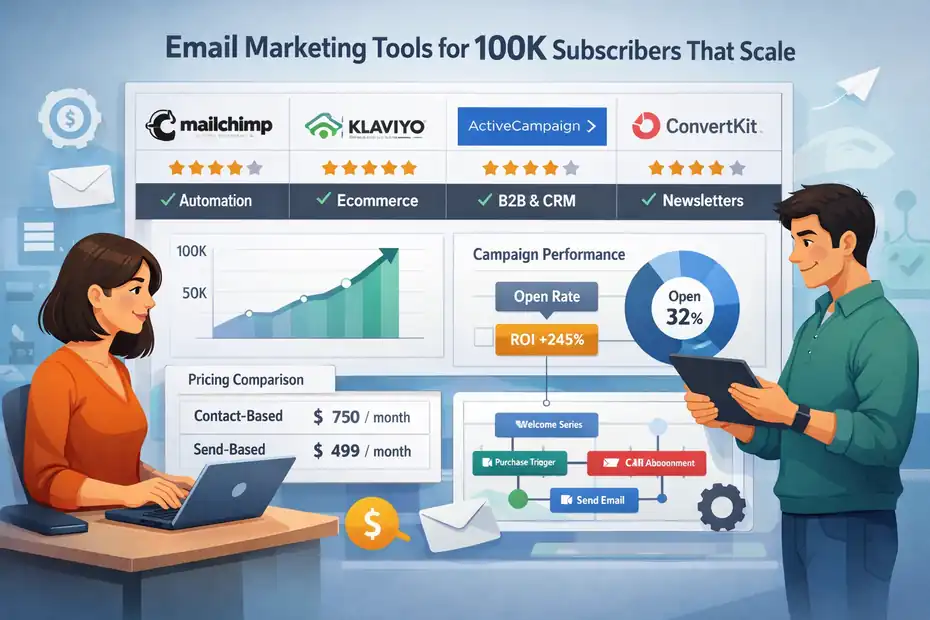
Email marketing tools for 100k subscribers are not all built for the same job, and that matters more than most teams realize. Once your list gets this big, the wrong platform can quietly drain budget, slow your team down, and make segmentation feel harder than it should.
I’ve found that at this stage, you are no longer choosing a “newsletter app.” You are choosing a delivery system, automation engine, reporting stack, and growth partner all at once.
The best option depends less on brand popularity and more on your sending model, revenue model, and how complex your audience logic really is.
What Changes When You Reach 100K Subscribers
At 100,000 subscribers, email stops being a lightweight marketing task and starts acting like infrastructure.
That shift is why so many growing brands outgrow tools they used happily at 5,000 or 20,000 contacts.
Why 100K Is A Different Buying Decision
It is no longer just about sending newsletters. At 100K subscribers, you are buying for cost control, segmentation depth, workflow reliability, and deliverability stability. A tool that feels simple at a lower tier can become expensive or restrictive when every resend, duplicate contact, or automation branch multiplies across a six-figure list.
Pricing models start to matter more than features pages. Some platforms charge by stored contacts, some by active profiles, and some by monthly email volume. That changes the math dramatically. A brand that emails once a week may save a lot on a send-based platform, while a store running daily campaigns and automated flows may benefit from a contact-based plan with stronger ecommerce data handling.
Your mistakes get magnified. A weak welcome sequence at 2,000 subscribers is a missed opportunity. The same weak sequence at 100K is a revenue leak. A bad segmentation rule can send the wrong message to 40,000 people in minutes. That is why I usually tell teams at this stage to evaluate email platforms like operational systems, not just marketing tools.
Automation starts outperforming campaigns by a wide margin. Klaviyo’s 2026 benchmarks show automated flows consistently outperform campaign emails, with flow emails producing about 3x higher click rates and 13x higher placed order rates than campaigns.
Omnisend reports a similar pattern, with automated emails generating far more revenue per email than scheduled campaigns. That tells you something important: the platform you choose must make automation easy to build and easy to maintain.
The Four Capabilities That Actually Matter At Scale
Deliverability control comes first. I know flashy builders get attention, but inbox placement is the real foundation. At 100K subscribers, domain authentication, list hygiene, bounce handling, sender reputation, and suppression logic all matter more than clever templates. ActiveCampaign’s own 2026 benchmark guidance points directly to authentication and list cleanliness when open rates lag.
Segmentation has to be practical, not theoretical. Lots of platforms promise segmentation. Fewer make it easy for a lean team to build “clicked product A but did not purchase in 14 days” or “engaged in the last 60 days but skipped the last two launches.” That is where tool quality shows up in real life.
Reporting has to connect to revenue. You do not just need opens and clicks. You need enough attribution and funnel visibility to decide whether your biggest gains will come from frequency control, better onboarding, cleaner segments, or stronger lifecycle automation.
Your team has to be able to move fast. At this list size, I would rather use a tool that is 10% less “advanced” but 40% easier to operate. Complexity creates hidden costs. If your team avoids building flows because the automation builder feels painful, the feature technically exists but practically does not.
How To Choose The Right Platform For Your Sending Model
This is the part many comparison posts skip. The best email marketing tools for 100k subscribers depend on how you send, not just how many people are on the list.
Match The Tool To Your Business Model First
Ecommerce brands need behavior-driven automation. If your revenue depends on browse abandonment, cart recovery, post-purchase cross-sells, win-back campaigns, and product-based segmentation, your platform has to understand customer behavior and catalog data. In practice, that usually pushes ecommerce brands toward tools like Klaviyo or Omnisend because event-driven automations and store integrations are central to the workflow.
Media brands and creators need publishing efficiency. If you run a newsletter-first business, paid subscriptions, sponsorships, referrals, and audience growth mechanics may matter more than deep product-event logic. In that case, creator-focused tools can make more sense than ecommerce-heavy platforms.
B2B and service businesses need CRM-aware logic. If your team cares about lead scoring, deal stages, multi-step nurturing, sales handoff, and lifecycle tagging, you need stronger contact management and sales alignment. That is where ActiveCampaign often enters the conversation.
Low-frequency senders should watch pricing closely. Brevo’s pricing is built around email volume rather than subscriber count, which can be a major advantage for businesses with large databases that do not send constantly. Its Starter plan begins from 5,000 emails per month, and the overall structure is built around send volume rather than just stored contacts.
Use This Simple Decision Filter Before You Compare Features
I suggest using four questions before opening any pricing page.
- How often do you email the full list? If the answer is rarely, send-based pricing deserves serious attention.
- How much revenue comes from automations versus broadcasts? If automations drive real revenue, prioritize workflow depth over newsletter polish.
- Does your team need CRM-style lifecycle management? If yes, do not choose a tool built mainly for simple newsletters.
- Do you need ecommerce data, media monetization, or B2B lead nurturing? Your core model should narrow the field quickly.
Imagine you run a skincare store with 100K subscribers and email five times a week. Cheap send-based pricing may look attractive at first, but if your abandoned cart and replenishment flows are weak, the revenue loss can erase the savings.
Now imagine a software company with 100K leads but only two newsletters a month and a few nurture tracks. In that case, a send-based model can be incredibly efficient.
That is why I believe “best” is the wrong first question. The better question is: which platform fits the way your database earns money?
Best Email Marketing Tools For 100K Subscribers By Use Case
Now let’s get practical. These are the tools I would put on a serious shortlist, based on how different teams actually operate.
Klaviyo: Best For Ecommerce Brands That Need Revenue-Level Segmentation
Why it scales well. Klaviyo is built around customer data, product events, and revenue attribution. For ecommerce teams, that matters because your best automations usually depend on behavior, not just list membership. Browse abandonment, cart recovery, predicted next purchase timing, VIP segmentation, and product-based targeting are much easier when the platform is designed for commerce from the start.
Where it wins. I would put Klaviyo near the top for stores on Shopify and similar stacks that need to tie email activity directly to sales outcomes. Its 2026 benchmark data also reinforces the value of flow-first email programs, which aligns with how strong ecommerce teams actually grow.
Where to be careful. Costs can climb quickly if your database is large and highly active. That does not automatically make it overpriced, but it does mean you need a clean list and a strong suppression strategy. If 20,000 inactive profiles sit untouched for months, you may be paying for people who are no longer helping the business.
My take. If your store earns serious revenue from automations and product-triggered messaging, Klaviyo is often worth the premium. I would not choose it for a simple weekly newsletter business, but for ecommerce retention, it is still one of the strongest fits.
ActiveCampaign: Best For Lifecycle Automation And B2B Nurture Depth
Why it scales well. ActiveCampaign is strong when your email system is not just broadcasting content but moving people through a lifecycle. That includes lead nurturing, sales-qualified routing, conditional automations, scoring, and relationship-based segmentation.
Where it wins. The platform pricing page emphasizes marketing automation, email marketing, segmentation, landing pages, and CRM/ecommerce integrations across plans, which tells you exactly where it wants to compete. Its 2026 benchmark guidance also leans hard into list quality and personalization, two areas that matter a lot once your database gets large.
Where to be careful. ActiveCampaign can feel like more system than some teams actually need. If your program is mostly newsletters plus a welcome sequence, you may end up paying with time and complexity rather than money alone.
My take. I recommend ActiveCampaign when your email channel overlaps with sales process, lead qualification, or more nuanced lifecycle journeys. It is especially strong for B2B, coaches, education brands, and service businesses that need logic-heavy automation.
Mailchimp, Brevo, Kit, MailerLite, And Omnisend: Best Secondary Fits Depending On Priorities
Mailchimp works when you want familiarity and broad capability. Mailchimp’s Standard plan supports up to 100,000 contacts, with a monthly send limit equal to 12 times your contact limit, while Premium goes higher and supports larger databases. That makes it viable at 100K, but the cost and send limits need careful review if you email frequently.
Brevo works when send volume is the real pricing lever. Because Brevo structures plans around email volume, it can be a strong value option for large lists that are not emailed aggressively every week. I particularly like that for businesses with big lead databases and selective campaigns.
Kit works for creators and newsletter-led businesses. Kit’s pricing page highlights automated sequences, API access, direct app integrations, and free migrations, which fits creators, educators, and audience-first businesses better than product-heavy ecommerce brands.
MailerLite works for lean teams that want simplicity. MailerLite is still one of the cleaner, more approachable options for brands that need newsletters, landing pages, and automation without a complicated operating environment. It is not the most advanced option in every category, but it often gives smaller teams a better chance of actually using what they pay for.
Omnisend is a serious ecommerce alternative. Omnisend starts at lower entry pricing than some competitors and includes access to all features even on free, with pricing that scales for growing ecommerce brands. Its own 2026 reporting continues to show strong returns from automation and email as a revenue channel.
Pricing Reality At 100K Subscribers
Pricing at this level is where many teams get surprised. The cheapest-looking tool is often not the cheapest operating choice.
Understand The Three Main Pricing Models
Contact-based pricing charges for stored subscribers. This is common and easy to understand, but it gets painful when you keep large inactive segments in the account. Mailchimp is a clear example of contact-based scaling, with Standard supporting up to 100,000 contacts and Premium going beyond that.
Send-based pricing charges for monthly email volume. This model can be excellent for low-frequency senders. Brevo is the cleanest example in this group because the plan structure starts with monthly email allowances instead of primarily subscriber tiers.
Hybrid or usage-sensitive pricing changes based on activity and feature depth. This can work well if your most valuable contacts are also your most active contacts, but it requires closer monitoring. Tools in this camp can feel reasonable until your engagement or workflow depth expands.
Here is the practical takeaway: a company with 100K subscribers sending four campaigns a month and basic automations may spend far less on a send-based platform than on a premium ecommerce suite. But a fast-growing store with high automation revenue may make more money on the expensive platform because better segmentation and triggered messaging lift conversion.
Hidden Costs Most Teams Miss
Inactive contacts are expensive when left unmanaged. If 30% of your list has not engaged in 180 days, you may be paying a premium to store dead weight. I recommend building an engagement-based sunset policy before you migrate or upgrade.
Extra sends create quiet overages. Mailchimp’s send limits matter here. A 100K-contact Standard account with a 12x monthly send cap sounds generous until you count campaigns, resends, automations, and tests. High-frequency programs can bump into limits faster than expected.
Complexity has labor cost. A platform that takes your team twice as long to build, QA, and troubleshoot is not cheaper just because the invoice is lower. I have seen brands save a few hundred dollars on software and lose much more in slower execution.
Migration is never truly free, even when onboarding is. Kit advertises free migrations, which is valuable, but every switch still carries internal time cost, QA cycles, template cleanup, tagging fixes, and reporting resets.
A Simple Budget Framework I Recommend
Use this formula before committing:
Monthly platform cost + estimated implementation labor + expected revenue lift from better automation – waste from inactive contacts = real platform cost.
That is the number that matters. Not the hero price on the homepage.
How To Set Up Your Platform So It Actually Scales
Choosing the tool is only half the job. The setup determines whether your 100K-subscriber account stays clean, fast, and profitable.
Build Your Account Architecture Before You Import Everyone
Start with naming rules. Decide how you will name segments, automations, forms, campaigns, and custom fields before the account gets messy. Something as simple as “Lifecycle – Welcome – New Leads” versus “Store – Cart Abandonment – 4 Hour Delay” saves real time later.
Keep tags and fields lean. I suggest using tags for temporary states and fields for lasting attributes. Many teams do the opposite and end up with bloated accounts full of duplicate logic. At 100K subscribers, clutter becomes an operational problem, not just a cosmetic one.
Separate source from behavior. A subscriber’s acquisition source should not be confused with their current lifecycle stage. “Webinar signup” and “high intent lead” are different things. Keep your data model clean so segmentation stays trustworthy.
Document suppression logic early. This means defining who should not receive what. New buyers may need to exit promo pushes. Unengaged contacts may need reduced frequency. If you set those rules upfront, your campaigns stay smarter as the list grows.
Set Up The Core Automations First
I would launch these before worrying about advanced experiments:
- Welcome series: Introduce the brand, set expectations, and drive the first key action.
- Engagement split: Separate active readers from passive subscribers within the first 30 to 60 days.
- Re-engagement flow: Try to recover attention before inactive contacts become expensive baggage.
- Post-conversion follow-up: Move buyers or booked leads into the next logical stage.
- Sunset automation: Suppress or remove contacts who stay inactive after re-engagement.
This setup matters because automation is where scale compounds. Klaviyo’s and Omnisend’s 2026 data both show that automated messages materially outperform standard campaigns on clicks, orders, and revenue. That means your biggest wins often come from building a few essential flows properly rather than sending more broadcasts.
Protect Deliverability From Day One
Authenticate your domain. This is non-negotiable. A big list without proper authentication is asking for inbox problems.
Warm up carefully after migration. Do not blast 100K people on day one from a new setup. Segment by recent engagement first, then expand.
Watch engagement by segment, not only overall. A decent overall open rate can hide a stale chunk of subscribers dragging down your reputation.
Clean regularly. ActiveCampaign’s benchmark guidance is blunt here: when open rates are weak, list cleanliness and sender reputation are some of the first places to look. I agree completely.
Common Mistakes That Break Email Programs At 100K
This is where a lot of teams get stuck. They do not fail because the platform is bad. They fail because the system around it never matures.
Mistake 1: Paying For List Size Instead Of Engagement Quality
Big list vanity is expensive. A 100K list sounds impressive, but if only 35,000 people engage regularly, your real asset is smaller than the dashboard suggests. I recommend tracking active subscribers separately from total subscribers and making platform decisions around the active group first.
Old contacts can damage more than budget. Unengaged segments hurt reporting quality and can weaken deliverability. That means dead weight costs you twice.
A realistic example: Say a brand keeps 25,000 cold subscribers on a contact-priced platform because deleting them feels scary. They pay more every month, campaign metrics flatten, and they mistake the weak averages for a creative problem. In reality, the biggest fix was list hygiene.
Mistake 2: Overbuilding Automation Before The Basics Work
Fancy branches do not save weak messaging. I have seen teams create huge workflow maps with seven splits, four wait steps, and a dozen conditions before they have one strong welcome series. That is backwards.
Start with the journeys closest to revenue. For ecommerce, that may be welcome, cart abandonment, browse abandonment, and post-purchase. For B2B, it may be lead magnet nurture, demo follow-up, and sales reactivation. For creators, it may be onboarding, content engagement, and paid conversion prompts.
I believe simple flows with sharper copy almost always beat clever flows with average copy. Automation should improve timing and relevance, not hide mediocre offers.
Mistake 3: Measuring Opens And Clicks Without Business Context
Performance metrics need business meaning. Opens can tell you something about subject lines and inbox placement, but they do not tell you enough about revenue, lead quality, or retention by themselves.
Use benchmarks as reference points, not as your whole goal. Omnisend reports average campaign opens around 30.7% globally and automated email opens around 38%, while ActiveCampaign’s overall click rate benchmark sits at 6.21% in its 2026 data set.
Those are useful directional numbers, but your actual target should connect to outcomes like sales per recipient, demo bookings, repeat purchase rate, or paid subscriber conversion.
Advanced Optimization Strategies For Teams Ready To Grow Further
Once your account is stable, the next gains usually come from better segmentation, better frequency control, and better monetization logic.
Segment By Intent, Not Just Demographics
Behavior beats biography. Age, role, or location can help, but recent actions usually predict revenue more accurately. Click patterns, product interest, purchase recency, site activity, and engagement depth are stronger segmentation signals in most cases.
Build intent tiers. One approach I like is a three-tier model: high intent, warm intent, and passive. High intent subscribers get faster follow-up and stronger offers. Passive subscribers get lower frequency and more reactivation-oriented messaging.
Klaviyo and Omnisend benchmark patterns support this approach. When automated, behavior-driven messages consistently outperform scheduled campaigns, that is a sign to organize your account around intent signals, not just broad list categories.
Tune Frequency Based On Engagement Windows
Do not send everyone at the same pace. Your most engaged 10% can often tolerate more frequency than the coldest 40%. Sending one universal cadence is usually lazy segmentation disguised as consistency.
Use engagement windows. Try 30-day, 60-day, and 90-day activity segments. Then set different campaign eligibility rules for each group. This protects deliverability and reduces unsubscribes without lowering total opportunity.
Imagine two subscribers. One has clicked three emails and visited pricing pages this week. The other has not opened anything in four months. Sending both the same campaign cadence makes no strategic sense. Your platform should make this split easy.
Build A Revenue Layer On Top Of Your Newsletter Layer
Your newsletter should not carry the whole program. At 100K subscribers, the strongest email systems combine recurring content with lifecycle monetization. That can mean upsells after purchase, replenishment reminders, webinar follow-ups, paid membership prompts, or sales-call invitations depending on the business.
Automation should create compounding returns. Omnisend reports that automated emails generate significantly more revenue per message than campaigns, and one in three people who click an automated email make a purchase in its 2026 benchmark set. Even if your exact numbers differ, the lesson is clear: revenue usually grows faster when triggered emails do more of the heavy lifting.
My advice. If you are already sending good campaigns, your next jump probably does not come from writing more emails. It comes from making each subscriber’s path more relevant.
Final Verdict: Which Tool Should You Choose?
If you want the clearest answer, here is how I would simplify it.
Choose Klaviyo if you run ecommerce and want the strongest behavior-based revenue automation.
Choose ActiveCampaign if your growth depends on lifecycle logic, lead nurturing, and CRM-style automation.
Choose Omnisend if you want ecommerce-focused capability with a strong automation angle and often friendlier entry pricing.
Choose Brevo if you have a large list but relatively controlled send volume, and pricing efficiency matters.
Choose Kit if you are a creator, educator, or newsletter-led business monetizing audience attention more than product-event data.
Choose Mailchimp or MailerLite if ease of use, familiarity, and broad capability matter more than pushing the most advanced automation edge.
At 100K subscribers, the best email marketing tool is the one that matches how your audience buys, how your team works, and how your costs scale as your program gets better. That is the real test. Not the homepage demo. Not the influencer recommendation. The actual operating fit.
And honestly, that is good news. Because once you choose from that lens, the decision gets much easier.
FAQ
What is the best email marketing tool for 100k subscribers?
The best email marketing tool for 100k subscribers depends on your business model. Ecommerce brands often benefit from tools with strong automation and product tracking, while B2B or creators may prefer platforms focused on lifecycle management or newsletters. The right choice balances cost, scalability, and ease of use.
How much do email marketing tools cost for 100k subscribers?
Pricing varies widely depending on the platform and pricing model. Contact-based tools charge for stored subscribers, while send-based tools charge by email volume. Monthly costs can range from affordable plans for low-frequency senders to premium pricing for advanced automation and high-volume campaigns.
Which email platform is best for ecommerce at scale?
For ecommerce at scale, platforms with behavior-based automation and deep segmentation perform best. These tools allow you to trigger emails based on browsing, purchases, and customer activity, which helps increase conversions and customer lifetime value through highly targeted messaging.
How do I manage deliverability with a large email list?
Managing deliverability requires maintaining a clean list, authenticating your sending domain, and monitoring engagement regularly. Segment active and inactive users, reduce sends to unengaged contacts, and gradually warm up new domains to maintain strong inbox placement and avoid spam filtering issues.
Are automation workflows necessary for large email lists?
Yes, automation workflows become essential as your list grows. They allow you to send relevant messages based on user behavior without manual effort. Automated emails often generate higher engagement and revenue compared to campaigns, making them a key driver of performance at scale.

Juxhin B is a digital marketing researcher and founder of JAK Digital Hub, specializing in email marketing software, marketing automation platforms, and digital growth tools. His work focuses on software testing, platform comparisons, and real-world performance analysis to help businesses choose the right marketing technology.
Related posts:
 Cheaper Email Automation System For Growing List Fast
 Should You Upgrade Email Automation Platform For Scaling?
 Best Email Automation Tool For Affiliate Marketers
 Best Email Tools Compared: 7 That Actually Convert
 Best Email Tools to Turn Subscribers Into Sales
 How To Switch Email Automation Software Safely Today