Table of Contents
Some links on JAK Digital Hub are affiliate links, meaning we may earn a small commission at no extra cost to you. Read full disclaimer.
How to build email marketing strategy for ecommerce is one of those questions that sounds simple until you actually sit down to do it. You send a few campaigns, maybe set up a welcome email, and then realize sales are not growing the way you hoped.
I’ve seen this happen a lot. The good news is that a strong ecommerce email strategy is not about sending more emails. It is about sending the right message, to the right person, at the right moment, with a system that keeps improving over time.
Understand What An Ecommerce Email Marketing Strategy Actually Needs To Do
A real strategy is bigger than promotions. Before you pick flows, templates, or tools, you need to define what email should do inside your store’s growth system.
Your Strategy Should Support Revenue, Retention, And Customer Experience
Many ecommerce brands treat email like a discount channel. That is usually where performance starts to flatten. A better approach is to think of email as your retention engine.
It helps you turn first-time visitors into subscribers, subscribers into customers, customers into repeat buyers, and repeat buyers into loyal fans.
That matters because email still delivers strong ROI for B2C marketers, and it continues to rank among the highest-performing owned channels for revenue efficiency. Ecommerce brands also rely heavily on segmentation and automation to outperform generic campaign sends.
Here is the mindset I recommend:
- Revenue goal: Drive first purchase, repeat purchase, and higher average order value.
- Retention goal: Keep customers engaged between purchases.
- Experience goal: Make the inbox feel useful, relevant, and timely.
When these three pieces work together, your email strategy stops feeling random. It becomes a system. Imagine you run a skincare store.
One email might educate a new subscriber about ingredients, another might recover an abandoned cart, and a third might remind a customer to reorder 45 days later. Those emails serve different jobs, but together they build sales.
Define The Core Metrics Before You Build Anything
A lot of ecommerce stores obsess over open rate first. I get why. It is visible and easy to track.
But in 2026, open rates are useful only when paired with deeper signals because privacy changes can distort them. Click rate, click-to-open rate, conversion rate, revenue per recipient, unsubscribe rate, and list growth tell you much more about whether your strategy is working.
Benchmark providers now emphasize that segmentation, automation, and revenue-based analysis matter more than broad vanity metrics alone.
I suggest building your strategy around these KPIs:
- List growth rate
- Welcome flow conversion rate
- Abandoned cart recovery rate
- Campaign revenue per recipient
- Repeat purchase rate
- Unsubscribe and spam complaint rate
A healthy benchmark context helps too. Recent benchmark sources show average click rates are still low across email overall, which means even small improvements in targeting and message relevance can create outsized revenue gains.
Build The Foundation Before You Send More Emails
Most weak ecommerce email programs do not fail because of creativity. They fail because the foundation is messy.
Start With Audience Capture And Permission-Based List Growth
If your list growth strategy is weak, everything downstream gets harder. You cannot automate what you never capture. And you definitely do not want to buy a list or use scraped contacts. That destroys deliverability, hurts engagement, and attracts the wrong people.
Your first job is to create intentional signup points across the store. These usually include pop-ups, embedded forms, checkout opt-ins, quiz forms, landing pages, and account creation touchpoints. The key is matching the offer to the visitor’s intent.
For example:
- A first-time visitor might respond to a welcome discount or free shipping offer.
- A category browser might respond to a style guide, bundle quiz, or buying guide.
- A returning customer might respond to VIP access or restock alerts.
I believe the smartest list growth offers do one thing well: they make the value of subscribing obvious. “Join our newsletter” is weak. “Get 10% off your first order and weekly restock drops” is much clearer.
Keep your forms simple. Ask for email first. Only add extra fields like product preference, gender, pet type, or skin concern when that data will actually improve segmentation later.
Clean Data Structure Makes Segmentation Possible Later
This part is not glamorous, but it saves you later. Every ecommerce email strategy gets stronger when the store collects and organizes the right customer data from day one.
At minimum, you want to capture:
- Source of signup
- Product/category interest
- Purchase history
- Email engagement activity
- Lifecycle stage
- Location if relevant for shipping, seasons, or local offers
Let me break it down simply. If someone signs up from a “running shoes” collection page, you already know something useful. If they later buy socks but not shoes, that tells you even more. If they click every training-content email but ignore sale campaigns, you have a profile you can act on.
Without this structure, every campaign becomes a broad blast. With it, you can send smarter emails that feel more personal without sounding creepy.
Map The Customer Journey Before Writing Campaigns
This is where strategy becomes practical. You need to know what customers need at each stage.
Break Your Ecommerce Journey Into Clear Email Stages
Most stores need at least five lifecycle stages:
- Subscriber: Has joined the list but has not purchased.
- New customer: Has placed a first order.
- Active customer: Has purchased and still engages.
- Lapsing customer: Has gone quiet or delayed a normal reorder cycle.
- Loyal or VIP customer: Buys repeatedly and spends more than average.
Each stage needs different messaging. A new subscriber may need trust, product education, and a reason to buy. A loyal customer may need exclusivity, referrals, bundles, or early access. Sending the same weekly promotion to both people is lazy targeting, and it usually costs sales.
In my experience, this is the biggest shift that improves performance fast. Once you stop asking, “What campaign should we send this week?” and start asking, “What does this segment need next?” the whole program gets sharper.
Match Email Intent To Customer Readiness
Here is a simple framework I like:
- Awareness emails: Explain product value, brand story, use cases, and social proof.
- Consideration emails: Handle objections, compare options, explain fit, shipping, or guarantees.
- Conversion emails: Use urgency, incentives, bundles, reminders, or deadlines.
- Retention emails: Teach usage, encourage repeat purchase, cross-sell logically, and deepen trust.
- Reactivation emails: Re-engage cold subscribers or win back old customers.
Imagine you sell coffee subscriptions. A first-time subscriber might get education on roast profiles and brew methods. A recent buyer might get brewing tips and reorder reminders. A lapsed customer might get a “still interested?” email with a curated offer based on what they bought before.
That is strategy. Not just sending emails, but matching message to readiness.
Set Up The Essential Automated Flows First
If you only build one part of your ecommerce email strategy properly, make it automation. Automated flows are usually where the highest-intent revenue lives.
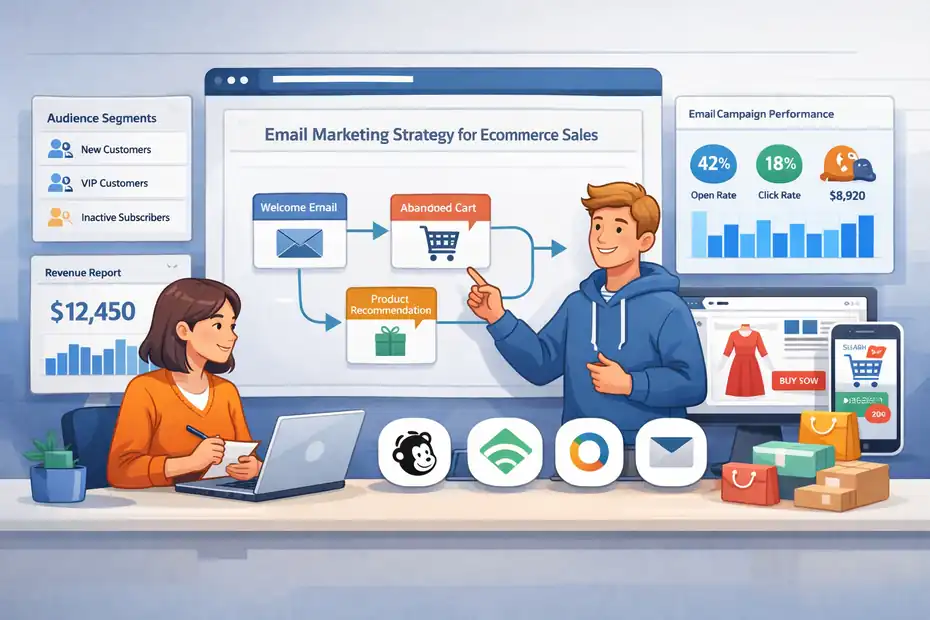
Welcome Flow: Turn New Subscribers Into First-Time Buyers
Your welcome flow is not just a hello. It is your first conversion sequence. It should introduce the brand, reduce hesitation, and guide the first purchase.
A strong welcome flow usually includes 3 to 5 emails:
- Email 1: Deliver the promised offer and set expectations.
- Email 2: Share bestsellers, categories, or a simple “start here” path.
- Email 3: Build trust with reviews, results, founder story, or product education.
- Email 4: Handle objections like shipping, returns, sizing, or compatibility.
- Email 5: Add urgency before the introductory offer expires.
I suggest keeping the first email very clear. Do not bury the offer under too much brand talk. Then use the next messages to help the subscriber choose confidently.
One of my favorite shortcuts here is reducing choice overload. Instead of showing 18 products, show 3 “best places to start” based on customer type. That small change often improves click quality because the reader knows what to do next.
Abandoned Cart And Browse Abandonment Flows Recover High Intent
These are essential because the customer has already shown intent. Cart abandonment is obvious: they added products and left. Browse abandonment catches people who viewed product pages or categories but never added to cart.
Your abandoned cart sequence should do more than say, “You left something behind.” It should answer the silent objections:
- Is this worth the price?
- Will it fit me or work for me?
- Can I trust this brand?
- Should I buy now or wait?
A good sequence might look like this:
- Email 1: Reminder with product image and direct return-to-cart link.
- Email 2: Social proof, FAQs, or product benefits.
- Email 3: Urgency or incentive if margins allow.
Browse abandonment works better when it feels helpful, not pushy. Think “Still comparing? Here’s what customers love about this collection” instead of “Buy now.”
Post-Purchase And Win-Back Flows Drive Long-Term Profit
A lot of stores stop working after the order confirmation. That is a mistake. The post-purchase stage is where you build repeat revenue and reduce buyer’s remorse.
A strong post-purchase flow should include:
- Order confirmation and shipping updates
- Product education or setup guidance
- Review request timed to product usage
- Cross-sell based on what was bought
- Replenishment reminder if the product is consumable
Then you need a win-back flow for customers who have not returned in the expected purchase window. If the average reorder cycle is 45 days, do not wait 180 days to re-engage them.
This is especially important because ecommerce conversion rates are often modest overall, meaning retention has an outsized impact on profitability. HubSpot’s 2025 roundup, citing Statista, notes overall ecommerce conversion rates remain under 2% on average, which is exactly why repeat purchase systems matter so much.
Plan Campaigns That Support, Not Compete With, Your Flows
Once your automated flows are running, campaigns become more strategic. They fill gaps, create momentum, and support key business moments.
Build A Campaign Calendar Around Merchandising And Customer Behavior
Campaigns should not exist because “it’s Tuesday.” They should support launches, promotions, seasonal demand, replenishment windows, customer education, and content moments.
A practical ecommerce campaign calendar often includes:
- Product launches
- Seasonal promotions
- Gift guides
- Restocks
- Educational sends
- User-generated content or reviews
- VIP exclusives
- Low-stock or last-chance offers
I recommend planning monthly, but thinking quarterly. That gives you structure without making the calendar too rigid. If you run a home decor store, for example, your campaigns in early fall might focus on room refresh ideas, while late November shifts to gift bundles and deadline messaging.
Recent benchmark reports also note seasonal swings in engagement and conversion, with stronger promotional periods affecting results. That is another reason your campaign calendar should follow customer buying patterns rather than an arbitrary send schedule.
Avoid The Common Mistake Of Oversending To Everyone
This is where many ecommerce brands quietly damage list health. They stack campaigns on top of flows and end up sending the same person four or five emails in two days.
You need contact rules. For example:
- Suppress recent purchasers from discount campaigns for a short period.
- Limit sends for highly engaged flow recipients.
- Prioritize flow emails over lower-intent broadcast campaigns.
- Exclude unengaged subscribers from frequent sends.
I believe frequency should be earned, not assumed. If a segment clicks regularly, you can test more volume. If another segment barely engages, more emails will not solve the problem. Better targeting will.
Create Segments That Actually Change Results
Segmentation is where average email programs become serious revenue channels.
Start With High-Impact Segments Instead Of Endless Complexity
You do not need 47 segments on day one. You need the right few.
Start with these:
- New subscribers with no purchase
- First-time customers
- Repeat customers
- High-value customers
- Cart abandoners
- Browsers by category
- Engaged non-buyers
- Lapsed customers
- Unengaged subscribers
Why these first? Because each one has a clear next action. A new subscriber needs a first order. A repeat buyer might be ready for bundles. A lapsed customer needs a reason to come back.
According to current benchmark guidance, segmentation remains one of the most effective performance levers in email marketing, with many reports emphasizing that brands outperform when they tailor sends to behavior rather than relying on batch campaigns.
Use Behavioral Triggers, Not Just Demographics
Demographics can help, but behavior is usually stronger. What someone clicked, viewed, bought, ignored, or returned tells you more than broad identity fields alone.
Here are behavioral signals that matter:
- Product category viewed
- Time since last purchase
- Average order value
- Discount usage tendency
- Number of orders
- Product replenishment timing
- Engagement recency
- Interest in specific content or collections
Imagine two customers both bought from your supplement store. One buys only during sales and clicks every discount email. The other never uses coupons but repeatedly buys premium bundles. Those are not the same customer, and they should not get the same emails.
That is the power of behavioral segmentation. It helps you speak to what people actually do, not just who they are supposed to be.
Write Emails That Convert Without Sounding Like Everyone Else
Strategy matters, but weak copy can still waste good targeting.
Focus On One Job Per Email
One email should do one main thing. That sounds obvious, but many ecommerce emails try to launch a product, tell a founder story, push three offers, ask for social follows, and mention free shipping all at once.
The result is friction.
I suggest using this simple structure:
- Hook: Why should the reader care right now?
- Context: What problem, desire, or opportunity is this about?
- Proof: Why trust this product or offer?
- CTA: What should they do next?
The hook matters most. “Our summer collection is here” is fine. “The breathable pieces our customers keep reordering in hot weather” is stronger because it connects to a real reason to click.
And yes, this is where product-specific language helps. Just explain it fast. If you say “enzyme exfoliant,” also say it means a gentler formula that helps remove dead skin without a rough scrub. Technical detail is useful only when the reader can immediately understand it.
Use Copy And Design To Reduce Buying Friction
Good ecommerce email copy removes doubt. Great copy removes it early.
Here are the friction points your email should solve:
- Product confusion
- Too many options
- Price hesitation
- Sizing or fit uncertainty
- Trust concerns
- Shipping or return anxiety
A few practical ways to do that:
- Show fewer products with clearer use cases.
- Add review snippets near the CTA.
- Include “best for” language.
- Use simple comparison framing.
- Make the CTA specific, like “Shop The Starter Bundle.”
In my experience, many brands over-design emails and under-explain the offer. Clean design helps, but clarity sells.
Choose Tools Only Where They Matter
Tools are important, but they are not the strategy. They only make the strategy easier to execute.
What To Look For In An Ecommerce Email Platform
When comparing ecommerce email platforms, look for features that support your actual use case:
- Native ecommerce integrations
- Behavioral event tracking
- Customer segmentation
- Automation builder
- Revenue attribution
- A/B testing
- Template flexibility
- Deliverability controls
- SMS support if you need cross-channel retention
Platforms like Klaviyo, Mailchimp, and HubSpot are commonly used, but the right choice depends on catalog size, store complexity, automation needs, and budget.
Klaviyo’s current benchmark ecosystem leans heavily toward ecommerce-specific automation and segmentation, while broader platforms may be enough for smaller or simpler stores.
My advice is simple: Do not choose based on popularity alone. Choose based on how well the platform handles customer data, segmentation logic, and automation depth for your store model.
Pricing, Complexity, And Scale Should Match Your Stage
A small brand with under 5,000 subscribers usually does not need enterprise complexity. But a fast-growing store with a larger product catalog and more segmented audiences often outgrows basic tools quickly.
Here is a practical way to think about it:
| Store Stage | Best Fit | Watch Out For |
|---|---|---|
| Early-stage store | Simpler setup, lower cost, basic automations | Weak segmentation and limited reporting |
| Growing DTC brand | Strong ecommerce integration and behavior-based flows | Rising cost as list grows |
| Mature multi-category brand | Advanced segmentation, predictive analytics, deeper reporting | Complexity and implementation overhead |
I have seen brands waste months migrating because they picked a cheap platform that could not support product feeds, flexible segments, or automation branching later. Saving money upfront is not always cheaper.
Improve Deliverability And Trust From The Start
You can write great emails and still lose if they land in spam or promotions too aggressively.
Deliverability Is A Strategy Issue, Not Just A Technical One
Deliverability is affected by setup, yes, but also by relevance. If your emails get ignored, deleted, or marked as spam, inbox placement suffers.
Start with the basics:
- Use confirmed opt-in where appropriate
- Authenticate your domain properly
- Warm up sending volume carefully
- Remove invalid and inactive contacts
- Avoid deceptive subject lines
- Keep complaint rates low
Then focus on relevance. Sending more segmented, timely, behavior-based emails usually helps deliverability because people engage more. Recent benchmark sources continue to show unsubscribe rates stay relatively low overall when relevance is strong, but they rise when brands over-send or miss intent.
Protect Your List Quality Even When Growth Slows
This can feel counterintuitive, but sometimes the best thing you can do for revenue is email fewer people.
If a large part of your list has not opened or clicked in months, ask whether they belong in regular campaign sends at all. I usually prefer a sunset policy:
- Try a re-engagement sequence first
- Suppress those who stay inactive
- Keep them out of core campaigns
- Continue focusing on fresh, qualified growth
A smaller, healthier list often earns more revenue per send than a bloated one. That is not a theory. It shows up again and again in real ecommerce accounts.
Test, Optimize, And Scale What Works
This is where good strategies become great. Most stores leave money on the table because they send and move on.
Test The Inputs That Actually Change Revenue
Do not test random details just to say you are optimizing. Test the parts most likely to affect clicks, conversions, and revenue.
Start here:
- Subject lines
- Send timing
- Offer type
- CTA wording
- Product selection
- Email length
- Social proof placement
- Discount threshold
- Number of products featured
I suggest testing one meaningful variable at a time. If you change the subject line, product lineup, design, and CTA all at once, you will not know what caused the lift.
One practical example: a fashion brand might test “Top Picks Under $80” against “The 3 Pieces Customers Keep Buying This Week.” The second version may win because it adds social proof and specificity, not because it is longer.
Use Revenue Per Recipient And Segment-Level Performance
This is one of the most useful shifts you can make. Instead of asking, “Did this email do well?” ask, “Did this email do well for this segment?”
Segment-level analysis reveals far more:
- Which customer groups respond to education vs offers
- Which products cross-sell best after purchase
- Which segments tolerate higher send frequency
- Which subscribers should be suppressed or reactivated
As your strategy matures, you can layer on advanced tactics like predictive replenishment, VIP tiering, browse-depth triggers, and dynamic content blocks by category interest.
That is how you scale. Not by sending more noise, but by increasing the relevance of every send.
Avoid The Mistakes That Quietly Kill Ecommerce Email Performance
These problems are common, and they often look harmless until results stall.
The Most Common Strategic Mistakes
Here are the big ones I see most often:
- Sending too many generic campaigns
- Using discounts as the only conversion lever
- Ignoring post-purchase email
- Treating all subscribers the same
- Failing to exclude recent buyers
- Measuring success with opens alone
- Letting inactive contacts pile up
- Writing vague CTAs like “Learn more”
- Showing too many products in one email
The discount issue deserves special attention. Discounts work, but they train behavior. If every campaign is a sale, many customers stop buying at full price. A healthier strategy mixes education, product discovery, usage content, bundles, exclusivity, urgency, and selective offers.
Troubleshooting A Weak-Performing Program
If your current email results feel disappointing, diagnose in this order:
- Is list quality poor?
- Are flows missing or weak?
- Are campaigns too broad?
- Is segmentation shallow?
- Is the message unclear?
- Is the offer unconvincing?
- Is email frequency out of sync with engagement?
- Is the customer journey broken after purchase?
I recommend fixing the journey before redesigning templates. Better strategy usually beats prettier emails.
Build A Simple 90-Day Ecommerce Email Strategy Plan
You do not need to launch everything at once. A phased rollout usually works better.
Days 1 To 30: Build The Core
Focus on essentials first:
- Audit current list growth forms
- Set up signup sources and tagging
- Define lifecycle stages
- Build welcome flow
- Build abandoned cart flow
- Create basic segments
- Clean inactive contacts
At this stage, your goal is not perfection. It is establishing a stable revenue foundation.
Days 31 To 60: Add Retention And Smarter Campaigns
Now deepen the system:
- Launch browse abandonment
- Build post-purchase flow
- Add review request and replenishment timing
- Create campaign calendar
- Exclude recent purchasers intelligently
- Test category-based segments
This is usually where brands start to see more consistent revenue lift because the strategy begins covering the whole customer journey.
Days 61 To 90: Optimize And Scale
Once the basics are working:
- Build win-back flow
- Create VIP segmentation
- Run A/B tests on subject lines and offers
- Analyze revenue by segment
- Tighten send frequency rules
- Expand product-specific content
By the end of 90 days, you should have a real ecommerce email marketing system, not just a collection of disconnected sends.
Final Thoughts
If you want to know how to build email marketing strategy for ecommerce in a way that actually drives sales, the answer is not sending more campaigns or chasing clever subject lines.
It is building a customer journey that starts with permission, uses smart segmentation, relies on essential automations, and keeps improving based on revenue data.
I believe the best ecommerce email strategies feel simple to the customer and disciplined behind the scenes. When your emails show up at the right moment, answer the right question, and make the next step easy, sales follow. That is the goal. Not more email. Better email.
FAQ
What is an ecommerce email marketing strategy?
An ecommerce email marketing strategy is a structured plan for using email to drive sales, retention, and customer engagement. It includes list building, segmentation, automation, and campaigns designed to guide customers from first interaction to repeat purchases through personalized and timely messaging.
How do I start building an email marketing strategy for ecommerce?
Start by defining your goals, capturing email subscribers through optimized forms, and mapping the customer journey. Then set up core automations like welcome emails and abandoned cart flows before creating targeted campaigns that align with customer behavior and purchase intent.
What emails should every ecommerce store have?
Every ecommerce store should have essential automated emails such as a welcome series, abandoned cart reminders, post-purchase follow-ups, and win-back campaigns. These emails target key customer moments and typically generate the highest return by reaching users when they are most likely to convert.
How often should ecommerce brands send marketing emails?
Ecommerce brands should send emails based on engagement and customer behavior rather than a fixed schedule. Most brands send one to three campaigns per week while relying on automated flows for timely messages, ensuring they avoid overwhelming subscribers and maintain strong engagement rates.
Why is segmentation important in ecommerce email marketing?
Segmentation allows ecommerce brands to send relevant emails based on customer behavior, purchase history, and engagement. This improves click rates, conversions, and customer experience by ensuring each subscriber receives content that matches their interests and stage in the buying journey.

Juxhin B is a digital marketing researcher and founder of JAK Digital Hub, specializing in email marketing software, marketing automation platforms, and digital growth tools. His work focuses on software testing, platform comparisons, and real-world performance analysis to help businesses choose the right marketing technology.
Related posts:
 How To Build A Better Email Campaign Strategy For Ecommerce
 Email Leads For New Ecommerce Store: What To Do First
 Email Marketing Jobs Without Degree: 10 Real Opportunities
 How To Get Email Marketing Jobs With No Experience Fast
 Email Marketing Strategy for 100K Subscribers That Scales
 Email Marketing Strategy for New Ecommerce Store Success