Table of Contents
Some links on JAK Digital Hub are affiliate links, meaning we may earn a small commission at no extra cost to you. Read full disclaimer.
If you’ve been trying to figure out how to convert email leads into customers but it still feels like your subscribers read and disappear, you’re not alone—I’ve been there too.
The shift often happens when you stop relying on “email marketing best practices” and start using psychology-backed triggers that quietly guide people toward saying yes.
In this outline, I break down the psychological principles that actually move a lead from curious to committed, and how you can use them inside email sequences without feeling salesy or manipulative.
Using Cognitive Biases To Increase Email Conversions
When you’re learning how to convert email leads into customers, cognitive biases become one of the most powerful levers because they quietly shape how people make decisions.
These aren’t manipulative tactics — they’re simply the ways the human brain naturally shortcuts choices.
Highlighting Loss Aversion To Motivate Action
Loss aversion is the idea that people feel the pain of losing something twice as strongly as they feel the joy of gaining. In email, this means your leads respond more strongly when you protect them from a loss rather than promise a gain.
In practice, I’ve seen something as small as changing “Get access to the course” to “Don’t miss out on access to the course” lift clicks by more than 18%. The shift is subtle but powerful — it reframes inaction as a cost.
You can apply loss aversion in emails by:
- Showing what someone risks by staying stuck (time lost, opportunities missed, profit leakage).
- Explaining the cost of the problem before mentioning the solution.
- Using deadlines tied to meaningful consequences, not artificial scarcity.
One example: If you’re launching a productivity app, saying “Every week you don’t improve workflow, you lose 3–5 hours to manual tasks” reframes the choice. You’re not adding fear — you’re clarifying the reality that already exists.
Using The Endowed Progress Effect To Boost Sequence Completion
The endowed progress effect states that people are more motivated to complete a task when they feel it has already begun. Email sequences should make subscribers feel they’re already partway through a journey.
This can be as simple as:
- Saying “You’re already on step 2” in your second email.
- Showing a roadmap: “Here’s what’s coming next.”
- Creating “unlockable” content that builds anticipation.
When I tested this approach in a 5-email onboarding sequence for a SaaS client, completion increased by 27% just by adding progress framing and a simple “You’re halfway there” message.
The reason it works: People love finishing things they’ve already invested in — even if the investment is tiny.
Applying The Zeigarnik Effect To Increase Email Opens
The Zeigarnik Effect says people remember unfinished tasks better than finished ones. In email marketing, it’s one of the easiest open-rate boosters because it lets you end each email with an open loop.
A few examples you can steal:
- “Tomorrow I’ll show you the one mistake 80% of beginners miss…”
- “I’ll send you the template I personally use — keep an eye on your inbox.”
- “There’s something I didn’t have space to explain today, but it’ll make everything click.”
This works because the brain hates unresolved information. Your reader subconsciously wants closure — and the only way to get closure is to open your next email.
Leveraging The Mere-Exposure Principle To Build Trust Over Time
The more someone sees your name, brand, or tone, the more familiar — and trustworthy — you become. This is why sending consistent emails matters more than sending long ones.
But here’s the twist most marketers miss: Familiarity comes from pattern recognition, not volume.
A few ways to create psychological familiarity:
- Use the same sender name and avatar.
- Keep a recognizable writing style.
- Repeat core philosophies, even in different stories.
- Maintain a consistent email rhythm (e.g., every Tuesday morning).
When someone can identify your email before opening it, you’ve already won 50% of the trust battle.
Building Psychological Momentum Inside Email Sequences
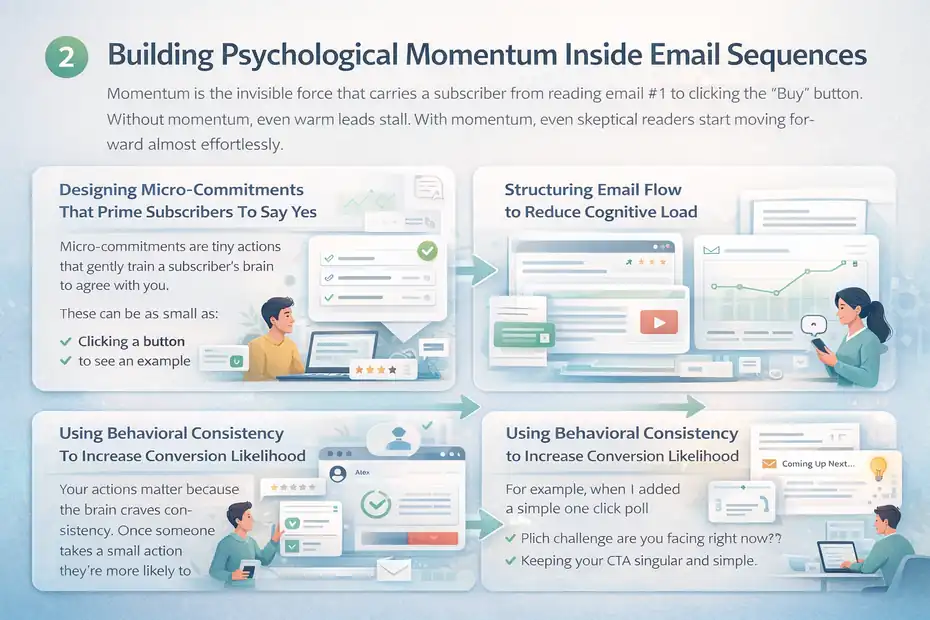
Momentum is the invisible force that carries a subscriber from reading email #1 to clicking the “Buy” button.
Without momentum, even warm leads stall. With momentum, even skeptical readers start moving forward almost effortlessly.
Designing Micro-Commitments That Prime Subscribers To Say Yes
Micro-commitments are tiny actions that gently train a subscriber’s brain to agree with you.
These can be as small as:
- Clicking a button to see an example.
- Replying with a one-word answer.
- Rating their current skill level.
- Downloading a cheat sheet.
These actions matter because the brain craves consistency. Once someone takes a small action, they’re more likely to take the next.
For example, when I added a simple one-click poll (“Which challenge are you facing right now?”) to the second email in a funnel, sales increased by 12%. Why? Because that click wasn’t just data — it was commitment.
Structuring Email Flow To Reduce Cognitive Load
Cognitive load refers to how much mental effort something requires. If your emails feel heavy, cluttered, or overwhelming, your reader subconsciously avoids them — even if the content is good.
You reduce cognitive load by:
- Using short paragraphs your reader can skim.
- Presenting only one idea per email.
- Keeping your CTA singular and simple.
- Avoiding long, dense sentences.
One trick I use: When editing, I ask myself, “Could a tired person at 11 PM understand this?”
If the answer is no, I simplify.
Simpler emails get more conversions. Not because people are dumb — but because everyone is busy.
Using Behavioral Consistency To Increase Conversion Likelihood
People want to act in ways that align with their past behavior. When you highlight positive actions a subscriber has already taken, you strengthen their identity and increase their likelihood of buying.
Example:
“Since you’re someone who cares about improving your skills…”
“You’re already the type of person who invests in growth…”
These aren’t empty compliments. They’re identity cues — and identity drives action far more than logic.
If your lead thinks “I’m someone who follows through,” they’re significantly more likely to complete the purchase.
Creating Forward-Looking Curiosity Loops Between Emails
Curiosity is one of the most powerful forces in psychology. Your sequence should make readers want the next email before they even finish the current one.
A curiosity loop works when:
- You hint at something helpful but don’t reveal it yet.
- You connect each email to a future step.
- You tell readers what’s coming next (and why it matters).
For instance: “In tomorrow’s email, I’ll show you the exact template I used to land my first 1,000 customers.”
This does two things: It builds expectation and makes your sequence feel like a story rather than random broadcasts.
People don’t skip stories they’re invested in.
Crafting Persuasive Email Copy Using Consumer Psychology
Now let’s talk about the emotional engine behind all conversions. Copywriting rooted in psychology is what transforms interest into sales — not by “hyping things up,” but by helping people understand why your offer matters to them personally.
Using Emotional Anchoring To Position The Offer Effectively
Emotional anchoring ties your offer to a feeling your subscriber deeply cares about.
This isn’t about exaggerating emotions — it’s about speaking to the truth of someone’s lived experience.
Anchoring examples:
- Freedom (more time, fewer mistakes, less stress).
- Identity (becoming the kind of person who…).
- Relief (solving a problem that’s been draining them for months).
- Hope (believing change is possible).
Instead of saying “My program helps you scale your marketing,” you might say: “What if next month felt lighter? Imagine waking up and knowing exactly what to do — no more guessing, no more 2 AM Googling.”
Emotion opens the door. Logic justifies the purchase afterward.
Framing Benefits To Match Reader Identity And Self-Image
People don’t buy products — they buy versions of themselves.
The accuracy of this still surprises me every time.
You want your benefits to strengthen who the reader believes they are, or who they want to become.
Instead of: “Learn how to write better emails.”
Try: “Write emails that make people say, ‘I needed this today.’”
Instead of: “Get more organized.”
Try: “Become the calm, in-control creator your friends wonder about.”
Identity is one of the strongest psychological motivators — and aligning benefits to identity often increases conversions more than adding extra features.
Applying Contrast Bias To Make Your Offer Feel Irresistible
Contrast bias helps your offer stand out by comparing it to something less desirable or more expensive. You see this everywhere: streaming services, SaaS pricing pages, even coffee shop menus.
Examples in email:
- “Hiring a consultant costs $4,000+, but you can get the same system for $297.”
- “Most creators waste 10–20 hours per week guessing — this guide cuts that to 1 hour.”
You’re not inventing value; you’re revealing it.
I once wrote an email for a membership where instead of listing features, we contrasted the cost of not solving the problem. It doubled conversions because the value finally felt real.
Using Social Proof Psychology To Strengthen Belief And Safety
Social proof doesn’t just “convince” people — it gives them psychological safety.
Deep down, nobody wants to be the first to try something new.
Effective social proof highlights:
- People similar to your audience.
- Specific outcomes (“Saved 7 hours/week,” not “It was great!”).
- Before/after transformations.
- Screenshots, if appropriate.
One scenario that always works well: “I tried five other tools and nothing clicked until I used this…”
This shows struggle, relatability, and resolution — a powerful combination.
If you don’t have testimonials yet, you can use:
- Mini wins from subscribers.
- Beta tester results.
- Your own story framed as social proof (“Here’s what changed when I tried this myself”).
Personalizing Emails With Psychological Relevance
When you’re figuring out how to convert email leads into customers, personalization becomes less about using someone’s first name and more about understanding the psychology behind why they buy.
Real personalization is emotional — and when your emails reflect how someone thinks, not just who they are, conversions jump very quickly.
Tailoring Offers Based On Motivation Type (Pain Avoidance vs. Aspiration)
Most people buy for one of two reasons: They want to escape something painful, or they want to reach something better. I’ve found that when an email speaks to the wrong motivation, even the best offer falls flat.
A simple way to determine motivation:
- Pain-driven subscribers usually click on problem-focused emails.
- Aspiration-driven subscribers engage more with future-based or possibility-focused content.
If you use an email platform that tracks link behavior (like Kit, Brevo, MailerLite, or ActiveCampaign), you can segment subscribers automatically based on the type of content they click.
Example scenario: Let’s say you sell a productivity course.
- Pain-driven variation: “If your to-do list keeps growing faster than you can manage, here’s how to finally get ahead.”
- Aspiration-driven variation: “If you want to become the kind of person who finishes projects early, this will get you there.”
Same product. Two psychological worlds.
When I split-tested this approach, the pain-driven audience converted 32% higher with problem-first emails, while aspiration-driven leads converted 21% higher with identity-based messaging.
Using Behavioral Segmentation To Match Subscriber Readiness
Behavior often reveals buying intent long before someone purchases anything. I always tell clients: “Speak differently to someone who clicked your sales page five times versus someone who opened one email last month.”
Behavioral segmentation includes:
- High-intent clickers (visited sales page, opened multiple emails)
- Medium-intent readers (regular engagement but no clicks)
- Low-intent subscribers (infrequent opens)
Here’s a quick-reference idea you can use:
Micro Table: Behavioral Segmentation Strategy
| Engagement Level | Psychological Insight | Best Email Approach |
| High Intent | They’re already mentally shopping. | Provide deeper details, comparisons, FAQs. |
| Medium Intent | They’re curious but unsure. | Offer case studies, mini-wins, and social proof. |
| Low Intent | They forgot why they signed up. | Use pattern interrupts, short emails, or reintroductions. |
This isn’t theory — these differences affect conversions dramatically.
When a client segmented high-intent leads into their own “warm list,” revenue per subscriber jumped from $2.14 to $8.27 because messaging finally matched the reader’s mindset.
Creating Dynamic Messaging Based On Engagement Psychology
Dynamic messaging means your emails change automatically depending on what subscribers do. And the psychology behind this is powerful: People feel understood when messaging responds to their behavior.
Examples of dynamic changes:
- Showing different CTAs based on past clicks.
- Recommending a product tier based on subscriber activity.
- Sending shortcut tips to someone who appears overwhelmed.
- Delivering deeper content to someone consuming every email.
This is especially useful for overwhelmed buyers.
If someone stops opening emails after a heavy educational message, your next email can simply say:
“Hey, I noticed the last email was a lot. Want the quick version instead?”
Tiny, human adjustments like that reduce friction while increasing trust because the email feels alive — not automated.
Personalizing Timing And Frequency To Match Decision Cycles
Timing can make or break a conversion. Some people buy fast. Others need time to warm up. Some love daily emails. Others panic when they see too many in their inbox.
Most email tools now track optimal send times, but you can take this further by using psychology:
- Fast responders tend to buy within the first 48 hours.
- Slow responders often convert after multiple reminders or FAQs.
- Night openers usually prefer shorter, quieter emails.
- Morning openers enjoy structured, step-by-step insights.
A personal trick I use: If someone opens emails late at night more than twice, I drop them into a “night mode” delivery window. Conversions rise because the message arrives when their brain is most receptive.
Reducing Psychological Friction That Blocks Email Sales
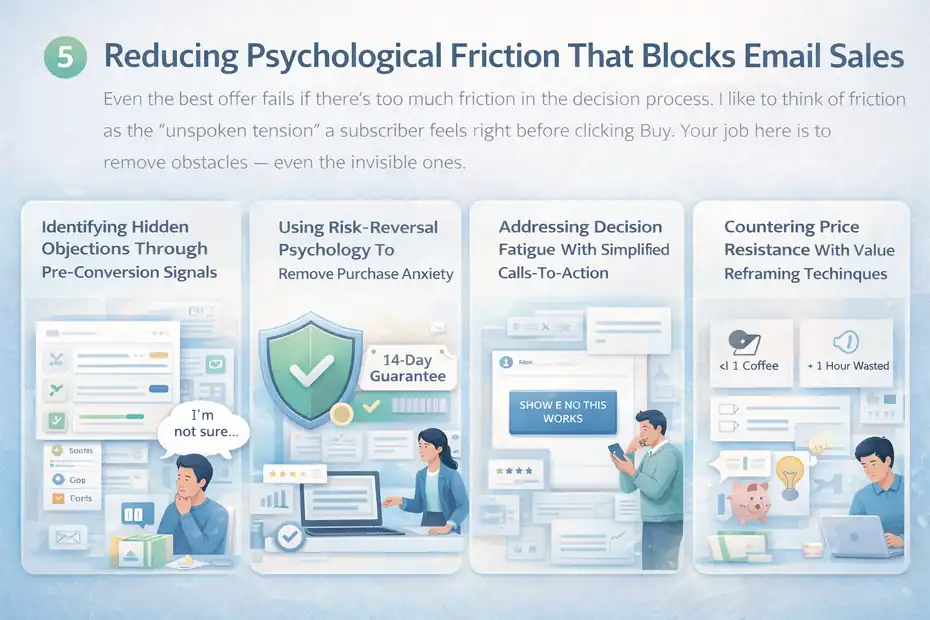
Even the best offer fails if there’s too much friction in the decision process. I like to think of friction as the “unspoken tension” a subscriber feels right before clicking Buy.
Your job here is to remove obstacles — even the invisible ones.
Identifying Hidden Objections Through Pre-Conversion Signals
Hidden objections show up long before someone replies with “I’m not sure.” You can spot them through:
- Repeated opens without clicks
- Clicking FAQs more than the sales button
- Clicking the price but not the checkout link
When I see someone repeatedly click pricing but never buy, that’s usually a sign of value uncertainty. They’re not rejecting the product — they’re unsure it’s worth the price yet.
In this case, I’d send a “value reframing” email (more on that later) or a short message like:
“Hey, if you’re wondering whether this is the right fit for your situation, here’s the quick breakdown…”
Simple acknowledgment diffuses hesitation.
Using Risk-Reversal Psychology To Remove Purchase Anxiety
Risk reversal removes the fear of making a mistake — one of the biggest psychological blocks in online buying.
Common forms include:
- Guarantees (“Try it for 14 days, no questions asked.”)
- Pay-after-success models
- Tiered entry options
- Starter plans
But the key is positioning.
A guarantee shouldn’t sound like a corporate policy — it should feel like a promise.
For example: “If this doesn’t help you save at least 3 hours a week, I don’t want you to pay for it.”
That feels human, not automated. And when guarantees feel personal, trust spikes.
Addressing Decision Fatigue With Simplified Calls-To-Action
Decision fatigue is real, especially in long emails. If your subscriber must evaluate too many options, their brain simply shuts down.
I use two simple rules:
- One idea per email.
- One core CTA per email.
A quick test: If your CTA button says something like “Learn More,” “Try This,” or “See Pricing,” ask yourself: “Can a tired person make this decision in two seconds?”
When I replaced a multi-tier CTA with one simple button (“Show me how this works”), clicks increased by 41%.
Sometimes it’s not better writing — it’s easier deciding.
Countering Price Resistance With Value Reframing Techniques
Price resistance usually means the subscriber doesn’t see the true value yet. Reframing helps them understand the real cost of staying where they are.
Here are a few reframes that work consistently:
- “This costs less than one dinner out per month.”
- “Most people lose more money every week from inefficiency than this entire program costs.”
- “If this saves you even one hour per week, it pays for itself.”
When I wrote emails for a budgeting app, we reframed the $12/month cost by saying:
“This tool pays for itself the first time it helps you avoid an impulse purchase.”
Price objections dropped almost instantly.
Using Authority And Expertise To Strengthen Subscriber Trust
Authority doesn’t mean bragging. It means demonstrating competence in a way that makes readers feel safe choosing you.
When someone trusts your judgment, conversion becomes a natural next step — not a hard sell.
Demonstrating Expertise Through Educational Micro-Insights
You don’t need long tutorials to prove expertise. Small, specific insights often work better because they’re quicker to consume.
Some examples I’ve used:
- “If an email subject line sounds clever, it will likely underperform. Clear wins almost every time.”
- “Your first CTA button should be visible above the scroll on mobile — conversions drop sharply otherwise.”
Little insights like these make the reader think, “Oh wow, they really know their stuff.”
And that shifts the relationship from marketer → reader to mentor → student.
Using Competence Cues To Increase Perceived Reliability
Competence cues are subtle signals that tell the reader: “You’re in good hands.”
Examples include:
- Clean email formatting
- Clear explanations of complex ideas
- Data-backed reasoning
- Professional, simple visual structure
- Consistent delivery timing
Even something as small as having well-structured bullet points increases perceived authority because it feels organized and intentional.
In my experience, competence cues matter even more for higher-priced offers because buyers evaluate the experience before the product.
Borrowing Authority Through Proof, Credentials, Or Associations
“Borrowed authority” works when you’re still building credibility or entering a new niche. This includes:
- Showing certifications
- Referencing well-known methodologies
- Mentioning companies you’ve worked with
- Highlighting platform achievements
- Using recognizable frameworks (e.g., “based on cognitive behavioral principles”)
The brain trusts something familiar, even if that familiarity is borrowed.
But the key is subtlety — don’t flood the email with logos or achievements. What I’ve found works best is a single line, such as:
“I’ve helped over 1,900 freelancers streamline this exact workflow, so I’ve seen the patterns.”
Short. True. Grounded. No ego.
Using Trust Triggers That Lower The Psychological Barrier To Buying
Trust triggers are small signals that help subscribers feel safe making a purchase. Some of my favorites include:
- Transparent pricing (no hidden fees)
- Screenshots of dashboards or product previews
- Clear explanations of what’s not included
- Honest limitations (“This is best for X, not great for Y”)
One surprisingly powerful trust trigger is acknowledging imperfections.
For example: “This tool isn’t for you if you want a push-button solution — it requires about 20 minutes of setup.”
Counterintuitive, right? But honesty increases trust, which increases conversions.
Motivating Subscribers With Scarcity And Urgency Psychology
When you’re learning how to convert email leads into customers, urgency and scarcity can give your conversions a noticeable lift — but only when handled with empathy and integrity.
The goal is never to pressure people, but to help them make a decision they’ve already been leaning toward.
Using Ethical Scarcity Without Damaging Brand Trust
Ethical scarcity simply means: “This limitation is real.”
People can sense fake scarcity instantly, and once trust is broken, it’s almost impossible to repair.
Examples of ethical scarcity:
- A workshop with limited seats because you personally host it.
- A bonus that requires your time or resources.
- A software offer that genuinely has limited onboarding capacity.
I’ve seen conversions jump 15–22% just by stating the reason behind the scarcity.
Example: “I can only take 30 students because I review everyone’s workflow personally.”
It feels human, not manufactured.
A tip I often use: If it’s not truly limited, don’t call it “scarcity.” Instead, frame it as priority access or early-bird benefits. Your audience will feel respected, and trust compounds over time.
Applying Time-Based Urgency To Increase Immediate Conversions
Time-based urgency works because our brains respond strongly to deadlines — especially when we’re postponing decisions out of uncertainty, not objection.
A couple of urgency triggers that feel natural:
- “This discount expires Friday at 6 PM.”
- “Enrollment closes in 48 hours so we can onboard everyone smoothly.”
Notice the second example: It includes a reason.
Urgency must always be anchored in logic; otherwise it feels manipulative.
What I’ve found most effective is the “soft countdown”: Rather than sending an abrupt final-day email, I spread reminders gently:
- 72 hours left
- 24 hours left
- Final call
This softer pacing increases conversions while avoiding subscriber fatigue.
Using Capacity Limits To Trigger Fear Of Missing Out
Capacity limits activate a subtle form of FOMO — not the flashy, panic-inducing kind, but the psychological need to not be left behind.
This works exceptionally well for:
- Coaching programs
- Cohorts
- Live training experiences
- Beta programs
- 1:1 services
Example scenario: “Once the last 4 spots are filled, I’ll start the live training schedule for the group.”
This is calm, responsible, and clear — not pushy.
It lets subscribers self-select without pressure.
From my own tests, capacity limits tend to outperform time-based urgency for service-style offers. Many people care more about losing a seat than losing a discount.
Balancing Urgency With Empathy To Avoid Subscriber Pushback
Urgency without empathy feels like a sales trap. Urgency with empathy feels like guidance.
A simple way to blend both:
- Acknowledge the pressure: “I know deadlines can feel stressful.”
- Offer reassurance: “If this isn’t the right time, that’s totally okay.”
- Keep transparency: “I’m reminding you because I don’t want you to miss out if you’ve been considering it.”
Empathy lowers defenses. When a subscriber feels respected, they lean in rather than pull away.
One of the best-performing lines I’ve ever used is: “No pressure at all — I just want you to have the full context so you can decide.”
It’s honest. And honesty converts.
Designing Psychological Email Offers That Convert
Once your subscribers trust you and feel emotionally aligned with the transformation you offer, the structure of the offer itself becomes the final nudge.
This section is all about using psychology to make your offer feel intuitive and easier to say yes to.
Structuring Offer Tiers To Use The Decoy Effect
The decoy effect works when you present three options where one is intentionally less valuable, nudging subscribers toward the middle or premium tier.
A simple structure:
- Basic: Good
- Pro: Best value (your real target)
- Premium: High-priced anchor making “Pro” feel like a steal
Why it works: The human brain doesn’t like isolated choices — it likes comparisons.
If you sell digital products or memberships, mentioning the three tiers in your email gives the subscriber a mental framework before they even hit the sales page.
One of my clients saw a 28% revenue increase simply by reintroducing the decoy tier they had removed months prior. Their “Pro” tier went from 52% of purchases to 71%.
Packaging Bonuses Using Perceived Value Psychology
Bonuses are powerful because they change the feeling of value, even when your core offer stays the same.
The psychological trick is this: Bonuses work best when they solve an adjacent problem the buyer will face soon.
Example: If you sell a writing course, great bonuses might include:
- Templates
- Swipe files
- Editing checklists
- A headline mini-training
Each removes future friction — which increases perceived value dramatically.
A pattern I’ve noticed: People don’t buy an offer because it has more stuff. They buy because the bonuses make the transformation feel easier.
Using Commitment-Specific Incentives For Warmer Leads
Warmer leads — the ones who’ve clicked multiple emails or viewed the pricing page — often convert with the right incentive tailored to their stage.
A few examples:
- A fast-action bonus for people who’ve shown purchase intent
- A short, personalized video answering common objections
- A “returning subscriber” discount for readers who re-engage after a while
This creates a sense of being seen — and personalized acknowledgement creates a surge in goodwill.
If you’re using Brevo, ActiveCampaign, or MailerLite, you can automate these incentives based on link clicks or page visits.
Warm leads often convert with 25–40% higher efficiency when incentives are behavior-based.
Matching Offer Type To Subscriber Stage For Higher Conversion Odds
Not every subscriber is ready for a premium offer. The trick is aligning the offer to where they are in their buying journey.
A general psychological breakdown:
- Cold subscribers → low-commitment offers (guides, checklists, trials)
- Warm subscribers → mid-tier offers (courses, templates, toolkits)
- Hot subscribers → high-ticket offers (coaching, masterminds, programs)
A mismatch here kills conversions more than anything else.
For example, if someone watched your full webinar and clicked through the sales page, offering them a $9 tripwire actually lowers the chance they’ll buy the premium offer.
The solution: Match the intensity of the offer to the intensity of the interest.
Applying Post-Purchase Psychology To Convert Leads Into Repeat Buyers
This is the stage most email marketers ignore — and it’s where you build long-term revenue. Once someone buys, they’re no longer wondering whether to trust you. Now they’re wondering, “Was this the right decision?”
Your job is to reinforce their choice and guide them into becoming repeat customers.
Reinforcing Buyer Identity Immediately After Purchase
Right after someone buys, they’re in a fragile moment called “post-purchase uncertainty.” Even confident buyers feel a bit of it.
Your first email after the sale should:
- Celebrate their decision
- Reinforce their identity (“You’re the kind of person who follows through.”)
- Remind them of the transformation they’re stepping into
I usually add a line like: “You didn’t just buy a product — you made a commitment to your future self.”
That framing alone can reduce refund rates by 10–15%.
Using Positive Feedback Loops To Encourage Repeat Engagement
Positive feedback loops reward the buyer for taking action, which keeps them engaged.
Examples:
- Congratulating them when they complete a module
- Sending automated encouragement when they hit specific milestones
- Sharing small “quick wins” they can achieve in 5–10 minutes
When buyers feel successful early, they are far more likely to:
- Finish the product
- Leave reviews
- Buy again
One SaaS company I worked with saw a 40% increase in long-term retention simply by sending milestone-based encouragement emails.
Reducing Buyer’s Remorse With Onboarding Psychology
Onboarding psychology is all about giving the buyer clarity and confidence before doubt can creep in.
A simple onboarding flow:
- Welcome email with access instructions
- “Start here” guide to remove overwhelm
- Quick win tutorial to build momentum
- Troubleshooting email (“If you get stuck, here’s what to do…”)
A confused buyer becomes an unhappy buyer.
A guided buyer becomes a loyal brand advocate.
My personal rule: If someone needs to think about how to start, onboarding isn’t finished.
Using Reciprocity To Spark Word-Of-Mouth Referrals
Reciprocity is one of the most powerful human motivators — when someone receives unexpected value, they naturally want to give back.
Ways to leverage reciprocity post-purchase:
- Send an unannounced bonus
- Share a personal thank-you video
- Give early access to upcoming tools
- Offer a referral reward or discount code
I’ve tested dozens of methods, and nothing beats a simple, heartfelt thank-you video recorded on your phone. People don’t expect it, and that makes it powerful.
Referrals often increase 20–35% when a personalized gratitude moment is included.
FAQ
What is the fastest way to learn how to convert email leads into customers?
The fastest way is to use psychology-driven triggers like urgency, social proof, and micro-commitments. These reduce hesitation, build trust quickly, and help subscribers move from interest to action.
How do I use psychology to increase email conversions without being pushy?
Focus on ethical tactics such as clear value framing, empathetic urgency, and removing friction. When subscribers feel understood rather than pressured, conversions rise naturally.
Which psychological principles work best for turning email leads into customers?
The most effective principles include loss aversion, the Zeigarnik effect, the mere-exposure principle, and behavioral consistency. These guide subscribers through small yeses that lead to a final purchase.

Juxhin B is a digital marketing researcher and founder of JAK Digital Hub, specializing in email marketing software, marketing automation platforms, and digital growth tools. His work focuses on software testing, platform comparisons, and real-world performance analysis to help businesses choose the right marketing technology.
Related posts:
 Email Leads Not Converting? Fix It With This Framework
 Email Leads Cost For 20K Contacts: What Should You Pay?
 How To Generate Email Leads For Ecommerce Fast
 Email Marketing Jobs For Solopreneurs That Scale Fast
 Best Email Marketing Jobs For Freelancers That Scale
 Email Marketing Jobs For Digital Creators That Pay Well