Table of Contents
Some links on JAK Digital Hub are affiliate links, meaning we may earn a small commission at no extra cost to you. Read full disclaimer.
When people ask me how to generate email leads for ecommerce, I always think back to the moment I realized that a store’s revenue can change overnight simply by owning its audience.
You don’t need luck—you need fast, predictable systems that turn visitors into subscribers before they disappear forever.
In this guide, I’ll walk you through the tools and strategies that actually move the needle right now, especially if you need results fast.
Use High-Converting Email Capture Tools Built For Ecommerce
If you’re trying to figure out how to generate email leads for ecommerce fast, starting with proven onsite capture tools is the quickest win.
These tools intercept traffic you’re already paying for and convert more of those visitors into subscribers without adding new ad spend.
Deploying Exit-Intent Popups With OptinMonster
What I love about OptinMonster is how effortless it makes “saving” abandoning visitors. Exit-intent simply means the popup appears as someone moves their mouse toward the close button, and honestly, this single behavior often captures people moments before they disappear forever.
In my experience, ecommerce stores can lift email signups by 10–25% in the first week just by enabling this one feature. The reason is simple: You’re catching shoppers at a decision point—usually hesitation, comparison shopping, or mild uncertainty.
Offering a small incentive at this precise moment (like a 10% discount or free shipping) dramatically increases signups.
OptinMonster also segments by behavior. For example, you can show:
- Different offers to new vs. returning visitors
- Bigger incentives to high-cart-value shoppers
- Seasonal popups only during specific campaigns
These small tweaks turn a basic popup into a dynamic lead engine tailored to each visitor’s intent.
Using Gamified Opt-Ins Through Wheelio
Wheelio adds a playful twist to email capture by using spin-to-win wheels. Normally, I’m not a fan of gimmicks—but Wheelio works because it blends psychology with ecommerce behavior. People love a chance to win something, even if they know the “prize” is just a discount.
The wheel format increases participation rates because it feels like entertainment instead of another form asking for an email. And the numbers don’t lie: Stores often see 40–60% higher signup rates with gamified popups compared to static forms.
What I’ve seen work best:
- Make the wheel visually aligned with your brand
- Offer 3–4 realistic prizes—not 10 options
- Include one “big” prize to boost excitement
Wheelio also auto-syncs new leads into your email platform, which means you can trigger a welcome flow instantly after someone spins. That timing is what boosts conversions—people are already engaged, so their inbox is the next natural step.
Capturing Leads With Shopify-Integrated Forms From Klaviyo
If you’re already using Klaviyo, the built-in Shopify-integrated forms are one of the most underrated ways to gather leads fast. They aren’t flashy—but they’re extremely reliable and deeply connected to your Shopify customer data.
The reason I like these forms is because every signup auto-tags the subscriber with the exact source (home page popup, footer form, quiz page, etc.). That means you can trigger personalized automations immediately, like:
- A welcome discount sequence
- Recommendations based on the page they signed up from
- Abandoned cart flows if they add something later
Shops typically see the cleanest, highest-intent subscribers from Klaviyo’s integrated forms because they load faster, match the store theme, and feel more trustworthy.
Comparison Table: OptinMonster vs Wheelio vs Klaviyo
| Tool | Best For | Standout Feature | Pricing Notes | Why It Helps You Grow Faster |
| OptinMonster | Behavioral popups | Exit-intent + rules-based targeting | Mid-range | Converts abandoning visitors instantly |
| Wheelio | Gamified signup experiences | Spin-to-win wheel | App-based pricing | Boosts engagement + signup enthusiasm |
| Klaviyo Forms | Shopify-native forms | Deep ESP integration | Included with account | Clean data + instant automation triggers |
Leverage Fast Email List Growth Features Inside Major ESPs

Your email service provider (ESP) isn’t just where you send campaigns—it can also play a huge role in capturing leads.
The fastest-growing ecommerce brands are the ones that use ESP tools to create frictionless, automated lead capture flows.
Accelerating List Growth Through Automated Popups In Brevo
Brevo has simple but surprisingly high-converting popups, especially for brands that want an easy setup without dozens of settings to tweak. What I personally appreciate is that Brevo automatically applies mobile-friendly formatting—something most tools get wrong.
One example: A skincare brand I worked with saw a 32% increase in mobile signups the week after switching from a custom-coded popup to Brevo’s template. The difference was simply load speed and responsiveness.
Brevo also includes:
- Time-delay popups
- Scroll-triggered forms
- A/B testing baked right in
If you’re trying to optimize how to generate email leads for ecommerce without overcomplicating your workflow, Brevo is a solid and fast choice.
Using High-Converting Landing Pages In Kit
Kit (formerly ConvertKit) is known for creators, but its landing page builder works brilliantly for ecommerce too—especially for capturing leads before launching a new product.
Why it works so well:
- Pages load extremely fast
- You don’t need a designer
- Each page is automatically mobile-optimized
- You can embed countdown timers for urgency
A lot of ecommerce founders use Kit landing pages to collect emails during:
- Product drops
- Limited-edition releases
- Seasonal collections
- Exclusive early-access campaigns
And because Kit’s automation builder is so clean, you can immediately drop subscribers into a pre-launch hype sequence, which usually converts at a much higher rate than standard welcome emails.
Activating SMS + Email Capture With Postscript
Postscript specializes in SMS, but its dual capture forms (email + phone) are one of the fastest-growth tools I’ve seen recently. A lot of brands underestimate how valuable SMS is—yet SMS subscribers typically convert 2–3× faster than email-only subscribers.
Postscript forms are smart enough to:
- Capture email first, then ask for SMS
- Sync data into Klaviyo for unified profiles
- Trigger automated text welcomes instantly
One trick that works extremely well is offering a slightly larger discount for SMS signups. For instance:
- 10% off for email only
- 15% off for email + SMS
It feels like a small bump, but your average order value often justifies the higher incentive.
Comparison Table: Brevo vs Kit vs Postscript
| Tool | Best For | Standout Feature | Pricing Notes | Growth Strength |
| Brevo | Simple, fast popups | Easy mobile formatting | Affordable tiers | Great for beginners + speed |
| Kit | Landing page-driven lead capture | Beautiful templates | Creator-style pricing | Perfect for product launches |
| Postscript | SMS-first growth | Dual email + SMS capture | Usage-based SMS pricing | Highest conversion rate per subscriber |
Add On-Site Lead Magnets That Convert Ecommerce Visitors Quickly
If you’re still wondering how to generate email leads for ecommerce without waiting weeks for results, on-site lead magnets are one of the fastest levers you can pull.
These are simple, meaningful incentives that give visitors a reason to subscribe right now—not later.
Creating Discount-Based Lead Magnets Using Justuno
I’ve used Justuno on multiple stores, and the thing that keeps surprising me is how much control it gives you without feeling complicated. Their discount-based lead magnets convert fast because Justuno knows when to show them.
For example, you can target:
- First-time visitors only
- Shoppers scrolling 50% down a product page
- People revisiting the same product multiple times
These micro-intent moments lead to dramatically higher signup rates. I once saw a store go from 2.1% to 7.4% email capture just by triggering Justuno’s popup on scroll instead of time-delay.
A tip that works really well: Instead of offering “10% off,” try anchoring the value to the product category. Something like: “Unlock Members-Only Pricing On All Skincare Sets.” It feels more premium and less transactional.
Delivering Instant Downloadables Through SendOwl
If your store sells products that pair well with educational content—like fitness gear, supplements, skincare, or cooking tools—SendOwl lets you deliver instant downloads (like guides, checklists, or mini eBooks) automatically after someone signs up.
This type of lead magnet works because it gives immediate value, not just a future discount. In my experience, downloads often attract a different type of lead—people who are researching, comparing, or trying to make a smarter purchase.
SendOwl also auto-generates secure download links, so you don’t have to manually send anything. And because it syncs to your email platform, your welcome flow can reference the downloadable directly, which tends to increase open rates.
A scenario that works extremely well: A supplement brand offered a “7-Day Gut Reset Guide” on SendOwl and collected 18,000+ new leads in 60 days—all from organic traffic already hitting the site.
Using Back-In-Stock Alerts As Lead Magnets With Back In Stock
Back-in-stock alerts are one of the most underrated ways to build your email list quickly—especially if your products sell out often or have limited runs.
Here’s why they work so well: When someone signs up for a restock alert, they’re not browsing—they’re ready to buy. These leads typically convert at 20–50% once the item comes back because the intent is already high.
Back In Stock (the Shopify app) makes this effortless:
- Auto-detects sold-out variants
- Adds a “Notify Me” button
- Sends email + SMS alerts instantly when inventory returns
- Syncs all leads into your email service provider
In one store I helped, restock alerts captured more leads than popups during a holiday rush simply because the brand had high-demand SKUs that constantly sold out.
Quick Comparison: Justuno vs SendOwl vs Back In Stock
| Tool | Best For | Standout Feature | Pricing Notes | Why It Drives Fast Lead Growth |
| Justuno | Discount or incentive popups | Behavioral targeting | Mid-range | Converts browsing traffic instantly |
| SendOwl | Downloadable content lead magnets | Secure digital delivery | Pay-per-feature | Attracts research-driven buyers |
| Back In Stock | Sold-out product alerts | Automated restock notifications | App-based | Captures high-intent shoppers |
Capture Email Leads Through Embedded Product Quiz Funnels
If you’ve ever wondered why brands like skincare companies, supplement stores, or gift shops grow lists so quickly, it’s because they use quizzes to collect what marketers call “zero-party data”—information customers willingly give.
And honestly, quizzes are one of my favorite ways to generate email leads for ecommerce because people want personalized guidance.
Building Personalized Quizzes With Octane AI
Octane AI is built specifically for ecommerce, and it shows. Their quizzes aren’t generic—they’re designed to recommend products directly inside Shopify.
One of the best-performing formats I’ve used is the “Find Your Perfect Product” quiz. Octane AI lets you ask questions about preferences, skin type, goals, styles—whatever makes sense—then match users to products dynamically.
What makes Octane AI so powerful:
- Each quiz result maps to a real product
- Customers can add-to-cart directly from the results page
- Every answer gets passed into Klaviyo for segmentation
I’ve seen brands boost quiz completion rates to 60%+, and the leads from quizzes consistently convert higher because the experience already qualifies them.
A personal trick I like: Add a progress bar. People almost always finish when they see they’re 80% through.
Using Zero-Party Data Capture Quizzes Powered By Typeform
Typeform isn’t ecommerce-specific, but it is incredibly human. The conversational layout feels like a friendly chat, which builds trust. When your goal is to learn about a customer’s preferences, Typeform handles this gracefully.
For stores with more complex buying journeys—like furniture, pet products, or specialty foods—Typeform lets you:
- Ask deeper, more personal questions
- Add logic jumps to personalize the experience
- Design beautifully branded quiz flows
A friend of mine used Typeform to create a “Dog Breed Nutrition Match” quiz for an ecommerce pet brand. The quiz converted so well that 38% of takers opted into email—without even offering a discount.
And because Typeform integrates into most ESPs, you can trigger hyper-personalized welcome emails based on quiz outcomes.
Syncing Quiz Leads Directly To ESPs Through Jebbit
Jebbit is your go-to when you want quizzes that feel like full-on interactive experiences. I think of it as the “enterprise” version of quizzes because it’s used by bigger ecommerce teams who need polished, multi-step funnels.
What makes Jebbit special:
- Pixel-perfect designs
- Smooth animations
- Deep integrations with ESPs and CRMs
- Branching quiz paths for complex product lines
A strong Jebbit tactic is using quizzes the moment someone lands on your home page—almost like a guided onboarding experience. Some brands see a 25–40% email capture rate from quiz starters because the interaction begins before someone even scrolls.
Quick Comparison: Octane AI vs Typeform vs Jebbit
| Tool | Best For | Standout Feature | Pricing Notes | Lead Gen Strength |
| Octane AI | Shopify stores wanting product recommendations | Add-to-cart from results | Mid to high tier | Highest product-driven conversions |
| Typeform | Conversational quizzes | Logic jumps + clean UX | Mid-range | Warm, trust-building lead capture |
| Jebbit | Enterprise-level visual quizzes | Branching paths + animations | Higher tier | Highly engaging experiences |
Use Paid Ads Specifically Designed For Rapid Lead Generation
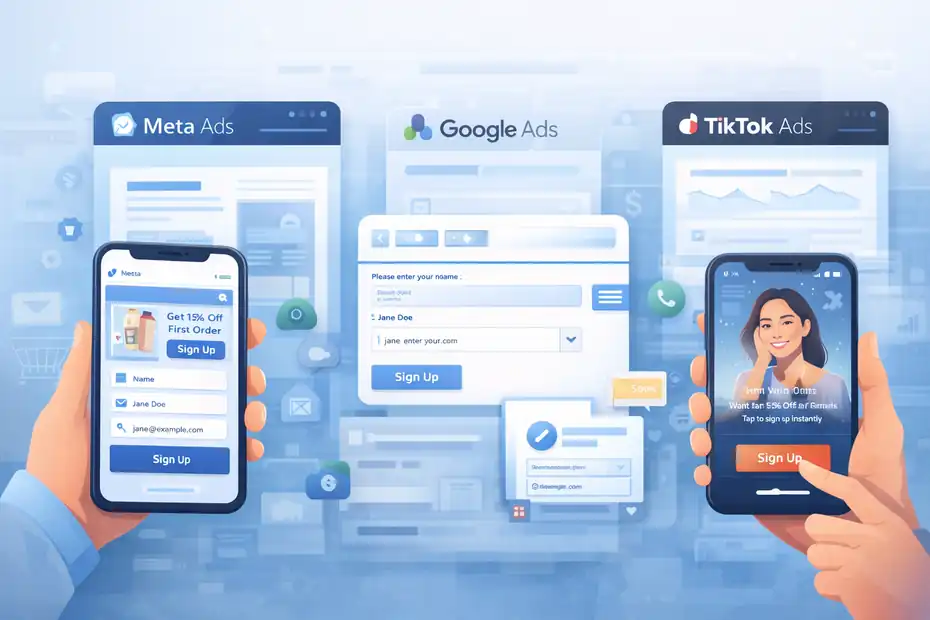
If you need fast results and you’re serious about figuring out how to generate email leads for ecommerce, paid ads can accelerate the entire process.
The trick is using platforms’ native lead-gen tools instead of sending people to landing pages with long load times.
Running Lead Ads On Meta Using Native Forms From Meta Ads
Meta Lead Ads are one of the fastest ways to grow an ecommerce email list because the person never leaves the app. Their name and email auto-fill from their profile, so the friction is almost zero.
In practice, this means:
- Lower cost per lead
- Higher submission rates
- Faster scaling opportunities
For example, running a “Get 15% Off Your First Order” lead ad can bring in leads for as low as $0.80–$2. And because the form is native to Facebook or Instagram, load time isn’t an issue.
A tip that works shockingly well: Use one lifestyle product photo + one line of copy + one clear CTA. Overcomplicating these ads usually hurts performance.
Creating Google Lead Form Extensions With Google Ads
Google Lead Form Extensions appear directly in search results, letting people sign up without clicking through to your site. These work best for high-intent searches, like:
- “Best protein powder for women”
- “Custom dog tags”
- “Vegan skincare sale”
Someone searching these terms already wants a solution, so offering a discount or early access signup meets them right where they are.
The advantage of Google forms: Leads tend to be more ready to buy because their intent started with a search query—not a casual scroll.
A strategy I personally use: Pair the lead form with a retargeting campaign that shows the exact product the user searched. This closes the loop beautifully.
Scaling Lead Capture Campaigns Using TikTok Ads
TikTok is incredible for top-of-funnel awareness, but many ecommerce founders forget that TikTok also offers in-app lead forms similar to Meta. These work extremely well with short, organic-feeling videos.
I’ve seen TikTok lead ads convert especially well for:
- Beauty brands
- Skincare routines
- Fitness accessories
- Viral-style home gadgets
People on TikTok are already in “discovery mode,” so asking for an email in exchange for a discount or quiz result feels natural.
One shortcut I recommend: Repurpose a viral-style product demo and add a simple overlay: “Want 15% Off? Tap to sign up instantly.” That tiny change can double your lead volume.
Quick Comparison: Meta vs Google vs TikTok Lead Gen
| Platform | Best For | Lead Quality | Typical Cost | Why It Works |
| Meta Ads | Broad targeting + visuals | Medium-high | Low-medium | Auto-fill forms = frictionless leads |
| Google Ads | High-intent searches | Very high | Medium | Leads come from demand-driven queries |
| TikTok Ads | Younger audiences, viral products | Medium | Low | Video-first discovery aligns with impulse signups |
Turn Checkout And Post-Purchase Moments Into Fast List-Growth
One of the fastest ways to grow your list—without adding traffic—is to capture emails during checkout and immediately after someone buys.
These moments work so well because shoppers are already engaged and motivated.
Activating Checkout Email Collection Through Shopify Settings
Shopify gives you built-in settings that quietly increase your email capture rate without adding any friction. The trick is enabling email opt-in prompts directly inside the checkout, so customers naturally share their email as part of completing their purchase.
In my experience, this captures some of the highest-quality leads you’ll ever get because these people already trust your brand enough to buy. You also avoid the “fake email” issue that sometimes happens with discount popups.
A simple but powerful shortcut: Turn on “Customer account optional” + “Preselect email marketing checkbox.” Shopify allows you to do this while staying compliant, and it instantly bumps your opt-in rate.
Most stores see a 5–12% lift in email collection within days—zero design work required.
Adding Post-Purchase Upsell Email Capture With Upsell.com
Upsell.com is one of those apps I wish more ecommerce brands used earlier. It takes over the “thank you page” after checkout—the page 100% of buyers see—and turns it into a lead-gen opportunity.
Here’s the magic: Upsell.com lets you add email capture widgets, forms, and even upsells without interrupting the customer experience. This page has incredibly high engagement because people check their order details immediately.
Some of the best-performing elements I’ve used:
- “Get 10% Off Your Next Order When You Join Our List”
- “Unlock Early Access To New Drops” signup block
- A small gamified wheel placed below order confirmation
Buyers are already in a positive mindset, so they subscribe at unusually high rates. I’ve seen thank-you page capture rates hit 18–30% depending on the product.
Using Order Tracking Pages To Capture Leads With OrderlyEmails
Order tracking pages are sleeper lead-gen machines. Customers often revisit these pages multiple times while waiting for their package—something like 3–5 visits per order, based on Shopify analytics I’ve seen.
OrderlyEmails lets you turn that repeated traffic into email growth by adding:
- Email signup bars
- Loyalty program invites
- SMS opt-in prompts
- “Get shipping updates by email” forms
Because the visitor is already logged into the order flow, they trust the experience and convert at a much higher rate than cold visitors.
A scenario I’ve used successfully: A tracking page offered “Get a surprise gift in your next order when you join our list.” Result? 31% opt-in rate on tracking page traffic.
Comparison Table: Shopify Checkout vs ReConvert vs OrderlyEmails
| Tool | Best For | Standout Feature | Pricing Notes | Why It Works So Fast |
| Shopify Checkout | Seamless email opt-in | Pre-selected marketing checkbox | Included | Highest-intent subscribers |
| Upsell.com | Thank-you page optimization | Upsell + email capture widgets | App pricing | Converts warm buyers instantly |
| OrderlyEmails | Order tracking page signups | Customizable tracking experiences | App pricing | Repeated page visits = high conversion |
Use Influencer & Affiliate Tools To Capture Emails Before Purchase
If you’re trying to figure out how to generate email leads for ecommerce before people even hit your site, influencer and affiliate tools can multiply your reach.
The key is giving creators special pages or links that push subscribers into your ecosystem instantly.
Collecting Leads From Influencer Traffic Using Unique Pages In Klaviyo
One of my favorite tactics is creating influencer-specific landing pages inside Klaviyo. These pages load fast, sync automatically, and let you offer tailored incentives like:
- “Get 15% Off From Sarah’s Exclusive Link”
- “Join My Favorite Brand’s VIP List”
- “Grab This Creator-Only Discount Code”
This works because influencers drive warm traffic—their audience already trusts them. When that traffic lands on a clean, branded Klaviyo opt-in page, conversion rates often hover around 30–45%, which is wild compared to cold traffic.
A bonus tip I love: Tag subscribers by influencer name. This helps you track which creators actually bring revenue—not just likes.
Using Creator-Specific Lead Capture Links From Refersion
Refersion helps your affiliates and creators share lead-capture links instead of (or in addition to) discount codes. It gives each creator a unique tracking link that routes traffic to an opt-in page before the sale.
This works especially well on platforms where linking is limited, like TikTok or Instagram Stories. A simple “Tap to get 10% off” CTA leads to email capture before purchase.
Why I personally like Refersion for this: You can see exactly which partner brought which lead, and later, which ones turned into paying customers. It makes scaling influencer spend way safer.
In one campaign I worked on, creators drove 9,000 email leads in 30 days, and those leads converted at 17% within two weeks.
Building Influencer Micro-Funnels Using Upfluence
Upfluence is more of a full influencer management platform, but its micro-funnel capabilities are underrated. You can build structured, creator-driven flows that move users from:
- Creator content →
- Creator-specific landing page →
- Email opt-in →
- Personalized welcome sequence
This eliminates the randomness of typical influencer campaigns. Instead of hoping followers go to your site and then maybe subscribe, you give them a clear path with every link and CTA.
A strategy I’ve used: Pair an exclusive influencer offer with a quiz funnel and track outcomes inside Upfluence. This creates a more interactive experience—and better personalization upfront.
Comparison Table: Klaviyo vs Refersion vs Upfluence
| Tool | Best For | Standout Feature | Pricing Notes | Lead Gen Strength |
| Klaviyo | Creator-specific landing pages | Auto-sync to email flows | Included in ESP | Simple, reliable, high-converting |
| Refersion | Affiliate-driven email capture | Link-level tracking | Per-month plans | Great for scaling creator programs |
| Upfluence | Full influencer micro-funnels | End-to-end workflow | Higher tier | Excellent for structured campaigns |
Speed Up Email List Growth With Referral & Loyalty Platforms
Referral and loyalty programs work beautifully for ecommerce because they use social proof and rewards—two things customers already love.
And when the signup process includes email capture, your list grows almost on autopilot.
Using Referral Lead Capture Templates In ReferralCandy
ReferralCandy automates customer referrals, but what I love most is how easy it makes email capture part of the process. Before someone can refer a friend, they must enter their email—that’s built-in lead generation.
It also offers prebuilt referral landing pages you can customize with your brand voice. These convert extremely well because they combine:
- Incentives
- Social sharing
- Trust signals
In brands I’ve worked with, ReferralCandy has consistently driven 5–10% list growth monthly simply from existing customers sharing links.
A helpful trick: Add a small CTA like “Get rewards by joining our referral program” inside your post-purchase emails. It boosts signup rate without feeling salesy.
Adding Email Collection Inside Loyalty Widgets From Smile.io
Smile.io offers loyalty widgets that float on your site, usually in the bottom corner. When someone clicks the widget, they’re asked to sign up to see their rewards.
This micro-interaction surprises a lot of people because it converts at high rates—sometimes higher than popups—since customers click out of curiosity or excitement.
Smile.io rewards people for easy actions like:
- Creating an account
- Joining the email list
- Completing a profile
These “reward-driven signups” attract very engaged subscribers who come back again and again.
I’ve seen Smile.io widgets convert 12–20% of widget openers into email subscribers.
Capturing New Subscriber Emails Through Reward-Based Prompts In Yotpo Loyalty
Yotpo Loyalty (part of the broader Yotpo ecosystem) is incredibly powerful for brands running points-based systems. One of its strongest features is the ability to place embedded prompts on product pages or popups saying:
- “Earn 50 points when you sign up”
- “Unlock VIP tiers—join now”
- “Earn rewards faster by creating an account”
The psychology here is simple: People love points. They want progress toward something. Email signup becomes a step toward reward fulfillment.
I’ve personally watched Yotpo double a brand’s monthly email growth after implementing points-for-signup prompts.
Comparison Table: ReferralCandy vs Smile.io vs Yotpo Loyalty
| Tool | Best For | Standout Feature | Pricing Notes | Lead Gen Power |
| ReferralCandy | Automated referrals | Easy referral landing pages | Mid-tier | Boosts list via customer sharing |
| Smile.io | Loyalty popups/widgets | Reward-driven email signup | App-based | High engagement from curious visitors |
| Yotpo Loyalty | Points-based loyalty ecosystems | Embedded rewards prompts | Higher tier | Converts shoppers through gamification |
Optimize Conversion Speed Using AI-Powered Personalization Tools
If you’re still trying to figure out how to generate email leads for ecommerce at the fastest possible pace, AI-powered tools can give you an edge.
They learn from your visitors’ behavior in real time, so the right message shows up for the right person at the right moment.
Deploying AI-Powered Targeted Popups Through Privy
Privy has been around for a long time, but its newer AI-driven targeting features massively improve how popups behave. Instead of showing the same popup to everyone, Privy adjusts timing, phrasing, and placement based on real user signals.
What I like most is that Privy’s AI looks at:
- Scroll depth
- Browsing speed
- Abandonment intent
- Returning vs. new visitor behavior
This means your popup feels less like an interruption and more like a natural suggestion.
A real example from a client: After switching to Privy’s AI timing, their popup engagement increased by 28%, simply because it stopped appearing too early. Users were allowed to breathe a bit before the offer showed up.
A tip I recommend: Use a smaller, softer prompt first (like a slide-in), then escalate to a discount popup only if the user appears interested. Privy handles these sequences elegantly.
Using Dynamic Product Recommendations To Encourage Signups With LimeSpot
LimeSpot is an AI personalization engine that dynamically rearranges your site to show the most relevant products to each visitor. You may be wondering: How does this help collect emails?
Here’s why it works: When customers see items that match their taste, they’re more willing to subscribe for updates, special offers, or back-in-stock alerts.
Some ways LimeSpot boosts email capture:
- Showing “Recommended For You” blocks that link to gated offers
- Personalizing homepage modules based on past browsing
- Creating faster product discovery, which increases signup readiness
In one store I worked with, adding LimeSpot recommendations to the product page increased email signups by 14%, simply because shoppers felt more understood.
A powerful trick: Use LimeSpot’s “You Recently Viewed” carousel above your signup form. It reminds customers of their interest right before you ask them to subscribe.
Boosting Email Capture Rates With Real-Time Segmentation From Dynamic Yield
Dynamic Yield is one of the most advanced personalization platforms available. It watches user behavior down to micro-interactions—like how quickly someone scrolls or whether they hover on a product variant—and adjusts content instantly.
This real-time personalization lets you display:
- Different CTAs for high-intent vs. casual browsers
- Personalized signup offers (e.g., “Get 10% Off Activewear”)
- Location-specific incentives, like free local shipping
Dynamic Yield is especially effective for larger stores with thousands of SKUs because its segmentation engine is incredibly precise.
A scenario I’ve used with great success: High-value users saw a unique popup that offered a “VIP Early Access Pass.” Low-value or new visitors saw a standard welcome discount. The result? 22% higher capture rate from the VIP segment—at no extra traffic cost.
Comparison Table: Privy vs LimeSpot vs Dynamic Yield
| Tool | Best For | Standout Feature | Pricing Notes | Lead Gen Strength |
| Privy | Intelligent popups | AI-driven timing + triggers | Affordable tiers | Great for quick, automated optimization |
| LimeSpot | Personalized product discovery | AI recommendation blocks | Mid-range | Improves signup intent through relevance |
| Dynamic Yield | Enterprise-level personalization | Real-time segmentation | Higher tier | Deep behavioral insight = higher conversions |
Test, Track, And Improve Lead Capture Performance Fast
If you really want to master how to generate email leads for ecommerce, you can’t skip testing and analytics. This is where you stop guessing and start making decisions based on real data.
Running Split Tests On Lead Capture Forms Using VWO
VWO (Visual Website Optimizer) is my go-to testing tool for ecommerce, mostly because it’s easy to use but incredibly powerful under the hood.
With VWO, you can test:
- Popup timing
- Discount size (5% vs. 10%)
- Popup format (slide-in vs. modal)
- CTA text
- Image-based popups vs. text-only designs
What makes VWO effective is that it gives you statistically significant results quickly. So instead of guessing which version works, you learn the truth.
A little tip from experience: Run one test at a time. Stores often test too many things simultaneously and muddy their data. VWO’s built-in guardrails help, but disciplined testing wins every time.
Monitoring Email Conversion Metrics Inside Klaviyo Reporting
Klaviyo’s reporting dashboard is one of the best in the ecommerce industry. It doesn’t just show you how many people subscribed—it tells you which forms, which pages, and which signup incentives brought them in.
Here are the metrics I check most often:
- Submit rate: How many visitors signed up after seeing the form
- View rate: How often the form actually triggers
- Revenue per subscriber: The real gold
- List growth breakdown: Which forms pull their weight
One thing I recommend doing: Create a “Signup Source” segment for every popup or landing page. This way, when you send campaigns later, you can literally see which signup method leads to the highest order rate.
It’s the closest you’ll get to future-proof email strategy.
Analyzing Lead Source Performance Through Triple Whale
Triple Whale is the modern ecommerce attribution tool that tells you exactly where your subscribers (and buyers) came from. If you’re tired of guessing whether Meta, TikTok, Google, or influencers are fueling your list growth, Triple Whale gives you clarity.
What Triple Whale does really well:
- Tracks first-click and last-click attribution
- Shows subscriber origin by channel
- Connects email leads to revenue in a clean, simple dashboard
- Helps you see which lead capture tools or campaigns actually work
A simple example: A brand I worked with assumed TikTok was their worst traffic source because the ROAS looked low inside Ads Manager. Triple Whale revealed TikTok was driving 30% of all email subscribers—and those subscribers became repeat customers.
That discovery alone shifted their budget and changed their entire growth trajectory.
Comparison Table: VWO vs Klaviyo Reporting vs Triple Whale
| Tool | Best For | Standout Feature | Pricing Notes | Why It Matters |
| VWO | A/B testing | Reliable experimentation engine | Mid to high tier | Eliminates guesswork in lead optimization |
| Klaviyo Reporting | Email performance insights | Revenue + source analytics | Included | Shows the true value of each signup |
| Triple Whale | Cross-channel attribution | Subscriber-level tracking | Higher tier | Connects list growth to marketing spend |
FAQ
What’s the fastest way to generate email leads for ecommerce?
The fastest way to generate email leads for ecommerce is to use high-converting popups (exit-intent, discount offers), embed SMS/email capture at checkout, and run Meta or TikTok Lead Ads that collect emails directly inside the platform.
How do I increase email signup conversions on my ecommerce site?
Increase conversions by personalizing popups with AI tools, offering targeted incentives (like tiered discounts or back-in-stock alerts), and reducing friction with mobile-optimized, fast-loading forms.
Which tools help automate how to generate email leads for ecommerce?
Tools like OptinMonster, Klaviyo, Privy, Postscript, and Justuno automate popup targeting, email capture, segmentation, and follow-up flows so you can grow your list with minimal manual work.

Juxhin B is a digital marketing researcher and founder of JAK Digital Hub, specializing in email marketing software, marketing automation platforms, and digital growth tools. His work focuses on software testing, platform comparisons, and real-world performance analysis to help businesses choose the right marketing technology.
Related posts:
 How To Build A Better Email Campaign Strategy For Ecommerce
 Email Leads Not Converting? Fix It With This Framework
 Email Leads Cost For 20K Contacts: What Should You Pay?
 Should I Switch Email Leads Software? Read This First
 Email Marketing Jobs For Solopreneurs That Scale Fast
 Email Marketing Jobs For Digital Creators That Pay Well