Table of Contents
Some links on JAK Digital Hub are affiliate links, meaning we may earn a small commission at no extra cost to you. Read full disclaimer.
Should I stop using free email marketing right now? In many cases, no. But I do think you should stop treating “free” as automatically smart.
Free email marketing can be a great starting point when your list is small, your sending volume is low, and you are still learning what your audience actually wants.
The problem starts when free tools quietly limit growth, reporting, automation, branding, or deliverability. At that point, staying free can cost more than upgrading. This guide will help you figure out where that line is for you, step by step.
What Free Email Marketing Really Gives You
Free email marketing sounds simple: send newsletters without paying.
But in practice, you are usually getting a limited version of a paid growth tool, not a complete email strategy engine.
What “Free” Usually Includes
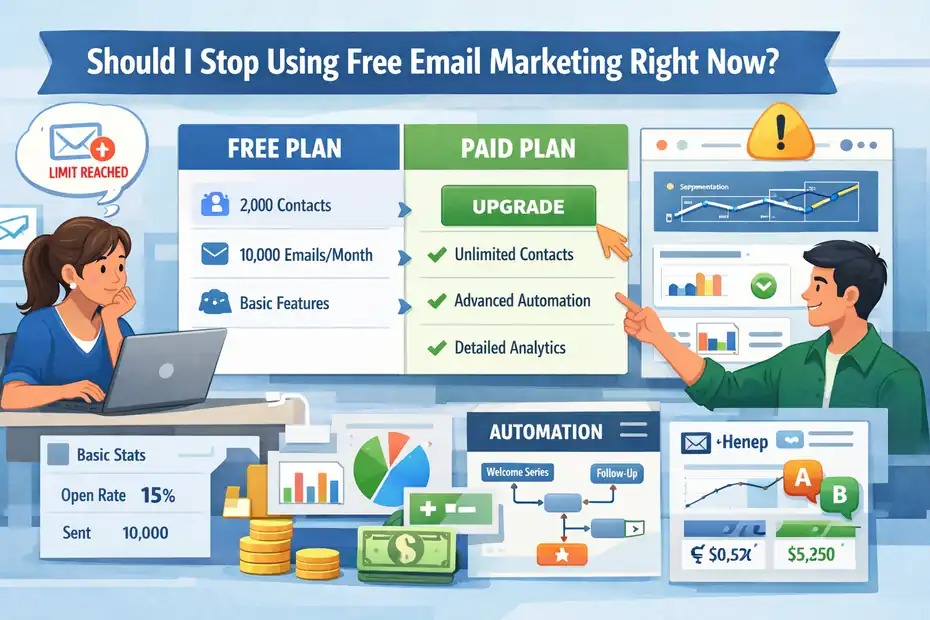
Most free email marketing plans are designed to help you get started, not help you scale. Mailchimp’s Free plan includes up to 250 contacts and 500 sends per month, with a daily send limit of 250.
MailerLite’s free plan allows up to 500 active subscribers and up to 12,000 emails per month, while Brevo’s pricing page highlights paid plans starting from 5,000 emails per month, with free tiers positioned more as entry-level access than long-term scaling plans.
That matters because “free” can mean very different things. One platform may cap subscribers. Another may cap monthly sends. Another may restrict automation, segmentation, support, branding removal, or advanced analytics. So before you ask whether you should stop using free email marketing, you need to ask a better question: what exactly is your free plan limiting?
I suggest thinking about free email marketing as a training plan. It is perfect when you need to learn the basics of list building, welcome emails, and newsletter rhythm. It becomes risky when you start needing precision.
Why Free Plans Exist In The First Place
Email platforms are not giving away free accounts out of pure generosity. They know email marketing has strong commercial value. Litmus reported that for every $1 spent on email, many marketing leaders still see returns in the $10 to $50+ range, with a meaningful share reporting $36 to $50 in return.
That is exactly why free tiers exist. They lower the barrier to entry, let you build habits inside the platform, and make it easier for you to upgrade later. There is nothing wrong with that model. In fact, I think it is fair. But you should recognize the trade: the provider is letting you in cheaply because they expect your needs to outgrow the free tier.
For many of us, the mistake is not using a free plan. The mistake is staying on one after the business case for upgrading is already obvious.
The Big Misunderstanding About “Saving Money”
Free software feels efficient because the monthly bill is zero. But a zero software bill does not always mean a lower total cost.
Imagine you run a small e-commerce store with 1,200 subscribers and no automated abandoned cart flow because your free plan does not support it well.
If that missing automation costs you even three or four recovered orders a month, your “free” setup may already be more expensive than a paid plan.
The same logic applies to creators missing sponsor clicks, coaches missing consultation bookings, or local businesses failing to follow up with leads quickly enough.
This is why I believe the real question is not “Is free bad?” It is “Is free blocking revenue, insight, or consistency?”
How To Know Whether Free Email Marketing Still Fits Your Stage
You do not need to upgrade just because someone on social media says “serious businesses pay for tools.” That advice is too broad to be useful.
Stay Free If You Are Still Validating The Basics
Free email marketing is still a smart choice when you are early and your core system is not proven yet.
Use a free plan when these conditions are true:
- You have a small list: Usually under the provider’s subscriber limit, with room to grow for a while.
- You send simple campaigns: A weekly newsletter, product update, or occasional promo is enough.
- You are learning audience fit: You are still figuring out what people click, open, and care about.
- You do not need advanced automation yet: A basic welcome email may be enough for now.
- You would rather invest elsewhere first: For example, product development, content, or traffic.
This is the stage where I recommend focusing less on software and more on message-market fit. Write better subject lines. Improve your signup offer. Learn what gets replies. Build consistency. Those habits matter more than shiny features early on.
A free plan is especially useful when your opportunity cost is low. If you only send one email per week to 180 subscribers, paying for advanced branching logic is probably unnecessary.
Upgrade When Your Business Model Depends On Email Performance
The answer changes the moment email becomes a real revenue channel instead of just a communication channel.
Here are common signs you are past the “free is enough” phase:
- You are close to subscriber or send caps: You are cleaning your list mainly to avoid paying, not to improve quality.
- You need automations that save time or recover revenue: Welcome sequences, lead nurturing, abandoned cart flows, re-engagement, or upsell sequences.
- You need better segmentation: Sending the same message to everyone is dragging down relevance.
- You care about attribution: You want to know which emails actually led to clicks, purchases, or booked calls.
- You need stronger branding and trust: Platform logos, limited templates, or restricted sending options start to look unprofessional.
From what I’ve seen, this is the tipping point most people miss. They upgrade too late, after growth has already become messy.
The Fastest Self-Test You Can Run Today
If you want a quick answer to “should I stop using free email marketing,” score yourself on these five questions:
- Is my list growth being slowed by plan limits?
- Am I skipping useful automations because my plan makes them hard or unavailable?
- Am I unable to segment subscribers the way my audience actually behaves?
- Do I lack reporting good enough to connect email to revenue or leads?
- Does my current setup make email feel harder than it should?
If you answered yes to three or more, I would seriously consider moving beyond free.
That does not always mean switching platforms. Sometimes it simply means moving to a paid tier on the platform you already like. The important thing is to stop letting “free” make your decisions for you.
The Hidden Costs Of Staying On A Free Plan Too Long
This is where the conversation gets more interesting, because the real downsides are often indirect.
Lost Revenue From Missing Automation
Automation is where email goes from “broadcast channel” to “system.” When you rely only on manual campaigns, you are doing one-off sending instead of building repeatable customer journeys.
A basic automated welcome sequence can introduce your brand, build trust, and push a subscriber toward their first action. A re-engagement flow can wake up quiet subscribers.
A lead nurture sequence can answer objections before a sales call. These are not advanced luxuries. They are practical systems that save time and raise conversion rates.
Free plans often give you partial automation or very restricted automation. That is fine in the beginning. But once your audience size grows, the missing revenue compounds.
Even a simple three-email welcome sequence can outperform random single sends because it meets people when attention is highest: right after signup.
In my experience, the easiest money you make in email often comes from fixing timing, not writing genius copy.
Weaker Segmentation Means More Generic Emails
Segmentation just means grouping subscribers by behavior, interest, source, or stage. It sounds technical, but it is really about relevance.
If your free plan pushes you toward sending the same message to everyone, you usually get weaker clicks and lower conversions. A new subscriber should not receive the same message as a loyal customer. A reader who clicked your “pricing” email is not in the same stage as someone who only downloaded a checklist.
When segmentation is limited, your email strategy becomes blunt. You either under-send to interested people or over-send to people who are not ready. Neither helps.
This is one reason email continues to deliver strong ROI: it is direct and intentional when used well. But that only works when the right people receive the right message at the right time.
Limited Reporting Can Keep You Guessing
A lot of free plans give you enough analytics to feel informed but not enough to make confident decisions. You may see opens, clicks, and unsubscribes, but not much context around revenue, conversion path, advanced engagement patterns, or list quality over time.
That creates a strange middle ground. You are doing “marketing,” but without enough visibility to improve systematically.
I believe this is one of the most expensive hidden costs. When you cannot connect email behavior to business outcomes, optimization becomes guesswork. You keep rewriting subject lines while ignoring bigger issues like weak signup intent, poor segmentation, or missing follow-up sequences.
Free tools can teach you how to send. Paid features often teach you how to improve.
The Real Decision Framework: When You Should Stop Using Free Email Marketing
You do not need a dramatic cut-off date. You need a framework.
Stop Using Free When You Have Outgrown Manual Work
Manual work is fine when volume is low. It becomes expensive when repetition increases.
Ask yourself how often you are doing tasks that software should handle for you:
- Repeated welcome emails: You keep recreating the same onboarding manually.
- Manual follow-up: Leads or customers only hear from you if you remember.
- One-size-fits-all campaigns: You cannot route people based on actions.
- List cleanup for cost reasons only: You are deleting growth opportunities to fit limits.
When your time starts bending around plan limitations, you have already outgrown the free setup.
A practical example: Say you run a consulting business and get 40 new leads each month from a downloadable guide. On a free plan, you send one general newsletter and hope some of those leads remember you later.
On a better plan, you can send a five-email trust-building sequence that answers objections, shares case studies, and invites a call. Same leads. Different system. Very different likely outcome.
Stop Using Free When Brand Presentation Matters More
This one is easy to underestimate. The more your emails influence buying decisions, the more presentation matters.
That does not mean your emails need to be fancy. In fact, some plain-text-style emails perform beautifully. But you do want control over branding, sender trust, template quality, and the overall subscriber experience.
Some free plans include platform branding, tighter design restrictions, or fewer options for more polished customer journeys. Those things may not bother a hobby newsletter. They matter more when you are selling services, products, memberships, events, or sponsorships.
I would not upgrade only for aesthetics. I would upgrade when better presentation supports trust, consistency, and conversion.
Stop Using Free When The Upgrade Cost Is Smaller Than One Win
This is my favorite decision rule because it cuts through emotion fast.
Estimate one monthly win that a better email setup could reasonably create:
- One recovered cart
- One extra coaching call
- One additional client inquiry
- Two extra product sales
- One sponsor click package
- One saved hour per week of manual email work
If the value of that win exceeds the cost of upgrading, the economics are already in your favor.
MailerLite’s free plan allows up to 500 subscribers and 12,000 monthly emails before limits push you toward paid tiers. Mailchimp’s free tier is much tighter at 250 contacts and 500 monthly sends. Those differences alone can change the math depending on your business model.
So no, you should not stop using free email marketing “right now” by default. But you should stop the moment free becomes more expensive than paid in real-world outcomes.
Which Free Plans Break First, And Why
Not all free plans fail in the same way. This is where a quick comparison helps.
A Simple Way To Compare Free Email Marketing Options
Here is a practical snapshot based on current public plan details from major providers:
| Platform | Free Tier Snapshot | Best For | Likely Breaking Point |
|---|---|---|---|
| Mailchimp | Up to 250 contacts and 500 sends/month, daily send limit 250 | Very early beginners testing email basics | You outgrow the list/send cap fast |
| MailerLite | Up to 500 active subscribers and 12,000 emails/month | Small creators, service businesses, simple newsletters | Subscriber growth or locked features as needs deepen |
| Brevo | Paid plans start at 5,000 emails/month; positioning emphasizes scalable sending and multichannel features | Businesses comparing email with broader messaging needs | Advanced needs push you into paid structure faster |
The point is not that one platform is “best” for everyone. The point is that each free setup has a different pressure point. One limits list size. Another limits sophistication. Another is better suited to businesses already planning for paid growth.
Why The Wrong Free Plan Creates The Wrong Habits
I have seen this happen a lot: a business chooses a free plan based on price alone, then designs its whole email strategy around the platform’s limitations.
That might look like this:
- A store avoids sending product education because monthly sends are capped.
- A creator refuses to segment because setup feels too restrictive.
- A local business delays follow-up because automation is limited.
- A consultant keeps every lead in one bucket because the platform makes tagging awkward.
This is backwards. Your email strategy should come from your business model, not from the cheapest software option.
Free tools are useful when they support the strategy you need. They become harmful when they shrink your strategy to fit the plan.
The Smarter Question To Ask Providers
Instead of asking, “Which tool has the best free plan?” ask this:
“What is the first important thing this platform will stop me from doing well?”
That question is much more honest. It shifts you away from surface-level feature comparisons and toward operational fit.
For example, if your business depends on a weekly newsletter and occasional launches, generous send volume matters. If your business depends on lead nurturing, automation flexibility matters more. If your business needs sales and marketing under one roof, broader workflow tools may matter more than list size alone.
I recommend choosing a tool based on your next six to twelve months, not just your next thirty days.
How To Move From Free To Paid Without Making A Mess
Upgrading or switching does not need to be painful, but it does need a plan.
Audit What You Already Have Before You Upgrade
Before spending anything, take inventory of your current email setup.
Review these areas:
- List quality: How many subscribers are active, inactive, or unengaged?
- Signup sources: Where are people coming from, and which sources convert best?
- Core email types: Newsletter, welcome sequence, sales sequence, follow-up, reminders.
- Missing automations: Which messages are still manual?
- Revenue path: Which email actions actually matter to your business?
This audit prevents a common mistake: upgrading to better software without fixing a weak system. If your signup offer is poor and your emails are unclear, a paid plan will not magically rescue results.
I suggest treating the audit like a cleanup before moving into a bigger house. Do not carry junk into the next setup.
Build The First Three Things Before Anything Fancy
When people upgrade, they often get distracted by advanced workflows and visual builders. That is understandable, but I think the better move is to build your highest-leverage basics first.
Start with these:
- A clear welcome sequence: Introduce your brand, set expectations, and guide the next action.
- Basic segmentation: Separate new subscribers, engaged readers, customers, and cold contacts.
- A regular sending rhythm: Weekly, biweekly, or whatever you can sustain consistently.
These three pieces usually create more value than ten fancy workflows nobody maintains.
Imagine you run a paid newsletter and course business. Your welcome sequence can explain your best content, your paid offer, and your publishing schedule. Your segmentation can separate free readers from buyers. Your regular rhythm builds trust. That alone can transform performance.
Watch These Metrics During The First 30 To 60 Days
The goal of upgrading is not to feel more sophisticated. The goal is better outcomes.
Track the basics that actually tell you whether the upgrade is working:
- List growth rate: Are more people joining than leaving?
- Click rate by segment: Are more relevant emails getting more action?
- Conversion rate: Are signups, calls, or sales increasing?
- Time saved: Are automations replacing repetitive manual tasks?
- Revenue per campaign or sequence: Is email creating measurable business value?
Litmus notes that a significant share of marketers still report strong email ROI, but many also fail to measure it properly. That is the part I would not copy. If you are going to pay, measure the business impact.
Common Mistakes People Make When Deciding Whether To Quit Free Email Marketing
This decision gets easier once you avoid the usual traps.
Mistake 1: Upgrading Too Early Out Of Anxiety
Some people move to paid tools because they think “real businesses” should pay for everything. I do not agree.
If your list is tiny, your sending is inconsistent, and you have not yet found what your audience wants, a paid plan can become a guilt subscription. You are paying for capacity you are not using.
Free email marketing is still the right move when your biggest problem is not the tool. If the real issue is weak positioning, low traffic, poor offers, or random publishing, solve that first.
Mistake 2: Staying Free Because The Monthly Fee Feels Annoying
This is the opposite problem, and I see it more often.
The monthly fee feels emotionally bigger than it really is, so you stay on a free plan long after it has started creating friction. You manually send things that should be automated. You avoid segmentation. You delay better reporting. You quietly accept lower performance because “at least it’s free.”
That is penny-wise and growth-foolish.
I recommend comparing software cost to business output, not to your comfort level. A plan that costs less than one meaningful conversion is usually not the real financial problem.
Mistake 3: Switching Platforms Before Fixing Strategy
Sometimes people ask, “Should I stop using free email marketing?” when the more honest question is, “Should I stop using a weak email strategy?”
Changing platforms can help. But it will not fix unclear messaging, bad signup incentives, inconsistent sending, or irrelevant campaigns.
Before you leave a free plan, make sure you know what problem you are solving. Is it limits? Automation? analytics? branding? workflow? If you cannot name the bottleneck, you risk buying complexity instead of progress.
That is why I believe the smartest upgrade is usually boring. It solves one real operational problem first, then expands from there.
Advanced Advice: What Smart Businesses Do After They Leave Free
Once you move beyond free, the opportunity is not just “send more emails.” It is “build a better system.”
Use Lifecycle Email, Not Just Campaign Email
Campaign email is what most beginners know: newsletter, promo, announcement. Lifecycle email is what stronger businesses rely on: timed, behavior-based messaging that matches where someone is in the journey.
That can include:
- New subscriber onboarding
- Lead nurturing
- Post-purchase education
- Re-engagement for inactive subscribers
- Upsell or renewal reminders
This is where email starts acting like an asset instead of a task. One good lifecycle sequence can outperform multiple one-off campaigns because it runs continuously in the background.
For many businesses, this is the real graduation point from free. Not because paid is more professional, but because lifecycle email needs more control.
Get More Aggressive About Relevance, Not Volume
A lot of people assume scaling email means sending more. I think that is incomplete advice.
Better email often comes from better matching. More relevant segments. Better timing. Cleaner journeys. Smarter offers. More useful follow-up.
HubSpot’s 2026 marketing materials emphasize trust, relevance, and brand distinctiveness in a crowded environment, which lines up with what good email already rewards: relevance over noise.
So after leaving free, do not just increase frequency. Increase precision.
Treat Email As Owned Infrastructure
This is probably the strongest reason not to stay stuck on a weak free setup forever. Email is one of the few channels you truly control compared with algorithm-driven reach elsewhere.
Brevo’s 2026 guide describes email marketing as a direct channel used to promote offers, share updates, and build loyalty, and that direct relationship is exactly why it matters.
When you treat email as owned infrastructure, your priorities change. You care more about list quality, subscriber experience, automation logic, and measurable outcomes. You stop seeing the platform as a cheap sender and start seeing it as part of your business engine.
That mindset is what usually separates casual emailing from serious growth.
Final Answer: Should You Stop Using Free Email Marketing Right Now?
For most people, not immediately.
You should keep using free email marketing if you are still validating your offer, growing a small list, learning what your audience wants, and sending simple campaigns that your current plan supports comfortably.
You should stop using free email marketing when free starts limiting growth, automation, segmentation, reporting, branding, or consistency. That is the point where “free” stops being practical and starts becoming expensive in hidden ways.
My honest take is this: do not upgrade because you feel pressured to look more advanced. Upgrade because your current setup is blocking obvious value.
Here is the simplest rule I can give you:
- Stay free while you are learning.
- Pay when better email systems will clearly save time or create revenue.
- Switch platforms only when the current one no longer fits your next stage.
That is the real answer to “should I stop using free email marketing right now?” Not yes. Not no. Just not blindly.
FAQ
What is free email marketing and how does it work?
Free email marketing allows you to send emails to subscribers without paying, usually with limits on contacts, sends, or features. It works as a basic version of paid platforms, helping you build a list, send newsletters, and test strategies before upgrading to more advanced tools.
Should I stop using free email marketing right now?
You should stop using free email marketing when it starts limiting your growth, automation, or results. If you are still learning and your list is small, free plans work well. But once email becomes important for revenue, upgrading usually makes more sense.
When should I upgrade from a free email marketing plan?
You should upgrade when your subscriber list grows, you need automation, or your campaigns require better targeting. If you are missing opportunities like follow-ups or segmentation, or hitting platform limits, it is a clear sign that a paid plan will support better results.
What are the limitations of free email marketing tools?
Free email marketing tools often limit subscribers, monthly email sends, automation features, and analytics. They may also include branding or restrict segmentation. These limitations can reduce performance and make it harder to scale your email strategy effectively.
Is free email marketing enough for small businesses?
Free email marketing can be enough for small businesses in early stages when sending simple newsletters. However, as the business grows and relies more on email for leads or sales, paid plans become more effective due to better automation, tracking, and customization.

Juxhin B is a digital marketing researcher and founder of JAK Digital Hub, specializing in email marketing software, marketing automation platforms, and digital growth tools. His work focuses on software testing, platform comparisons, and real-world performance analysis to help businesses choose the right marketing technology.
Related posts:
 Email Marketing Strategy for 100K Subscribers That Scales
 Why Is My Email Marketing Strategy Not Working Anymore?
 Is Email Marketing Strategy Worth It for Real Growth?
 Email Marketing Jobs Without Degree: 10 Real Opportunities
 How To Get Email Marketing Jobs With No Experience Fast
 How to Build Email Marketing Strategy for Ecommerce Sales