Table of Contents
Some links on JAK Digital Hub are affiliate links, meaning we may earn a small commission at no extra cost to you. Read full disclaimer.
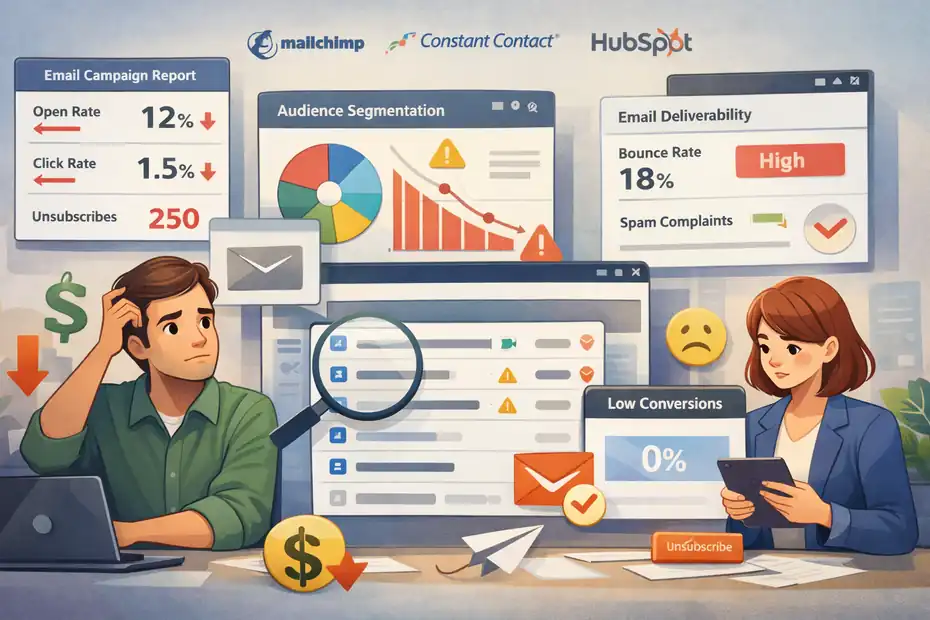
Why is my email marketing strategy not working is the kind of question most marketers ask after a few disappointing campaigns, not when things are obviously broken. That is exactly why it feels so frustrating.
You’re sending emails, your platform says they were delivered, and yet sales, replies, clicks, or signups are flat. In my experience, this usually is not one giant failure.
It is a stack of smaller issues: weak targeting, tired offers, deliverability problems, misleading metrics, and emails that sound fine but give people no real reason to act.
Let me break it down clearly.
What Changed When Email Suddenly Stops Performing
When email performance drops, most people blame the subject line first. Sometimes that is true, but usually the bigger issue is that the environment changed while the strategy stayed the same.
Your Benchmarks May Be Misleading You
A lot of email marketers still judge success by open rate first, and that is where confusion begins. Mailchimp’s current benchmark data shows average open rates around 35.63% across all users, with average click rates around 2.62%, but those numbers vary by industry.
Ecommerce averages are lower on clicks at about 1.74%, while sectors like nonprofits and education often perform better. At the same time, Apple Mail Privacy Protection has made opens less trustworthy because Apple preloads tracking pixels, which can inflate reported opens.
Litmus says over 50% of email opens happen on devices with Apple’s Mail Privacy Protection activated, which means a “good” open rate can still hide weak real engagement.
That matters because you can look at a dashboard and think, “People are opening my emails, so the strategy must be working.” But the real question is not whether a pixel fired. It is whether a human clicked, replied, bought, booked, or moved forward.
I suggest treating opens as directional, not definitive. When performance feels off, put more weight on click rate, click-to-open rate, reply rate, conversion rate, revenue per recipient, and unsubscribe trends. That shift alone often reveals where the real problem lives.
Inbox Placement Got Harder, Even If Your Emails Still “Send”
Since February 2024, Gmail has required stronger standards for bulk senders, including authentication, easy unsubscribe, and low spam complaint behavior for high-volume senders.
Google also continues pushing senders toward better compliance monitoring through Postmaster Tools updates.
In plain English, that means it is easier than before to technically send an email while still struggling to consistently land in the inbox.
This is one of the biggest hidden reasons people ask why is my email marketing strategy not working anymore. The campaign may not be failing because the copy is weak. It may be failing because fewer people are really seeing it.
I have seen brands obsess over templates while ignoring the much less glamorous stuff: SPF, DKIM, DMARC alignment, bounce cleanup, warming new domains, and complaint rates. Those details are not exciting, but they directly affect whether the strategy gets a fair chance to work.
Audience Expectations Moved Faster Than Your Emails Did
People are more selective than they were a few years ago. Their inbox is crowded, AI-generated content is everywhere, and generic marketing language gets ignored fast.
Litmus’ 2025 email findings highlight low engagement, personalization challenges, and measurement problems as key issues for marketers right now.
HubSpot’s 2026 marketing stats also point to email still converting well, but the brands winning are the ones that focus on trust, relevance, and more human-feeling communication.
So if your email strategy still sounds like a polished corporate blast from 2022, that might be the issue. People do not want more “just checking in” emails. They want emails that feel timely, useful, and clearly worth opening.
That does not mean every email needs to be clever. It means every email needs a job.
The Real Reasons Your Email Marketing Strategy Is Not Working
Most underperforming email programs fail in patterns. Once you know the patterns, fixing them gets much easier.
You Are Sending To The Wrong People, Not Just Too Many People
A list can look healthy in your platform while quietly getting worse every month. HubSpot notes that email databases naturally decay by about 22.5% per year as people change jobs, abandon addresses, or unsubscribe.
That number is brutal because it means a list that worked last year can underperform today even if your content has not changed.
Imagine you run a small B2B software company. You built a list of 20,000 contacts over two years, then kept emailing everyone the same newsletter. On paper, that feels like scale. In reality, a big chunk of those people may have changed roles, stopped caring, or never matched your ideal customer in the first place.
This is why list size can become a vanity metric. I would rather send to 3,000 highly relevant contacts than 30,000 loosely interested ones. Smaller, cleaner, better-segmented audiences often produce stronger revenue per send and better deliverability.
A simple rule I recommend is this: If a contact has not clicked, replied, purchased, or shown real interest in a meaningful period, stop assuming they belong in your main send pool.
Your Emails Are Too Broad To Feel Personal
Segmentation and personalization are related, but they are not the same. Segmentation means grouping people by something meaningful, like product interest, lifecycle stage, purchase history, or lead source. Personalization means adapting the content to that group or person.
A lot of brands do the easy version only. They insert a first name and call it personalized. That does almost nothing if the offer is irrelevant.
Here is a practical example. If someone downloaded a pricing guide last week, they should not get the same email as a person who bought from you six months ago and has not opened since. Those are different contexts, different levels of intent, and different next steps.
From what I’ve seen, underperforming email strategies usually over-broadcast. They treat the whole list like one audience, then wonder why clicks stay low. The fix is not always more automation. Often it is simply smarter grouping and more precise messaging.
Your Offer Is Weak, Even If The Email Looks Good
Sometimes the campaign is designed beautifully and written clearly, but it still fails because the offer has no urgency, no specificity, or no real payoff.
People do not click because an email is “nicely written.” They click because they want what is on the other side. A discount that is too small, a lead magnet that sounds generic, or a webinar with a vague promise will drag down results no matter how polished the email is.
This is where I think many marketers spend energy in the wrong order. They tweak button colors while the actual proposition is bland. Before editing copy, ask:
- Is this useful right now?
- Is the benefit obvious within seconds?
- Is the next step worth the click?
- Does this solve a clear problem for this exact segment?
If the answer is shaky, the email is not your core issue. The value proposition is.
How To Diagnose What Is Actually Broken
Before you change everything, you need a clean diagnosis. Otherwise, you will fix the wrong problem and waste weeks.
Start With A Five-Metric Audit
When someone asks me why is my email marketing strategy not working, I do not start with design. I start with five metrics:
- Delivered rate: Tells you whether the email is actually reaching inbox ecosystems at all.
- Click rate: Shows whether recipients cared enough to act.
- Click-to-open rate: Helps you judge message relevance after the open.
- Conversion rate: Tells you whether the traffic from email did something valuable.
- Unsubscribe or complaint trend: Reveals mismatch, fatigue, or trust issues.
Mailchimp’s reporting guidance emphasizes tracking opens, clicks, and unsubscribes, and its benchmark data shows unsubscribe rates averaging around 0.22% overall, with industry differences. Continued high unsubscribe levels can also hurt sending reputation over time.
Here is how I interpret the pattern. Low delivery points to list quality or sender reputation. Good opens but weak clicks suggest poor message-to-offer match. Good clicks but weak conversions usually means the landing page or next step is the problem.
This one framework can save you from a lot of random guessing.
Compare Campaigns By Segment, Not Just Overall Average
Overall averages hide the truth. HubSpot’s current reporting documentation specifically supports viewing performance by segment, and that matters because one audience group can quietly outperform another by a huge margin.
For example, your “all subscribers” newsletter may look mediocre. But inside that average, recent buyers might be clicking at 4.5% while older cold leads click at 0.4%. If you only look at blended performance, you miss the obvious action: send different emails to different groups.
I recommend comparing at least these segments:
- New subscribers
- Engaged non-buyers
- Recent customers
- Lapsed customers
- Cold subscribers
- Leads by source or product interest
This is where hidden wins usually show up. One segment often already tells you what resonates. You just have to notice it.
Look Beyond The Email Itself
A surprising number of “bad email strategies” are really broken funnel strategies. The email gets the click, then the page fails.
Maybe the landing page loads slowly. Maybe the headline changes and creates friction. Maybe the form asks for too much. Maybe the product page does not match the promise in the email. Maybe mobile users cannot easily complete the action.
I believe every email audit should include the entire path from inbox to outcome. Click your own email on mobile. Fill the form. Buy the product. Read the thank-you page. You will often find the leak there.
If the email promise and landing page experience do not line up perfectly, conversions drop and the email gets blamed unfairly.
The Biggest Strategic Mistakes That Quietly Kill Results
Once you know the mechanics, the next layer is strategy. This is where good teams often get stuck because nothing looks obviously broken.
You Are Sending Too Often Or Not Often Enough
Cadence is one of those frustrating variables because there is no universal perfect number. A weekly send can feel helpful for one audience and exhausting for another.
The mistake is not just “too many emails.” It is inconsistency without purpose. Some brands disappear for six weeks, then suddenly send four promotions in five days. Others send every Tuesday out of habit, even when they have nothing useful to say.
That creates two problems. First, subscribers stop developing a clear expectation of value. Second, mailbox providers can see uneven engagement patterns, which does not help your sender reputation.
A better approach is to match cadence to audience temperature. Warmer segments can usually handle more frequency if the content is genuinely relevant. Colder segments often need a slower, more selective approach.
I suggest building cadence around intent, not your internal content calendar.
You Focus On Newsletter Output Instead Of Customer Journey
Many email programs are organized around what the company wants to send rather than what the reader needs to receive next.
That sounds small, but it changes everything.
A customer journey approach asks:
- What does this person need to know now?
- What might stop them from buying?
- What would make the next step easier?
- What signal did they just give us?
A newsletter approach asks:
- What are we sending this week?
You can feel the difference immediately. Journey-driven email tends to convert because it meets context. Broadcast-driven email tends to blend in because it is built around publishing routine.
In my experience, the strongest email strategies are not content calendars with random sends. They are intentional paths: welcome, educate, qualify, convert, retain, re-engage.
You Rely On Automation But Never Refresh It
Automation is powerful, but old automation becomes invisible dead weight. Welcome sequences, abandoned cart flows, lead nurtures, trial onboarding, and win-back campaigns often keep running long after the market, product, and customer objections have changed.
That is dangerous because automation gets trusted. People assume it works because it exists.
A simple example: Your welcome sequence may still lead with “who we are,” while your audience now cares much more about implementation speed, pricing transparency, or proof.
Or your abandoned cart flow may still use a generic reminder when a stronger version would answer common objections or include social proof.
I advise reviewing every core automation at least quarterly. Not just the design. The angle, CTA, timing, audience logic, and conversion path.
How To Fix A Failing Email Marketing Strategy Step By Step
This is where you move from diagnosis into repair. You do not need a total rebuild on day one. You need smart sequencing.
Step 1: Clean Your List And Protect Deliverability
Start with the least glamorous work because it creates room for everything else to improve.
Remove or suppress hard bounces, invalid emails, and long-term inactive subscribers from your primary campaign audience. Make sure your domain authentication is set correctly, your unsubscribe path is simple, and your sending identity is consistent.
Google’s sender guidance explicitly emphasizes authentication and easy unsubscribing for compliant sending, especially at scale. Warm-up strategy guidance from Mailchimp also stresses strong early engagement, minimal bounces, and low complaints as signals that support future inbox placement.
I know this step feels boring compared with writing new campaigns, but it can produce an immediate lift. Better list hygiene often improves inboxing, which improves engagement, which improves future inboxing again. It is one of the few compounding wins in email marketing.
If you have a large inactive segment, do not keep blasting it by default. Create a separate re-engagement plan or let a portion of it go. A smaller healthy list usually beats a larger tired one.
Step 2: Rebuild Segments Around Intent
Once the list is cleaner, stop thinking in terms of one master audience. Build segments around actual behavior.
Useful segment examples include:
- New subscribers who joined in the last 30 days
- Contacts who clicked in the last 90 days
- Customers by product category
- Cart abandoners
- Demo requesters
- Trial users who have not activated
- Past buyers who have not purchased again
The point is not to create dozens of segments just to feel sophisticated. The point is to speak more directly.
Imagine two people on your list. One downloaded a beginner guide yesterday. The other has bought three times and only needs a nudge toward a refill or upgrade. If they get the same message, one of them is getting the wrong email.
That mismatch is one of the clearest answers to why is my email marketing strategy not working for many brands.
Step 3: Rewrite Around One Job Per Email
A weak email often tries to do too much. It educates, sells, announces, and asks for feedback all at once.
I recommend giving every email one primary job. That job might be:
- Get the click
- Get the reply
- Recover the cart
- Book the demo
- Start the trial
- Confirm the onboarding step
- Bring back inactive customers
Once the job is clear, the copy becomes much easier to write. You know what the headline should support, what proof to include, and what CTA matters.
One strong structure I use often is simple:
- Problem: Name the friction or need.
- Payoff: Show the practical benefit.
- Proof: Add evidence, clarity, or example.
- Prompt: Ask for one clear next action.
This works because it respects attention. People should not need to decode what you want them to do.
Step 4: Fix The Landing Experience
After the email rewrite, check the destination with the same intensity.
I suggest matching these elements exactly:
- Subject line promise to email opening line
- Email CTA to landing page headline
- Offer details to page content
- Audience segment to page relevance
- Mobile email experience to mobile landing flow
HubSpot’s email reporting guidance emphasizes conversion as a key action-based metric, and that is a useful reminder: email success does not end at the click.
A realistic scenario: You send an email promising “Book A 15-Minute Audit.” The click goes to a general services page with five menu options and a long generic contact form. That is not an email problem. That is a conversion friction problem.
Tightening this handoff often creates bigger gains than rewriting the email again.
What To Optimize Once The Basics Are Fixed
After the foundation is stable, optimization starts to matter more. Before that, optimization is often just decoration.
Test The Right Variables In The Right Order
A/B testing is useful, but only if you test meaningful variables. Litmus’ 2025 guidance on email A/B testing frames testing as a way to learn audience preferences and improve performance, not just tweak tiny cosmetic details.
My preferred order is:
- Offer or angle
- Audience segment
- CTA framing
- Subject line
- Email layout
- Send timing
That order surprises some people because subject lines get the most attention. But if the underlying offer is weak, a better subject line might improve opens without fixing revenue.
I would rather test “free sample” versus “10% off first order” than blue button versus green button. One changes motivation. The other barely changes anything.
Good testing asks bigger questions first.
Shift Reporting Toward Revenue And Intent Signals
Because opens are less reliable now, stronger reporting matters more than ever. Mailchimp explicitly notes that Apple privacy changes can affect open-rate accuracy, and both Mailchimp and Litmus point marketers toward clicks and downstream actions as stronger engagement signals.
The metrics I care about most are:
- Revenue per recipient
- Conversion rate by segment
- Click-to-open rate
- Reply rate for lower-volume emails
- Unsubscribe rate by campaign type
- Time to first purchase or first key action
- Performance by lifecycle stage
This is where strategy gets smarter. Instead of asking, “Did the campaign perform?” you start asking, “For whom did it perform, and which message moved them?”
That is a much more useful question.
Use Personalization Where It Changes Decision-Making
Personalization gets overhyped because the shallow version is easy. Real personalization should reduce friction or increase relevance.
Examples that actually matter:
- Showing the exact product category someone browsed
- Referencing plan type or trial status
- Sending onboarding content based on setup progress
- Recommending next-best products after purchase
- Changing proof points based on company size or use case
Litmus’ 2025 findings highlight personalization as one of the major ongoing challenges for email teams, which tracks with what I see in practice: most teams know it matters, but many stop at surface-level tokens.
My advice is simple. Personalize only where it improves the decision. If it does not make the next action easier, it is probably not worth the complexity.
Advanced Fixes For Brands That Want Consistent Growth Again
Once your campaigns are stable, your next goal is not just “better emails.” It is a more resilient system.
Build A Simple Lifecycle Email Architecture
If your strategy feels messy, create a structure that covers the full journey:
- Welcome: Introduce value fast and set expectations.
- Nurture: Build trust and handle objections.
- Conversion: Give a clear reason to act now.
- Post-purchase: Reinforce the decision and drive repeat action.
- Re-engagement: Recover interest before full churn.
This kind of architecture works because each stage has a purpose. It also makes performance easier to diagnose. If welcome performs but nurture fails, you know where to focus.
I believe this is one reason advanced email teams improve faster. They do not treat email as random campaigns. They treat it as a system of timed conversations.
That is a much stronger foundation for long-term growth.
Use Tools Only Where They Solve A Real Bottleneck
Tools matter, but only in the right sections of the strategy. If you are comparing platforms, making migration decisions, or choosing implementation features, then tool choice matters a lot. If you are trying to fix poor messaging, weak segmentation, or bad offer strategy, a different platform usually will not save you.
The place where tools genuinely help is visibility and execution. Features like segment reporting, journey automation, deliverability monitoring, conversion attribution, and testing workflows can make a strong strategy easier to run.
Google’s newer Postmaster Tools experience, for example, is specifically designed to help senders monitor compliance with sender guidelines. That is useful because it gives you a clearer picture of whether your sending behavior is helping or hurting inbox placement.
But I would not blame your platform unless your strategy is already reasonably solid and the software is clearly limiting execution.
Treat Email As A Compound Channel, Not A Quick Win
Email still delivers strong ROI for many businesses. Litmus reports that many companies see returns in the 10:1 to 36:1 range, and some see more, while HubSpot continues to cite email as one of the stronger conversion channels in marketing.
The mistake is expecting that ROI from a neglected list, generic creative, and weak measurement.
Email becomes powerful when you improve it over time:
- Better list quality improves inboxing.
- Better inboxing improves engagement.
- Better engagement improves sender reputation.
- Better segmentation improves click quality.
- Better click quality improves conversions.
- Better reporting improves future decisions.
That is the real game. Not one perfect campaign. A system that gets smarter every month.
The Fastest Way To Answer “Why Is My Email Marketing Strategy Not Working?”
By this point, you can probably see the answer is rarely just one thing. Most struggling email programs are dealing with a mix of four problems at once: deliverability, weak segmentation, unclear offers, and misleading success metrics.
A Quick Self-Check You Can Use This Week
Ask yourself these questions honestly:
- Are my emails reaching the inbox consistently?
- Am I sending the same message to people with different intent?
- Is the offer strong enough to earn the click?
- Does the landing page fully match the email promise?
- Am I judging success by opens instead of real actions?
- Have I refreshed my automations in the last quarter?
- Am I sending based on customer journey, not internal routine?
If you answered “no” to several of those, that is probably why the strategy feels stuck.
The good news is that none of these issues are mysterious. They are fixable.
What I Would Do First If This Were My Account
If I were walking into your account today, I would do this in order:
- Audit deliverability, authentication, bounce trends, and inactive segments.
- Pull performance by segment instead of looking at blended averages.
- Rewrite one high-impact automation and one core campaign around a single clear goal.
- Tighten the landing page handoff.
- Change reporting so clicks, conversions, and revenue matter more than opens.
That is not flashy advice, but it is the kind that works.
And honestly, that is usually the turning point. Once you stop trying to “make email work” in general and start fixing the exact points of friction, results become a lot easier to improve.
Final Thought
Why is my email marketing strategy not working anymore? In most cases, it is because the strategy did not fully evolve with inbox rules, buyer expectations, and measurement reality. The solution is not sending more. It is sending smarter.
Clean the list. Protect deliverability. Segment by intent. Give each email one job. Make the offer stronger. Track outcomes that matter. Refresh the parts of the system you set and forgot.
Do that consistently, and email usually stops feeling random. It starts feeling reliable again.
FAQ
Why is my email marketing strategy not working anymore?
Your email marketing strategy may not be working due to poor deliverability, outdated messaging, weak segmentation, or low-quality lists. Even if emails are sent successfully, they might not reach inboxes or resonate with your audience. Focus on engagement metrics like clicks and conversions instead of just open rates.
How can I fix a failing email marketing strategy?
Start by cleaning your email list, improving segmentation, and aligning each email with a clear goal. Make sure your offer is strong and relevant, and optimize your landing pages. Track performance using clicks and conversions to identify what actually drives results and refine your strategy accordingly.
Does email deliverability affect marketing performance?
Yes, email deliverability plays a major role in performance. If your emails land in spam or promotions folders, fewer people will see them. Poor sender reputation, high bounce rates, and low engagement can reduce inbox placement, making even well-written campaigns underperform.
What metrics should I track instead of open rates?
You should focus on click-through rates, conversion rates, revenue per email, and unsubscribe rates. Open rates are less reliable due to privacy changes. These deeper metrics give a clearer picture of whether your emails are actually driving engagement and meaningful business results.
How often should I send marketing emails?
The right frequency depends on your audience and content value. Sending too often can lead to unsubscribes, while sending too rarely reduces engagement. The best approach is to align your sending schedule with user intent and consistently deliver valuable, relevant content.

Juxhin B is a digital marketing researcher and founder of JAK Digital Hub, specializing in email marketing software, marketing automation platforms, and digital growth tools. His work focuses on software testing, platform comparisons, and real-world performance analysis to help businesses choose the right marketing technology.
Related posts:
 How to Build Email Marketing Strategy for Ecommerce Sales
 Email Marketing Strategy for 100K Subscribers That Scales
 Email Marketing Jobs Without Degree: 10 Real Opportunities
 How To Get Email Marketing Jobs With No Experience Fast
 Is Email Marketing Strategy Worth It for Real Growth?
 Email Marketing Strategy vs Paid Ads: Where to Invest