Table of Contents
Some links on JAK Digital Hub are affiliate links, meaning we may earn a small commission at no extra cost to you. Read full disclaimer.
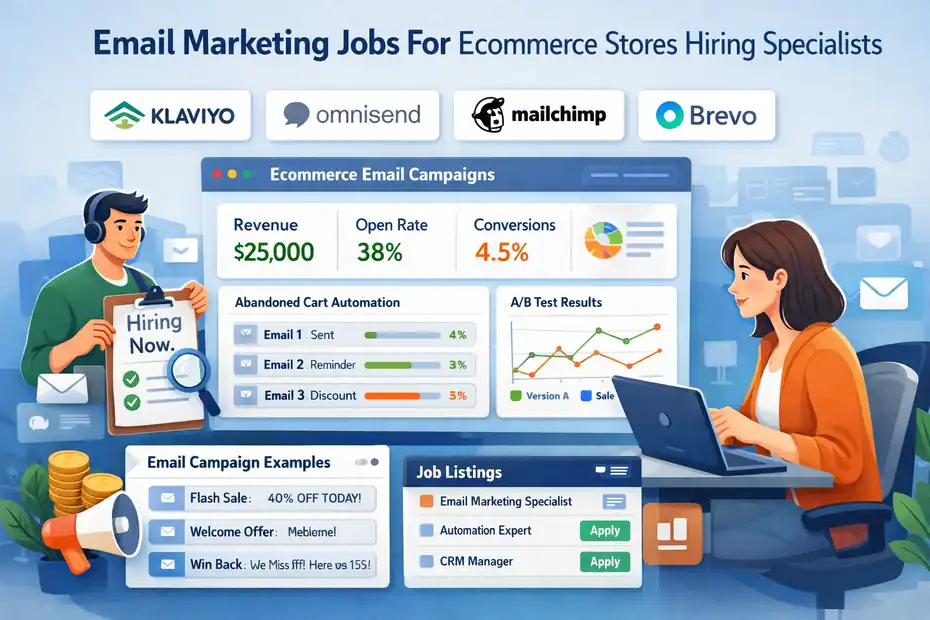
Email marketing jobs for ecommerce stores are growing fast in 2026, and for good reason. Ecommerce brands rely heavily on email to recover abandoned carts, launch products, build loyalty, and drive repeat purchases.
In fact, many stores generate 20–40% of their total revenue from email marketing alone, which is why businesses are actively hiring specialists who understand how ecommerce email actually works.
If you’re looking to work in ecommerce, email marketing can be one of the most profitable and flexible career paths. The demand is high, remote work is common, and skilled specialists can earn anywhere from freelance retainers to full-time salaries.
In this guide, I’ll walk you through how email marketing jobs for ecommerce stores work, what skills companies look for, how to get hired, and how to grow into a high-paid specialist.
Why Ecommerce Stores Are Hiring Email Marketing Specialists in 2026
Ecommerce has become more competitive than ever, and brands are realizing something important: paid ads alone are no longer enough to grow profitably.
Email marketing is one of the few channels companies fully control, which is why stores invest heavily in specialists who can manage and optimize it.
The Revenue Impact of Email Marketing for Ecommerce
Many ecommerce founders underestimate just how powerful email marketing is until they see the numbers.
According to multiple ecommerce studies, email marketing generates an average ROI of $36–$42 for every $1 spent. For ecommerce brands specifically, the impact can be even higher because email targets customers who already showed interest in a product.
Here’s where email marketing usually drives revenue:
- Abandoned cart recovery emails
- Post-purchase follow-ups
- Product launch campaigns
- Seasonal promotions
- Customer loyalty sequences
Imagine a small Shopify store making $100,000 per month. If email contributes just 25% of revenue, that’s $25,000 monthly generated by email alone. Because of this, companies are willing to hire specialists who can build and manage these campaigns.
In my experience, once a store crosses $50k–$100k monthly revenue, email marketing becomes a dedicated role rather than something the founder handles.
Why Ecommerce Email Marketing Requires Specialized Skills
Email marketing for ecommerce is very different from traditional newsletters or corporate email campaigns.
Ecommerce email specialists focus heavily on automation, behavioral triggers, and revenue optimization. The goal isn’t just sending emails — it’s designing systems that generate sales automatically.
For example:
- A visitor adds a product to their cart but leaves the site.
- An automated sequence sends 3 recovery emails over 24 hours.
- One of those emails includes urgency or a limited discount.
That sequence alone can recover 10–20% of lost carts.
Companies want specialists who understand:
- Customer lifecycle marketing
- Email segmentation
- Revenue attribution
- Conversion optimization
- Automation logic
These skills turn email from a simple communication channel into a predictable sales engine.
Types of Email Marketing Jobs for Ecommerce Stores
Not every email marketing role is the same. Some positions focus on strategy, while others handle technical setup or campaign management.
Understanding these roles helps you decide where you fit best.
Email Marketing Specialist
This is the most common role ecommerce companies hire for.
An email marketing specialist typically manages the entire email marketing system for the store.
Daily responsibilities often include:
- Building automated email sequences
- Writing promotional campaigns
- Segmenting customer lists
- Monitoring campaign performance
- Running A/B tests
For example, a typical weekly workflow might include:
- Monday: Analyze previous campaign performance
- Tuesday: Build product promotion campaign
- Wednesday: Optimize abandoned cart sequence
- Thursday: Segment VIP customers
- Friday: Schedule weekend promotions
Many specialists work either in-house or as freelancers managing multiple ecommerce brands.
Average salary range:
- Junior: $45,000–$60,000 per year
- Mid-level: $60,000–$90,000
- Senior: $90,000–$130,000+
Freelancers often charge $500–$3,000 per month per client depending on store size.
Email Automation Specialist
Automation specialists focus specifically on behavior-triggered email systems rather than regular campaigns.
Their work centers around building complex automated flows like:
- Welcome sequences
- Cart abandonment flows
- Browse abandonment emails
- Post-purchase upsell sequences
- Customer re-engagement campaigns
For ecommerce stores, these automated flows often generate 60–80% of email revenue.
A skilled automation specialist might build a flow structure like:
- Visitor subscribes to email list
- Welcome email sent immediately
- Second email introduces product benefits
- Third email offers social proof
- Final email provides limited-time incentive
This sequence warms up new subscribers and turns them into customers.
Automation specialists often earn slightly higher rates because their work directly impacts long-term revenue.
Ecommerce CRM Manager
Larger ecommerce brands usually hire CRM managers to oversee customer communication across multiple channels.
Their responsibilities go beyond email marketing.
They manage:
- Customer lifecycle marketing
- Email segmentation strategy
- SMS marketing
- Customer retention systems
- Loyalty campaigns
Instead of sending individual campaigns, CRM managers design long-term retention strategies.
For example, they might build a lifecycle structure like:
| Customer Stage | Email Strategy |
|---|---|
| New Subscriber | Welcome series |
| First-Time Buyer | Post-purchase nurturing |
| Repeat Customer | VIP offers |
| Inactive Customer | Re-engagement campaigns |
CRM managers often work for mid-size or large ecommerce brands doing $1M+ annual revenue.
Skills Needed to Land Email Marketing Jobs for Ecommerce Stores
The truth is that ecommerce stores don’t just want someone who can write emails. They want someone who understands how email drives revenue.
Here are the core skills companies actually look for.
Email Copywriting That Drives Sales
Email marketing copywriting is very different from blog writing or social media content.
The main goal is conversion.
Good ecommerce email copy focuses on:
- Clear product benefits
- Strong subject lines
- Urgency and scarcity
- Short, scannable content
- Clear call-to-action buttons
For example:
Weak email copy: “Check out our new products in store.”
Strong ecommerce email copy: “Your cart is waiting — complete your order before your items sell out.”
Small changes like this can increase open rates and conversions significantly.
A good benchmark:
- Open rate: 25–40%
- Click-through rate: 2–5%
- Conversion rate: 1–3%
Customer Segmentation and Lifecycle Marketing
Segmentation is one of the most important ecommerce email skills.
Instead of sending the same message to everyone, you divide customers based on behavior.
Common ecommerce segments include:
- New subscribers
- First-time buyers
- Repeat customers
- High-value customers
- Inactive subscribers
For example:
If someone already purchased a product, sending them the same promotion again is ineffective.
Instead, a specialist might send:
- Accessory recommendations
- Product care guides
- Loyalty rewards
This improves customer lifetime value while reducing unsubscribe rates.
Email Deliverability and List Health
Deliverability is a technical skill many beginners ignore.
If emails land in spam folders, even the best campaigns fail.
A good specialist monitors:
- Bounce rates
- Spam complaints
- List engagement
- Sender reputation
Best practices include:
- Regularly cleaning inactive subscribers
- Avoiding spam-trigger words
- Maintaining consistent sending volume
- Using double opt-in signup forms
Healthy lists improve inbox placement and increase revenue.
Email Marketing Tools Used by Ecommerce Stores
Once you understand the strategy, you also need to know the platforms ecommerce brands use.
These tools handle automation, segmentation, campaign tracking, and revenue analytics.
Popular Ecommerce Email Marketing Platforms
Several platforms dominate the ecommerce email marketing space.
| Platform | Best For | Key Features |
|---|---|---|
| Klaviyo | Ecommerce automation | Advanced segmentation, Shopify integration |
| Omnisend | Multi-channel marketing | Email + SMS campaigns |
| Mailchimp | Small businesses | Easy email builder |
| Brevo | Budget-friendly automation | Email and CRM tools |
Klaviyo is widely used among Shopify brands because it connects directly to ecommerce data.
Omnisend focuses on combining email and SMS marketing in one platform.
Mailchimp is still common among smaller ecommerce businesses starting with email marketing.
Brevo is a strong option for companies that want both email marketing and CRM features.
Learning at least one of these platforms significantly improves your chances of getting hired.
How to Get Email Marketing Jobs for Ecommerce Stores
Breaking into ecommerce email marketing is easier than most people think, but you need to approach it strategically.
Step 1: Learn Ecommerce Email Systems
Start by understanding the core email flows every ecommerce store needs.
These include:
- Welcome series
- Abandoned cart sequence
- Post-purchase follow-up
- Customer re-engagement flow
You don’t need a real store to practice.
Many beginners create demo projects where they design flows for hypothetical ecommerce brands.
For example, you could build a sample automation for a skincare brand or fitness store.
This helps you demonstrate real skills when applying for jobs.
Step 2: Build a Simple Email Marketing Portfolio
A portfolio is often the difference between getting hired or ignored.
Your portfolio should show:
- Sample email campaigns
- Automation flow diagrams
- Subject line examples
- Conversion strategies
Instead of just saying you understand email marketing, you show how you would implement it.
Even three well-structured case studies can be enough to land your first freelance client.
Step 3: Find Ecommerce Companies Hiring Email Specialists
Many ecommerce companies actively search for email marketing talent.
Common places to find opportunities include:
- Ecommerce job boards
- Freelance marketplaces
- Marketing communities
- Direct outreach to Shopify stores
A simple outreach message might say:
“Hi, I noticed your store could improve its abandoned cart emails. I specialize in ecommerce email marketing and would love to share a few ideas.”
This approach works surprisingly well.
Common Mistakes Beginners Make in Ecommerce Email Marketing
If you’re trying to land email marketing jobs for ecommerce stores, avoiding beginner mistakes can give you a huge advantage.
Mistake 1: Treating Email Like a Newsletter
Many beginners send long emails full of information.
Ecommerce emails should be short, focused, and product-driven.
A good rule I follow: One email = one message.
For example:
- One product launch
- One promotion
- One offer
Too many messages reduce conversions.
Mistake 2: Ignoring Automation Flows
Campaign emails are important, but automation flows generate the majority of revenue.
Many beginners focus only on newsletters and promotions.
Experienced specialists prioritize:
- Cart abandonment
- Welcome flows
- Customer retention emails
These sequences work 24/7 without manual effort.
Mistake 3: Not Tracking Email Revenue
Email performance isn’t just about open rates.
The real metric is revenue per recipient.
Experienced email marketers track:
- Revenue per email
- Conversion rate
- Average order value
- Customer lifetime value
This helps companies understand how email contributes to total sales.
Advanced Strategies to Grow as an Ecommerce Email Marketing Specialist
Once you gain experience, you can increase your value significantly.
Strategy 1: Focus on Customer Retention
Acquiring new customers is expensive.
Retention email marketing increases profits by encouraging repeat purchases.
According to ecommerce research, increasing retention by just 5% can increase profits by up to 95%.
Email specialists who improve retention become extremely valuable.
Strategy 2: Combine Email With SMS Marketing
Many ecommerce brands combine email with SMS messaging.
For example:
- Email announces a sale
- SMS reminder triggers hours before the sale ends
This increases conversions dramatically.
Strategy 3: Specialize in One Ecommerce Platform
Many email marketers increase their value by specializing in one ecommerce ecosystem.
For example:
- Shopify email automation
- WooCommerce retention marketing
- Subscription ecommerce lifecycle marketing
Specialization makes you easier to hire because companies know exactly what problems you solve.
How Much Email Marketing Specialists Earn in Ecommerce
Income varies depending on experience and whether you work freelance or full-time.
Here’s a general breakdown.
| Role | Average Income |
|---|---|
| Junior Email Marketer | $45k – $60k |
| Email Marketing Specialist | $60k – $90k |
| Senior CRM Manager | $90k – $130k |
| Freelance Specialist | $1k – $10k+ per month |
Many freelancers work with 3–5 ecommerce brands simultaneously, which can significantly increase income.
From what I’ve seen, the most successful specialists eventually move into retainer-based consulting, where brands pay monthly for ongoing email optimization.
Final Thoughts on Email Marketing Jobs for Ecommerce Stores
Email marketing jobs for ecommerce stores are one of the most overlooked opportunities in digital marketing right now. While many people focus on ads or social media, email quietly generates some of the highest returns in ecommerce.
If you learn how ecommerce email systems actually work — from automation flows to lifecycle marketing — you become incredibly valuable to online stores.
The best part is that you don’t need years of experience to get started. With a few strong portfolio examples and a solid understanding of ecommerce email strategy, you can start landing freelance clients or full-time roles.
And as ecommerce continues to grow globally, the demand for skilled email marketing specialists is only going to increase.
FAQ
What are email marketing jobs for ecommerce stores?
Email marketing jobs for ecommerce stores involve creating campaigns, managing automated email flows, segmenting customer lists, and optimizing email performance to increase online store revenue and customer retention.
Do ecommerce stores hire dedicated email marketing specialists?
Yes. Many ecommerce stores hire email marketing specialists to manage automation flows, promotional campaigns, and customer lifecycle emails because email can generate a large portion of store revenue.
What skills are required for email marketing jobs in ecommerce?
Key skills include email copywriting, customer segmentation, automation setup, deliverability management, and performance analysis. Ecommerce brands prefer marketers who understand how email campaigns influence conversions and repeat purchases.
How much do ecommerce email marketing specialists earn?
Ecommerce email marketing specialists typically earn between $45,000 and $90,000 annually. Experienced freelancers managing multiple ecommerce clients can earn $3,000 to $10,000 or more per month.
How can beginners get email marketing jobs for ecommerce stores?
Beginners can start by learning ecommerce email flows, creating a portfolio with sample campaigns, and applying for freelance or remote jobs with online stores looking to improve their email marketing performance.

Juxhin B is a digital marketing researcher and founder of JAK Digital Hub, specializing in email marketing software, marketing automation platforms, and digital growth tools. His work focuses on software testing, platform comparisons, and real-world performance analysis to help businesses choose the right marketing technology.
Related posts:
 Email Marketing Jobs Remote Part Time That Pay Well
 Email Marketing Jobs For Small Business Hiring Now
 Email Marketing Jobs Without Degree: 10 Real Opportunities
 Email Marketing Jobs For Content Marketers Hiring Now
 Email Marketing Jobs For Solopreneurs That Scale Fast
 Email Marketing Jobs For Career Changers: Start A New Path