Table of Contents
Some links on JAK Digital Hub are affiliate links, meaning we may earn a small commission at no extra cost to you. Read full disclaimer.
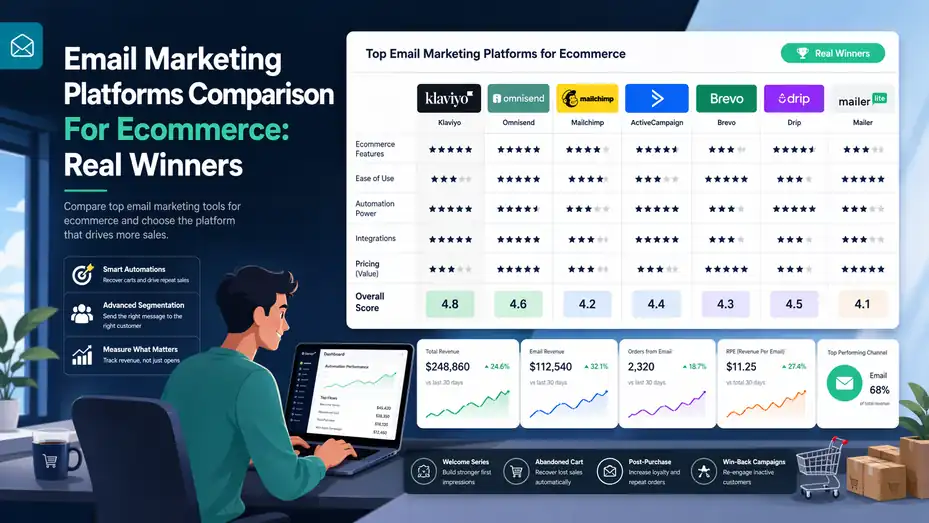
Email marketing platforms comparison for ecommerce gets confusing fast because most reviews lump every business together. That is a mistake. A fashion brand on Shopify, a subscription box store, and a high-ticket WooCommerce shop do not need the same platform.
In my experience, the real winner is not the tool with the longest feature list. It is the one that matches your store size, automation needs, and margin reality.
Below, I’ll break down what actually matters, where each platform wins, and how to choose without wasting six months on the wrong setup.
What Actually Matters In An Ecommerce Email Platform
Choosing an ecommerce email platform should start with outcomes, not features. You are not buying “email software.” You are buying a system that should recover carts, increase repeat purchases, improve segmentation, and protect deliverability while your list grows.
Email still produces strong returns for many brands, with Litmus reporting that a large share of companies see ROI in the 10:1 to 36:1 range. That is exactly why the platform choice matters so much.
Match The Platform To Your Store Model
If you sell low-ticket, fast-repeat products, you usually need strong automation, product recommendations, and easy campaign production more than a built-in CRM. If you sell high-consideration products, richer lifecycle logic and sales-touch coordination can matter more. This is why I suggest ignoring generic “best email platform” lists.
Ecommerce is its own category because revenue often comes from flows like welcome, browse abandonment, cart abandonment, post-purchase, replenishment, and win-back rather than newsletters alone. Platforms that are built around store events usually feel dramatically better once you start scaling.
A simple way to think about it is this: if your store depends on customer behavior data, you want a tool that treats shopping signals as first-class inputs. That includes viewed product activity, started checkout, placed order, predicted next purchase, and customer lifetime value.
The more revenue you expect from automation, the less sense it makes to choose a platform mainly because it is cheap on day one. That “cheap” decision often becomes expensive when you need deeper segmentation later.
The Five Buying Criteria That Matter Most
I use five criteria when comparing email platforms for ecommerce. First is data depth: how well the platform understands product, order, and customer behavior. Second is automation flexibility: how easily you can build flows with conditions, delays, branching, and exclusions.
Third is usability: whether your team can actually launch campaigns without an agency every week. Fourth is pricing model: whether you pay by contacts, sends, or both. Fifth is deliverability support: whether the tool helps you stay compliant with modern sender rules.
Many store owners overvalue templates and undervalue segmentation. Templates are nice. Revenue logic is better. A platform with average templates and excellent event-based automation will usually outperform a prettier tool that cannot react to shopper behavior in a smart way.
I believe this is where many ecommerce brands lose momentum. They buy the platform that is easiest to understand in week one, then outgrow it by month six.
How The Pricing Models Really Work
Pricing is where most comparisons become misleading. Some tools charge mostly by contacts. Others emphasize send volume. Others bundle email and SMS in ways that look generous at first but rise sharply as your audience grows.
Official pricing pages show that Klaviyo scales around contacts and channel usage, Omnisend offers free and paid tiers with email and SMS benefits, Mailchimp prices by audience size and plan, ActiveCampaign starts from lower entry pricing but expands through higher tiers, Drip bases cost on list size and send volume, and Brevo stands out by leaning heavily on email sends rather than stored contacts.
Contact-Based Pricing Versus Send-Based Pricing
Contact-based pricing usually makes sense for brands that email regularly and rely on automation. You are paying for the value of an engaged database, not just monthly volume. The downside is obvious: inactive subscribers can quietly make your bill worse.
This is common with ecommerce stores that collect emails aggressively during promotions but do not clean their lists often enough. Klaviyo, Mailchimp, ActiveCampaign, and Drip all have versions of this growth dynamic.
Send-based pricing can be much more forgiving when you hold a large database but email selectively. Brevo is the clearest example here because it supports large contact storage on some tiers while charging around monthly email volume.
Shopify Email also takes a send-based approach, with 10,000 free emails each month and then per-thousand pricing after that. For lean teams or stores with broad lists and simple campaigns, this can be a very practical model.
A Practical Pricing Comparison Table
| Platform | Pricing Style | Entry Signal | Best Budget Fit | Watch-Out |
|---|---|---|---|---|
| Klaviyo | Contacts + channel usage | Free plan available | Growth brands using segmentation heavily | Costs can rise fast with large lists |
| Omnisend | Tiered plans with email + SMS value | Free and paid plans | Shopify-first brands wanting quick value | Advanced needs still increase cost |
| Mailchimp | Contacts + plan limits | Pricing calculator by audience size | Smaller teams wanting familiarity | Ecommerce depth depends on plan and setup |
| ActiveCampaign | Contacts + tiered capability | Starts around $15 for 1,000 contacts | Lifecycle-heavy stores needing automation | Best features live higher in the stack |
| Drip | List size + send volume | Around $39/month from 2,500 contacts | DTC brands wanting strong automation | No forever-free entry point on main pricing path |
| Brevo | Monthly email sends | Starter from low monthly cost | Cost-sensitive stores with large lists | Ecommerce-specific depth is lighter than specialists |
| Shopify Email | Sends | 10,000 free emails monthly | Very small Shopify stores | Limited compared with dedicated platforms |
What matters here is not only the starting price. It is how fast your cost grows once you hit 10,000, 25,000, or 100,000 contacts and whether that extra spend creates extra revenue.
I usually tell store owners to compare expected cost at today’s list size and at 12 months out. That one step prevents a lot of painful migrations later.
The Real Winners By Ecommerce Use Case
There is no single universal winner, but there are very clear winners for different store realities. The mistake is assuming that the “most popular” option is automatically the best fit for your business model. It rarely is.
Below is the breakdown I would use if I were choosing for a real store today.
Best Overall For Established Ecommerce Brands: Klaviyo
Klaviyo remains the safest “serious ecommerce” choice for many brands because its whole pitch is built around B2C CRM, email, SMS, reporting, and customer data that connects directly to store behavior.
It also publishes ecommerce benchmark data drawn from more than 183,000 customers, which gives you a sense of just how deeply it is embedded in this market. That does not make it automatically right for everyone, but it does explain why it is often the default for scaling Shopify and ecommerce teams.
Where Klaviyo wins is segmentation depth. If you want to target people who viewed a category twice, purchased in the last 90 days, have not bought their usual replenishment item, and are likely to respond to a discount, Klaviyo is built for that style of work.
In my experience, this matters most once your store has enough traffic and purchase history for advanced logic to outperform simpler batch campaigns. The downside is cost. If your list grows quickly and you keep too many low-value subscribers, pricing can sting.
I recommend Klaviyo when your store already has traction, your average order value can support lifecycle marketing investment, and you care more about revenue precision than bare-minimum cost. For mature ecommerce, it is still one of the clearest winners.
Best For Small-To-Mid Shopify Stores: Omnisend
Omnisend is one of the easiest platforms to recommend for smaller ecommerce teams because it stays very focused on ecommerce use cases and does not feel bloated.
Its messaging is squarely aimed at stores using email, SMS, forms, templates, and automations without needing a heavy technical setup, and the company highlights strong ecommerce ROI positioning, including a claim of $79 returned for every $1 spent.
That is a marketing claim, not a universal guarantee, but it shows how tightly the product is aligned with ecommerce revenue outcomes.
The real strength of Omnisend is speed to value. Many teams can go from signup to useful popups, welcome series, and cart recovery flows without a long implementation cycle.
That matters when you do not have a retention marketer or an agency on call. It also helps that current pricing includes accessible entry tiers and SMS value, which makes it attractive for brands that want multichannel automation without committing to a more expensive enterprise-like stack too early.
I would choose Omnisend for a Shopify or WooCommerce store that wants ecommerce-first automation, fast setup, and a better balance between capability and simplicity. It is often the most practical winner for growing brands that are not ready for maximum complexity.
Best For Advanced Lifecycle Logic: ActiveCampaign
ActiveCampaign is not always positioned as “the ecommerce tool,” but it remains extremely strong when you want automation depth, branching logic, and broader lifecycle orchestration.
Official plan information and pricing pages show that it layers more sophisticated capabilities as you move up the stack, and current comparisons highlight entry pricing around $15 for 1,000 contacts on Starter and richer automation in higher plans.
The reason some ecommerce brands love ActiveCampaign is that it feels more like a lifecycle engine than a newsletter platform. If your business has longer customer journeys, lead nurturing before purchase, or a mix of ecommerce and sales-assisted conversion, it can outperform more purely retail-focused tools.
You get room to build nuanced funnels rather than just classic ecommerce flows. The tradeoff is that it can be more than some stores need, especially if your revenue mainly comes from standard purchase-triggered sequences.
I usually suggest ActiveCampaign to stores that are a bit more operationally mature. If you enjoy building logic and want a platform that can coordinate marketing more deeply, it is one of the strongest options in the field.
Best For DTC Brands That Care About Automation Without Bloat: Drip
Drip deserves more attention than it gets in mainstream roundups. Its positioning is explicitly B2C and ecommerce-friendly, with automation, segmentation, and store integrations at the center.
Official pricing shows a starting point around $39 per month, with cost based on active people and send volume, and its site emphasizes Shopify, WooCommerce, and BigCommerce integrations.
What I like about Drip is that it often feels opinionated in the right way. It is not trying to be everything for everyone. It is trying to help a store send better lifecycle messaging.
Drip also publishes customer performance figures on its site, including a 99.8% delivery rate and stronger workflow engagement metrics than one-off campaigns, which reinforces the point that automation is the core value proposition.
Again, those are platform-reported numbers, not a guarantee for your brand, but they are useful directional signals.
I would put Drip high on the list for DTC brands that want serious automation but do not want a giant all-in-one suite. It is a strong fit when your marketing team values behavior-based campaigns more than broad CRM complexity.
Best For Tight Budgets And Big Lists: Brevo
Brevo is a very sensible option when your budget is limited and your list size is larger than your send volume. Its pricing emphasizes monthly email sends, includes email and SMS features, and allows substantial contact storage even on accessible plans.
That alone makes it different from many ecommerce-heavy tools that become more expensive simply because you collected a lot of subscribers.
The tradeoff is that Brevo is broader and less ecommerce-specialized. It is an all-in-one customer engagement platform, which can be great for flexibility, but it usually does not feel as purpose-built for ecommerce merchandising and advanced store-triggered logic as Klaviyo or Omnisend.
I would not call that a flaw. It just means the winner here is “best value for certain stores,” not “best for every retention team.”
If your store is early-stage, your campaigns are still fairly simple, and you care a lot about keeping software costs predictable, Brevo is one of the best value picks in this comparison.
What Features Actually Move Revenue
Features only matter when they influence revenue. In ecommerce, the core money-makers are almost always segmentation, triggered automation, deliverability, and reporting that ties messages to purchases.
Fancy extras can help, but they are not what usually changes the business.
Revenue-Critical Features To Prioritize First
The first must-have is event-triggered automation. You want flows that react to signup, browse behavior, cart activity, purchase, lapsed time, and product replenishment windows.
The second is dynamic segmentation that lets you slice by recency, frequency, monetary value, product interest, and engagement.
The third is attribution and revenue reporting that show which campaigns and flows are actually driving orders. The fourth is a usable editor, because even the smartest platform fails if your team avoids using it.
A useful mental test is this: Can the platform help you send fewer, smarter emails? That is usually a better sign than whether it can send more. Good ecommerce email is not about blasting everyone. It is about sending the right message at the right point in the purchase cycle. The tools that win long term usually make relevance easier.
Nice-To-Haves Versus Real Necessities
AI writing helpers, drag-and-drop builders, and template libraries are useful, but they are not your moat. Neither are superficial dashboards. I would rank those as secondary.
More important are things like predictive segments, reusable automation logic, product feed support, and the ability to suppress recent buyers from promotion-heavy campaigns. These are the features that quietly protect margins and customer experience.
Imagine two stores with the same list size. One sends a weekly discount email to everyone. The other uses product-interest segments, sends replenishment reminders based on expected reorder timing, and excludes recent purchasers from discount pushes.
The second store does not just earn more revenue. It usually builds better deliverability and less list fatigue too. That is why feature depth matters in a practical, not theoretical, way.
Setup, Migration, And Day-One Execution
Most platform decisions fail during implementation, not selection. The demo looks great, then the team delays migration, forgets DNS setup, imports dirty lists, and launches a welcome flow without proper suppression logic.
A strong platform cannot rescue a weak setup.
The Smart Way To Migrate Without Hurting Revenue
Step 1: Clean the list before import. Remove invalid, cold, or clearly unengaged contacts where appropriate.
Step 2: Set up authentication immediately. Google says all senders should use SPF or DKIM, while bulk senders should use SPF, DKIM, and DMARC. Yahoo similarly requires authentication and advises keeping spam complaint rates below 0.3%. These are not optional “best practices” anymore. They are part of staying inboxed.
Step 3: Rebuild your highest-value automations first. For most stores, that means welcome, abandoned cart, post-purchase, browse abandonment if available, and win-back.
Step 4: Warm the sending setup carefully if you are moving significant volume or changing sending infrastructure.
Step 5: QA every trigger and every merge field before going live.
In my experience, most revenue leakage in migrations comes from tiny logic errors, not giant disasters. A broken discount code or wrong product block can quietly waste money for weeks.
A Simple Launch Priority Framework
| Priority | Flow Or Asset | Why It Matters |
|---|---|---|
| 1 | Welcome Series | Converts fresh intent while expectations are highest |
| 2 | Abandoned Cart | Recovers revenue already close to purchase |
| 3 | Post-Purchase | Drives repeat orders and reduces buyer remorse |
| 4 | Browse Abandonment | Captures product interest earlier in the funnel |
| 5 | Win-Back | Revives dormant customers more cheaply than reacquisition |
This is the order I would use for most stores. You do not need 27 flows on day one. You need the right five working correctly. That is a much better path to fast wins.
Common Mistakes That Make The Wrong Platform Feel “Bad”
Sometimes the platform is wrong. Often the setup is wrong. I have seen store owners blame software for problems caused by poor segmentation, over-mailing, weak offer strategy, or messy data sync.
It is worth separating platform limitations from operator mistakes before you migrate again.
The Most Expensive Errors
Mistake 1: Choosing based on free plan generosity alone. Cheap entry pricing is attractive, but it does not tell you whether the platform will support your next stage.
Mistake 2: Ignoring data structure. If product, customer, and order events are messy, your automation quality drops no matter which platform you use.
Mistake 3: Treating every subscriber the same. That is how you create unsubscribes, complaints, and discount dependency.
Mistake 4: Delaying authentication and deliverability hygiene. Google and Yahoo’s sender requirements changed the stakes here permanently.
Another mistake is chasing “all-in-one” convenience when your business really needs ecommerce depth. All-in-one platforms can be great, but if ecommerce retention is a major revenue lever for your store, a specialist tool often produces better targeting and reporting.
I believe this is one of the clearest lessons in email marketing platforms comparison for ecommerce: breadth is not always better than fit.
My Recommendations For Different Store Sizes
At this point, the comparison becomes much easier.
You do not need the “best platform.” You need the best platform for your current store stage and the next stage you are likely to hit.
Which Platform I Would Choose In Real Scenarios
If I were running a very small Shopify store with limited time and budget, I would start with Omnisend or Shopify Email depending on complexity. Shopify Email is fine when you mainly need lightweight campaigns and simple economics. Omnisend is the better step-up when you want proper automation and ecommerce-first workflows sooner.
If I were running a growing DTC brand with meaningful traffic and enough margin to invest in retention, I would lean Klaviyo or Drip. Klaviyo gets the nod when segmentation depth and broad ecosystem support matter most. Drip becomes very attractive when I want powerful automation with less of an “everything platform” feel.
If I were operating a store with a more complex lifecycle, maybe with higher-ticket products, longer nurture windows, or stronger CRM needs, I would seriously consider ActiveCampaign. And if cost control were the dominant constraint while my database was large, Brevo would be on the shortlist quickly.
Final Verdict: The Real Winners
The real winners are clearer than most comparison articles admit. Klaviyo is the strongest overall choice for established ecommerce brands that want deep segmentation, rich customer data, and sophisticated revenue automation.
Omnisend is the best practical choice for many small-to-mid ecommerce stores that want fast setup and ecommerce-first features without excessive complexity.
ActiveCampaign wins for advanced lifecycle logic, Drip wins for focused DTC automation, Brevo wins on cost efficiency for the right list profile, and Shopify Email wins only when simplicity matters more than depth.
If you want my honest opinion, the safest decision for most serious ecommerce brands is to choose the platform you can still see yourself using when your list is 3x larger and your automation strategy is much smarter. That mindset usually leads you to a better fit than comparing surface-level features ever will.
And that is the core lesson behind any useful email marketing platforms comparison for ecommerce: the winner is the one that keeps making you money as your store gets more complex, not the one that merely looks easy on signup day.
FAQ
What is the best email marketing platform for ecommerce?
The best platform depends on your store size and goals. Klaviyo is ideal for advanced segmentation and scaling brands, while Omnisend works well for smaller stores needing fast setup. The right choice should support automation, customer data tracking, and revenue-focused email flows.
How do I choose an email marketing platform for ecommerce?
Start by evaluating your store’s size, budget, and automation needs. Focus on platforms that integrate with your ecommerce system, support behavioral triggers, and offer flexible segmentation. Avoid choosing based only on price, as long-term scalability and performance matter more.
Are free email marketing platforms good for ecommerce?
Free plans can work for beginners, especially for small lists and simple campaigns. However, they often limit automation, segmentation, and reporting. As your store grows, upgrading to a paid platform becomes necessary to unlock features that drive consistent ecommerce revenue.
What features should an ecommerce email platform have?
An effective platform should include automation workflows, behavioral triggers, segmentation, and revenue tracking. Features like cart recovery, post-purchase emails, and personalization are essential. These tools help send targeted messages that increase conversions and improve customer retention.
Why is email marketing important for ecommerce?
Email marketing helps ecommerce stores build relationships, recover lost sales, and increase repeat purchases. It gives you direct access to your audience without relying on ads. With proper automation and targeting, it becomes one of the most profitable marketing channels.

Juxhin B is a digital marketing researcher and founder of JAK Digital Hub, specializing in email marketing software, marketing automation platforms, and digital growth tools. His work focuses on software testing, platform comparisons, and real-world performance analysis to help businesses choose the right marketing technology.
Related posts:
 7 Better Email Marketing Tools For Ecommerce Growth
 Free Email Marketing For Ecommerce: 7 Tools That Sell
 How To Choose Email Marketing Platforms For Ecommerce Smartly
 Moosend vs MailerLite Pricing: Which One Saves You More?
 Email Leads Software Comparison: Which One Wins?
 Should I Leave Omnisend? The Decision Guide You Wish You Had