Table of Contents
Some links on JAK Digital Hub are affiliate links, meaning we may earn a small commission at no extra cost to you. Read full disclaimer.
How to choose email marketing platforms for ecommerce is one of those decisions that looks simple at first, then gets expensive if you rush it.
I’ve seen store owners pick a platform because the homepage looked polished, only to realize later that segmentation was weak, automations were limited, or pricing jumped the moment the list grew. The smarter move is to choose based on your store model, customer data, and growth stage.
In this guide, I’ll walk you through exactly how to evaluate platforms so you can avoid tool regret and pick something that actually helps you sell more.
Start With What Your Store Actually Needs
The fastest way to choose the wrong platform is to shop by popularity instead of fit. Before you compare tools, get clear on what your ecommerce business needs the platform to do in the next 12 to 18 months.
Know Your Store Model Before You Compare Features
A good ecommerce email platform should match the way your store makes money, not just the way your team sends campaigns.
- One-time purchase stores: You usually need strong welcome flows, abandoned cart recovery, product education, and post-purchase upsells.
- Repeat purchase brands: You should care more about replenishment reminders, win-back campaigns, loyalty segmentation, and customer lifetime value tracking.
- High-ticket products: You may need longer nurture sequences, better lead scoring, and stronger attribution because people rarely buy on the first click.
- Large catalogs: You’ll want product recommendation blocks, category-based segmentation, and filters that use browse or purchase behavior.
I suggest writing down three things before you even open comparison tabs: your average order value, how often customers buy again, and how many products or categories you sell. Those three details shape almost everything.
Imagine you run a skincare store with repeat orders every 45 to 60 days. In that case, a platform with weak automation but pretty templates is a bad trade. On the other hand, if you sell custom furniture with long decision cycles, deep automation matters more than daily campaign volume.
This is why “best platform” lists often mislead people. The real question is whether the platform fits your customer journey.
Define Your Non-Negotiables Early
Once you understand your store model, create a short list of must-haves. Not wishlist items. Real deal-breakers.
- Must-have example 1: Native integration with Shopify, WooCommerce, or BigCommerce.
- Must-have example 2: Behavior-based segmentation using product views, cart events, and order history.
- Must-have example 3: Visual automation builder for flows like welcome, cart abandonment, browse abandonment, and win-back.
- Must-have example 4: Revenue attribution you can trust.
- Must-have example 5: Pricing that still works when your list doubles.
This matters because platforms often look similar at the campaign level. Almost all of them let you design emails, schedule sends, and create forms. The real differences show up later in segmentation depth, data sync quality, deliverability controls, and reporting.
I recommend separating needs into two buckets: “need now” and “need soon.” For many stores, “need now” includes basic campaigns, popups, and cart recovery. “Need soon” might include SMS, predictive analytics, advanced product recommendations, or multi-store support. That way, you don’t overbuy too early, but you also don’t trap yourself in a system you’ll outgrow in six months.
Check The Data And Integration Layer First
This is the part many people skip because it feels technical. But in ecommerce email, your platform is only as good as the customer and store data it can actually use.
Make Sure The Platform Sees Real Ecommerce Behavior
After every H2 in this article, I want to keep it practical, so here’s the core idea: ecommerce email works when your platform can react to customer behavior in near real time.
- Customer events: Can it track viewed product, added to cart, started checkout, purchased, refunded, and reordered?
- Catalog sync: Can it pull product names, prices, images, collections, and stock status into emails automatically?
- Profile data: Can it store order count, average order value, location, tags, and historical engagement?
- Event freshness: Does data update fast enough to power triggered emails while the buying intent is still warm?
Klaviyo positions itself around real-time ecommerce data and native integrations with platforms like Shopify, while Omnisend, Mailchimp, Drip, and ActiveCampaign also support ecommerce connections with varying depth.
This is where hands-on evaluation matters. A platform may say it “integrates with ecommerce,” but that can mean anything from basic order syncing to full behavioral tracking. Those are not the same thing.
If I were reviewing a platform for a growing store, I would test one thing first: can I build a segment of people who viewed a category, did not buy, and spent more than a certain amount historically? If the answer is no, the platform is probably too shallow for serious retention marketing.
Review Integration Quality, Not Just Integration Quantity
A long integrations page looks impressive, but it does not guarantee useful data flow.
- Native integration: Usually easier to set up and more reliable for core events.
- Middleware connection: Helpful when you use several tools, but it can introduce delays or missing fields.
- Custom API option: Best for complex setups, though usually more work.
- Two-way sync: Important if you want customer data to move back and forth between your email tool and other systems.
Mailchimp’s ecommerce documentation confirms it supports order notifications, abandoned cart automations, follow-ups, and product recommendations through its ecommerce data model. Drip highlights integrations with Shopify, BigCommerce, and WooCommerce, while ActiveCampaign emphasizes ecommerce automation and a large integration ecosystem.
Here’s my honest opinion: I would rather have five strong integrations than 500 weak ones. If your store depends on subscriptions, loyalty data, quizzes, reviews, or a help desk, verify those connections directly. A broken or delayed sync can quietly wreck your segmentation, trigger the wrong flows, and make your reporting look better or worse than reality.
Compare Platforms By Use Case, Not By Hype
Once your data requirements are clear, platform choice gets easier. You are no longer asking, “Which one is best?” You’re asking, “Which one is best for my current business model and team?”
What Different Platforms Tend To Be Good At
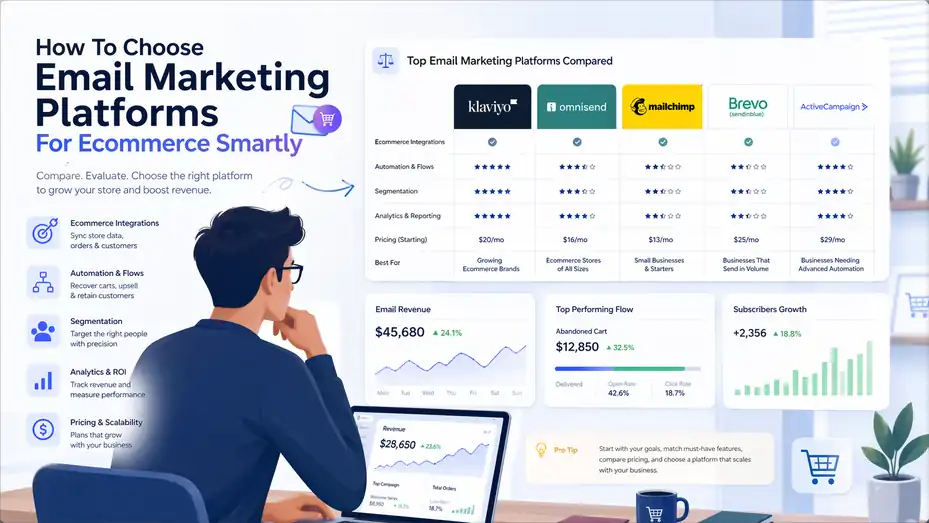
Here is a practical snapshot of how several well-known options are positioned right now.
| Platform | Best Fit | Pricing/Plan Signal | What Stands Out |
|---|---|---|---|
| Klaviyo | Growing to advanced ecommerce brands | Free plan includes up to 250 active profiles and 500 emails/month | Strong segmentation, automation, and ecommerce data depth |
| Omnisend | Ecommerce brands wanting email + SMS + push in one place | Standard starts at $16/month | Multichannel focus and ecommerce-friendly automation |
| Mailchimp | Small businesses that want usability and broad marketing features | Free plan available for fewer than 250 contacts | Beginner-friendly with broad brand recognition |
| Shopify Email | Shopify stores with simple needs and tight budgets | First 10,000 emails/month are free, then pricing starts at $1 per 1,000 emails | Convenient and cost-effective for basic sending |
| Drip | Ecommerce brands wanting focused automation without heavy enterprise feel | Starts at $39/month | Ecommerce-specific positioning and straightforward feature access |
| Brevo | Stores that care about send-volume pricing more than contact-count pricing | Pricing based on monthly email volume | Useful if you have many contacts but controlled send frequency |
| ActiveCampaign | Brands needing broader automation logic beyond ecommerce campaigns | Custom-tailored pricing | Strong automation heritage and wide app ecosystem |
These details are based on current platform pricing or official positioning pages.
I believe the mistake here is treating all of these tools as interchangeable. They are not. Some are built around ecommerce event data. Some are built around email volume. Some are built around broader automation or SMB simplicity.
Match The Platform To Your Growth Stage
A smart pick for a startup can become an expensive bottleneck later. That does not mean you should buy enterprise-grade software on day one. It means you should choose with your next stage in mind.
- Early-stage store: Prioritize fast setup, templates, forms, cart recovery, and simple reporting.
- Growth-stage store: Prioritize segmentation, stronger flows, product recommendations, and deeper revenue attribution.
- Scaling brand: Prioritize deliverability support, multi-channel orchestration, advanced analytics, and team permissions.
- Complex operation: Prioritize custom data, multiple stores, advanced audience logic, and API flexibility.
For example, Shopify Email can make a lot of sense for a small Shopify merchant who mainly wants newsletters and occasional automations, especially because the first 10,000 emails each month are free. Klaviyo and Omnisend become more attractive when segmentation and automated revenue become bigger priorities.
This is one of those moments where restraint matters. Don’t pay for sophistication you won’t use. But also don’t choose a cheap platform if your retention strategy depends on data it cannot act on.
Evaluate The Features That Actually Drive Ecommerce Revenue
Not every feature deserves equal weight. Some look good in demos but barely move revenue. Others quietly become the reason a store grows faster.
Prioritize Segmentation, Automations, And Personalization
If I had to narrow the platform decision down to three things, it would be these: segmentation, automation depth, and personalization quality.
- Segmentation: Can you target by product viewed, order value, purchase frequency, predicted next order, engagement level, or category affinity?
- Automation depth: Can you create branching logic, delays, conditional splits, and exclusions without needing a developer?
- Personalization: Can the platform insert dynamic product blocks, custom properties, and relevant recommendations automatically?
Why these three? Because campaigns alone usually do not build an efficient ecommerce program. The money often comes from flows that run all the time: welcome, cart abandonment, browse abandonment, post-purchase, replenishment, cross-sell, and win-back.
Mailchimp offers ecommerce features such as abandoned cart automations and product recommendations. Klaviyo’s free tier includes automations, segmentation, and reports, and Omnisend’s positioning emphasizes ecommerce marketing with multichannel automation.
From what I’ve seen, stores often underestimate how much segmentation quality affects revenue per send. A smaller list with sharper targeting usually beats a bigger list blasted with generic promotions. That is why platform capability matters more than template polish once your store starts growing.
Look Closely At Reporting And Attribution
A platform should not just send emails. It should help you decide what to do next.
- Revenue attribution: Can you see which flows and campaigns are driving orders?
- Engagement reporting: Can you break performance down by segment, campaign type, and device?
- Conversion windows: Can you control or at least understand how attribution is calculated?
- Cohort insight: Can you compare first-time buyers, VIPs, repeat purchasers, or inactive segments?
Mailchimp publishes industry benchmarks showing ecommerce average open rates around 29.81%, click rates around 1.74%, and unsubscribe rates around 0.19%, which can give you a rough baseline when reviewing your own results. Litmus also reports that many companies see email ROI in the 10:1 to 36:1 range, with some reporting more.
These benchmarks are useful, but I would not obsess over them too early. The platform question is really this: does it help you find profitable patterns? For example, can you tell whether first-time buyer follow-ups outperform general promotions? Can you see which segments respond to discounting and which buy without it? Good reporting shortens the feedback loop. That is what makes optimization possible.
Understand Pricing Before It Understands Your Wallet
Email platform pricing can look harmless on a comparison page and then become painful once your subscriber list, send volume, or SMS usage expands. This is where smart buyers slow down.
Learn The Pricing Model Behind The Sticker Price
Two platforms can both say “starts at $16” and still have completely different long-term costs.
- Contact-based pricing: You pay more as your list grows, even if many people rarely engage.
- Email-volume pricing: You pay more when you send more, which can be better for stores with large but lightly mailed lists.
- Active-profile pricing: Usually charges for contacts who are marketable or active rather than every stored record.
- Add-on pricing: SMS, reviews, advanced analytics, or onboarding can sit outside the base plan.
Right now, Klaviyo’s free plan includes up to 250 active profiles and 500 email sends per month. Omnisend’s Standard plan starts at $16 per month. Mailchimp offers a free plan for fewer than 250 contacts, Shopify Email includes the first 10,000 emails monthly, and Drip starts at $39. Brevo’s pricing is based on monthly email volume rather than contact count.
I suggest modeling your cost at three points: now, at 2x list growth, and at 5x list growth. That simple exercise reveals a lot.
Build A Realistic Cost Scenario Before You Commit
Here is a simple way to think about platform cost beyond the headline number.
| Cost Factor | What To Check | Why It Matters |
|---|---|---|
| Contacts | Are you charged for all contacts or only active/reachable ones? | A large inactive list can inflate cost fast |
| Send limits | Is there a monthly email cap? | Promo-heavy brands can outgrow cheap plans quickly |
| SMS | Is it included, bundled, or extra? | Multichannel programs can get expensive fast |
| Onboarding | Is migration or setup support extra? | Hidden service costs matter during switching |
| Feature gates | Are key automations or reports locked to higher tiers? | Cheap plans can become false economy |
| Team access | Are more users included? | Important for agencies and growing internal teams |
A realistic example helps. Imagine you have 20,000 subscribers, send four campaigns a week, and run six automations. A contact-based tool may get expensive as the list grows, while a send-volume tool may be more attractive if your list is large but your email frequency is moderate. On the other hand, if your revenue depends on deep segmentation and predictive features, paying more for a stronger ecommerce platform can still be the cheaper decision because the revenue gap outweighs the subscription cost.
Test The User Experience And Operational Fit
Features matter, but so does the day-to-day experience of actually using the platform. A powerful tool that your team avoids is not a good choice.
Judge How Easy It Is To Launch Real Campaigns And Flows
This is where demos can be misleading. Most platforms look clean when a sales rep clicks through a perfect account with sample data. What matters is how quickly your team can do real work.
- Campaign setup: Can you build, approve, and send a campaign without unnecessary friction?
- Flow builder: Is the automation editor intuitive when logic becomes more complex?
- Template editing: Can a marketer change content without breaking the design?
- QA process: Is previewing, testing, and link checking easy enough to become routine?
Mailchimp is widely recognized for ease of use, while Klaviyo, Omnisend, ActiveCampaign, and Drip lean more heavily into ecommerce automation depth. That tradeoff is common: simpler tools often feel easier early on, while deeper tools usually demand a bit more setup effort.
In my experience, a great trial test is this: create a welcome flow, an abandoned cart flow, a segment for past 90-day buyers, and one promotional email. If your team struggles to do that confidently in the trial period, the platform may not be the right operational fit.
Evaluate Support, Migration, And Team Workflow
The platform is not just software. It is also the support structure behind the software.
- Migration help: Is there guided onboarding or free migration?
- Support channels: Do you get live chat, email, or phone support on your plan?
- Documentation: Are help articles actually useful, or just marketing pages in disguise?
- Permissions: Can designers, marketers, and managers work without stepping on each other?
Klaviyo’s free plan includes core creation and reporting tools, while Mailchimp highlights onboarding support on higher tiers. ActiveCampaign also emphasizes onboarding and migration support in its pricing and services messaging.
This becomes especially important during a platform switch. If you are moving from one provider to another, migration friction can cost more than a month of software fees. Broken forms, missing automations, duplicate sends, or lost suppression lists are not small issues.
I would rather choose a slightly pricier platform with smoother onboarding than save a little and create a messy transition.
Watch For Common Selection Mistakes
A lot of platform regret comes from predictable mistakes. The good news is that you can avoid most of them before signing a contract.
Mistakes That Lead To Expensive Replatforming Later
Here are the traps I see most often.
- Choosing for design over data: Nice templates do not compensate for weak segmentation.
- Buying for today only: What works at 2,000 subscribers may fail at 25,000.
- Ignoring migration complexity: Rebuilding flows and data structures later is rarely fun.
- Not checking billing logic: Pricing based on inactive records can quietly waste budget.
- Overvaluing feature count: More features do not help if the core ecommerce features are shallow.
This is why it helps to think in systems, not screenshots. Your platform sits at the center of forms, list growth, campaigns, automations, reporting, and customer retention. Changing it later often means retesting all of those moving parts.
I also think many brands choose based on what a founder, freelancer, or agency already knows. That is understandable, but it can bias the decision. Familiarity is useful. It should not replace fit. The best platform for your last project may be the wrong one for this store’s margins, order cycle, or catalog structure.
Don’t Ignore Deliverability And List Quality Controls
Deliverability sounds boring until your revenue drops because your emails stop hitting the inbox.
- Authentication support: The platform should make SPF, DKIM, and domain setup straightforward.
- Suppression logic: You need clean rules for unsubscribes, bounces, and inactive users.
- Engagement management: The best tools help you segment or sunset cold subscribers.
- Consent handling: Important for compliance, trust, and future deliverability health.
Current reporting around email performance continues to show that many teams struggle to measure ROI consistently, and deliverability remains a real constraint on performance. Litmus also notes that email remains a high-ROI channel, but proving and protecting that ROI requires stronger fundamentals than just sending more messages.
A platform cannot fix a bad email strategy by itself, but it can make healthy list management easier. That matters more than people realize. In most ecommerce programs, cutting low-intent sends and tightening segmentation improves performance faster than simply increasing volume.
Use A Smart Decision Framework Before You Buy
By this point, you probably have a few finalists. Now you need a decision method that keeps emotion and demo-day excitement under control.
Score Each Platform Against Revenue-Critical Criteria
I recommend using a simple weighted scorecard. Keep it practical.
| Criteria | Weight | What Good Looks Like |
|---|---|---|
| Ecommerce data depth | 25% | Strong event tracking, catalog sync, and customer properties |
| Automation flexibility | 20% | Easy branching logic for core lifecycle flows |
| Segmentation quality | 20% | Can target by behavior, value, frequency, and engagement |
| Pricing scalability | 15% | Costs stay reasonable as contacts and sends grow |
| Ease of use | 10% | Team can build and manage flows quickly |
| Reporting and attribution | 5% | Useful revenue and segment-level insights |
| Support and migration | 5% | Clear onboarding, reliable help, and good docs |
Now score each contender from 1 to 5. Multiply by the weight. Total the result.
This removes a lot of noise. A platform that looks polished but scores poorly on data depth and automation should not win for an ecommerce brand. On the flip side, a platform that scores slightly lower on interface polish but much higher on segmentation and lifecycle automation may create more revenue over time.
I believe this is the most practical way to choose email marketing platforms for ecommerce smartly: make the decision with business criteria, not brand recognition.
A Simple Recommendation By Store Type
Let me make this even more tangible with a few realistic scenarios.
- Small Shopify store with basic newsletter needs: Shopify Email is worth serious consideration because it is inexpensive and tightly connected to the store. It is especially sensible if you do not yet need heavy automation.
- Growing DTC brand focused on retention: Klaviyo or Omnisend usually deserve a close look because ecommerce segmentation and automation are core to the value proposition.
- Brand needing broader automation beyond pure ecommerce campaigns: ActiveCampaign can make sense if you also care about more expansive automation logic and connected workflows.
- Budget-conscious store with many contacts but moderate send volume: Brevo may be attractive because its pricing is based on send volume rather than simply charging by contact count.
- Team that prioritizes ease of use and general email marketing familiarity: Mailchimp still deserves consideration, especially for smaller operations, though serious ecommerce teams should verify the depth they need.
The key is not to copy someone else’s stack. It is to choose the platform that fits your revenue model, customer behavior, and internal workflow right now while still leaving room to grow.
Final Thoughts
Choosing an ecommerce email platform smartly is less about finding the “best” tool and more about avoiding the wrong tradeoffs. I suggest you focus on data quality, segmentation, automation depth, reporting clarity, and how pricing behaves once your list grows. That gives you a much better shot at choosing a platform you can stick with.
If you remember one thing, let it be this: the right platform should make your retention strategy easier to run, easier to improve, and easier to scale. If it cannot do that, it is probably just another monthly bill dressed up as software.
FAQ
How do I choose the best email marketing platform for ecommerce?
Start by identifying your store’s needs, such as automation, segmentation, and integrations. Focus on platforms that track customer behavior and support ecommerce data. Compare pricing as your list grows and test usability before committing. The right choice should align with your sales model and long-term growth strategy.
What features should an ecommerce email marketing platform have?
A strong ecommerce platform should include advanced segmentation, automated flows like abandoned cart emails, and product-based personalization. It should also provide accurate revenue tracking and real-time data syncing. These features help you target customers more effectively and increase repeat purchases without manual effort.
Which email marketing platform is best for small ecommerce businesses?
For small ecommerce stores, simple and affordable platforms work best. Look for tools with easy setup, basic automation, and low starting costs. As your business grows, you can upgrade to platforms with deeper segmentation and analytics to support more advanced marketing strategies.
Why is segmentation important in ecommerce email marketing?
Segmentation allows you to send targeted emails based on customer behavior, purchase history, and preferences. This increases engagement and conversions because messages feel more relevant. Instead of sending the same email to everyone, you can personalize campaigns and improve overall performance.
How much should I expect to pay for an ecommerce email platform?
Pricing depends on your subscriber count, email volume, and features. Many platforms offer free plans for small lists, but costs increase as you grow. It’s important to evaluate long-term pricing, including automation and add-ons, to avoid unexpected expenses later.

Juxhin B is a digital marketing researcher and founder of JAK Digital Hub, specializing in email marketing software, marketing automation platforms, and digital growth tools. His work focuses on software testing, platform comparisons, and real-world performance analysis to help businesses choose the right marketing technology.
Related posts:
 Email Marketing Strategy for New Ecommerce Store Success
 Better Email Marketing Strategy for Ecommerce Growth
 7 Better Email Marketing Tools For Ecommerce Growth
 Best Email Automation Software For New Ecommerce Store
 Free Email Marketing For Ecommerce: 7 Tools That Sell
 Best Email Tools Compared: 7 That Actually Convert