Table of Contents
Some links on JAK Digital Hub are affiliate links, meaning we may earn a small commission at no extra cost to you. Read full disclaimer.
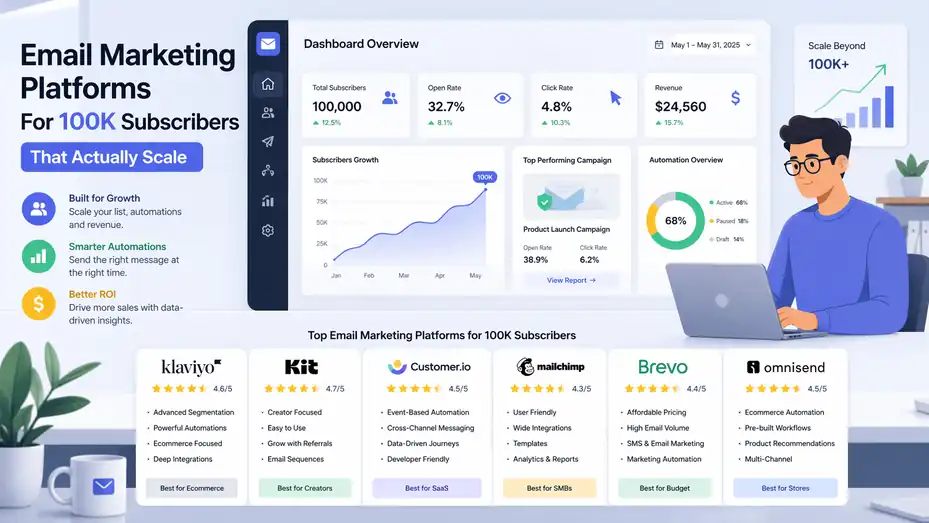
Email marketing platforms for 100k subscribers look very different from the tools that feel “good enough” at 5,000 or 10,000 contacts.
At this size, you are not just buying a newsletter sender. You are choosing deliverability controls, automation depth, segmentation logic, reporting quality, and a pricing model that will not punish growth.
If you are trying to pick the right platform without getting trapped in a migration six months later, this guide will help you sort out what actually matters, which tools fit different business models, and how to choose a system that keeps working as your list gets bigger.
What Changes When You Reach 100K Subscribers
Once you cross into a six-figure list, the platform decision stops being mostly about templates and ease of use. It becomes an operational decision.
Why 100K Is A Real Scaling Threshold
At 100,000 subscribers, small weaknesses become expensive. A slightly worse segmentation system means more wasted sends. Weak automation means more manual campaigns.
Poor data structure means your team starts guessing instead of targeting. And a pricing model built around contact count or send volume can swing your monthly cost fast if you are running frequent campaigns or high-volume automated flows.
Mailchimp’s Standard plan, for example, supports up to 100,000 contacts and sets a monthly send limit at 12 times your contact limit, while Brevo’s pricing is tied heavily to send volume and can scale up to 1 million monthly sends with 500,000 contact storage on Standard tiers.
I believe this is the point where many businesses make the wrong comparison. They compare “email tool A vs email tool B” as if both are solving the same job. They usually are not. A creator newsletter, a Shopify store, and a SaaS lifecycle team each need very different infrastructure.
That matters because performance benchmarks also show there is a huge difference between general campaign performance and behavior-driven automation. Klaviyo’s 2026 benchmark data shows average campaign click rates at 1.69%, while automated flow click rates average 5.58%.
In other words, the platform you choose should help you trigger the right message at the right moment, not just send more blasts.
The Five Problems That Show Up At This Size
When I look at teams struggling at 100k subscribers, the pain usually falls into five buckets:
- Cost creep: You grow the list, but your tool’s pricing jumps faster than revenue.
- List quality issues: Old contacts stay active in billing, hurting both spend and engagement.
- Weak segmentation: You can tag people, but you cannot build flexible behavior-based audiences.
- Automation limits: You can create a welcome series, but deeper branching gets messy.
- Reporting gaps: You see opens and clicks, but not enough purchase or lifecycle context.
Litmus’ 2025 State of Email recap also highlighted ongoing pain around low engagement, data quality, personalization, and ROI measurement. That lines up exactly with what breaks first at larger list sizes.
What Actually Matters In Email Marketing Platforms For 100K Subscribers
You do not need the “best” platform in the abstract. You need the best fit for your audience model, revenue model, and campaign complexity.
Deliverability, Segmentation, And Automation Matter More Than Fancy Templates
Most platforms look good in a demo because demos emphasize the visual email builder. That is rarely the bottleneck at 100k.
What matters more is whether the platform helps you send less often but more accurately.
Klaviyo positions this around unified data and personalized email/SMS tied to ecommerce behavior, while Customer.io centers its product around first-party data, journeys, and data-driven segmentation across channels.
Those are not small differences in wording. They tell you how each platform expects you to work.
Here is how I suggest you frame it:
- Deliverability controls: Can you separate active from inactive contacts and suppress low-quality segments easily?
- Segmentation depth: Can you build audiences from behavior, purchase history, attributes, and events?
- Automation logic: Can you branch workflows based on what users do next, not just whether they opened an email?
- Data flexibility: Can the platform ingest the customer data you already have?
- Billing model: Are you paying mostly for contacts, for sends, or for both?
That last point is easy to underestimate. Brevo’s structure is notable because it scales around monthly email sends and allows large contact storage, while Customer.io openly shows usage-based billing for extra profiles and additional 1,000 emails. Those are very different cost curves.
Your Business Model Should Decide The Platform Shortlist
This is the shortcut I would use before even opening comparison tabs.
| Business Type | Best-Fit Platform Style | Why It Scales Better At 100K |
|---|---|---|
| Creator newsletter, media brand, educator | Kit | Built around newsletters, email sequences, forms, and creator-to-creator growth features like the Creator Network and Recommendations. |
| Ecommerce brand | Klaviyo or Omnisend | Strong ecommerce integrations, revenue-oriented segmentation, and automated flows tied to products, orders, and shopping behavior. |
| SaaS or product-led app | Customer.io or ActiveCampaign | Better fit for lifecycle messaging, event-based triggers, and behavior-led automation. |
| Cost-sensitive high-volume sender | Brevo or MailerLite | More accessible pricing entry points and, in Brevo’s case, send-volume logic rather than pure contact-count pressure. |
| Broad SMB needing familiar interface | Mailchimp | Mature ecosystem and known UX, but you need to watch contact caps and pricing at scale. |
The Best Platform Types For Different 100K-Subscriber Scenarios
This is where the decision gets practical. Different tools really do win in different environments.
Best For Creators, Publishers, And Personal Brands: Kit
Kit is one of the clearest fits for newsletter-first businesses. Its platform is built around automated email sequences, forms, landing pages, RSS campaigns, API access, and a creator ecosystem that helps newsletters grow through recommendations and the Creator Network.
What I like here is the business model match. If your revenue comes from content, sponsorships, digital products, memberships, or audience trust, you usually do not need a heavy ecommerce CRM. You need reliable broadcast sending, clean automations, subscriber tagging, and growth loops that make sense for newsletters.
Imagine you run a finance newsletter with 100k readers. You care about referral-style growth, lead magnets, welcome sequences, and product launches. Kit fits that workflow better than an ecommerce-first system because it is designed around creators building owned audiences, not around catalogs and cart events.
Where I would be cautious: if you need highly sophisticated event-based journeys across app behavior, billing data, product usage, and multi-team lifecycle orchestration, Kit can start to feel narrow compared with Customer.io. But for newsletter operators, that simplicity is often a strength, not a weakness.
Best For Ecommerce Brands: Klaviyo And Omnisend
For ecommerce, I would not overcomplicate this. Klaviyo and Omnisend are the strongest natural fits because both are built to connect messaging with store behavior.
Klaviyo emphasizes ecommerce integrations, historical data, and personalized email and SMS that drive revenue. It also says it supports 350+ pre-built integrations and flexible APIs, which matters when your store stack includes subscriptions, loyalty, reviews, shipping, and support tools.
Omnisend is also clearly ecommerce-focused. Its official support docs highlight native integrations with Shopify, WooCommerce, and BigCommerce, plus real-time syncing of customers, products, and orders for targeted campaigns and automations like cart recovery.
Here is the practical difference as I see it:
- Choose Klaviyo if your team is more advanced in segmentation, wants broader ecosystem flexibility, and treats email/SMS as a revenue engine tied deeply to customer data.
- Choose Omnisend if you want a strong ecommerce-specific setup with less overhead and a simpler path to the core flows most stores need.
Benchmark data supports why this matters. Klaviyo’s 2026 figures show automated email flows dramatically outperform batch campaigns on click rate, which is exactly why cart, browse, post-purchase, and win-back flows deserve better tooling at scale.
Best For SaaS, Apps, And Lifecycle Teams: Customer.io And ActiveCampaign
If your list is tied to user accounts, in-app behavior, onboarding steps, subscriptions, or retention, I would look first at Customer.io and then at ActiveCampaign.
Customer.io is built around first-party data, journeys, analytics, and flexible audience logic. Its documentation and platform pages keep returning to event data, unlimited attributes, custom objects, and cross-channel orchestration. That is exactly what a SaaS or product-led team needs when sending onboarding nudges, trial conversion sequences, churn prevention, and account-based lifecycle messages.
ActiveCampaign sits in a useful middle ground. It remains more approachable for many SMB teams while still offering multiple plan levels geared around automation and growth. Its official materials position it around sales, retention, and engagement, and its pricing structure scales by contacts and plan depth.
My opinion here is simple: If your team says things like “events,” “attributes,” “renewal risk,” “product-qualified lead,” or “in-app lifecycle,” Customer.io will usually make more sense. If your team is smaller and wants strong automation without leaning too far into CDP-style complexity, ActiveCampaign can be the easier operational fit.
Platform Comparison Table For 100K Subscribers
A comparison table helps, but only if it reflects how these tools are actually bought and used.
Side-By-Side Snapshot
| Platform | Best For | Pricing Signal | Scaling Strength | Watch-Out |
|---|---|---|---|---|
| Mailchimp | General SMB, familiar interface | Contact-based; Standard supports up to 100,000 contacts with 12x monthly send limit | Easy to adopt, widely known | Can feel expensive or restrictive as complexity grows. |
| Kit | Creators, newsletters, educators | Scalable plans; strong creator features | Great for audience-led businesses and newsletter growth | Less ideal for deep app/event lifecycle messaging. |
| Klaviyo | Ecommerce brands | Paid plans scale by contacts and channel usage; enterprise available | Deep ecommerce personalization and integrations | Best value appears when you fully use data-driven flows. |
| Omnisend | Ecommerce SMB to mid-market | Contact-based paid plans; ecommerce-first setup | Fast path to store-connected automations | Less flexible outside ecommerce-heavy use cases. |
| Brevo | Cost-conscious senders | Send-volume-led tiers; up to 500,000 contact storage on certain plans | Useful when contact counts are high but send strategy is controlled | You must model send volume carefully. |
| MailerLite | Budget-conscious newsletters and SMBs | Lower starting price points | Clean, simple, accessible | May feel limiting for complex enterprise-style automation. |
| ActiveCampaign | SMB automation, sales + marketing overlap | Contact-based tailored pricing and multiple plans | Good balance of automation and usability | Exact large-list costs may require quote conversations. |
| Customer.io | SaaS, lifecycle, data-driven teams | Starts at $100/mo Essentials, $1,000/mo Premium, plus usage-based billing | Very strong for first-party data and journey orchestration | More powerful, but more demanding operationally. |
How I Would Interpret This Table In Real Life
A lot of comparison articles stop at features. That is not enough.
The real question is which platform lets your team execute its strategy with the least friction. For many teams, the most scalable platform is not the one with the most features. It is the one your team will fully use.
A two-person content brand with 100k subscribers can absolutely outgrow Mailchimp and move into Kit. A lean ecommerce brand can do better with Omnisend than with a more expensive enterprise stack it barely uses. A SaaS company can lose months trying to force newsletter-style tooling into an event-driven lifecycle problem.
That is why I always suggest choosing the platform that matches your data model first, then your budget second.
How To Choose The Right Platform Step By Step
You do not need a 19-tab spreadsheet to make a smart choice. You need a scoring system.
Step 1: Audit Your Sending Model
Start with these questions:
- How many emails do you send per month?
- What percentage are campaigns versus automations?
- Do inactive contacts still count toward billing?
- Do you need email only, or email plus SMS and other channels?
- Is revenue tied to content, products, subscriptions, or app usage?
Brevo is a great example of why this matters. Its pricing can make sense when you have many stored contacts but more controlled send volume. On the other hand, if you send aggressively to a large percentage of your list every week, a send-based model may stop looking cheap very quickly.
I suggest writing down your actual monthly send count before you compare plans. Most people compare subscriber count only, and that is how they end up surprised by the bill.
Step 2: Score Segmentation And Automation Needs
This part is even more important than price.
Ask yourself whether your future state looks like:
- Basic segmentation: Tags, forms, welcome sequence, newsletters.
- Mid-level automation: Branching flows, purchase triggers, re-engagement, lead scoring.
- Advanced orchestration: Event-triggered journeys, custom objects, synced audiences, cross-channel lifecycle.
If you are in the first group, MailerLite, Kit, or Mailchimp may be enough. If you are in the second, ActiveCampaign or Omnisend may be a better fit. If you are in the third, Klaviyo or Customer.io will usually make more sense depending on whether you are ecommerce-led or product-led.
In my experience, teams regret under-buying automation more often than they regret over-buying templates.
Step 3: Review Migration Risk Before You Commit
A platform choice at 100k is partly a migration decision.
You need to know whether you can move:
- historical subscriber data
- tags and custom fields
- automations and triggers
- forms and landing pages
- deliverability setup like domain authentication
- reporting continuity
This is one of those boring steps that saves you a lot of pain. If your platform today is tolerable but your data is messy, migration will feel harder than it should. So before you switch, simplify your segments, remove dead fields, and archive junk automations. A cleaner account migrates better.
I would also test one critical flow before a full move. For ecommerce, that may be cart abandonment. For SaaS, it may be trial onboarding. For a creator, it may be the welcome sequence plus lead magnet delivery.
Common Mistakes People Make At 100K Subscribers
This is usually where budgets get wasted.
Paying For Contacts You Should Have Suppressed
A lot of businesses brag about list size while quietly paying for years of inactivity. That is not scale. That is billing drag.
If 20% to 30% of your list has not clicked, purchased, or meaningfully engaged in months, you may be paying to store people who actively hurt performance. Larger lists can actually perform worse when they are not cleaned regularly.
Litmus’ 2025 recap called out data quality and personalization as major issues, which is exactly why this problem gets expensive at six figures.
I recommend building an “engaged 90 days” and “engaged 180 days” segment no matter what tool you choose. Then decide who really deserves regular campaigns.
Choosing A Platform Because It Is Popular, Not Because It Fits
Klaviyo is excellent. That does not mean every 100k list should use it.
If you run a creator newsletter with no catalog, no cart, and no ecommerce stack, you probably do not need an ecommerce-first engine. In the same way, if you run a subscription app with behavioral event data, you may outgrow creator-style tools fast.
The best platform is the one that matches your triggers, segments, and monetization path. Popularity is not a strategy.
Overvaluing Open Rates And Undervaluing Conversion Logic
Open rates can be directionally useful, but they are not enough to judge performance. Klaviyo’s 2026 benchmarks show the bigger opportunity is in flow performance and downstream outcomes like click rate and placed order rate. Automated flows outperform regular campaigns for a reason: they match intent better.
So if a platform helps you build smarter triggers, better suppression rules, and more relevant segmentation, that usually matters more than whether it offers a prettier drag-and-drop editor.
How To Optimize Performance After You Pick A Platform
Choosing the tool is only half the job. Scaling it well is where the returns show up.
Build Your Core Revenue Flows First
Do not start by designing 27 campaigns and 14 popups. Start with the flows that compound.
For most businesses, that means:
- Welcome series
- Abandoned cart or browse recovery for ecommerce
- Onboarding sequence for SaaS or courses
- Post-purchase or post-signup nurture
- Re-engagement or win-back
- Sunset flow for inactive users
This approach fits the benchmark reality. Automated flows usually outperform broadcast campaigns because they respond to behavior, not calendar pressure. Klaviyo’s published 2026 benchmark data makes that difference pretty clear.
I suggest getting five flows working extremely well before adding more. A smaller set of high-intent automations usually beats a large library of mediocre workflows.
Segment By Intent, Not Just Demographics
At 100k subscribers, “subscribers in the US” is not a useful segment. Intent is more useful than geography in most cases.
Better examples include:
- clicked pricing page in the last 14 days
- purchased twice but not in the last 60 days
- joined from webinar lead magnet
- read three newsletters but never bought
- trial user who invited teammates
- customer with high average order value and no repeat purchase yet
Customer.io’s emphasis on event data, attributes, and journeys is a good example of why intent-based segmentation scales better than static list buckets.
This is where bigger lists become an advantage. You finally have enough volume to segment aggressively without starving each audience of scale.
Use Benchmarks Carefully
Benchmarks are useful for orientation, not for ego.
Klaviyo reports 31% average campaign open rates across industries, 1.69% average campaign click rates, and 5.58% average automated flow click rates, with top performers substantially above those numbers. Those figures are useful because they tell you where to investigate, not because you should blindly chase them.
If your campaign click rate is weak but your flow click rate is healthy, the issue may be campaign targeting. If open rates are decent but placed-order or conversion rates lag, the issue may be offer, landing page, or audience quality. Benchmarks only help when you pair them with context.
Advanced Scaling Tips For Teams That Want More Than “Good Enough”
This is the stage where the platform choice starts paying off.
Add A Real Subscriber Quality Framework
Not all 100,000 subscribers are equal. I would create a simple scoring framework around recency, engagement, purchase intent, and business value.
For example:
- Tier A: Engaged in last 30 days, clicked, purchased, or high-intent action
- Tier B: Engaged in last 90 days but lower commercial intent
- Tier C: Still subscribed but fading
- Tier D: Inactive and eligible for sunset or suppression
This makes send decisions cleaner and cost control easier. It also protects deliverability because you stop treating inactive subscribers like your best readers or buyers.
Match Platform Complexity To Team Capacity
This is a blunt opinion, but it saves people a lot of frustration: an advanced platform does not magically create an advanced team.
Customer.io and Klaviyo can be powerful because they make richer data and workflow logic possible. But if your team lacks a clear segmentation strategy, naming conventions, testing process, and owner for lifecycle operations, even the best platform turns into an expensive dashboard.
Sometimes the smartest move is to choose the slightly simpler tool your team will actually operationalize well.
Plan One Level Beyond Today
At 100k subscribers, you should not choose only for present needs. Choose for the next jump.
Ask yourself what changes if you reach 150k or 250k subscribers, add SMS, launch a paid membership, introduce a subscription product, or split lifecycle messaging across multiple brands or teams.
ActiveCampaign openly frames larger contact tiers through tailored plans, Customer.io supports usage-based profile and email scaling, and Brevo already structures large tiers around very high send allowances and big contact storage.
That is the real definition of scale: not whether the platform can technically hold your list, but whether it still makes operational and financial sense as your complexity rises.
Final Verdict: Which Email Marketing Platform Should You Choose For 100K Subscribers?
There is no single winner, but there are clear best fits.
If you run a newsletter-led creator business, I would start with Kit. If you run ecommerce, I would shortlist Klaviyo first and Omnisend second depending on your complexity and budget. If you run a SaaS or product-led lifecycle program, I would look hard at Customer.io, with ActiveCampaign as the more approachable middle option.
If you are heavily cost-sensitive and send volume is your key variable, Brevo deserves serious attention. If you want a familiar all-rounder and your needs are not deeply specialized, Mailchimp still has a place, but you need to keep an eye on scaling limits and spend.
The biggest takeaway is simple: email marketing platforms for 100k subscribers should be chosen around business model, data model, and billing model, not around brand recognition alone.
A six-figure list gives you leverage, but only if your platform helps you turn that audience into cleaner segmentation, stronger automation, and better monetization. That is what actually scales.
FAQ
What is the best email marketing platform for 100k subscribers?
The best email marketing platform for 100k subscribers depends on your business model. Ecommerce brands benefit from tools like Klaviyo, while creators prefer Kit. SaaS companies often choose Customer.io. The right platform should support automation, segmentation, and pricing that scales without increasing costs too quickly.
How much do email marketing platforms cost for 100k subscribers?
Costs for email marketing platforms for 100k subscribers vary widely depending on pricing models. Some charge based on contact count, while others focus on email send volume. Monthly costs can range from moderate to high, especially if you send frequent campaigns or require advanced automation features.
Can email marketing platforms handle automation at 100k subscribers?
Yes, most modern email marketing platforms for 100k subscribers support advanced automation. However, the depth of automation varies. Platforms like Customer.io and Klaviyo offer event-based workflows, while simpler tools may only support basic sequences. Choosing the right level of automation is key for scaling effectively.
What features should I look for at 100k subscribers?
At 100k subscribers, focus on segmentation, automation, deliverability, and pricing structure. You need tools that allow behavior-based targeting, flexible workflows, and clear reporting. Strong data handling and the ability to manage inactive contacts are also essential for maintaining performance and controlling costs.
Is it hard to switch email platforms at 100k subscribers?
Switching email marketing platforms at 100k subscribers can be complex but manageable with proper planning. The main challenges include migrating subscriber data, automations, and maintaining deliverability. Cleaning your list and simplifying workflows before migration can significantly reduce risks and ensure a smoother transition.

Juxhin B is a digital marketing researcher and founder of JAK Digital Hub, specializing in email marketing software, marketing automation platforms, and digital growth tools. His work focuses on software testing, platform comparisons, and real-world performance analysis to help businesses choose the right marketing technology.
Related posts:
 7 GetResponse Alternatives For Small Business Growth
 Best MailerLite Alternatives for Small Business Growth
 Moosend Alternatives for Small Business: What Works Better?
 Email Automation Tools Cost for 20k Subscribers—Price Breakdown
 Is It Hard To Migrate From Omnisend? The Honest Truth You Need
 How To Migrate From Free Email Marketing Safely