Table of Contents
Some links on JAK Digital Hub are affiliate links, meaning we may earn a small commission at no extra cost to you. Read full disclaimer.
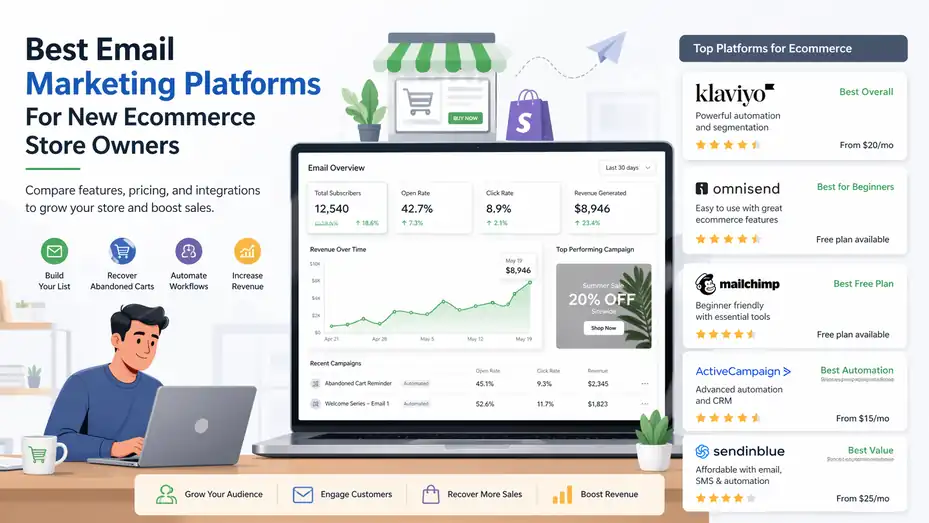
Choosing the right email marketing platforms for new ecommerce store owners can save you a lot of time, money, and frustration in your first year.
I’ve seen too many new stores pick a tool that looks cheap at first, then realize it cannot handle automations, segmentation, or ecommerce data when sales start coming in.
In this guide, I’ll walk you through how these platforms work, what features actually matter, which tools fit different store stages, and how to avoid the mistakes that make beginners overpay or underperform.
What New Store Owners Really Need From An Email Platform
A new store does not need every advanced feature on day one. What you need is a platform that helps you collect subscribers, send core campaigns, recover abandoned carts, and understand which emails actually drive sales.
Simplicity Matters More Than Endless Features
When you are launching a store, the best platform is usually the one you will actually use consistently. That sounds obvious, but it matters. Many beginners get pulled toward feature-heavy tools and then never finish setup because the system feels too technical.
A good early-stage platform should make a few things easy. You should be able to connect your store, build forms, create a welcome flow, set up abandoned cart emails, and view revenue reporting without digging through ten menus.
Klaviyo, Omnisend, Mailchimp, Brevo, and Shopify’s own messaging tools all position themselves around this kind of early setup, though they differ a lot in how ecommerce-focused they are.
Klaviyo’s free plan includes up to 250 active profiles and 500 email sends per month, while Omnisend’s free plan also supports up to 250 contacts and 500 emails per month.
Mailchimp’s free plan caps users at 250 contacts and 500 monthly emails, and Brevo’s free tier emphasizes daily sending limits and high contact storage instead.
That difference is important. Some tools price around contacts, some around sends, and some around both. For a new ecommerce store, I usually suggest choosing the platform whose billing model matches how you expect to grow. If you plan to build a large list fast but send less often, a send-based tool can be attractive.
If you plan to automate heavily with a smaller, more engaged list, a contact-based tool may still work well.
The Core Features That Actually Drive Early Revenue
You do not need fifty templates. You need the right four or five building blocks.
Here is what I believe matters most in the first 90 days:
- Signup Forms: You need popups, embedded forms, and basic targeting so you can capture traffic before it disappears.
- Welcome Automation: This is often the highest-impact flow for a new store because it turns first-time interest into first purchases.
- Abandoned Cart Recovery: A strong cart series can recover revenue you would otherwise lose.
- Segmentation: Even basic grouping by subscribers, customers, and repeat buyers makes campaigns more relevant.
- Revenue Attribution: You need reporting that ties email activity back to store sales, not just opens and clicks.
That is why ecommerce-native tools tend to win for store owners. Omnisend’s free plan includes access to automations, forms, segmentation, and channels like SMS and push with the main limits tied to contacts and email volume.
Klaviyo’s free offering includes built-in reporting, revenue attribution for campaigns, basic segmentation, and ecommerce-related customer hub features.
Shopify’s messaging app also highlights segmentation, templates, conversion tracking, and direct purchase support inside the Shopify ecosystem.
For many of us, that is the real dividing line: not “Which platform has the most features?” but “Which one helps me make my first email-attributed sales with the least friction?”
How Email Marketing Platforms Work In Ecommerce
Before comparing tools, it helps to understand what the platform is actually doing behind the scenes. Once you get this, choosing the right software becomes much easier.
Your Email Platform Is Really A Customer Data Engine
Most people think an email platform is just a newsletter sender. In ecommerce, it is much more than that. It pulls in customer actions from your store and turns those behaviors into messages.
For example, when someone views a product, adds it to cart, starts checkout, buys once, buys twice, or stops purchasing for 60 days, your platform can store that behavior and use it for segmentation or automation. That is why native ecommerce integrations matter so much.
Klaviyo’s Shopify app positions itself around personalized email and SMS with strong commerce integration, while Drip promotes integrations with Shopify, WooCommerce, and BigCommerce. ActiveCampaign highlights more than 1,000 app integrations, which is strong for flexibility but often means a less ecommerce-specific starting point than tools designed mainly for stores.
Think of it this way: your store creates signals, and the platform turns those signals into campaigns and flows. The better the data sync, the better your targeting. That is why product views, order value, purchase frequency, and checkout status are more valuable than generic demographic fields alone.
Campaigns And Automations Solve Different Problems
New store owners often confuse campaigns with flows. They are not the same, and using both well is what makes email perform.
Campaigns are one-time sends. You might email your list about a new product launch, a weekend sale, or a restock. Automations are ongoing sequences triggered by behavior. Welcome emails, cart recovery, browse abandonment, post-purchase sequences, and win-back flows all live here.
This distinction matters because automated email is usually where ecommerce stores get leverage. Klaviyo emphasizes automated, data-driven campaigns and benchmarks built from a large customer base, Omnisend promotes ecommerce email and SMS automation as a core growth channel, and ActiveCampaign centers its product around multi-step marketing automation.
In practice, I suggest this split for a new store: use campaigns for promotions and announcements, then let automations handle the always-on revenue work. That usually keeps your calendar manageable while still building a reliable retention system behind the scenes.
Best Email Marketing Platforms For New Ecommerce Store Owners
This is the comparison most people actually came for. The truth is there is no single best option for everyone. There is a best fit based on budget, store platform, growth speed, and how advanced you want to get.
Quick Comparison Table
A fast side-by-side view makes the decision easier.
| Platform | Best For | Free/Entry-Level Starting Point | Notable Strengths | Main Tradeoff |
|---|---|---|---|---|
| Klaviyo | Stores that want strong ecommerce data and scaling room | Free plan with up to 250 profiles and 500 emails/month | Revenue attribution, segmentation, ecommerce automations, Shopify presence | Can get expensive as contacts grow |
| Omnisend | New ecommerce stores that want built-in ecommerce features fast | Free plan with up to 250 contacts and 500 emails/month; paid plans start at $16/month | Ecommerce-first automation, SMS/push access, beginner-friendly | Less broad outside ecommerce |
| Mailchimp | Beginners who want a familiar general marketing platform | Free plan with 250-contact limit and 500 emails/month; Essentials from $13/month for 12 months, Standard from $20/month for 12 months | Easy learning curve, broad recognition, onboarding | Ecommerce depth is less native than top commerce-first tools |
| Brevo | Budget-conscious stores with larger contact storage needs | Free plan includes 300 daily emails and 100,000 contacts; Starter begins at $9/month | Send-based pricing, transactional messaging, affordable entry | Ecommerce features are not as central as Klaviyo or Omnisend |
| ActiveCampaign | Stores that care more about automation depth than beginner simplicity | Packages start at $15/month | Strong automation logic, broad integrations | Pricing and setup can feel heavier for very new stores |
| Drip | Growing DTC-style stores that want ecommerce CRM depth | Pricing based on active people and monthly email volume | Smart segmentation, ecommerce positioning, major store integrations | Less transparent starter pricing on main site |
These platform details come directly from current vendor pricing and product pages.
My Honest Breakdown Of Who Should Choose What
If you want the simplest recommendation, here is how I would think about it.
- Choose Klaviyo if you are on Shopify or another major ecommerce platform and already know retention marketing will matter to your business. It gives you strong segmentation, revenue reporting, and a path to grow into more advanced flows. The free plan is useful, but the big caution is cost growth as your active profiles increase.
- Choose Omnisend if you want an ecommerce-focused platform that feels accessible early. I like it for new stores that want email, SMS, forms, and automations without overcomplicating things. Its free plan includes all features with usage caps, which is appealing when you are testing.
- Choose Mailchimp if your needs are simple, your list is small, and you value familiarity. It is a reasonable starting point, especially for founders who already know the brand, but you should look carefully at ecommerce needs before committing long term.
- Choose Brevo if budget is the main issue and you care about email volume more than pure ecommerce-native depth. Its pricing model can be practical for stores that want affordable sending and transactional support.
- Choose ActiveCampaign if you love automation logic and plan to build a more advanced lifecycle setup. I usually see it as a better fit once a store has some traction and wants more control.
- Choose Drip if you want a more ecommerce-CRM-style approach and you already know customer segmentation will be central to your strategy.
My personal view: most new store owners should start by choosing between Klaviyo and Omnisend first, then consider Mailchimp or Brevo when budget or simplicity is the bigger concern.
How To Choose The Right Platform For Your Store
Once you narrow the options, the next step is matching the software to your actual business model instead of picking whatever is most popular.
Match The Platform To Your Store Stage And Catalog
A one-product skincare brand and a 300-SKU apparel store do not need the same email setup. That is where a lot of bad software decisions happen.
If you have a small catalog and a low-volume launch strategy, almost any decent platform can handle your first welcome flow and cart sequence. But if you have multiple categories, frequent restocks, or a catalog where shoppers browse before buying, you will benefit much more from stronger segmentation and product-based triggers.
Here is the rule I suggest: the more product variety and repeat-purchase potential you have, the more valuable an ecommerce-native platform becomes. Tools like Klaviyo, Omnisend, and Drip are designed to tie product behavior and customer history back into your email strategy. General-purpose platforms can still work, but they often feel less natural when you need product recommendations, revenue attribution, and deeper lifecycle logic.
Imagine you sell refillable supplements. A platform that can segment first-time buyers, subscription buyers, lapsed customers, and high-AOV customers will pay off much faster than one that mainly helps you send newsletters.
Compare Costs The Way Store Owners Actually Experience Them
Pricing pages can be misleading if you only look at the lowest number. What matters is how cost changes once your list grows and you send more often.
Mailchimp lists a free plan for up to 250 contacts, with Essentials starting at $13 per month for 12 months and Standard at $20 per month for 12 months in the current pricing view. Brevo starts its Starter plan at $9 per month and includes email volume tiers rather than charging strictly by contact count. Omnisend says paid plans start at $16 per month. ActiveCampaign says packages start at $15 per month.
What matters more than that sticker price is your growth model:
- Contact-based pricing: Better when your list stays lean and engaged.
- Send-based pricing: Better when you store many contacts but mail selectively.
- Hybrid or scaling tiers: Better only if the features justify the jump.
I recommend running a simple forecast before choosing. Estimate your likely list size at 3, 6, and 12 months, then compare platform cost at each stage. A tool that looks cheaper at 250 contacts can become the expensive option once you hit 5,000 subscribers and start sending multiple flows every week.
How To Set Up Your Platform The Right Way
The platform itself will not save you. Setup quality matters more than brand name in the first few months.
Start With The Five Essential Automations
If I were helping a brand new store today, I would not start with ten different workflows. I would build these five first:
- Welcome Series: Introduce the brand, explain the product, answer objections, and give a reason to buy.
- Abandoned Cart Flow: Recover carts with a reminder, product value message, and urgency if appropriate.
- Browse Abandonment: Re-engage visitors who viewed products but did not add to cart.
- Post-Purchase Sequence: Confirm the order, set expectations, and encourage repeat buying.
- Win-Back Flow: Reconnect with customers who have gone quiet.
This kind of setup aligns well with what ecommerce-focused platforms emphasize. Omnisend’s free plan highlights automations, forms, segmentation, and multichannel options. Klaviyo’s platform includes reporting, segmentation, and customer/order-related capabilities inside its free tier. Shopify’s messaging app also emphasizes segmented sending and conversion tracking.
A realistic example: If your welcome series converts at 4%, your cart flow recovers even a small portion of abandoned checkouts, and your post-purchase series drives a second order within 30 days, that one setup project can outperform months of random newsletters.
Build Your First Campaign System Before You Chase Advanced Tricks
A lot of beginners obsess over fancy segmentation before they even have a repeatable campaign routine. I think that is backward.
You need a simple campaign rhythm first. For most new stores, one to two campaigns per week is enough. That could mean a product education email, a user-generated content feature, a restock announcement, or a limited promotion. The goal is not to blast your list. The goal is to stay relevant while your automations do most of the heavy lifting.
Use a very simple segmentation structure in the beginning:
- Subscribers who have not purchased
- Customers with one purchase
- Repeat customers
- Highly engaged contacts
- Inactive contacts
Once that is in place, your messaging gets smarter fast. A first-time visitor should not get the same email as someone who already bought twice. Ecommerce tools that support basic segmentation and revenue reporting make this much easier to manage and measure.
Klaviyo explicitly includes basic customer segmentation and campaign revenue attribution in its free setup, and Brevo includes advanced segmentation in its Starter plan.
My advice here is simple: Master your first campaign calendar before layering on complex conditional logic.
Common Mistakes New Ecommerce Stores Make
This is where most early revenue leaks happen. The good news is that these mistakes are fixable once you know what to watch.
Picking A Platform Based On Popularity Instead Of Fit
Mailchimp is well known. Klaviyo is trendy in ecommerce. ActiveCampaign has strong automation credibility. None of that matters if the platform does not match your store model.
I have seen founders choose a tool because a YouTuber recommended it, only to realize later that they needed better Shopify syncing, easier product-triggered automation, or a less aggressive pricing curve. This is why platform selection should start with your store’s needs, not social proof.
For example, Klaviyo and Omnisend both clearly position themselves around ecommerce growth, while Shopify’s own messaging app focuses on sending personalized email and SMS inside the Shopify ecosystem. ActiveCampaign, on the other hand, leans into broader automation and app connectivity. Those are different strengths, and your decision should reflect that.
A good test is this: Can you explain in one sentence why the tool fits your current business? If not, you probably are choosing on brand perception rather than operational fit.
Waiting Too Long To Measure Revenue, Not Vanity Metrics
Open rates still matter a little, but for ecommerce, revenue is the real scoreboard. A pretty campaign with a strong open rate means very little if it does not lead to clicks, orders, or repeat purchases.
This is one reason I like ecommerce-focused platforms for store owners. Klaviyo’s free plan highlights campaign revenue attribution and email performance metrics.
Shopify’s app mentions conversion tracking. Industry reporting also continues to show strong ROI potential in email when businesses actually measure performance properly; recent reporting on Sinch Mailgun’s 2026 findings noted that fewer than half of organizations can reliably track email ROI, while 60% of those that do measure it report returns above $10 for every $1 spent.
So instead of asking, “Did people open this?” ask:
- Did this campaign generate orders?
- Did this flow improve conversion rate?
- Did repeat-purchase rate move?
- Did unsubscribe rate spike after a certain message?
That mindset alone can make your email program much more profitable.
How To Optimize Email Revenue After Setup
Once your basic system is live, the next stage is optimization. This is where email starts becoming a meaningful profit channel instead of just a box you check.
Improve Relevance With Segmentation And Lifecycle Timing
The fastest way to improve results is usually not “send more.” It is “send more relevant messages.”
A new subscriber needs education and trust. A recent buyer may need product usage guidance or a complementary recommendation. A lapsed customer needs a reason to come back. When your platform helps you group customers around real behaviors, your campaigns naturally become more useful.
Klaviyo’s benchmarks are built from more than 183,000 customers in its 2026 benchmark resource, which reflects how central segmentation and behavior-based analysis have become in modern ecommerce email. Omnisend also positions segmentation, automation, and multichannel orchestration as core growth levers for merchants.
Here is a simple scenario. Imagine your store sells coffee gear:
- New subscribers get a brand story and best-seller introduction.
- First-time buyers get brew tips and a related accessory suggestion.
- Repeat buyers get refill timing reminders.
- Inactive buyers get a reactivation offer or product quiz.
Same list, very different messaging. That is where email starts to feel personal instead of promotional.
Test The Right Variables Instead Of Random Changes
Optimization gets messy when people test without a clear goal. I recommend testing variables that directly affect buying behavior.
Start with these:
- Subject line angle: Curiosity versus clarity
- Offer structure: Percent discount versus dollar-off versus bundle
- Email layout: Product-first versus story-first
- Timing: Immediate send versus delayed send in flows
- CTA focus: Shop now versus learn more versus complete your order
Brevo’s Standard plan includes A/B testing, advanced reporting, click heatmaps, geography and device reports, plus AI send-time optimization. That makes it a decent option for founders who want more testing without jumping straight into enterprise-level complexity.
One caution, though: Do not test five things at once. In my experience, the fastest route to better revenue is to change one meaningful variable, give it enough volume, then keep what improves clicks, conversion, or revenue per recipient.
When To Upgrade, Switch, Or Scale Your Platform
A tool that works for month one may not be the best tool for month twelve. That does not mean you chose badly. It just means your store changed.
Signs You Have Outgrown Your Current Platform
You have probably outgrown your platform when one of these starts happening regularly:
- You cannot build the automations you need without workarounds.
- Product, customer, or order data is not syncing cleanly.
- Reporting stops at vanity metrics and does not show ecommerce value.
- Pricing increases faster than the value you get back.
- You need multichannel coordination and your platform makes it awkward.
This is often where newer stores move from a general email tool into a more ecommerce-native system. Klaviyo, Omnisend, and Drip all emphasize stronger commerce-driven targeting and lifecycle logic, while ActiveCampaign becomes more attractive when you want deeper automation structure across a broader stack.
A switch is annoying, yes, but staying with the wrong system too long is usually more expensive than migrating.
How To Scale Without Making Email Unmanageable
Scaling does not mean sending more campaigns every week. It means building a smarter retention engine.
Here is what I suggest after the basics are working:
- Expand your lifecycle map: Add review requests, replenishment reminders, VIP campaigns, and category-specific flows.
- Tighten list hygiene: Remove or suppress inactive contacts so you protect deliverability and control cost.
- Use revenue-based reporting: Judge flows by sales contribution, not just clicks.
- Layer channels carefully: SMS, push, or transactional messaging can help, but only when the customer journey supports them.
That is why it is useful that tools like Omnisend combine email with SMS and push, Shopify supports email and SMS inside its messaging app, and Brevo includes email, SMS, and transactional capabilities in its broader messaging offer.
I believe the smartest scaling move for most new store owners is this: keep your stack simple, deepen your customer data, and make every additional automation solve a real revenue problem.
Final Thoughts
The best email marketing platforms for new ecommerce store owners are not the ones with the flashiest dashboards. They are the ones that help you launch quickly, automate the right journeys, and understand what is actually making you money.
For most new stores, I would start the shortlist with Klaviyo and Omnisend, then look at Mailchimp or Brevo when budget or simplicity is the bigger driver. ActiveCampaign and Drip make more sense when you know you want heavier automation logic or deeper CRM-style segmentation.
If you make the decision based on your catalog, growth model, and email strategy instead of hype, you will give your store a much stronger foundation from the start.
FAQ
What is the best email marketing platform for a new ecommerce store?
The best email marketing platform for a new ecommerce store depends on your goals, but ecommerce-focused tools like Klaviyo and Omnisend are popular because they connect directly with your store, track customer behavior, and support automated emails like welcome flows and abandoned cart recovery from day one.
Do I need email marketing for a new ecommerce store?
Yes, email marketing is essential for a new ecommerce store because it helps you capture visitors, recover abandoned carts, and build repeat customers. Unlike paid ads, email gives you direct access to your audience and can generate consistent revenue with minimal ongoing cost once automated.
How much do email marketing platforms cost for beginners?
Most email marketing platforms for new ecommerce stores offer free plans with limited contacts and monthly email sends. Paid plans typically start between $9 and $20 per month, depending on features, number of subscribers, and how often you send emails to your list.
What features should I look for in an ecommerce email platform?
You should look for features like automated email flows, ecommerce integration, customer segmentation, signup forms, and revenue tracking. These features allow you to send targeted emails based on customer behavior, which increases conversions and helps you understand what is driving sales.
How quickly can email marketing generate results for a new store?
Email marketing can generate results quickly, especially with automated flows like welcome emails and abandoned cart recovery. Many new ecommerce stores see their first sales within days of setting up these automations, making email one of the fastest channels to start generating consistent revenue.

Juxhin B is a digital marketing researcher and founder of JAK Digital Hub, specializing in email marketing software, marketing automation platforms, and digital growth tools. His work focuses on software testing, platform comparisons, and real-world performance analysis to help businesses choose the right marketing technology.
Related posts:
 Email Automation Tools for New Ecommerce Store: What to Start With
 Email Marketing Tools For New Ecommerce Store (Starter Picks)
 Email Marketing Tools Comparison For Ecommerce (Best Picks)
 Best Email Tools to Turn Subscribers Into Sales
 Best Email Marketing Tools (Tested & Compared)
 How To Build A Better Email Campaign Strategy For Ecommerce