Table of Contents
Some links on JAK Digital Hub are affiliate links, meaning we may earn a small commission at no extra cost to you. Read full disclaimer.
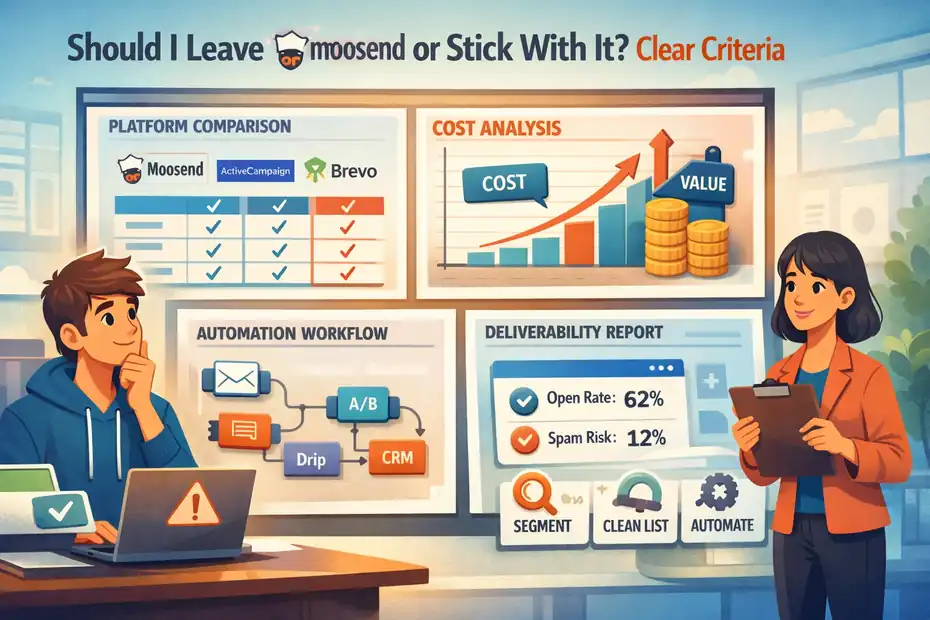
If you’re asking should I leave Moosend, chances are something in your email marketing workflow isn’t feeling right anymore. Maybe automation feels limited, maybe pricing no longer matches your list growth, or maybe you’re wondering if another platform could convert subscribers better.
I’ve seen this moment happen often with growing bloggers, ecommerce stores, and small teams—when the tool that worked in the early stage starts raising questions. Instead of guessing, it helps to evaluate Moosend using clear criteria: cost, automation depth, deliverability, integrations, and long-term scalability.
The sections below break down the exact factors that help you decide whether staying with Moosend makes sense—or whether moving to another platform will unlock better results.
Should I Leave Moosend Because Of Pricing Limits
One of the most common reasons people start asking should I leave Moosend is pricing. The platform is affordable in the early stages, but as your subscriber list grows, the cost structure can start to feel less predictable compared to other email marketing tools.
When Moosend Pricing Stops Making Sense As Your List Grows
In the early stage of blogging or running a small ecommerce store, Moosend is genuinely affordable. That’s one reason many beginners start with it.
But the moment your list crosses a few thousand subscribers, things can shift.
Here’s what often happens in real scenarios:
Imagine you’re running a content site and collecting emails through lead magnets. At 2,000 subscribers, Moosend still feels inexpensive. But when you reach 10,000–20,000 subscribers, monthly pricing begins climbing quickly.
Many email tools follow a similar model, but the difference is what you get for the price increase.
From what I’ve seen, this is where some users pause and rethink the platform:
| Platform | Starting Price | Key Value At Scale |
|---|---|---|
| Moosend | ~$9/month | Strong automation for beginners |
| Kit | ~$15/month | Built for creators with monetization tools |
| Brevo | Free plan available | Strong transactional + marketing emails |
For example, if a blogger with 15,000 subscribers is mostly sending newsletters and simple automations, the price difference between platforms can start to matter.
At that stage, people begin asking: Am I paying for features I actually use?
If the answer is no, pricing becomes a real decision factor.
Hidden Cost Signals That Suggest A Platform Switch
Pricing problems rarely show up as a single big issue. Instead, they appear as small friction points over time.
Here are a few signals I personally look for when evaluating whether Moosend still makes sense.
1. Your list growth outpaces your revenue growth
For example:
- Email list grows from 5k → 20k
- Email revenue grows only slightly
This means the platform cost is rising faster than your return.
2. You’re paying for features you barely use
Many Moosend users rely on just:
- newsletters
- basic automations
- segmentation
If you’re not using advanced automation features, paying for them may not make sense long-term.
3. Multiple tools start replacing Moosend features
Sometimes people keep Moosend but add tools like:
- ecommerce automation software
- landing page builders
- funnel builders
Once that happens, the email platform becomes just a broadcast tool, which may not justify the cost.
Comparing Moosend Pricing Against Kit And Brevo
Let me break down the real comparison people often make.
| Feature | Moosend | Kit | Brevo |
|---|---|---|---|
| Free Plan | No | Yes | Yes |
| Best For | Automation workflows | Creators & bloggers | Transactional + marketing |
| Automation | Strong | Very strong | Moderate |
| Subscriber Pricing | Scales quickly | Creator-focused tiers | Email-volume pricing |
Here’s how I usually see it play out:
Creators and bloggers often move toward Kit because it’s designed for monetization. It includes things like creator-focused automation and tagging that work well for newsletters and digital products.
Ecommerce stores sometimes consider Brevo, especially if they want both marketing emails and transactional emails (like order confirmations) in one system.
Moosend sits somewhere in the middle. It’s powerful, but not always specialized.
That’s why pricing comparisons matter.
When Moosend Still Offers The Best Budget Value
Despite the concerns above, I’ll be honest: Moosend can still be one of the best budget tools in email marketing.
In many cases, leaving would actually make things worse.
Moosend tends to work extremely well if:
- Your list is under 10k subscribers
- You rely heavily on automation workflows
- You don’t need deep ecommerce integrations
- You’re running funnels for lead generation
For example:
A freelance consultant using automated onboarding emails, client nurture sequences, and webinar reminders can run their entire funnel inside Moosend at a relatively low cost.
In that situation, switching platforms creates:
- migration headaches
- automation rebuilds
- potential deliverability resets
And honestly, that’s rarely worth it.
So if you’re wondering should I leave Moosend because of pricing, my advice is simple:
Ask yourself this question: Is Moosend helping me make more money than it costs?
If yes, staying is usually the smarter move.
Should I Leave Moosend If Automation Feels Limited
Automation is one of Moosend’s biggest strengths, but it’s also where some users start feeling friction as their marketing strategies become more advanced.
If your funnels are getting more complex, it’s natural to question whether Moosend can still keep up.
How Moosend Automation Workflows Actually Scale
When people first open Moosend’s automation builder, they usually notice something: it’s visually simple and easy to use.
The platform supports triggers like:
- subscriber joins list
- email opened
- link clicked
- purchase completed
- custom field change
For many small businesses, this is more than enough.
For example, a basic automation funnel might look like this:
- Subscriber downloads a lead magnet
- Welcome email is sent
- Two educational emails follow
- A product pitch appears after 5 days
Moosend handles this type of workflow easily.
In fact, many users build automations like:
- onboarding sequences
- webinar funnels
- abandoned cart emails
- product education series
From what I’ve seen, the platform performs best with linear funnels rather than extremely complex automation trees.
That’s an important distinction.
If your strategy is simple and clear, Moosend works beautifully.
Signs Your Funnel Strategy Has Outgrown Moosend
Now let’s talk about the moment when people start asking should I leave Moosend because automation feels limited.
It usually happens when marketing funnels become multi-layered.
Here are some real-world examples.
Scenario 1: Multi-product segmentation
Imagine you run a digital product business with:
- 5 courses
- 3 lead magnets
- multiple audience interests
You might want automations that change depending on:
- past purchases
- behavior patterns
- content engagement
This creates very complex branching funnels.
Scenario 2: Lifecycle marketing
Advanced marketers often want sequences that adapt based on:
- subscriber activity
- buying stage
- engagement score
Moosend can handle some of this, but not always with the flexibility found in higher-end platforms.
Scenario 3: Cross-channel automation
Some marketing strategies combine:
- SMS
- CRM triggers
Moosend focuses mainly on email automation, which can feel limiting for larger operations.
Automation Capabilities Compared With Kit
Many creators comparing platforms look closely at Moosend vs Kit.
Here’s a simple breakdown.
| Automation Feature | Moosend | Kit |
|---|---|---|
| Visual Automation Builder | Yes | Yes |
| Tag-Based Automation | Limited | Strong |
| Creator Monetization Tools | Basic | Advanced |
| Subscriber Path Branching | Moderate | Very flexible |
In my experience, Kit shines for creators because it relies heavily on tag-based automation.
That means you can create workflows like:
- If subscriber clicks link → add tag
- If tag applied → trigger product funnel
- If purchase happens → remove from pitch sequence
This level of tagging flexibility makes complex funnels easier to manage. Moosend supports segmentation, but the tagging ecosystem isn’t always as fluid.
That’s often where people feel friction.
Advanced Segmentation Scenarios Moosend Struggles With
Segmentation is where email marketing becomes extremely powerful.
But it’s also where tools begin to show their limits.
Here are some advanced segmentation scenarios where Moosend can feel restrictive.
Behavioral scoring systems
Some marketers assign points for actions like:
- opening emails
- clicking links
- visiting pages
This creates engagement scores that trigger different campaigns.
Moosend doesn’t fully support this kind of scoring logic.
Cross-campaign personalization
Advanced funnels sometimes adjust messaging based on multiple campaigns.
For example:
A subscriber who clicked three product emails but didn’t purchase might receive a discount-only campaign.
This level of dynamic targeting can become difficult to manage.
Content interest clusters
Some newsletters track interest categories like:
- SEO
- affiliate marketing
- ecommerce
- blogging
Subscribers then receive content based on these interests.
While Moosend allows segmentation, managing dozens of interest tags and paths can become complicated.
That’s usually when marketers start exploring other tools.
But here’s my honest opinion.
Before leaving Moosend because of automation limits, it’s worth asking:
Is the complexity actually necessary?
Many businesses perform better with simpler funnels.
More automation doesn’t always mean more revenue.
Should I Leave Moosend Due To Deliverability Concerns
Deliverability is one of the most overlooked factors in email marketing. If your emails don’t reach the inbox, even the best campaign strategy won’t perform well. So it’s completely fair to ask should I leave Moosend if open rates suddenly drop.
Email Placement Rates That Signal Deliverability Issues
Most people look only at open rates, but deliverability problems show up in several ways.
Here are common warning signs:
- Open rates suddenly drop below 10–12%
- Click rates fall dramatically
- Emails land in Promotions or Spam folders
- Gmail shows low sender reputation
According to multiple email marketing studies, average open rates across industries often range between 20–30% depending on list quality.
So if you’re consistently seeing:
- 8% open rate
- 1% click rate
something may be wrong.
However, the issue is not always the platform.
In many cases the real cause is:
- poor list hygiene
- cold subscribers
- spam-triggering subject lines
I’ve seen many marketers blame their email tool when the real issue was simply an unengaged list.
How Shared Sending Infrastructure Affects Inbox Rates
Most email platforms—including Moosend—use shared sending infrastructure.
Let me explain what that means in simple terms.
Your emails are sent through a shared group of IP addresses used by many other senders. If those senders behave responsibly, everything works well.
But if some users send spam or low-quality campaigns, sender reputation can suffer. That’s why reputable platforms monitor accounts carefully.
Still, shared infrastructure can occasionally cause:
- temporary deliverability dips
- stricter spam filtering
- reputation fluctuations
Large senders sometimes solve this with dedicated sending IPs, which isolate their reputation.
However, this is usually only necessary for very large lists (100k+ subscribers).
For most bloggers and small businesses, shared sending works fine.
Comparing Moosend Deliverability With Brevo
Deliverability is difficult to measure perfectly because results depend on list quality and sending behavior. Still, we can compare general strengths.
| Deliverability Factor | Moosend | Brevo |
|---|---|---|
| Shared Infrastructure | Yes | Yes |
| Dedicated IP Option | Limited | Available |
| Transactional Email Support | Limited | Strong |
| Reputation Monitoring | Yes | Yes |
One reason some ecommerce stores choose Brevo is its ability to handle transactional emails and marketing emails in the same ecosystem.
That can sometimes improve sending reputation consistency.
However, for many bloggers and small creators, the difference in deliverability between Moosend and Brevo is not dramatic.
The biggest factor will always be list quality and engagement.
Technical Fixes To Try Before Leaving Moosend
Before deciding to switch platforms, I strongly recommend trying a few technical fixes.
Many deliverability issues can be solved without migrating your entire email system.
Here are a few steps I usually suggest.
1. Clean your email list
Remove subscribers who haven’t opened emails in 60–90 days.
Inactive contacts can hurt deliverability.
2. Authenticate your domain
Make sure your email domain has:
- SPF records
- DKIM authentication
- DMARC policy
These records tell inbox providers that your emails are legitimate.
3. Warm up sending patterns
If you suddenly send large campaigns after inactivity, inbox providers may flag your domain.
Gradually increase sending volume instead.
4. Improve engagement signals
Encourage readers to:
- reply to emails
- click links
- add your address to contacts
These actions improve sender reputation.
In my experience, many people who wonder should I leave Moosend because of deliverability eventually realize the issue wasn’t the platform at all.
It was list health and engagement strategy.
Fix those first, and you may not need to switch tools at all.
Should I Leave Moosend If Integrations Slow Growth
If you’re wondering should I leave Moosend because integrations feel limited, you’re not alone. Integrations are the invisible engine behind most marketing systems, and when they break or require too many workarounds, your growth can slow down quickly.
Let’s look at where Moosend works well and where some users start feeling friction.
Critical Ecommerce Integrations Moosend Supports
Moosend integrates with several ecommerce platforms and marketing tools. For many small businesses, these integrations are actually enough to run a complete email marketing system.
Some of the most commonly used integrations include:
| Integration Type | Examples | Why It Matters |
|---|---|---|
| Ecommerce Platforms | Shopify, WooCommerce | Sync customer and purchase data |
| CMS Platforms | WordPress | Capture subscribers via forms |
| CRM Tools | Salesforce | Manage contacts and sales pipelines |
| Automation Platforms | Zapier | Connect hundreds of additional tools |
For example, imagine you run a Shopify store selling handmade jewelry.
A typical Moosend setup might look like this:
- Shopify sends customer data to Moosend
- Moosend tracks purchases and customer activity
- Automation triggers follow-up emails
- Customers receive product recommendations
This workflow works surprisingly well for smaller stores.
Moosend can also trigger automations based on events like:
- purchases
- abandoned carts
- new subscribers
- product interactions
For many ecommerce entrepreneurs just starting out, this setup is perfectly functional.
When Integration Gaps Start Breaking Your Workflow
Problems usually appear when your marketing stack becomes more advanced.
Here are some scenarios where integration gaps start causing friction.
Scenario 1: Advanced CRM workflows
Some businesses rely heavily on customer relationship management systems (CRM). When email marketing needs to interact deeply with sales pipelines, the integration between platforms becomes critical.
For example:
- lead scores trigger email campaigns
- sales team actions update email segments
- deals trigger automated follow-ups
Moosend can connect to CRM systems, but the integration depth is sometimes limited compared to CRM-focused platforms.
Scenario 2: Multi-platform marketing ecosystems
Growing businesses often combine tools like:
- ecommerce platforms
- membership systems
- analytics platforms
- marketing automation tools
If data isn’t syncing smoothly between these systems, it creates manual work.
And manual work usually means slower growth.
Scenario 3: Custom product data
Some ecommerce stores need advanced product-based segmentation like:
- category-based targeting
- dynamic product recommendations
- inventory-triggered campaigns
These workflows sometimes require deeper integrations than Moosend provides.
Comparing Moosend Integrations With ActiveCampaign
A common comparison happens between Moosend and ActiveCampaign, especially for businesses running complex marketing systems.
Here’s a simple breakdown.
| Integration Capability | Moosend | ActiveCampaign |
|---|---|---|
| Ecommerce Integrations | Good | Excellent |
| CRM Integration | Basic | Native CRM |
| Automation Data Triggers | Moderate | Advanced |
| API Customization | Available | Extensive |
The biggest difference is that ActiveCampaign includes a built-in CRM, which allows deeper automation between sales and marketing.
For example:
A lead visiting a pricing page could automatically:
- trigger a sales task
- start a nurture campaign
- update a deal stage
Moosend focuses primarily on email automation, not full marketing automation.
That doesn’t make it worse—it just means it serves a different purpose.
Middleware Tools That Extend Moosend Integrations
Before deciding to switch platforms, there’s an important strategy many people overlook: middleware tools.
Middleware tools connect different apps together when native integrations don’t exist.
Some popular options include:
| Tool | Purpose |
|---|---|
| Zapier | Connect thousands of apps automatically |
| Make (formerly Integromat) | Advanced automation workflows |
| Pabbly Connect | Cost-effective integration automation |
For example, you could create an automation like this:
- A customer purchases a product in Shopify
- Zapier sends purchase data to Moosend
- Moosend triggers a product education email series
- Customer receives cross-sell offers
This approach can extend Moosend’s capabilities significantly.
In my experience, many people considering a platform switch discover that one integration tool solves their problem instantly.
So before leaving Moosend due to integration limits, it’s worth testing middleware solutions first.
Should I Leave Moosend For Better Ecommerce Features
If you run an online store, you might start asking should I leave Moosend once your ecommerce marketing becomes more advanced. Email marketing for ecommerce often requires deeper automation, product tracking, and revenue attribution.
Let’s explore where Moosend performs well and where specialized ecommerce tools start pulling ahead.
Ecommerce Automations Moosend Handles Well
For small and mid-size stores, Moosend actually supports several essential ecommerce automations.
These include:
- abandoned cart reminders
- post-purchase follow-ups
- product recommendation emails
- customer re-engagement campaigns
Imagine you run a WooCommerce store selling fitness equipment.
A typical automation funnel inside Moosend might look like this:
- Customer views a product but doesn’t purchase
- An abandoned cart email is sent within 2 hours
- A second reminder is sent after 24 hours
- A limited-time discount appears on day three
This type of automation works very well with Moosend.
Many stores recover 10–20% of abandoned carts using these simple campaigns.
Moosend also allows segmentation based on:
- purchase history
- customer location
- subscriber behavior
For many ecommerce businesses under $500k in annual revenue, these features are often enough.
Revenue Features Missing From Moosend Workflows
As stores grow, some advanced ecommerce marketing features become more important.
This is where Moosend can feel slightly limited.
Here are a few examples.
Predictive product recommendations
Some platforms use AI to recommend products automatically based on customer behavior.
Moosend supports product recommendations but not always with advanced predictive algorithms.
Customer lifetime value tracking
Advanced ecommerce marketers track:
- total customer value
- purchase frequency
- retention segments
This helps create campaigns targeting high-value customers differently from occasional buyers.
Moosend offers reporting, but not always the deep customer analytics that larger stores expect.
Dynamic product feeds
Some ecommerce platforms allow real-time product content inside emails.
For example:
- showing trending products
- automatically updating prices
- displaying inventory levels
These features are more common in specialized ecommerce email platforms.
Comparing Moosend Ecommerce Tools With Klaviyo
One of the most common comparisons for ecommerce stores is Moosend vs Klaviyo.
Here’s a quick overview.
| Ecommerce Feature | Moosend | Klaviyo |
|---|---|---|
| Abandoned Cart Automation | Yes | Yes |
| Product Recommendation AI | Limited | Advanced |
| Customer Data Platform | Basic | Very advanced |
| Ecommerce Revenue Analytics | Moderate | Extensive |
Klaviyo is widely known for deep ecommerce integrations and customer data tracking.
For example, it can automatically segment customers based on:
- predicted future spending
- purchase frequency
- product preferences
That level of data is extremely powerful for stores generating large revenue from email marketing.
However, it also comes with higher pricing.
For many smaller stores, Moosend provides most of the essential features at a much lower cost.
Store Growth Stages Where Moosend Still Works
From what I’ve seen, Moosend tends to perform best at certain stages of ecommerce growth.
Let me break it down.
| Store Stage | Revenue Range | Platform Fit |
|---|---|---|
| Early-stage store | $0 – $100k | Moosend works well |
| Growing store | $100k – $500k | Moosend still viable |
| Scaling ecommerce brand | $500k – $2M+ | Advanced tools often needed |
For example:
A new Shopify store selling handmade candles might only need:
- welcome sequences
- cart recovery emails
- product education campaigns
Moosend handles these perfectly.
But once a store begins running:
- dozens of products
- multiple audience segments
- personalized recommendations
switching to a specialized ecommerce platform might make more sense.
Still, for many businesses, Moosend remains a very practical and affordable choice.
Should I Leave Moosend For Better Analytics Insights
Analytics is where many email marketers begin asking deeper questions. If you’re trying to optimize campaigns or scale revenue, you might wonder should I leave Moosend to access better reporting tools.
Let’s take a realistic look at what Moosend reports well—and where more advanced platforms offer deeper insights.
Key Metrics Moosend Reports Well For Small Lists
For most small businesses, Moosend covers the core metrics that matter.
These include:
- open rates
- click-through rates
- unsubscribe rates
- campaign performance
- automation statistics
For example:
If you send a weekly newsletter to 3,000 subscribers, Moosend can clearly show:
- which subject lines performed best
- which links received the most clicks
- which segments engaged most
This is enough to make practical improvements.
A simple workflow might look like this:
- Test two subject lines
- Analyze open rates
- Identify top-performing email content
- Adjust future campaigns
For many bloggers, freelancers, and creators, these insights are already powerful.
Advanced Attribution Data Moosend Lacks
As businesses scale, marketing analytics often becomes more sophisticated.
Here are some features advanced marketers sometimes look for.
Multi-touch attribution
This tracks how different marketing channels contribute to a sale.
For example:
- email campaign introduces a product
- retargeting ad brings customer back
- final purchase happens through email
Some advanced platforms track this entire journey.
Customer lifecycle analytics
Large brands analyze how customers move through stages like:
- awareness
- engagement
- purchase
- loyalty
Moosend offers campaign analytics but doesn’t fully map long-term lifecycle journeys.
Revenue attribution per campaign
While Moosend does support revenue tracking with ecommerce integrations, the depth of reporting is not as extensive as specialized analytics platforms.
Comparing Moosend Reporting With HubSpot
Another comparison that often appears is Moosend vs HubSpot, particularly for companies that want deep marketing analytics.
Here’s a simple overview.
| Reporting Feature | Moosend | HubSpot |
|---|---|---|
| Email Campaign Analytics | Strong | Strong |
| Marketing Attribution | Limited | Advanced |
| CRM-Based Insights | Basic | Extensive |
| Customer Journey Tracking | Moderate | Very detailed |
HubSpot is designed as a full marketing platform with integrated CRM and analytics.
That allows businesses to analyze data like:
- lead sources
- sales funnel performance
- customer lifetime value
However, HubSpot is also significantly more expensive and complex.
For many small teams, it can actually feel overwhelming.
When Basic Email Analytics Are Actually Enough
Here’s something I’ve learned after working with many marketing tools.
More analytics does not always lead to better marketing decisions.
Many successful email marketers focus primarily on three metrics:
- open rate
- click rate
- revenue per email
If those numbers improve consistently, the campaign is working.
For example:
A newsletter generating $1,500 in monthly affiliate revenue doesn’t necessarily need enterprise-level analytics dashboards.
Simple metrics can guide optimization perfectly well.
So before leaving Moosend for deeper analytics, I often recommend asking this simple question:
Am I actually using the data I already have?
If the answer is no, upgrading platforms may not solve the real problem.
Sometimes the smartest move is simply using the existing data more effectively.
Should I Leave Moosend Because Of Support Quality
Customer support becomes important the moment something breaks in your email system. When campaigns stop sending, integrations fail, or automation triggers behave strangely, you don’t want to spend hours searching for answers.
This is why some users begin asking should I leave Moosend if support feels slow or limited.
Response Time Expectations From Moosend Support
In most cases, Moosend support is provided through:
- live chat
- email support
- documentation and knowledge base
From what many users report, live chat responses typically arrive within a few minutes to a few hours, depending on workload and time zones.
Here’s a quick comparison of typical support channels among common email platforms:
| Platform | Support Channels | Typical Response Time |
|---|---|---|
| Moosend | Live chat, email | Minutes to several hours |
| ActiveCampaign | Chat, email, onboarding | Faster priority tiers |
| Brevo | Email, chat | Varies by plan |
In my experience, Moosend’s support works well for technical questions and basic troubleshooting. For example, if an automation trigger stops firing or a campaign fails to send, their team usually responds with step-by-step instructions.
But expectations matter. Moosend is not positioned as a high-touch enterprise platform, so you shouldn’t expect a dedicated account manager unless you’re on advanced plans.
Situations Where Limited Support Slows Progress
Support becomes a bigger issue when your marketing setup becomes more complex.
Let me give you a realistic scenario.
Imagine you’re running a growing ecommerce store and suddenly:
- abandoned cart emails stop triggering
- subscriber data stops syncing from Shopify
- automation sequences fail mid-campaign
In that moment, every hour matters because sales depend on it.
Here are situations where limited support can slow things down:
Complex automation troubleshooting
Large automation trees with dozens of triggers can break in unexpected ways. Diagnosing those issues sometimes requires deeper support.
Migration help
When moving thousands of subscribers or rebuilding automation funnels, some platforms offer guided onboarding. Moosend’s assistance here is more self-service.
Technical integration debugging
If APIs or integrations stop syncing data, resolving the issue can require technical investigation.
For smaller setups this isn’t a major problem. But for large revenue-generating funnels, support speed can impact income.
Support Experience Compared With ActiveCampaign
Many businesses compare Moosend’s support with platforms like ActiveCampaign, which emphasize onboarding and hands-on assistance.
Here’s a simplified comparison.
| Support Feature | Moosend | ActiveCampaign |
|---|---|---|
| Live Chat | Yes | Yes |
| Email Support | Yes | Yes |
| Dedicated Account Managers | Limited | Available on higher tiers |
| Onboarding Training | Basic | Structured onboarding |
ActiveCampaign tends to offer more structured onboarding and customer success programs, especially for larger accounts.
That’s helpful for companies managing:
- large subscriber lists
- multiple sales pipelines
- complex automations
However, this also comes with significantly higher pricing.
In other words, you’re partly paying for the extra support infrastructure.
When Documentation Alone Is Enough For Your Team
Here’s something many people overlook: good documentation can solve most problems without needing support.
Moosend’s knowledge base includes tutorials for:
- automation setup
- campaign design
- subscriber segmentation
- integration configuration
If your team is comfortable learning from tutorials, documentation might be more than enough.
For example, many bloggers and solo creators only need help with:
- building welcome sequences
- scheduling newsletters
- creating basic segmentation rules
In those cases, waiting for support responses rarely becomes a major obstacle.
So before deciding should I leave Moosend because of support quality, ask yourself:
Do I actually need hands-on support, or just clear documentation?
For many smaller businesses, the documentation approach works perfectly fine.
Should I Leave Moosend If My Business Is Scaling
Growth is exciting—but it also exposes the limits of tools. When your subscriber list grows quickly or your marketing strategy becomes more complex, it’s natural to ask should I leave Moosend as your business scales.
Let’s walk through the milestones where this question usually appears.
Subscriber Growth Milestones That Trigger Platform Switch
Email platforms often feel different depending on list size.
Here’s a general pattern many marketers experience:
| Subscriber Count | Typical Needs | Platform Pressure |
|---|---|---|
| 0–5,000 | Newsletters and simple funnels | Moosend works great |
| 5,000–20,000 | Segmentation and automation | Still manageable |
| 20,000–50,000 | Advanced targeting | Limits begin showing |
| 50,000+ | Deep analytics and CRM | Migration often considered |
For example:
Imagine you run a blog that grows from 3,000 subscribers to 40,000 subscribers within two years.
Suddenly you might want to:
- create multiple content segments
- run targeted product promotions
- track subscriber engagement trends
At this point, you may start exploring more advanced marketing platforms.
But reaching these milestones doesn’t automatically mean you must switch.
Many businesses continue using Moosend successfully at larger list sizes.
Automation Complexity That Requires Advanced Tools
As businesses scale, automation often becomes more sophisticated.
Instead of simple funnels, marketers build multi-layered automation ecosystems.
For example:
- behavior-triggered emails
- dynamic subscriber paths
- lifecycle marketing campaigns
- personalized product recommendations
Here’s a simplified example of a complex automation funnel:
- Subscriber downloads an ebook
- System tracks content interests
- Automation branches based on engagement
- Personalized product offers appear
Moosend handles branching automations reasonably well. However, extremely advanced automation logic can become harder to manage compared to more enterprise-focused tools.
In my experience, businesses running dozens of simultaneous funnels sometimes outgrow simpler automation builders.
Team Collaboration Limits Inside Moosend
Another scaling challenge involves team collaboration.
When you’re a solo creator, collaboration tools rarely matter.
But as teams grow, you might need features like:
- role-based permissions
- approval workflows
- multi-user campaign editing
- marketing and sales coordination
Here’s a quick comparison:
| Collaboration Feature | Moosend | Larger Marketing Platforms |
|---|---|---|
| Multi-user access | Yes | Yes |
| Advanced user permissions | Limited | Extensive |
| Workflow approvals | Limited | Available |
| CRM collaboration | Basic | Integrated |
For agencies or larger marketing teams, these collaboration tools become increasingly valuable.
However, if your team remains small, these limitations might never affect you.
Revenue Thresholds Where Upgrading Platforms Pays Off
Let’s talk about the point where switching platforms can actually make financial sense.
In my experience, many businesses reconsider their email platform when email marketing generates a meaningful percentage of revenue.
For example:
- email contributes 20–40% of ecommerce sales
- automated funnels generate thousands per month
- advanced targeting could increase conversion rates
At that stage, even small improvements in automation or segmentation can produce significant revenue increases.
Imagine a store generating $1 million annually, with 30% of revenue coming from email.
If improved segmentation increases email revenue by just 5%, that’s $15,000 in additional income.
In situations like this, upgrading tools becomes easier to justify.
But if email marketing is still a small part of your business, switching platforms might not create meaningful results.
Should I Leave Moosend Or Optimize It First
Before migrating to a new platform, there’s one step I always recommend: optimize your current setup first.
Many people think switching tools will magically fix performance issues. In reality, the same problems often follow them to the next platform.
Let’s walk through some practical ways to improve results without leaving Moosend.
Fixing Poor Email Performance Without Switching Tools
Low open rates or poor engagement are often caused by content and list health rather than platform limitations.
Here are quick improvements that often work:
1. Clean inactive subscribers
Removing unengaged contacts improves deliverability.
Many marketers remove subscribers who haven’t opened emails in 90 days.
2. Improve subject lines
Simple changes can increase open rates dramatically.
For example:
- curiosity-driven headlines
- shorter subject lines
- personalization tokens
3. Send emails consistently
Irregular sending patterns confuse both subscribers and inbox algorithms.
Consistency builds familiarity and improves engagement.
Automation Tweaks That Improve Conversion Rates
Small automation improvements can produce surprisingly large gains.
For example:
Abandoned cart sequence improvement
Instead of sending one reminder email, try:
- reminder after 1 hour
- second email after 24 hours
- discount email after 48 hours
Many ecommerce stores recover 10–15% more sales using multi-step cart recovery.
Another improvement involves behavior-based triggers.
If a subscriber clicks multiple product links but doesn’t purchase, trigger a special offer or product guide.
These adjustments often increase conversions without needing a new platform.
Segmentation Adjustments That Increase Engagement
Segmentation is one of the most powerful email marketing strategies.
Instead of sending every email to your entire list, divide subscribers into smaller groups.
For example:
- active readers
- customers
- new subscribers
- dormant subscribers
Imagine sending a re-engagement campaign only to inactive subscribers.
This prevents disengaged users from dragging down your overall performance metrics.
Moosend supports segmentation rules based on:
- campaign engagement
- purchase behavior
- subscriber attributes
Used correctly, segmentation alone can significantly improve campaign performance.
Cost Optimization Strategies Inside Moosend
If pricing is your concern, there are ways to reduce costs without switching tools.
Here are a few simple tactics.
Remove inactive contacts: Most email platforms charge based on subscriber count. Removing inactive contacts lowers monthly costs.
Use automation instead of frequent broadcasts: Automated sequences often generate better results than constant newsletters.
Combine campaigns when possible: Instead of sending multiple emails per week, focus on high-quality campaigns with clear objectives.
These adjustments can reduce costs while improving overall performance.
Should I Leave Moosend Or Stay Based On Your Model
The final answer to should I leave Moosend often depends on the type of business you run. Different business models require different marketing capabilities.
Let’s break this down.
Bloggers And Creators Who Benefit From Staying
Bloggers, creators, and newsletter publishers often find Moosend perfectly adequate.
Typical needs include:
- welcome sequences
- content newsletters
- simple lead magnet funnels
- occasional promotions
For example:
A blogger running a weekly SEO newsletter with 8,000 subscribers may only need:
- list segmentation
- automated welcome emails
- occasional affiliate promotions
Moosend handles these tasks easily.
In many cases, switching platforms wouldn’t significantly improve results.
Ecommerce Brands That May Outgrow Moosend Faster
Ecommerce stores often require more advanced automation and analytics.
As stores scale, marketers may want features like:
- AI product recommendations
- predictive purchase behavior
- advanced customer lifetime value tracking
Platforms designed specifically for ecommerce sometimes provide deeper data insights.
For stores generating large revenue through email marketing, these advanced features can increase conversions.
However, for smaller ecommerce stores, Moosend remains a practical and cost-effective option.
Freelancers And Agencies Managing Client Campaigns
Freelancers and agencies often manage email marketing for multiple clients simultaneously.
This creates additional needs such as:
- multi-account management
- collaboration tools
- detailed reporting dashboards
Some agency-focused platforms offer more advanced tools for managing multiple brands at once.
That said, many freelancers still use Moosend successfully for smaller client campaigns.
It largely depends on how complex those campaigns become.
Decision Framework To Know If Switching Is Worth It
If you’re still unsure whether to stay or leave, here’s a simple framework I suggest.
Ask yourself these questions:
- Is Moosend limiting my revenue growth?
- Are integrations or automation preventing better campaigns?
- Is my business generating enough revenue to justify a platform migration?
- Would switching realistically improve results?
If the answer to most of these questions is no, staying with Moosend may be the smartest decision.
But if multiple limitations are holding your marketing back, exploring alternative platforms could be worthwhile.
In many cases, the best decision isn’t about finding the “perfect tool.”
It’s about choosing the tool that fits your current stage of growth.
FAQ
Should I leave Moosend if my email list is growing quickly?
If your subscriber list is growing rapidly and you need advanced automation, deeper segmentation, or CRM integration, it may be worth evaluating alternatives. However, many businesses continue using Moosend successfully up to tens of thousands of subscribers if their email strategy remains relatively simple.
Should I leave Moosend because of pricing?
You should consider leaving Moosend if your monthly costs increase faster than the revenue generated from email marketing. If Moosend still helps you generate more value than it costs and your feature needs remain basic, staying with the platform is often the more practical choice.
Should I leave Moosend for better automation tools?
If your marketing requires complex automation paths, behavior-based triggers, or advanced lifecycle campaigns, another platform might offer more flexibility. However, Moosend’s automation builder is strong enough for most small businesses, bloggers, and ecommerce stores running straightforward funnels.
Should I leave Moosend due to deliverability concerns?
Not necessarily. Many deliverability issues are caused by list quality, poor engagement, or improper domain authentication rather than the email platform itself. Before switching tools, improve list hygiene, authenticate your sending domain, and monitor engagement metrics to see if performance improves.
Should I leave Moosend or optimize my setup first?
In most cases, optimizing your current setup is the better first step. Improving segmentation, cleaning inactive subscribers, and refining automation sequences can significantly improve results. If performance issues remain after optimization, then exploring alternative email marketing platforms becomes a reasonable next step.

Juxhin B is a digital marketing researcher and founder of JAK Digital Hub, specializing in email marketing software, marketing automation platforms, and digital growth tools. His work focuses on software testing, platform comparisons, and real-world performance analysis to help businesses choose the right marketing technology.
Related posts:
 Is It Hard to Migrate From Moosend? Honest Breakdown
 Is It Hard To Migrate From Omnisend? The Honest Truth You Need
 Email Marketing Jobs For Startups Hiring Remote Talent
 Email Leads Not Converting? Fix It With This Framework
 Email Leads Cost For 20K Contacts: What Should You Pay?
 Should I Leave MailerLite? Read This Before Switching