Table of Contents
Some links on JAK Digital Hub are affiliate links, meaning we may earn a small commission at no extra cost to you. Read full disclaimer.
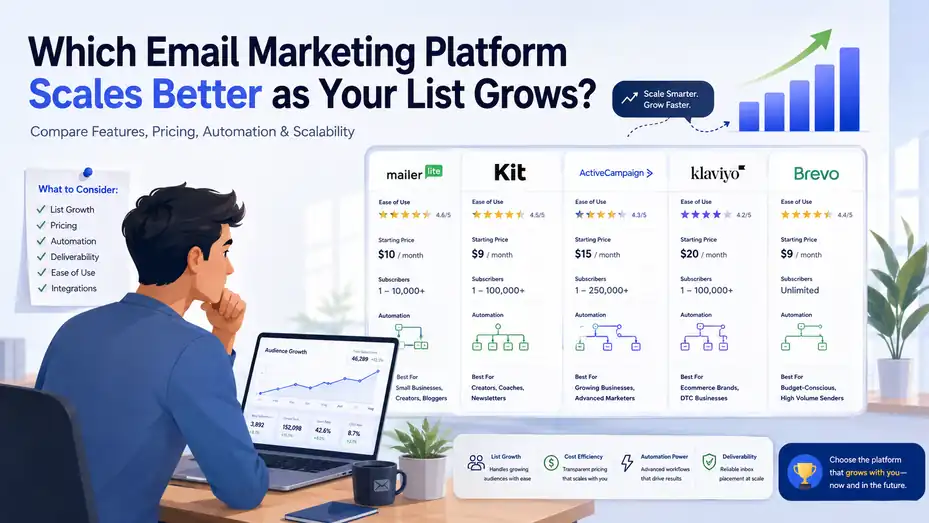
Which email marketing platform scales better is not really a beginner question. It usually shows up when your list is getting expensive, your automations are starting to feel messy, or you’re realizing that one extra tool decision now could save you a painful migration later.
I’ve seen this happen a lot. A platform that feels perfect at 1,000 subscribers can feel restrictive, overpriced, or overly complex at 25,000.
The real answer depends on how you grow, how often you send, and whether your business is driven by content, ecommerce, or lifecycle automation.
What “Scales Better” Actually Means In Email Marketing
When people compare platforms, they often focus too much on monthly price. That matters, of course, but it is only one piece of the scaling puzzle.
Cost Per Subscriber Is Only The Starting Point
At the beginning, most platforms feel affordable. The problem shows up when your list jumps from 2,000 to 20,000 subscribers and your software bill quietly becomes one of your biggest recurring expenses. That is the moment when “cheap” and “scalable” stop meaning the same thing.
A platform scales well when pricing still feels logical as your contact count grows. In my experience, that means you want to look beyond the advertised entry plan and ask a better question: what happens when my list grows 5x or 10x? Some tools charge mainly by stored contacts. Others charge more by email volume. That difference matters a lot.
Imagine you run a weekly newsletter with 50,000 subscribers. A contact-based platform may become expensive fast, even if you only send once per week. On the other hand, if you run daily campaigns and complex automations, a send-based model can lose some of its pricing advantage.
This is why list size alone is not enough. You also need to understand send frequency, automation load, and how much dormant audience you carry.
The first shortcut I recommend is simple: calculate your expected monthly cost at 1,000, 10,000, and 50,000 subscribers before you choose anything. That one exercise will save you from a very common mistake.
Automation Depth Becomes More Important As You Grow
A small list can survive on basic broadcasts and one welcome sequence. A larger list usually cannot. Once your audience grows, automation becomes the real productivity engine.
This is where many people get trapped. They choose a beginner-friendly tool, then later discover they need behavior-based triggers, lead scoring, branching logic, event tracking, or stronger segmentation. Suddenly the platform that once felt simple now feels limiting.
I believe this is the clearest dividing line between “good for starting” and “good for scaling.” A platform that scales well should let you build smarter journeys without forcing you to stack extra tools too early. That includes things like onboarding flows, abandoned cart emails, re-engagement campaigns, subscriber tagging, and revenue tracking.
For example, a creator selling one digital product may only need a clean sequence builder at first. But once they launch multiple offers, track link clicks, and want different follow-ups for different interests, automation depth starts to matter more than the template library.
When your list grows, time becomes more expensive than software. That is why a platform with stronger automation can sometimes be the cheaper choice, even if the monthly plan costs more.
Deliverability, Reporting, And Admin Load Decide Long-Term Fit
At scale, you are not just buying an email sender. You are buying operational stability.
Deliverability is a huge part of this. If a platform makes domain authentication, list hygiene, segmentation, and sender reputation easy to manage, it can protect revenue in ways that are hard to notice until something goes wrong.
The same goes for reporting. You need to know not just opens and clicks, but which segments convert, which flows underperform, and where subscriber quality starts to drop.
Then there is admin load. This is the quiet cost that many buyers ignore. If your team spends too much time cleaning lists, exporting data, patching workflows, or working around reporting gaps, the platform is not scaling well, even if the price looks good on paper.
A good scaling platform should reduce friction as complexity increases. It should help you manage growth, not create more maintenance work because growth happened.
The Main Platform Types And Who They Serve Best
Not every email platform is trying to solve the same problem. That is why comparisons often feel confusing.
Creator-Focused Platforms Win On Simplicity And Audience Monetization
Creator-first platforms are built for newsletters, audience relationships, digital products, and content-led businesses. The best examples here are Kit and Beehiiv.
These tools usually feel lighter and more intuitive than full marketing automation suites. That is a real advantage when your main job is publishing, not managing a complicated CRM setup. You can create forms, sequences, tags, basic automations, and monetization paths without feeling buried in enterprise-style dashboards.
Kit is especially strong when your business revolves around creators, educators, coaches, writers, or niche publishers. It does a good job balancing approachable automation with monetization features that make sense for audience businesses. Beehiiv is also compelling when newsletter growth itself is the business model, especially if sponsorships, referral loops, and publication growth matter more than complex customer journeys.
The trade-off is that creator-focused tools are not always the best fit for advanced ecommerce behavior tracking or multi-team marketing operations. They scale well for media-style and personal-brand businesses, but not always for complex B2C lifecycle orchestration.
If your list grows because your content grows, these platforms often scale more gracefully than general-purpose tools. If your list grows because your product catalog, sales team, and customer data complexity grow, they may start to feel narrow.
SMB Platforms Usually Balance Ease, Cost, And Broad Use Cases
This is the middle ground most people start in. Think MailerLite, Mailchimp, Brevo, AWeber, and GetResponse.
These platforms tend to appeal to small businesses because they cover a lot of ground without demanding a steep learning curve. You can usually build campaigns, landing pages, sign-up forms, core automations, and segmentation without needing a specialist.
MailerLite stands out when simplicity and predictable cost matter most. It is one of the easiest tools to recommend for service businesses, bloggers, educators, and smaller brands that want room to grow without jumping immediately into a premium automation stack. Brevo is interesting for a different reason: its send-based pricing model can be very attractive if you store a large contact base but do not hammer that list with constant email volume.
Mailchimp still has strong brand recognition and a familiar interface, but in my experience, it becomes a tougher sell once businesses need more flexibility, deeper automation, or better cost efficiency at higher list sizes. It can still work, but it is no longer the default “safe” answer many people assume it is.
These platforms scale reasonably well for broad small-business use. They just scale in different ways, so matching the pricing model to your actual sending behavior is crucial.
Advanced Automation Platforms Scale Best For Revenue Operations
Once email becomes tightly tied to sales, customer lifecycle, or ecommerce revenue, the conversation changes. This is where ActiveCampaign, Klaviyo, and Omnisend enter the picture.
These tools are built for more serious automation and segmentation. ActiveCampaign is often the strongest choice for businesses that need advanced journeys, CRM alignment, conditional logic, and lifecycle marketing depth. It can absolutely scale, but it asks more from you. You need a clearer strategy and a willingness to build with intention.
Klaviyo is especially powerful for ecommerce brands that want strong customer data, product-driven segmentation, and revenue attribution. Omnisend is also ecommerce-focused, but often feels more operationally straightforward, especially for stores that want solid prebuilt automations without an overly technical setup.
I usually frame this category like this: If your growth depends on sending the right message based on what a customer bought, browsed, clicked, abandoned, or ignored, advanced platforms scale better than beginner tools. They simply give you more leverage.
The trade-off is complexity and, sometimes, cost. But for revenue-driven businesses, better automation often pays for itself faster than people expect.
Which Platforms Tend To Scale Best By Business Model
This is the part most comparison articles skip, and honestly, it is the part that matters most.
Best Scaling Choice For Creators, Coaches, And Newsletter Businesses
If you run a creator-led business, I would usually start by looking at Kit first, then Beehiiv, and only then broader SMB tools.
Why? Because scaling is not just about how many contacts you can afford. It is about whether the platform fits how you publish, promote, segment, and sell. Creator businesses often need landing pages, opt-in forms, simple funnels, visual automations, and monetization features that work without a big operations team. Kit handles that balance especially well.
Imagine you are a course creator with 18,000 subscribers, three lead magnets, a paid workshop funnel, and a weekly newsletter. You do not necessarily need a full ecommerce CRM environment. You need tagging, sequences, subscriber paths, and offers tied to interests. That is exactly where Kit tends to feel natural.
Beehiiv becomes more attractive when your business behaves more like a media property. If referrals, ad monetization, publication growth, and newsletter-native expansion are core priorities, it can scale very well. But for direct audience nurture and creator offer funnels, I still think Kit usually feels more complete.
MailerLite can work here too, especially if cost sensitivity is high. But once the business becomes more audience-monetization driven, creator-native tools often age better.
Best Scaling Choice For Ecommerce Brands
For ecommerce, I would not overcomplicate this. Klaviyo and Omnisend are the two names I would put at the center of the conversation, with Shopify, WooCommerce, and BigCommerce integrations being part of that decision.
Klaviyo tends to scale better when you want deep customer segmentation, stronger analytics, and tighter control over revenue attribution. It is especially compelling for brands with growing SKU counts, repeat-purchase logic, and advanced lifecycle campaigns. The downside is that it can become expensive as contact volume rises, especially if list hygiene is weak.
Omnisend often feels more practical for lean ecommerce teams that still want serious automation. Its ecommerce orientation is strong, and the workflow setup is approachable. In some cases, it gives you enough of what you need without making the platform feel like another full-time job.
A realistic example: A DTC store doing $80,000 per month may outgrow a generic email tool very quickly because cart abandonment, browse abandonment, post-purchase flows, win-back campaigns, and product targeting need to work together. That is where ecommerce-native platforms usually scale better than general SMB tools.
For stores, “scales better” usually means revenue per recipient improves as the list grows. That is a much better lens than just watching software cost.
Best Scaling Choice For B2B, Services, And Lifecycle Marketing
For B2B and service businesses, ActiveCampaign is often the most scalable option if you actually plan to use its depth. It is not always the easiest platform, but it is one of the most capable when your customer journey is long and relationship-driven.
This matters when lead nurturing is central to the business. Think agencies, SaaS companies, consultants, education businesses, or local service brands with longer buying cycles. These businesses often need forms, tagging, lead qualification, multi-step nurture journeys, and sales handoff logic. That is where ActiveCampaign shines.
Brevo can also be a smart choice for businesses that need broader marketing utility without going all-in on a complex automation stack. And HubSpot Email Marketing may come into the conversation when email is just one part of a larger CRM-led setup, though cost can escalate quickly when businesses add more HubSpot layers.
If your business closes deals through trust-building over time, not impulse purchases, a more advanced lifecycle platform usually scales better than a simple newsletter sender. You want segmentation that reflects real buyer behavior, not just a growing list count.
Side-By-Side Comparison Of Popular Scaling Options
A clean comparison helps you spot fit faster than reading feature pages for an hour.
| Platform | Best For | Pricing Logic As You Grow | Scaling Strength | Main Trade-Off |
|---|---|---|---|---|
| MailerLite | Small businesses, bloggers, educators | Mostly contact-based, relatively transparent | Cost-efficient and simple | Less depth than advanced automation suites |
| Kit | Creators, coaches, audience businesses | Subscriber-based | Excellent creator workflow fit | Not ideal for deep ecommerce complexity |
| Brevo | Senders with large but lower-frequency lists | More send-based than contact-heavy | Strong value for large stored audiences | Less elegant for some advanced use cases |
| Mailchimp | Familiar general SMB use | Contact tiers plus send limits/overages | Easy to start | Cost and flexibility can become frustrating |
| ActiveCampaign | B2B, SaaS, services, lifecycle marketing | Contact-based with feature-driven pricing | Deep automation and segmentation | More setup complexity |
| Klaviyo | Ecommerce brands needing data depth | Contact and channel usage driven | Strong revenue attribution and segmentation | Can get expensive quickly |
| Omnisend | Ecommerce brands wanting speed and usability | Ecommerce-oriented tiers | Strong prebuilt ecommerce automations | Less flexible than Klaviyo for some advanced cases |
| Beehiiv | Media newsletters and publication growth | Subscriber-tiered | Great for newsletter-native growth | Less suited to broad lifecycle marketing |
The Cheapest Platform Is Not Always The Best Value
I want to stress this because it trips people up constantly. A lower monthly fee can still be the more expensive decision.
If a cheaper tool limits segmentation, forces manual work, or makes migration likely within a year, you are not saving money. You are just delaying cost. In many cases, the biggest expense is not the software bill. It is the operational drag created by a poor-fit tool.
For example, a business may save $40 to $80 per month by staying on a simpler platform. But if that decision costs them one missed automation opportunity, poor cart recovery, or lower re-engagement, the “savings” disappear fast. Email is one of those channels where better system design often beats lower software cost.
This is why I usually suggest comparing value across three lenses at once: software cost, labor cost, and revenue upside. Once you do that, the better scaling choice becomes much easier to spot.
How To Choose The Right Platform Before You Outgrow It
You do not need to predict the future perfectly. You just need a better decision framework.
Step 1: Map Your Next 12 To 24 Months, Not Just Today
Most people shop for email software based on current needs. That is understandable, but it is rarely enough.
Instead, outline what your business will probably look like over the next year or two. Ask yourself a few practical questions. Will you add products? Will you segment by interest? Will you need abandoned cart flows? Will your team grow? Will sales and email need tighter coordination? Will your newsletter become a core monetization channel?
The goal is not to build a perfect forecast. It is to avoid choosing a platform that only fits your smallest version. A creator planning paid newsletters and digital products should not buy like a hobby blogger. An ecommerce brand planning aggressive retention campaigns should not buy like a local consultant.
I suggest writing down three future milestones: around 5,000 subscribers, 20,000 subscribers, and 50,000 subscribers. Then ask whether the platform still looks comfortable at each stage. That exercise reveals a lot very quickly.
Step 2: Audit Your Real Use Case, Not The Marketing Copy
Every platform claims to be scalable. The issue is that “scalable” means something different depending on who is saying it.
A better approach is to define your own scaling criteria. For example: I need strong automations, easy segmentation, clean reporting, and sane pricing for weekly sends. Or: I need ecommerce triggers, revenue attribution, and deep product targeting. Or: I need a newsletter-first platform that helps me monetize attention.
Once you do that, vendor messaging becomes much easier to filter. A platform may have excellent branding but still be a weak fit for your actual workflow. Another may look less exciting on the surface but match your needs almost perfectly.
In my experience, most selection mistakes happen because people buy the platform with the broadest reputation instead of the one that best fits their growth mechanics. That is why Mailchimp often gets chosen by default, while tools like Kit, ActiveCampaign, Brevo, or Omnisend may actually fit better depending on the model.
Step 3: Price The Migration Cost Before You Commit
This is the overlooked step I wish more people took seriously. Migration is not just moving subscribers. It means rebuilding automations, forms, tags, templates, segments, tracking, and sometimes deliverability setup too.
Even a modest migration can drain weeks of attention. If your system is more advanced, the hidden cost grows fast. That includes QA, broken triggers, formatting fixes, integration checks, and the inevitable cleanup work after import.
So before you pick a platform, ask a hard question: if I have to leave this tool in 12 months, what will that cost me in time, risk, and lost momentum? Sometimes the answer is small. Sometimes it is painful enough that spending more upfront is the smarter move.
A platform scales better when it reduces the chance of a forced migration. That is not flashy advice, but it is some of the most profitable advice in this whole topic.
Common Mistakes That Make A Platform Feel “Bad” At Scale
Sometimes the platform is the problem. Sometimes the setup is.
Keeping Cold Subscribers Too Long
One of the biggest reasons software feels expensive is that businesses keep dead weight in the account. If a platform charges by contacts, a bloated list becomes a tax on bad hygiene.
I have seen brands complain that their software became unaffordable, then discover that 25% to 40% of their list had not engaged in months. At that point, the platform may not be overpriced. The list may just be unmanaged.
Cleaning inactive subscribers, running re-engagement sequences, and suppressing non-responders can dramatically improve both cost efficiency and deliverability. It is one of the fastest scaling fixes available.
This matters even more on premium tools like Klaviyo or ActiveCampaign, where list bloat can get expensive. But honestly, it matters everywhere. A smaller, healthier list often performs better than a larger, weaker one.
Choosing Based On Templates Instead Of Systems
Pretty email builders get a lot of attention because they are easy to evaluate. You can see them quickly. Automation architecture is harder to judge, so people often underweight it.
That is a mistake. Templates matter, but systems matter more. A strong automation framework, clear segmentation, and good reporting will outperform a gorgeous editor every time over the long run.
If your evaluation process spends more time on drag-and-drop aesthetics than on logic, triggers, and reporting, you are likely optimizing for the wrong thing. At scale, backend structure becomes more important than front-end polish.
Waiting Too Long To Reevaluate Platform Fit
A lot of businesses stay on the wrong tool simply because switching feels annoying. I get it. But there is a difference between avoiding unnecessary migration and tolerating a platform that is actively slowing growth.
A healthy rule is to reevaluate fit at major business milestones. That might be when your list doubles, when email revenue becomes material, when your team expands, or when you launch a new business model. Those moments often reveal platform mismatch clearly.
The worst time to rethink your system is in the middle of a crisis, like a broken automation stack before a launch. I recommend reviewing platform fit before you reach that point.
My Verdict: Which Email Marketing Platform Scales Better?
This comes down to business model more than brand reputation.
Best Overall For Budget-Conscious General Growth
If you want the most practical balance of cost, usability, and room to grow, I think MailerLite is one of the strongest general answers for many small businesses. It stays approachable, pricing is easier to stomach than some bigger names, and it gives you enough functionality to grow without immediate friction.
For businesses with larger stored lists and lighter send frequency, Brevo deserves a serious look because its pricing logic can scale more favorably in that specific situation.
Best For Creators And Newsletter-Led Businesses
For creators, coaches, and audience-first businesses, Kit usually scales better than more generic platforms because it is built around how those businesses actually grow. It tends to age well as your list becomes a business asset instead of just a contact database.
If your newsletter itself is the product, Beehiiv is also a strong contender.
Best For Ecommerce And Revenue Automation
For ecommerce, I would usually choose Klaviyo when deep segmentation and customer data are central, and Omnisend when you want a more streamlined ecommerce automation stack that still scales well.
For B2B, SaaS, and service-led lifecycle marketing, ActiveCampaign is still one of the best scaling choices when you are ready to use its automation power properly.
My honest answer is this: the platform that scales best is the one that matches your business model, pricing reality, and automation maturity before growth forces a migration. That is the whole game.

Juxhin B is a digital marketing researcher and founder of JAK Digital Hub, specializing in email marketing software, marketing automation platforms, and digital growth tools. His work focuses on software testing, platform comparisons, and real-world performance analysis to help businesses choose the right marketing technology.
Related posts:
 Moosend Alternatives for Small Business: What Works Better?
 GetResponse vs MailerLite Automation: Which One Actually Converts Better?
 Email Leads Software Comparison: Which One Wins?
 Email Automation Tools Cost for 20k Subscribers—Price Breakdown
 Email Marketing Platforms For 100K Subscribers That Actually Scale
 Better Email Marketing Software for Ecommerce: 11 Top Picks Compared