Table of Contents
Some links on JAK Digital Hub are affiliate links, meaning we may earn a small commission at no extra cost to you. Read full disclaimer.
Better email marketing software for ecommerce can make the difference between sending pretty newsletters and actually driving repeat revenue. If you run an online store, you do not need just “an email tool.”
You need a platform that can track customer behavior, trigger abandoned cart emails, segment buyers by purchase history, and help you turn one-time orders into repeat customers.
In this guide, I’ll walk you through 11 strong options, who they fit best, where each one falls short, and how to choose without wasting months on the wrong platform.
What Makes Email Marketing Software “Better” For Ecommerce?
Not every email platform is built for online stores. Some are great for bloggers, creators, or local businesses, but they feel clunky once you need product feeds, order-triggered automations, or revenue tracking.
The Features That Actually Matter For Online Stores
If you sell products online, the basics are not enough. A drag-and-drop editor is nice, but it will not save a weak ecommerce setup.
What matters more is your ability to react to shopper behavior. That usually means abandoned cart emails, browse abandonment flows, post-purchase follow-ups, win-back campaigns, product recommendations, and segmentation based on what people bought or almost bought.
I also suggest paying attention to how the platform handles data. Some tools are built around subscriber lists. Others are built around customer events, like viewed product, started checkout, placed order, or predicted repeat purchase. In my experience, the second model is usually better for serious ecommerce growth because it gives you more useful triggers.
A strong ecommerce email platform should also make these jobs easier:
- Segmentation: Group shoppers by behavior, order value, product category, or engagement.
- Automation: Trigger campaigns without manually scheduling every email.
- Revenue Tracking: See not just opens and clicks, but actual sales influenced by each flow.
- Store Integrations: Sync cleanly with your storefront, checkout, and product catalog.
If a tool cannot do those things well, it might still be a decent email sender, but it is probably not the better email marketing software for ecommerce.
Why General Newsletter Tools Often Hit A Ceiling
A lot of store owners start with a simple email platform because it feels cheaper and easier. That can work for the first few months. Then the cracks show.
Imagine you are running a small skincare store. You want one flow for first-time buyers, one for VIP customers, one for shoppers who viewed serums but did not buy, and another for customers who bought once but went quiet for 60 days. With a lightweight newsletter tool, that setup can become messy fast.
This is where “cheap” gets expensive. You save money on software, but you lose time, data, and sales opportunities. I have seen brands delay migration for too long because moving feels annoying. Then they realize they spent six months sending batch campaigns when they should have been building lifecycle automations.
That does not mean everyone needs an enterprise-level platform on day one. It does mean you should choose based on the business you are becoming, not just the list size you have today.
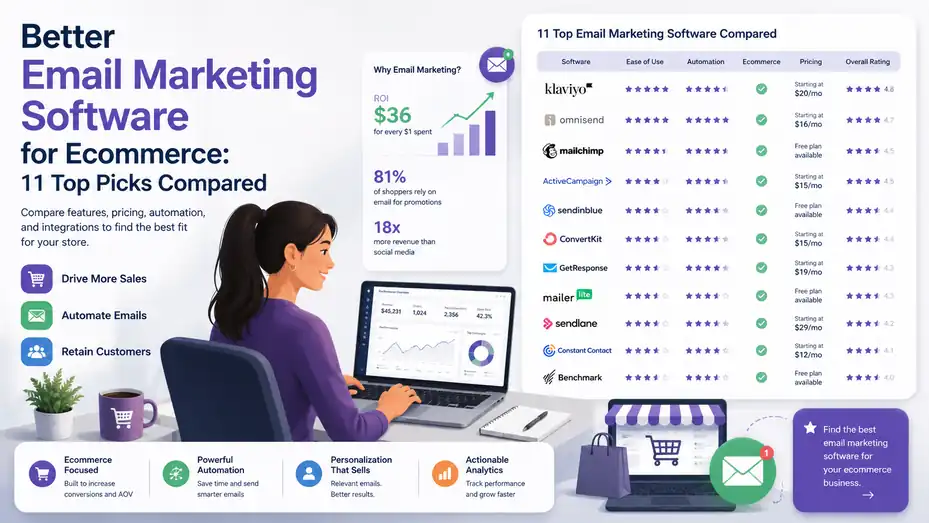
The 11 Best Ecommerce Email Platforms Compared
Below is the shortlist I would actually consider if I were choosing today. Each pick solves a slightly different problem, so the goal is not to crown one universal winner. The goal is to match the platform to the kind of store you run.
Klaviyo: Best For Data-Heavy DTC Brands
Klaviyo is still the tool many ecommerce teams think of first, and that is not an accident. It is built around customer data, which means you can trigger campaigns from real shopping behavior instead of relying on basic list logic.
For brands with enough traffic and order volume, that matters a lot. You can build flows around viewed products, started checkout, repeat purchase windows, predicted churn, and customer value segments. That gives marketers more room to improve performance without constantly creating new one-off campaigns.
Where Klaviyo shines is depth. It is especially strong for Shopify-centered brands, established DTC stores, and teams that care about revenue attribution down to the flow level. If you want to know whether your browse abandonment sequence is outperforming your sunset flow, Klaviyo is built for that kind of work.
The downside is that it can become expensive as your list grows, especially if you layer in SMS. I also would not call it the easiest option for complete beginners. Powerful tools often ask you to think more strategically, and Klaviyo is one of them.
Best fit: Mid-size and scaling ecommerce brands that want serious segmentation, advanced automation, and strong reporting.
Omnisend: Best Value For Growing Ecommerce Stores
Omnisend is one of my favorite recommendations for stores that want strong ecommerce functionality without jumping straight into premium-level pricing pain. It is clearly designed for merchants, not generic newsletter users.
You get prebuilt automations for abandoned cart, welcome series, browse abandonment, and reactivation. The setup usually feels faster than more technical platforms, which is a big deal when you are a lean team trying to launch flows quickly. Its email, SMS, and push messaging setup also gives smaller brands a cleaner path into omnichannel retention.
What I like most is that Omnisend often feels practical. It does not force you into a giant learning curve before you can get useful campaigns live. For many stores, that alone improves results because speed matters. A good abandoned cart flow live today usually beats the “perfect” automation map you still have not launched.
The trade-off is that very advanced brands may eventually want deeper analytics or more custom logic. But for many small and midsize ecommerce teams, Omnisend hits a very smart middle ground between capability, ease of use, and cost control.
Best fit: Shopify, WooCommerce, and growing store owners who want ecommerce-first automation without enterprise complexity.
Drip: Best For Lifecycle Automation
Drip has long positioned itself as an ecommerce CRM-style email platform, and that mindset shows up in how it handles automation. It is less about pretty newsletters and more about customer journeys, segmentation, and conversion paths.
If your strategy revolves around lifecycle marketing, Drip deserves serious attention. You can create flexible automations based on customer actions, tags, purchase behavior, and engagement signals. That makes it useful for brands selling repeat-purchase products, subscriptions, bundles, or replenishable items.
I think Drip is particularly strong for marketers who already know what flows they want to build. If you can picture your funnel clearly, Drip gives you a lot of room to execute it well. This is one of those platforms that tends to reward strategic users.
The catch is that Drip is not always the most budget-friendly choice for very small stores, and some beginners may find other platforms more approachable out of the box. It is also a more focused retention tool, so if you want a huge all-in-one marketing suite, you may lean elsewhere.
Best fit: Ecommerce operators who care about lifecycle retention, repeat purchase flows, and tighter customer journey control.
Mailchimp: Best For Familiarity And Simplicity
Mailchimp still wins on recognition. Many founders have touched it at some point, and that familiarity makes it easier to adopt. The interface is approachable, the templates are simple to work with, and for basic campaigns it gets the job done.
For ecommerce, though, Mailchimp sits in an interesting spot. It can absolutely support stores, especially if your email strategy is still straightforward. A welcome sequence, occasional campaigns, and a few automations are all manageable here.
Where I hesitate is scale. As soon as your retention strategy becomes more behavior-driven, Mailchimp can start to feel less specialized than ecommerce-first competitors. It is not that it cannot do ecommerce; it is that other platforms tend to do it with more focus.
Still, I would not dismiss it. For a brand that wants a recognizable platform, manageable learning curve, and enough features to start building email revenue, Mailchimp remains a valid option. I just would not choose it for a store planning to get very aggressive with segmentation and automation in the near future.
Best fit: Early-stage stores and teams that want a familiar platform with a relatively gentle setup curve.
Brevo: Best For Budget-Conscious Multi-Channel Marketing
Brevo is appealing when you want more than just email but do not want to assemble five different tools to do it. It combines email, SMS, automation, CRM-style contact management, and transactional messaging in one system.
That matters more than some people expect. Many ecommerce businesses eventually need both marketing email and transactional sends like order notifications, confirmations, and updates. Having those pieces closer together can simplify operations.
I also think Brevo is one of the better choices for brands that are cost-sensitive. It tends to attract businesses looking for value, especially when compared with platforms that become expensive the moment your contact count rises. If you send often but want tighter budget control, Brevo is worth a close look.
The trade-off is that its ecommerce depth may not feel as purpose-built as a platform like Klaviyo or Omnisend. You may gain flexibility across channels while giving up some store-specific finesse. For many brands, that is a fair exchange. For pure-play ecommerce retention teams, it may not be.
Best fit: Stores that want affordable email plus SMS, CRM, and transactional messaging in one place.
ActiveCampaign: Best For Advanced Automation Beyond Basic Ecommerce
ActiveCampaign has always been automation-heavy, and that remains its main advantage. If your business needs richer logic, more branching, and deeper customer journey control, it is a serious contender.
I usually think of ActiveCampaign as the platform for operators who want marketing automation to behave more like a system than a newsletter calendar. It can work especially well for ecommerce brands with layered funnels, wholesale segments, high-consideration products, or cross-sell journeys that go beyond basic templates.
There is also a strong argument for ActiveCampaign if your store sits inside a larger sales and customer communication environment. Some ecommerce businesses outgrow pure email tools because they need automation across more customer touchpoints, not just campaigns.
The downside is that it can feel like more software than a very small store needs. If all you want is quick ecommerce flows and weekly promos, this may be overkill. But if you are hitting the limits of lightweight tools and want more automation horsepower, ActiveCampaign earns its place here.
Best fit: Advanced marketers, hybrid ecommerce businesses, and teams that want complex automation logic.
MailerLite: Best For Small Stores That Need Affordability
MailerLite has built a strong reputation for being clean, simple, and affordable, which makes it attractive for smaller ecommerce brands. If your list is growing and you do not want your software bill to jump before your revenue does, this is one of the first names I would check.
Its value is straightforward. You can build good-looking campaigns, create landing pages, run automations, and manage forms without much friction. That is often exactly what a newer store needs. Simplicity is not a weakness when your main job is getting campaigns out consistently.
Where MailerLite can fall behind is in deep ecommerce sophistication. If you want highly granular product-based segmentation and richer revenue automation, you may eventually outgrow it. But not every store needs that immediately.
I think MailerLite works best when you are still proving your retention engine. Maybe you sell a focused product line, maybe your catalog is not huge, and maybe your email strategy is still becoming more mature. In that stage, ease and affordability can beat feature overload.
Best fit: Small ecommerce brands that want a low-friction, budget-friendly email platform.
GetResponse: Best For Ecommerce Plus Funnels And Landing Pages
GetResponse is one of those platforms that can quietly solve more problems than people expect. It is not just an email sender. It also leans into automations, landing pages, conversion funnels, and broader campaign infrastructure.
That makes it interesting for ecommerce brands running promotions, lead magnets, launches, or pre-sale funnels alongside a normal store. If you sell through both email and landing-page-led campaigns, GetResponse can feel more complete than a narrower ecommerce email tool.
I also like it for businesses that want strong marketing functionality without stitching together a landing page builder, email tool, webinar solution, and basic automation platform. Not every store needs that bundle, but some really do.
Its weakness is that pure ecommerce specialists may still prefer software built more aggressively around customer events and product data. GetResponse covers a wider marketing surface area, which is useful, but that breadth can mean less specialization in certain retention workflows.
Best fit: Ecommerce businesses that also depend on landing pages, lead generation, and funnel-driven campaigns.
Shopify Email: Best For Shopify Stores That Want Native Simplicity
Shopify Email is appealing for one obvious reason: it lives inside Shopify. You do not need a complicated setup, your store data is already there, and the pricing is easy to understand. For many merchants, that simplicity is genuinely useful.
If you are just starting email marketing, I think native tools are underrated. They reduce setup friction, which means you are more likely to actually send campaigns and build your first flows. Sometimes the smartest move is not buying a more advanced platform too soon.
That said, Shopify Email is usually best viewed as a starter or simplicity-first option. It handles branded campaigns and basic segmentation well enough, but it is not my first recommendation for brands that want advanced lifecycle marketing, cross-channel automation, or very nuanced customer journeys.
I would frame it this way: Shopify Email is not trying to be the deepest retention platform on the market. It is trying to be convenient, native, and cost-effective for Shopify merchants. For a lot of smaller stores, that is a fair and useful promise.
Best fit: New or smaller Shopify stores that want low-friction email marketing directly in their admin.
AWeber: Best For Simplicity And Support
AWeber is one of the old, reliable names in email marketing, and its appeal is still ease of use. The platform is geared toward small businesses that want something approachable, dependable, and not overloaded with complexity.
For ecommerce specifically, AWeber is not the most advanced option in this list, but it can still work for shops with straightforward needs. If your strategy is mostly newsletters, promotional campaigns, and basic automations, AWeber can handle that without asking you to become a lifecycle marketing expert overnight.
One thing that still matters here is support. Some platforms assume you want to self-serve everything. Others make it easier to get help when you hit a wall. If you value a more guided experience, AWeber becomes more attractive.
Would I choose it over a more ecommerce-native platform for a scaling store? Probably not. But for a solo founder or small shop that values usability and support over advanced segmentation, it can still be a solid fit.
Best fit: Beginners and small ecommerce businesses that want ease of use and dependable support.
KIT (Convertkit): Best For Creator-Led Commerce
Kit is not a classic ecommerce email platform, but it earns a spot here because many modern online stores are really creator-led businesses in disguise. Think newsletters that sell merch, authors selling products, coaches with digital bundles, or niche audiences monetized through commerce.
Its strength is audience relationship building. Tags, automations, forms, and broadcast emails are all built for people who lead with content and trust. If your store grows through personality, community, education, or audience ownership, Kit can work beautifully.
Where it struggles compared with ecommerce-first platforms is deep product-event automation. If you run a large catalog, rely heavily on browse abandonment, or need sophisticated order-based segmentation, Kit is probably not the sharpest tool for the job.
But for lean, content-driven commerce, I still think it deserves respect. A creator with a loyal audience can outperform a bigger store with a better tool simply because the messaging is stronger. Software matters, but business model fit matters more.
Best fit: Creator brands, digital product sellers, and audience-first commerce businesses.
Constant Contact: Best For Straightforward Promotional Emailing
Constant Contact is usually strongest when the need is simple, consistent email marketing without a steep technical learning curve. It is built more around usability and dependable campaign execution than cutting-edge ecommerce automation.
For online stores, that means it can work if your retention strategy is fairly direct. Maybe you send weekly offers, seasonal promotions, product launches, and the occasional follow-up series. In that environment, Constant Contact can be enough.
Where it becomes less compelling is when you want advanced ecommerce workflows with more event-based logic. Competing platforms in this list simply lean harder into store-specific behavior, product sync, and automation depth.
Still, not everyone needs the most sophisticated setup. Some businesses do better with a tool they will actually use consistently. I have seen plenty of owners stall inside overpowered software because it felt too complicated. A simpler platform, used well, can still produce solid results.
Best fit: Stores with simple campaign needs that value usability more than advanced lifecycle depth.
Quick Comparison Table
Here is the practical snapshot I would use to narrow the shortlist.
| Platform | Best For | Strength | Main Limitation | Pricing Feel |
|---|---|---|---|---|
| Klaviyo | Scaling DTC brands | Deep data and segmentation | Can get expensive fast | Premium |
| Omnisend | Growing ecommerce stores | Strong value and fast setup | Less depth than top enterprise options | Mid-range |
| Drip | Lifecycle marketing | Flexible automations | Less beginner-friendly | Mid to premium |
| Mailchimp | Familiar SMB use | Easy to start | Less ecommerce-specific depth | Mid-range |
| Brevo | Multi-channel on a budget | Email, SMS, CRM, transactional | Less store-specific than ecommerce-first tools | Budget to mid |
| ActiveCampaign | Advanced automation | Powerful workflow logic | More complexity | Mid to premium |
| MailerLite | Small stores | Affordable and simple | Easier to outgrow | Budget |
| GetResponse | Funnels plus email | Broad marketing toolkit | Less specialized for pure ecommerce | Mid-range |
| Shopify Email | Shopify-native simplicity | Easy setup and native data | Basic compared with specialists | Budget |
| AWeber | Support and simplicity | Beginner-friendly | Limited advanced ecommerce depth | Budget to mid |
| Kit | Creator commerce | Audience-first email marketing | Not ideal for large-catalog ecommerce | Mid-range |
| Constant Contact | Straightforward campaigns | Usability | Lighter automation depth | Mid-range |
How To Choose The Right Platform For Your Store
This is where most people get stuck. They compare feature lists instead of buying based on the kind of store they actually run.
Match The Tool To Your Business Model
Start with your store model, not the logo you see recommended most often. A subscription brand, fashion store, handmade business, and creator-led merch shop do not need the exact same software.
If you sell repeat-purchase products like supplements, skincare, coffee, or pet supplies, lifecycle automation should be near the top of your list. You will probably get the most value from Klaviyo, Omnisend, or Drip.
If you are running a smaller store and mostly need campaigns, basic flows, and manageable costs, MailerLite, Shopify Email, or AWeber may be enough. There is nothing wrong with starting simpler as long as you know what you are giving up.
If your business blends store revenue with content, education, or newsletter-led sales, Kit or GetResponse may actually fit your workflow better than a pure ecommerce retention platform.
The best choice is not the “best” tool overall. It is the one that fits your customer journey with the least friction.
Use This Simple Buying Framework
When I compare platforms, I usually boil it down to four questions.
- How complex is your customer journey? The more branching and segmentation you need, the more advanced your platform should be.
- How fast is your list growing? Cheap today can become painful later if pricing jumps sharply with contacts.
- How much setup time do you realistically have? A more powerful tool is not better if you never finish implementing it.
- Do you need more than email? SMS, push, CRM, forms, landing pages, and transactional messaging can change the decision fast.
A simple rule I like is this: Buy the least complicated platform that can still support your next 12 to 18 months of growth. That usually keeps you from underbuying and overbuying at the same time.
Common Mistakes When Picking Ecommerce Email Software
A lot of these mistakes are avoidable, but only if you see them early.
Choosing Based On Price Alone
Price matters. I am not going to pretend otherwise. But software cost without context is misleading.
A $20 tool that cannot support abandoned cart recovery, post-purchase upsells, and customer segmentation may cost you more in lost revenue than a $100 tool that handles those jobs properly. On the other hand, paying premium pricing for features you never use is also wasteful.
The smarter move is to look at revenue fit. Ask yourself how much value the platform can realistically unlock based on your current traffic and order volume. If you only have a few hundred monthly visitors, you probably do not need the most advanced system in the market. If you are already doing steady sales, better automation can pay for itself quickly.
I believe many store owners frame this decision backwards. They ask, “What is the cheapest software?” when they should ask, “What is the cheapest software that will not hold back retention growth?”
Migrating Too Late Or Too Early
Timing the switch is tricky. Move too early and you may pay for complexity you do not need. Move too late and you end up rebuilding everything under pressure.
I usually recommend switching when your current platform starts blocking obvious revenue opportunities. Maybe you cannot build the flows you need. Maybe product data is unreliable. Maybe reporting is too shallow to know what is working. Those are real migration signals.
At the same time, avoid changing platforms just because another tool looks shinier on social media. Migration always has hidden work: list cleanup, template rebuilds, DNS and deliverability checks, flow recreation, form updates, and team retraining.
The best reason to switch is not hype. It is a clear gap between your current setup and your retention goals.
My Final Recommendations By Store Type
This is the fast answer for readers who want a practical shortlist without rereading every section.
Best Picks Based On Where You Are Now
If you are a scaling DTC brand and email is already an important revenue channel, I would start with Klaviyo.
If you want the strongest balance of ecommerce features, reasonable usability, and value, I would put Omnisend near the top of the list.
If lifecycle marketing is your main growth lever and you want flexible automation, Drip is a smart choice.
If you are very small and want to keep costs under control, MailerLite or Shopify Email make sense depending on whether you want a general lightweight tool or a Shopify-native one.
If you need wider automation beyond pure ecommerce email, ActiveCampaign is the stronger systems play.
If your store is really an audience-led brand with products attached, Kit can be a better fit than traditional ecommerce tools.
That is why “better email marketing software for ecommerce” is not one universal answer. Better depends on your store model, your team, your budget tolerance, and how advanced your retention strategy needs to become.
Verdict
For most growing online stores, Omnisend, Klaviyo, and Drip are the three platforms I would look at first.
Klaviyo is the strongest choice when you want depth, data, and serious segmentation. Omnisend is the easiest recommendation when you want ecommerce-first functionality with better value and faster implementation. Drip is the one I like for brands that think in customer journeys and repeat-purchase systems.
If your store is earlier-stage, MailerLite or Shopify Email can get you moving without overwhelming you. If you need more breadth, Brevo, GetResponse, and ActiveCampaign all make sense for different reasons.
My honest advice is simple: Do not buy based on hype, and do not buy based only on price. Buy the platform that makes your next best email automations easier to launch, measure, and improve. That is usually the software that ends up making you more money.
If you want, I can also turn this into a fully polished affiliate-ready version with a meta description, FAQ section, and internal link anchor suggestions.

Juxhin B is a digital marketing researcher and founder of JAK Digital Hub, specializing in email marketing software, marketing automation platforms, and digital growth tools. His work focuses on software testing, platform comparisons, and real-world performance analysis to help businesses choose the right marketing technology.
Related posts:
 Moosend Alternatives for Small Business: What Works Better?
 GetResponse vs MailerLite Automation: Which One Actually Converts Better?
 Email Automation Tools for New Ecommerce Store: What to Start With
 Email Leads Software Comparison: Which One Wins?
 Email Marketing Tools For New Ecommerce Store (Starter Picks)
 Best Email Marketing Platforms For New Ecommerce Store Owners