Table of Contents
Some links on JAK Digital Hub are affiliate links, meaning we may earn a small commission at no extra cost to you. Read full disclaimer.
Is email marketing strategy worth it when every brand seems obsessed with social media, short-form video, and paid ads?
I believe it still is, and for many businesses, it is one of the few channels that can reliably turn attention into repeat revenue without forcing you to “rent” your audience forever.
The real question is not whether email works in general. It is whether your business can build a smart system that earns trust, gets opened, and drives action.
Let me break that down in a practical way so you can decide with confidence.
What “Worth It” Really Means In Email Marketing
Before you judge whether email is worth the time, money, and effort, you need a clear definition of what “worth it” actually means for your business. For some brands, that means direct sales.
For others, it means nurturing leads, improving retention, or reducing reliance on paid traffic.
Is Email Marketing Strategy Worth It For Revenue, Retention, Or Both?
Most people ask this question as if email has one job. It does not. That is usually the first mistake.
Revenue is the obvious metric. A good email strategy can drive welcome-offer purchases, abandoned cart recoveries, repeat orders, webinar signups, booked calls, and upsells.
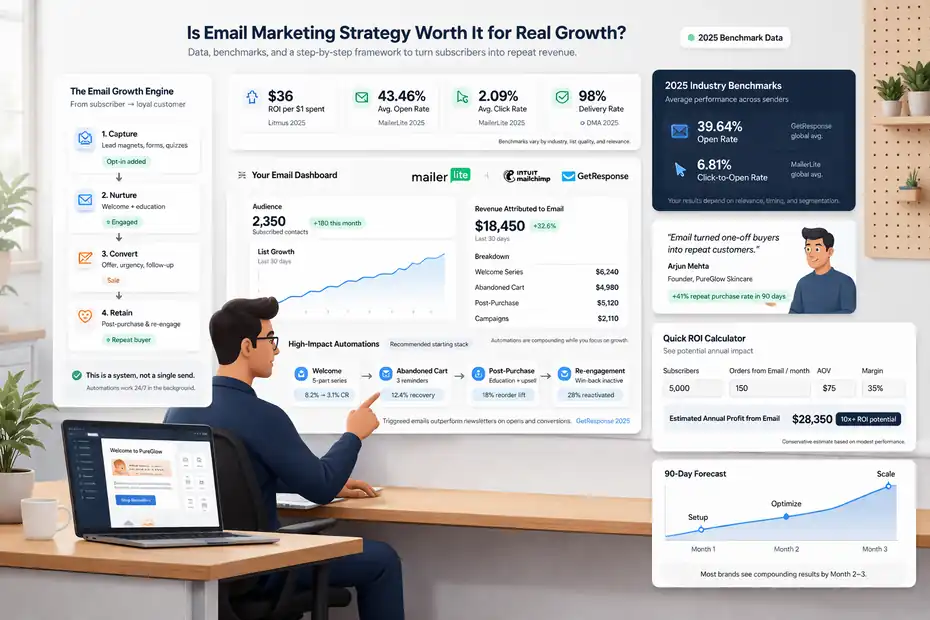
Litmus says email delivers an average ROI of $36 for every $1 spent, and its 2025 reporting also shows that many companies still see returns in the $10 to $50+ range depending on execution.
But email also improves retention, which is where a lot of quiet growth happens. A subscriber who opens your emails for three months may not buy on day one, yet they become cheaper to convert than someone you must reacquire through ads.
In my experience, this is where email becomes less of a campaign tool and more of a business asset.
Imagine you run a skincare store. A single paid ad gets a first purchase. Email then handles the second order reminder, educational content, product pairing suggestions, and seasonal promotions.
That means one customer acquisition can create multiple revenue moments. When you look at it this way, email is not just a marketing tactic. It is part of your margin protection system.
Why Owned Audience Matters More Than Ever
One reason email still matters is simple: you own the relationship more directly than you do on rented platforms. Social reach changes. Ad costs rise. Platform rules shift. Your email list is not immune to problems, but it is far more stable than building your whole growth strategy on algorithms.
That matters because business growth gets fragile when one channel controls your access to customers. If your Instagram reach drops, your audience can vanish overnight. If your ad account gets limited, your pipeline slows immediately. Your email list gives you a way to speak to people who already said yes.
I suggest thinking about email as a hedge against volatility. It is not the flashiest channel, but it is one of the most durable. That durability becomes even more important in competitive markets where acquisition costs are rising and attention is fragmented.
This is also why email works especially well for brands with longer sales cycles. Coaches, SaaS companies, consultants, course creators, local service businesses, and ecommerce stores all benefit when they can keep educating people over time instead of hoping for instant conversion. That kind of patience is hard to buy through ads alone.
How Email Marketing Actually Creates Real Growth
A lot of businesses send emails without ever building a strategy. Then they say email “didn’t work.” Usually, the problem is not the channel. It is the structure behind it.
The Growth Engine Behind A Strong Email Program
Email creates growth by moving people through stages, not by blasting everyone with the same message. That is the difference between random campaigns and a real strategy.
At the top of the funnel, email captures interest through lead magnets, discounts, waitlists, quizzes, event registrations, or content subscriptions. In the middle, it builds trust with useful education, proof, objections handling, and product relevance. At the bottom, it creates conversion moments with clear offers, urgency, reminders, and follow-up.
That sequence matters because people rarely buy the second they discover you. They need context. They need timing. They need a reason to care now.
A realistic example: A small B2B software company offers a free checklist. A new lead joins the list, receives a short welcome sequence, gets two educational emails about the problem their software solves, then receives a case study and demo invitation. That sequence does more than “stay in touch.” It creates momentum.
I believe this is why email outperforms expectations when done well. It gives you repeat chances to explain value in a calm, structured way. That is incredibly powerful when your buyers are busy, skeptical, or comparing alternatives.
Why Email Works Better Than “Post And Hope”
Social media is useful. Paid ads are useful. Content marketing is useful. But all three can become weak if they are not connected to follow-up.
Email is the follow-up system.
You post content, someone clicks, and then what? Without email, many of those people disappear. With email, you can continue the conversation. That is the practical reason email strategy is worth it. It turns one touchpoint into a relationship.
The numbers still support that relevance. MailerLite reported that the average email open rate in 2025 was 43.46%, with a 2.09% click rate and a 6.81% click-to-open rate. GetResponse also reported average open rates around 39.64% across industries, with triggered emails outperforming newsletters.
Those figures do not mean every email performs well. They mean people still open and engage with email when the content is relevant. That is important, because it proves the inbox is not “dead.” It is selective.
So no, email is not magic. But it is one of the most reliable places to continue a buyer journey after someone first notices you. That makes it one of the few channels that can support growth instead of just attention.
Who Benefits Most From Email Marketing Strategy
Not every business needs the same type of email strategy, but most businesses with repeat contact opportunities can benefit from one.
The key is matching email to your buying cycle and customer behavior.
Businesses Where Email Usually Has The Highest Payoff
Email tends to deliver the best payoff when you have one or more of these conditions: repeat purchases, longer decision cycles, multiple offers, education-heavy sales, or a need to build trust over time.
That is why email works so well for ecommerce, SaaS, agencies, service providers, creators, coaches, membership brands, and B2B companies. In each case, the audience usually needs more than one touch before taking action.
For ecommerce, email helps recover carts, drive repeat purchases, and increase average order value. For service businesses, it helps warm up leads before calls. For SaaS, it supports trial activation, onboarding, and churn reduction. For creators, it turns casual followers into an audience that actually sees future launches.
I have noticed that email becomes even more valuable when your business has a “considered purchase.” That means the buyer has questions, hesitations, and alternatives. Email gives you room to answer those concerns without relying on a single sales page visit.
This is also where segmentation matters. A first-time lead should not get the same email as a loyal customer. If your business has different buyer types or product paths, email becomes more valuable because it lets you communicate with more relevance instead of more noise.
When Email May Not Feel Worth It At First
There are situations where email feels slow. That does not always mean it is a bad fit. It may simply mean expectations are off.
If you have almost no traffic, no lead capture system, no repeat buying, and no clear offer, email will not fix those foundational issues. It can support growth, but it cannot invent demand from nothing. In those cases, email may feel underwhelming because the business is feeding it weak inputs.
Another issue is timeline. Paid ads can sometimes create faster visible spikes. Email usually compounds. You build the list, improve the welcome sequence, refine segmentation, and learn what content converts. That means the payoff can be delayed but stronger over time.
For example, a local photographer might only add 100 subscribers in a few months. That sounds small. But if those subscribers are highly relevant and 5 to 10 of them book a package over time, the list is still doing meaningful work.
So if email has felt disappointing, I would not automatically conclude it is not worth it. I would first ask whether the audience quality, offer clarity, and follow-up logic were strong enough to give it a fair chance.
What A Good Email Marketing Strategy Includes
A strategy is more than sending newsletters. It is the system that decides who gets what, when, and why. Without that system, email turns into a calendar full of random sends.
The Core Building Blocks Of An Effective Strategy
A strong email marketing strategy usually has five parts: list growth, segmentation, automation, campaigns, and measurement.
List growth is how you attract the right subscribers. That can come from forms, checkout opt-ins, lead magnets, booking funnels, quizzes, webinars, or content upgrades. Segmentation is how you group people by behavior, interest, stage, or purchase history.
Automation handles key moments like welcomes, abandoned carts, post-purchase education, re-engagement, and lead nurturing. Campaigns cover your regular broadcasts such as launches, newsletters, offers, and announcements. Measurement tells you what is working.
This structure matters because each part supports a different growth function. If you only focus on sending weekly emails, you miss the bigger opportunity. The real leverage usually comes from automated flows that continue working in the background.
A simple version might look like this:
- Welcome sequence for new subscribers
- Abandoned cart sequence for shoppers
- Post-purchase sequence for repeat sales
- Re-engagement sequence for inactive contacts
- Weekly or biweekly campaign calendar
That does not sound glamorous, but it is the kind of setup that creates dependable results. I recommend starting with these essentials before chasing advanced tactics.
The Difference Between Sending Emails And Running A Strategy
Here is the clearest way I can put it: sending emails is an activity, but strategy is a decision framework.
Without strategy, you may send a sale announcement every Friday because “that’s what brands do.” With strategy, you ask better questions. Who is this for? What stage are they in? What objection are we addressing? What action should happen next? What metric tells us this worked?
That shift changes everything.
Imagine two stores both send 12 emails in a month. Store A sends generic promotions to everyone. Store B sends a welcome flow to new signups, a replenishment reminder to past buyers, a cart recovery sequence to non-buyers, and a targeted launch to subscribers who clicked related product links. Same channel, completely different strategic value.
This is why some people say email is overrated while others treat it like a profit center. They are often talking about two different things. One is sending. The other is strategy.
In my experience, email becomes worth it when you stop treating the list like a crowd and start treating it like a set of conversations.
Step-By-Step: How To Decide If Email Is Worth It For Your Business
You do not need to guess. You can evaluate email using a few practical questions and a simple forecasting mindset. This section is where the decision becomes real.
Step 1: Check Your Business Model And Customer Journey
Start by mapping your customer journey in plain language.
Ask yourself: do people buy immediately, or do they need time? Do they buy once, or can they buy again? Do they need education before committing? Do they compare options? Do they abandon checkout? Do they disappear after the first purchase?
If the answer to several of those is yes, email is probably worth exploring.
For example, a supplement brand may need educational content, reorder reminders, and product pairing suggestions. A home service company may need estimate follow-up, trust-building content, and seasonal reminders.
A SaaS company may need onboarding emails, feature education, and upgrade prompts. These are all email-friendly journeys.
I suggest writing down these stages:
- How people discover you
- What makes them hesitate
- What helps them trust you
- What triggers purchase
- What encourages repeat action
Once you see those stages, email starts looking less optional. It becomes the bridge between them.
If your business has no follow-up need and almost all buyers convert instantly with no repetition, email may play a smaller role. But that is rarer than most people think.
Step 2: Estimate The Value Of Even A Small List
A lot of people underestimate email because they imagine needing a huge list. You do not.
A small, relevant list can outperform a large, cold audience. The better question is not “How many subscribers do I need?” It is “What is one engaged subscriber worth over time?”
Let’s say you sell a $75 product with a 35% margin. If a list of 1,000 subscribers produces just 20 sales a month from campaigns and automations, that is 240 sales a year. If email also increases repeat purchases, the long-term value grows even more.
This is where “worth it” becomes a math question instead of a vibe. Even modest performance can justify the setup if your product economics are decent.
DMA’s 2025 benchmarking report found delivery rates around 98%, open rates at 35.9%, and unique click rates at 2.3% across a massive email dataset, which reinforces the point that email still creates measurable attention at scale when programs are healthy.
You do not need fantasy conversion rates. You need a reasonable estimate of list growth, engagement, and downstream value. That is often enough to show that email deserves a seat in your growth plan.
The Costs, Trade-Offs, And Common Reasons Email Fails
Email is not free just because sending an extra message is cheap. There are real costs, and it is better to be honest about them before you invest.
What Email Marketing Actually Costs In Time And Resources
The biggest cost is usually not software. It is consistency and strategic thinking.
Yes, platforms cost money. Pricing varies based on list size, sending volume, features, and automation needs. Most businesses can start at a relatively low monthly cost, then grow into more robust plans as the list expands.
But the real resource drain is writing, segmentation planning, offer strategy, list hygiene, testing, and reporting.
That is why email disappoints teams that treat it like a side task. Good email requires customer understanding. It requires knowing what someone needs at each stage. It also requires enough patience to improve over time.
Here is a realistic breakdown of what you may be investing:
- Setup time for forms, automations, and templates
- Ongoing copywriting and campaign planning
- Analytics review and testing
- Occasional design or deliverability cleanup
- Compliance and consent management
I believe email is worth it when you see this as building an asset, not doing busywork. If you want instant payoff with no learning curve, email will frustrate you. If you are willing to build a repeatable system, the economics can become very attractive.
Why So Many Email Programs Underperform
Underperformance usually comes from four problems: weak list quality, poor messaging, bad timing, or no segmentation.
Weak list quality happens when you collect the wrong subscribers. A giant giveaway may bring people who want the prize but not your product. Poor messaging happens when every email sounds generic, salesy, or irrelevant.
Bad timing happens when emails arrive too often, too rarely, or at the wrong stage. No segmentation means buyers, browsers, and inactive contacts all get the same content.
There is also a measurement issue. Open rates can still be useful directionally, but privacy changes have made them less reliable as a standalone truth. That is why I recommend paying closer attention to clicks, replies, conversions, revenue per recipient, and unsubscribe patterns.
Benchmarks can help, but context matters. Mailchimp, for example, notes that open rates vary widely by industry and reports an overall benchmark around 34.23%.
So when people ask, “Is email marketing strategy worth it?” I often think the hidden question is, “Is it worth doing properly?” My answer is yes. But half-done email tends to produce half-proof.
The Tools And Platforms That Make Email Easier
Tools matter, but only after you understand the strategy. The platform should support the workflow, not replace the thinking. Still, choosing the right setup can save a lot of time and friction.
What To Look For In An Email Platform
When comparing platforms, I would focus on five things: automation depth, segmentation flexibility, ease of use, reporting clarity, and pricing as your list grows.
Automation depth matters if you want more than newsletters. You need conditional logic, behavior triggers, time delays, and purchase-based flows. Segmentation flexibility matters because relevance drives performance. Ease of use matters because a powerful tool that your team avoids is not a real advantage.
Reporting clarity matters because you need to see what drives revenue, not just vanity metrics. Pricing matters because some platforms become expensive fast as your contact list expands.
If you are early-stage, you may value simplicity and low friction. If you are scaling, you may care more about advanced automations and ecommerce integrations. Neither is inherently better. It depends on your model.
I suggest making a short checklist before choosing:
- Can it handle welcome, nurture, and post-purchase automations?
- Can it segment by behavior and purchase activity?
- Does it integrate with your store, CRM, or booking flow?
- Can you test subject lines, send times, or content variations?
- Will pricing still make sense at 10,000 subscribers?
That kind of selection process protects you from buying based on hype.
Useful Platform Categories Without Overcomplicating It
You usually do not need a giant stack to start. Most businesses begin with one email platform plus whatever website, ecommerce, or CRM system they already use.
There are broad categories rather than one universal winner. Some platforms are strong for ecommerce workflows. Others are better for creators and newsletters. Others are designed for CRM-heavy sales pipelines or B2B lead nurture. The right choice is the one that matches your customer journey.
For example, an ecommerce brand may prioritize product-triggered flows, cart recovery, and catalog syncing. A consultant may care more about lead capture, appointment nurturing, and pipeline visibility. A media brand may care about newsletter analytics, referral loops, and audience growth tools.
From what I’ve seen, businesses get into trouble when they overbuy. They choose advanced software before they have a clear welcome sequence or content strategy. The result is more features and less performance.
So yes, tools matter. But email marketing strategy becomes worth it because of message-to-market fit and smart lifecycle design, not because you bought the fanciest dashboard.
How To Make Email Worth It Faster
If you decide email deserves investment, the next question is how to make it pay off sooner. The answer is not “send more.” It is build the highest-leverage pieces first.
Start With The Highest-Impact Automations
If I had to prioritize just a few automations for most businesses, I would start here:
- Welcome sequence: Introduce the brand, set expectations, deliver the signup incentive, and guide the first conversion.
- Abandoned cart or abandoned inquiry follow-up: Recover intent that was already close to converting.
- Post-purchase sequence: Reinforce the decision, reduce refund anxiety, and create the next relevant offer.
- Re-engagement flow: Wake up inactive subscribers before removing them.
Triggered emails matter because they respond to behavior. GetResponse reported that triggered emails outperform regular newsletters on opens, which makes sense because timing and relevance are stronger.
A good welcome sequence alone can change the economics of your list. Imagine a subscriber joins after downloading a guide. Instead of one generic thank-you email, they receive a 5-part sequence that teaches, handles objections, shares proof, and ends with a focused offer. That sequence can work every week without you manually rewriting it.
This is why automation is usually where email starts feeling “worth it” fastest. It compounds effort instead of just adding tasks.
Use Segmentation To Increase Relevance Without Sending More
A lot of teams try to grow email revenue by increasing frequency. Sometimes that works. Often it just creates fatigue.
Segmentation is usually the cleaner solution. Rather than sending more emails to everyone, send better emails to smaller groups. That keeps content relevant and protects your sender reputation and unsubscribe rates.
Useful segments often include:
- New subscribers
- Engaged non-buyers
- First-time customers
- Repeat customers
- Cart abandoners
- Inactive subscribers
- Interest-based groups by category or content clicked
Here is a simple scenario. You sell fitness equipment and accessories. One segment clicked strength-training content. Another clicked recovery-related products. Sending the same promotion to both groups wastes intent. Sending category-specific recommendations feels far more useful.
I recommend segmenting based on behavior before demographics whenever possible. What people click, buy, ignore, or browse often tells you more than what they said on a form.
This is where email becomes smarter, not louder. And smarter email is almost always more worth it than more email.
Common Mistakes That Make Email Feel Like A Waste
Email often gets blamed for problems that actually come from execution. If you avoid a few common traps, the channel becomes much easier to trust.
Treating The Inbox Like A Billboard
The inbox is personal. People do not experience it like a highway sign. They experience it like a stream of interruptions they permit only when the interruption feels useful.
That means every email competes not just with other brands, but with coworkers, friends, receipts, appointments, and real life. So when a business sends vague, self-centered, or repetitive emails, it loses attention fast.
One common mistake is focusing only on the brand’s schedule. “We need to send our weekly promo.” That is not a customer reason. A better question is, “Why would this person care today?”
I suggest using a simple filter before sending any email: is this message timely, relevant, and specific? If not, revise it.
Another issue is lazy subject lines. Curiosity matters, but clarity matters more. People need a reason to open. Subject lines should connect to a real problem, outcome, update, or benefit. Cleverness is fine. Confusion is expensive.
When email feels like a billboard, subscribers tune out. When it feels like guidance, reminders, or genuinely relevant offers, they pay attention.
Ignoring Deliverability And List Hygiene
This is the less glamorous side of email, but it matters a lot. Even strong copy fails if your emails land in spam, promotions overload, or dead inboxes.
List hygiene means regularly removing or suppressing contacts who never engage, cleaning invalid addresses, and avoiding sketchy acquisition tactics. Deliverability depends on list quality, sending patterns, engagement, authentication setup, and content behavior.
Double opt-in can help quality, and GetResponse has highlighted stronger engagement among industries using it.
I would also avoid chasing vanity list growth. A smaller list with active interest is healthier than a bloated list full of people who forgot they subscribed.
This sounds boring, but it directly affects performance. A clean list can improve engagement rates, protect domain reputation, and make your actual best emails more visible. That is a big reason some brands see email as profitable while others see it as dead weight.
So, Is Email Marketing Strategy Worth It?
This is the part you came for. For most businesses with repeat contact opportunities, a clear offer, and some patience, yes, email marketing strategy is worth it.
But it is worth it for a specific reason: it turns scattered attention into a system you can improve over time.
The Honest Answer For Most Businesses
If you expect email to rescue a weak product, fix bad traffic, or generate instant results with no strategy, it will disappoint you. If you use it to capture intent, build trust, automate follow-up, and increase customer lifetime value, it can become one of the most dependable growth channels you own.
That is why I believe the better question is not just “is email marketing strategy worth it.” It is “am I willing to build the kind of email system that makes it worth it?”
The data still points to strong potential. Litmus continues to cite average ROI around $36 per $1 spent, and major benchmark reports show healthy engagement across industries even in a crowded inbox environment.
So yes, email is still relevant. But relevance is earned. The businesses that win with email usually do the simple things well: permission-based list growth, useful welcome sequences, thoughtful segmentation, behavior-based automation, clear offers, and consistent testing.
My Practical Recommendation Before You Invest Heavily
If you are still unsure, do not treat this like an all-or-nothing decision. Run a focused 90-day test.
Set up a basic lead capture path. Build one welcome sequence. Add one revenue automation. Send consistent campaigns. Track clicks, conversions, unsubscribe rate, and revenue influenced by email. Then evaluate.
That kind of test tells you much more than asking for opinions on social media.
In my experience, businesses rarely regret building a quality email system. They regret neglecting it, overcomplicating it, or assuming one or two weak campaigns proved it was not worth doing. Email is not exciting in the same way viral content is exciting. But real growth usually likes systems more than excitement.
And that is exactly why email still deserves serious attention.
FAQ
What is an email marketing strategy and why does it matter?
An email marketing strategy is a structured plan for sending targeted emails based on user behavior and lifecycle stages. It matters because it helps turn subscribers into customers through consistent communication, improving conversions, retention, and long-term customer value without relying only on paid traffic.
Is email marketing strategy worth it for small businesses?
Yes, email marketing strategy is worth it for small businesses because it offers a cost-effective way to build relationships and drive repeat sales. Even a small, engaged email list can generate consistent revenue when paired with automation and relevant messaging.
How long does it take to see results from email marketing?
Most businesses start seeing initial engagement within a few weeks, but meaningful revenue results typically take one to three months. Email marketing works best as a long-term strategy where consistent optimization and audience growth lead to compounding returns over time.
What is the average ROI of email marketing strategy?
Email marketing strategy delivers an average ROI of around $36 for every $1 spent, depending on execution and industry. This high return comes from its ability to nurture leads, automate follow-ups, and increase customer lifetime value without ongoing acquisition costs.
What makes an email marketing strategy successful?
A successful email marketing strategy includes quality list building, strong welcome sequences, behavior-based automation, and audience segmentation. It also requires consistent testing, relevant messaging, and a clear understanding of the customer journey to improve engagement and conversions.

Juxhin B is a digital marketing researcher and founder of JAK Digital Hub, specializing in email marketing software, marketing automation platforms, and digital growth tools. His work focuses on software testing, platform comparisons, and real-world performance analysis to help businesses choose the right marketing technology.
Related posts:
 Email Marketing Strategy for 100K Subscribers That Scales
 Better Email Marketing Strategy for Ecommerce Growth
 Email Marketing Jobs For Startups Hiring Remote Talent
 Email Marketing Strategy for New Ecommerce Store Success
 Email Marketing Strategy vs Paid Ads: Where to Invest
 Email Leads Not Converting? Fix It With This Framework