Table of Contents
Some links on JAK Digital Hub are affiliate links, meaning we may earn a small commission at no extra cost to you. Read full disclaimer.
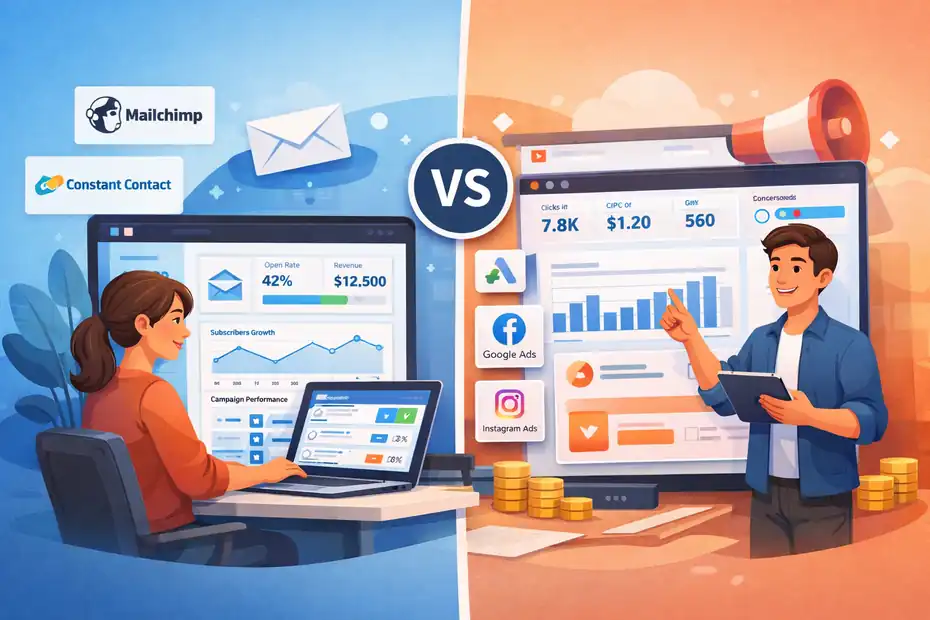
Email marketing strategy vs paid ads is one of those decisions that looks simple until you actually have to spend real money.
I’ve seen smart businesses waste months chasing fast traffic from ads when they really needed a stronger email engine, and I’ve also seen brands hide in email when paid acquisition was the missing growth lever.
The truth is, both channels can work extremely well. The better question is where each dollar should go first, why, and what kind of return you should realistically expect based on your stage, margins, speed, and goals.
Understand What You’re Really Comparing
When people compare email and paid ads, they often compare the wrong things. This is not just about cost per click versus cost per send.
It is really a comparison between renting attention and building an audience you can reach again and again.
Email Marketing Builds An Owned Asset
Email is an owned channel. That matters more than most teams realize.
When someone joins your list, you are building a direct line to a person who has already shown interest. You do not have to keep paying a platform every single time you want to reach them. You still pay for software, creative work, and list growth, of course, but the economics are different from paid media. Over time, email becomes a compounding asset.
A lot of the return in email comes from the second, third, and tenth message, not just the first one. That is why email often performs so well for brands with longer buying cycles, repeat purchase potential, or products that need trust before conversion.
HubSpot says email marketing remains one of the highest-ROI channels for B2C brands, and Litmus’ 2025 findings show many marketing leaders reporting returns between $10 and $50+ for every $1 spent on email.
Here is the practical takeaway I suggest you remember: email usually gets stronger the longer you use it well.
Paid Ads Buy Speed, Reach, And Testing Power
Paid ads do the opposite job. They buy immediate distribution.
You can put a new offer in front of people today. You can test messaging, target cold audiences, launch a product, recover seasonal demand, and scale traffic without waiting months for list growth. That speed is why paid ads are still essential in many businesses, especially when you need demand now rather than later.
Paid ads are also incredibly useful as a diagnostic tool. They tell you whether your market responds to your offer, your landing page, and your creative. If nobody clicks or converts, that feedback is painful, but useful.
WordStream’s 2025 benchmarks put the average Google Ads conversion rate at 7.52%, with average cost per lead at $70.11 across Google Ads, which gives you a realistic frame for how quickly costs can add up if your funnel is not ready.
In my experience, ads are best treated as an accelerator, not a replacement for strategy.
The Real Difference Is Compounding Vs Immediate Demand
This is where the decision gets clearer.
Email tends to win on lifecycle value. Paid ads tend to win on immediacy. Email helps you monetize existing interest. Paid ads help you create attention at the top of the funnel.
Email is stronger when you already have traffic, customers, or leads. Paid ads are stronger when you need to generate opportunities from scratch.
A simple way to think about it is this:
- Email marketing: Better for retention, repeat purchases, nurturing, and margin efficiency.
- Paid ads: Better for awareness, lead generation, launch velocity, and predictable traffic volume.
- Best long-term setup: Use ads to acquire attention and email to convert more of that attention over time.
That last point is where most profitable teams land. It is usually not email or ads. It is ads feeding email, and email increasing the return on ads.
Decide Based On Your Business Stage
The smartest investment choice depends less on channel hype and more on where your business is right now.
A startup, a local service business, and a mature ecommerce brand should not make the same decision.
If You Are New And Need Customers Fast, Paid Ads Usually Go First
A new business often has one urgent problem: nobody knows you exist.
In that situation, paid ads can make more sense as the first growth lever because they create exposure immediately. You can validate positioning, offers, and landing pages faster than you can build a large email list organically. This is especially true for local services, product launches, and niche B2B offers where search intent is strong.
That said, I would not pour money into ads unless you have a minimum viable funnel. You need a clean landing page, one clear conversion goal, and some way to capture leads even if the visitor does not buy right away. Otherwise, you pay to attract people and then lose them forever.
Imagine you run a new bookkeeping service for online sellers. Search ads might bring in leads quickly for terms with clear intent. But if you do not collect emails with a free tax checklist or profit calculator, your ad spend becomes single-touch only. That is expensive.
My view is simple: If you are early-stage, paid ads often open the door, but email should be built from day one so the traffic you buy keeps paying you back.
If You Already Have Traffic, Email Often Delivers The Better Marginal Return
This is where email becomes hard to ignore.
If your site already gets visitors from SEO, referrals, social media, marketplaces, or past customers, email is often the highest-leverage place to invest next.
You already have attention. You just are not monetizing enough of it yet. Email lets you capture that interest, segment it, follow up, and bring people back without paying for another click.
This is a very common growth gap. A store gets 50,000 monthly visitors, spends heavily on acquisition, and still complains about rising CAC. Then you look closer and realize abandoned cart emails are weak, welcome emails are generic, and there is no post-purchase sequence.
In other words, the business is trying to outspend a retention problem.
HubSpot’s marketing data continues to show email among the strongest ROI channels for B2C brands. That aligns with what many of us see in practice: once a business has consistent traffic, email can improve revenue efficiency faster than simply increasing ad budgets.
If You Have Repeat Purchase Potential, Email Should Be A Core Investment
Some business models are built for email.
Think skincare, supplements, apparel basics, SaaS, education, memberships, coaching, and B2B services with long nurture cycles. In all of these, one purchase or inquiry is rarely the end of the relationship. Email helps you educate, upsell, cross-sell, and re-engage. That makes customer acquisition economics healthier.
Here is the part I think people underestimate: repeat purchase businesses do not just make more from email because they send more promotions. They make more because email supports timing. You can reach people when replenishment is due, when usage drops, when a trial is about to expire, or when interest signals change.
If I were advising a brand with strong lifetime value, I would rarely choose “ads only.” I would choose “ads plus serious email infrastructure,” because long-term growth comes from how well you monetize customers after acquisition, not just how many first purchases you buy.
Compare Cost, ROI, And Payback Period
This is the section most people care about, because budget decisions eventually come down to numbers.
The problem is that many teams compare these channels on the wrong timeline.
Email Usually Wins On Efficiency, But Not On Speed
Email is often the more efficient channel over time.
Litmus’ 2025 reporting shows a wide range of email ROI outcomes, with many marketers seeing returns between $10 and $50+ per dollar spent. Even allowing for variation by list quality, offer, and attribution model, that range explains why email stays near the top of so many budget conversations.
But email is not magic. The return usually comes after setup work: list growth, segmentation, automation, deliverability, and message testing. If you have a tiny list, weak offers, or low engagement, you may not see that return immediately.
That is why I tell people not to judge email by the first month alone. Judge it by the system you are building. A well-run email program can improve conversion rate, repeat purchase rate, average order value, and customer retention at the same time. Ads rarely do all of that on their own.
Paid Ads Often Win On Speed, But The Cost Pressure Is Real
Paid ads can create pipeline quickly, but they come with constant pressure.
Every click has a price. Every test has a cost. Every scaling move can push CPA upward if your creative, audience quality, or conversion path weakens. That is why paid ads feel amazing when they work and brutal when they do not.
WordStream’s 2025 Google Ads benchmarks report a 7.52% average conversion rate and a $70.11 average cost per lead. Those averages do not mean your numbers will match, but they are a useful reminder that paid acquisition can get expensive fast, especially in competitive markets.
I believe the smartest way to use ads is to decide your acceptable payback period before launching. If your business cannot tolerate a 60- to 90-day payback window, cold paid traffic may feel much riskier than email-led growth.
Use A Simple Investment Formula Instead Of Guessing
Here is a practical framework I recommend:
- Invest more in email first when: You already have traffic, repeat purchases matter, your margins are healthy, and your list or automation is underdeveloped.
- Invest more in paid ads first when: You need leads now, your offer is proven, your landing page converts, and cash flow can support testing.
- Split budget more evenly when: You have product-market fit and need both pipeline growth and better monetization of existing demand.
A quick example helps. Imagine two brands each have $5,000 to invest.
- Brand A: Established ecommerce store, 40,000 monthly visitors, weak welcome series, no browse abandonment flow, no win-back campaign. I would put more of that budget into email.
- Brand B: New local roofing company, very little traffic, strong offer, good landing page, high ticket value. I would put more of that budget into paid search, while still capturing every lead into email follow-up.
The right answer is not ideological. It is economic.
Match The Channel To Your Goal
A lot of bad budget decisions happen because businesses pick a channel based on popularity instead of purpose. The better move is to match the channel to the exact result you need.
Choose Email For Retention, Nurture, And Revenue Recovery
Email shines when the goal is to get more value from people who already know you.
This includes welcome sequences, abandoned cart recovery, post-purchase education, replenishment reminders, renewal prompts, win-back campaigns, and lead nurture. These are not glamorous compared with ad creative, but they often move profit faster.
I especially like email when the buyer needs reassurance. Maybe your product is not cheap, your service is considered carefully, or your audience needs proof before acting. Email gives you room to explain, educate, and build trust over time without paying for every touchpoint.
A realistic scenario: An online course creator sees decent webinar signups from social content but low direct conversions. Paid ads could push more traffic into the webinar, yes.
But a smarter first move might be a stronger email sequence after signup: reminder emails, student results, objection handling, deadline framing, and follow-up after the event. In many cases, revenue lifts faster there.
Choose Paid Ads For Immediate Acquisition And Controlled Testing
Paid ads are best when your priority is top-of-funnel demand.
This makes sense for launches, promotions, high-intent search capture, and fast validation. Ads are also excellent when you need controlled experiments. You can test headlines, hooks, landing pages, and audience segments quickly. That kind of speed is valuable.
For example, if you are launching a new product category, ads can tell you which positioning angle gets attention: affordability, speed, quality, or convenience. Email cannot solve that at scale if you do not yet have a large qualified audience.
That is why I see paid ads as a market-testing engine as much as an acquisition engine.
Use Both When You Want Lower CAC Over Time
This is where the strongest systems are built.
Paid ads can bring in the lead. Email can make that lead worth more. Paid ads can generate the first sale. Email can increase repeat orders. Paid ads can test the message. Email can deepen the relationship.
This combination is especially powerful because it changes your customer acquisition cost math. If email lifts conversion rate and customer lifetime value, you can often afford higher acquisition costs in ads without hurting profitability. That is a huge competitive advantage.
Many businesses think they have an ad problem when they really have a post-click monetization problem. Fix the email layer, and the same ad spend can become much more productive.
Build The Right System Before Spending More
It is very easy to spend money on the wrong bottleneck. Before you invest heavily in either channel, make sure the underlying system is ready.
What Your Email Foundation Should Include
A serious email program does not need to be huge, but it does need structure.
At minimum, I suggest these core pieces:
- Lead capture: One strong opt-in tied to a real benefit, not a generic “join our newsletter.”
- Welcome sequence: A short series that explains who you are, what makes you different, and what the subscriber should do next.
- Behavior-based automation: Cart abandonment, browse abandonment, lead follow-up, or inquiry follow-up where relevant.
- Post-purchase flow: Onboarding, education, review requests, cross-sell, and retention messaging.
- Basic segmentation: New leads, customers, repeat customers, inactive subscribers, and high-intent visitors.
You do not need complexity for its own sake. What you need is relevance. In my experience, even a modest list performs well when each sequence has a clear job.
A helpful benchmark from Litmus’ 2025 reporting is that stronger email results correlate with greater investment in email operations and budget share.
That fits what many teams learn the hard way: email pays well when you actually build it like a system.
What Your Paid Ads Foundation Should Include
Ads deserve the same discipline.
Before you increase budget, make sure you have:
- A clear conversion event: Purchase, booked call, demo request, qualified lead, or signup.
- A focused landing page: One message, one audience, one action.
- Tracking that works: Platform tracking plus analytics so you can see where leads and revenue come from.
- Offer clarity: Why this, why now, why trust you.
- Testing room: Enough budget to gather real data, not random noise.
I would also add one more thing: emotional patience. Ads often punish impulsive decisions. Teams kill campaigns too early, scale winners too fast, or judge everything by click volume instead of business outcomes.
Why Tracking And Attribution Change The Whole Decision
This part is unsexy, but it matters.
If your attribution is weak, paid ads can look worse than they are, and email can look better than it deserves, or the reverse. A branded search click may get too much credit. A nurture sequence may get too little. Cross-device behavior can muddy everything.
The answer is not perfect attribution. Most businesses will never get that. The answer is consistent attribution plus common-sense interpretation.
Look at channel-assisted conversions, not just last-click numbers. Track lead quality, not just lead volume. Watch payback period, not just ROAS screenshots.
From what I have seen, businesses make better channel choices when they stop asking, “Which platform got the sale?” and start asking, “Which system increased total profitable demand?”
Know The Common Mistakes That Waste Budget
Most underperformance is not caused by choosing email or choosing ads. It is caused by using either one poorly.
Email Mistakes That Make The Channel Look Weaker Than It Is
The biggest email mistake is treating the list like a megaphone instead of a relationship.
That usually shows up as generic campaigns, weak segmentation, slow follow-up, or constant discounting. Then performance drops, unsubscribes rise, and the team concludes email “doesn’t work.” In reality, the issue is usually relevance.
Here are a few common problems I see:
- No real value exchange at signup: People join, but they are not truly interested.
- One-size-fits-all messaging: New subscribers and loyal customers get the same emails.
- No automation depth: The business sends campaigns but neglects welcome, cart, or post-purchase flows.
- Over-mailing or under-mailing: Both hurt. One creates fatigue, the other loses momentum.
I believe email becomes profitable when you stop thinking in blasts and start thinking in journeys.
Paid Ads Mistakes That Destroy ROI Quickly
Paid ads have their own traps, and they can be expensive.
The most common one is sending paid traffic to a page that was never designed to convert cold visitors. Another is scaling spend before the offer and economics are proven. A third is optimizing for cheap clicks instead of profitable customers.
A few warning signs:
- Weak landing page fit: The ad promise does not match the page experience.
- Too-broad targeting: You buy curiosity instead of intent.
- Poor offer clarity: Visitors are interested, but not convinced.
- No lead capture fallback: Non-buyers disappear forever.
- No creative testing process: The team guesses instead of learning.
When paid ads fail, people often blame the platform. Sometimes the real problem is that the business is paying to expose unresolved messaging issues.
The Biggest Mistake: Forcing One Channel To Do Everything
This is the mistake I would avoid above all others.
Email is not built to create large-scale cold demand on its own. Paid ads are not built to maximize customer lifetime value on their own. When you force either channel to carry the entire growth model, you create fragility.
A healthier mindset is this: let each channel do the job it does best.
- Ads create attention.
- Email captures and compounds it.
- Ads test demand.
- Email develops it.
- Ads open the relationship.
- Email extends it.
That is not theory. That is how many of the strongest acquisition systems actually work.
Choose Your Investment Split Based On Real Scenarios
The easiest way to answer “where to invest” is to look at your situation honestly. Here are practical budget approaches I would recommend in common cases.
Scenario 1: Small Business With Limited Traffic
If you are a small business with little existing traffic, I would usually lean toward paid ads first, but not exclusively.
A workable split might be 70% paid ads and 30% email setup. The reason is simple. You need people entering the funnel now. But every click should feed an email system, even if the system starts small.
For example, a local HVAC company could use paid search to capture urgent service demand, while email handles estimate follow-up, seasonal reminders, financing education, and maintenance plan renewals. In that case, ads create the opportunity, and email increases close rate and retention.
Scenario 2: Ecommerce Brand With Steady Traffic But Thin Margins
This is where I would often flip the investment.
A brand with decent traffic and rising acquisition costs usually gets more leverage from retention and conversion optimization. A split like 60% email and lifecycle optimization, 40% paid ads can make sense. Not because ads do not matter, but because squeezing more value from existing traffic can relieve margin pressure faster.
If average order value is decent and repeat purchase potential exists, email can improve welcome conversion, recover abandoned carts, increase reorder rate, and revive dormant customers. That stack of gains often beats simply buying more cold traffic.
Scenario 3: B2B Service With A Longer Sales Cycle
For B2B, I usually think in terms of lead quality and nurture depth.
Paid ads can drive demo requests or lead magnet downloads, but email is often what turns raw interest into qualified pipeline. A balanced split can work well here, especially if sales cycles are 30 to 180 days. You need ads for lead generation and email for education, trust, and timing.
A software consultant, agency, or SaaS company may close only a small percentage of cold leads immediately. That does not mean ads failed. It means nurture matters. This is where email earns its keep.
Scenario 4: Mature Brand Focused On Efficiency
Once a business has product-market fit, brand awareness, and stable traffic, I generally prefer a more integrated model.
You do not ask, “Email marketing strategy vs paid ads?” You ask, “How do we use both to maximize profit?” At this stage, budget allocation becomes less about channel identity and more about bottleneck management. If list growth slows, invest in acquisition. If CAC rises, strengthen email monetization. If conversion plateaus, improve landing pages and flows.
That is the level I think every business should aim for.
The Best Long-Term Answer: Use Paid Ads To Feed Email
If you want my honest opinion, the best investment decision for most established businesses is not choosing one winner forever.
It is building a system where paid ads and email make each other better.
A Practical Funnel That Works In Real Life
Here is the structure I recommend most often:
- Paid ads drive targeted traffic to a focused landing page.
- The page converts visitors into buyers or leads.
- Non-buyers are captured through an email opt-in with a real incentive.
- Email sequences educate, recover, remind, and convert.
- Customer behavior triggers follow-up offers and retention campaigns.
- Paid retargeting and email work together to re-engage high-intent users.
That system works because it respects how people actually buy. Many visitors are interested before they are ready. Email gives you a second, third, and fourth chance without paying full acquisition cost again.
Where I Would Invest First If Budget Is Tight
If I had to simplify this into one direct recommendation, it would be this:
Invest in paid ads first when you do not yet have enough demand to work with. Invest in email first when you already have attention but are failing to convert and retain enough of it.
More specifically:
- Choose paid ads first: New business, low traffic, urgent lead needs, validated offer, strong landing page.
- Choose email first: Existing traffic, repeat customers, weak lifecycle flows, rising CAC, underused list.
- Choose both intentionally: Proven business with budget discipline and a need for both growth and efficiency.
That is the clearest answer I can give without pretending every business is identical.
The Final Decision Framework
Before you invest, ask yourself these five questions:
- Do I need demand now, or better monetization of demand I already have?
- Do I have enough traffic or leads to justify serious email investment right now?
- Do I have the margins and cash flow to test paid ads properly?
- Does my business benefit from repeat purchases or longer-term nurturing?
- Where is the actual bottleneck: acquisition, conversion, or retention?
Your answers will usually point to the right budget decision faster than any generic marketing advice.
Final Verdict: Where To Invest
Here is the blunt version.
If your business already has traffic, customers, or leads, I would usually invest in email before increasing paid ad spend. Email is often the more efficient lever, especially when lifecycle marketing is underbuilt and customer lifetime value matters.
Current industry reporting supports that view, with email continuing to rank among the strongest ROI channels and many marketers reporting substantial returns per dollar spent.
If your business is new and demand is the main problem, I would put more budget into paid ads first, as long as your offer and landing page are ready. Paid media buys speed. It helps you validate what works. But it gets expensive quickly, and benchmark data shows that cost per lead can rise fast when funnels are not dialed in.
For many businesses, the best answer is not picking a side. It is using paid ads to generate attention and using email to capture, convert, and compound that attention over time.
That is where the smartest investment usually lands.
FAQ
Is email marketing better than paid ads?
Email marketing often delivers higher long-term ROI because it targets people who already know your brand. Paid ads, however, are better for immediate traffic and reaching new audiences. The better option depends on whether your priority is fast acquisition or maximizing existing customer value.
When should I invest in paid ads instead of email marketing?
You should invest in paid ads when your business needs quick visibility, lead generation, or product validation. Ads help you reach new audiences instantly, which is especially useful for new businesses or product launches that lack existing traffic or an established email list.
Why does email marketing have higher ROI than paid ads?
Email marketing typically has higher ROI because it targets warm audiences and does not require paying for each interaction. Once someone joins your list, you can communicate repeatedly at a low cost, increasing conversions, repeat purchases, and overall customer lifetime value over time.
Can email marketing and paid ads work together?
Yes, combining email marketing and paid ads creates a stronger growth system. Paid ads bring in new traffic, while email nurtures leads and increases conversions. This combination lowers customer acquisition costs and improves long-term profitability by maximizing the value of each visitor.
How do I decide between email marketing strategy vs paid ads?
Deciding between email marketing strategy vs paid ads depends on your business stage and goals. If you need immediate traffic, choose paid ads. If you already have visitors or customers, focus on email to increase conversions and retention before scaling ad spend.

Juxhin B is a digital marketing researcher and founder of JAK Digital Hub, specializing in email marketing software, marketing automation platforms, and digital growth tools. His work focuses on software testing, platform comparisons, and real-world performance analysis to help businesses choose the right marketing technology.
Related posts:
 Email Marketing Jobs For Startups Hiring Remote Talent
 Better Email Marketing Strategy for Ecommerce Growth
 Email Leads Not Converting? Fix It With This Framework
 Email Leads Cost For 20K Contacts: What Should You Pay?
 Email Marketing Jobs For Solopreneurs That Scale Fast
 Email Marketing Jobs For Career Changers: Start A New Path