Table of Contents
Some links on JAK Digital Hub are affiliate links, meaning we may earn a small commission at no extra cost to you. Read full disclaimer.
Free email marketing for ecommerce can absolutely work when you are starting out, testing product-market fit, or trying to squeeze more revenue from traffic you already paid for.
I’ve seen too many store owners assume they need an expensive stack before they even have a reliable welcome flow or abandoned cart sequence. Usually, the opposite is true. You need a simple setup, clear triggers, and a tool that matches how your store sells.
In this guide, I’ll walk you through the free platforms worth considering, how to pick one, and how to turn a free plan into real sales without getting stuck later.
What Free Email Marketing For Ecommerce Really Means
Free tools are helpful, but in ecommerce, “free” rarely means unlimited. Most platforms cap contacts, email sends, advanced automation, or ecommerce-specific features like product recommendations and abandoned cart flows.
That is not necessarily a bad thing. For a smaller store, those limits can still be more than enough to build a profitable system.
Why Free Can Still Be Enough To Generate Sales
The biggest mistake I see is thinking more software equals more revenue. It usually does not. What moves the needle first is sending the right message at the right moment: a welcome email after signup, a reminder after cart abandonment, and a post-purchase follow-up after delivery.
Email is still one of the stronger conversion channels for online stores. HubSpot cites a 2.8% average B2C email conversion rate, and Litmus reports many companies see email ROI in the 10:1 to 36:1 range. That is a pretty strong argument for getting the basics right before spending heavily.
Here’s the practical version: If your store has 1,000 monthly visitors, a 2% email signup rate, and one decent welcome offer, you do not need enterprise software. You need a clean opt-in form, a useful incentive, and a sequence that feels relevant. In my experience, a focused free setup beats a messy paid one almost every time.
The Features That Matter Most For Ecommerce
When you evaluate free email marketing for ecommerce, ignore flashy extras for a minute and focus on what directly affects revenue.
- Store Data Sync: Your email platform should pull in customers, orders, and products automatically so you can personalize campaigns.
- Automation: You want triggered emails, not just one-off newsletters. Welcome flows and cart recovery matter more than fancy templates.
- Segmentation: Even basic groups like first-time buyers, repeat buyers, and non-buyers help you avoid sending the same email to everyone.
- Send Limits: A generous free plan is only useful if the monthly cap fits your traffic and list size.
I’d also add one overlooked factor: migration risk. Some free tools are great for learning but awkward once your list grows. So the right choice is not just “What is free?” It is “What is free and still sensible six months from now?”
The 7 Tools That Sell
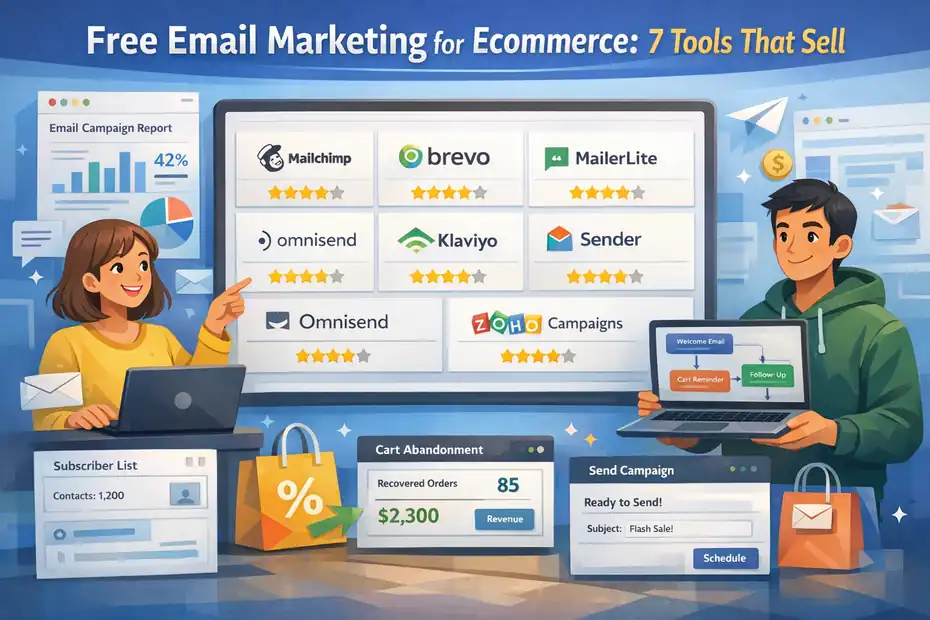
This is the part most people care about, so let me keep it practical. These seven tools all have a real free entry point, and each one fits a different type of ecommerce store. The best one depends less on hype and more on your catalog, order volume, and store platform.
Mailchimp: Best For Tiny Lists And Familiar Setup
Mailchimp’s free marketing plan includes up to 250 contacts and 500 monthly sends, with a 250-per-day cap. It also supports Shopify and WooCommerce integrations, including syncing customer and order data for targeted ecommerce emails.
What I like about Mailchimp is that many store owners already know the brand, so the learning curve feels lower. The interface is approachable, templates are easy to work with, and it is decent for basic newsletters and simple automations.
Where it gets limiting is scale. A 250-contact cap is tight for ecommerce. If you run paid traffic or collect emails aggressively with popups, you can hit that wall fast. I usually see Mailchimp make the most sense for a very small store, a pre-launch list, or a side project that needs something recognizable and easy.
A realistic use case would be a handmade jewelry shop with a small monthly audience. You could run a popup for 10% off, send a welcome series, and announce product drops. That can work well. But once the list starts growing, the free tier becomes more of a trial runway than a long-term solution.
Brevo: Best For Send-Based Pricing And Mixed Marketing Needs
Brevo’s free option allows 2,000 contacts and 300 emails per day, and its Shopify integration syncs customer, product, collection, and order data. That matters if you want ecommerce behavior to feed your campaigns automatically.
I recommend Brevo when a store wants flexibility without paying based primarily on contact count. That model can be helpful if you have a decent-sized list but you are not blasting it constantly. It is also appealing if you want email plus SMS or transactional messaging under one roof later.
The tradeoff is that 300 emails a day can feel restrictive during promotions. If you want to send a big weekend sale to a fast-growing list, that cap forces you to think more carefully about cadence and segmentation.
Still, for many ecommerce brands, Brevo punches above its price. A store selling consumables, for example, could use it for a welcome flow, replenishment reminders, and occasional campaigns without running into immediate cost pressure. I think it is one of the more balanced options for stores that want room to grow without overcommitting early.
MailerLite: Best For Simplicity And Lean Teams
MailerLite’s free plan includes up to 500 subscribers, campaign creation, automation, forms, websites, and up to 10 landing pages. MailerLite also offers Shopify syncing and ecommerce features such as abandoned cart emails through its integration.
This is one of the cleanest platforms for a solo founder or small team. I like MailerLite when someone wants less clutter and fewer “enterprise” distractions. It is straightforward, and that matters because complexity often delays execution.
Where MailerLite works best is a store that needs core lifecycle email without a huge automation map. Think niche apparel, digital products, subscriptions, or a small home decor brand. You can build forms, route people into a welcome flow, and send campaigns without feeling buried in settings.
The cap is smaller than what some competitors offer, so I would not call it the most generous free option. But if your biggest problem is not volume, it is actually launching email properly, MailerLite is a strong choice. Sometimes clean and usable wins over feature-heavy.
Omnisend: Best For Ecommerce-First Automation
Omnisend’s free plan includes all features, supports up to 500 emails per month, and limits sending to 250 unique contacts. Its Shopify connection is deeply ecommerce-focused, with support for syncing contact data and store events.
If your store is clearly ecommerce-first, Omnisend deserves serious attention. This is one of the few tools where the product direction feels built around online stores rather than general email marketing users.
That shows up in the kinds of automations people actually need: cart abandonment, browse abandonment, post-purchase follow-up, and product-led segmentation. For a Shopify brand that wants to move quickly, I think Omnisend often feels more natural than a general-purpose platform.
The downside is the free send limit. Five hundred emails a month disappears quickly once flows start working. But I still like it for testing because you can build your ecommerce logic inside a platform designed for retail behavior from day one.
If I were helping a new Shopify skincare store set up email from scratch, Omnisend would be near the top of my shortlist. The free tier is tight, but the workflow logic is aligned with how ecommerce stores sell.
Klaviyo: Best For Data-Driven Stores Planning To Scale
Klaviyo offers a free plan with up to 250 active profiles and 500 email sends per month, while still giving access to segmentation, automation, editors, and built-in reporting.
Klaviyo has a strong reputation in ecommerce for a reason. It is built around customer data, behavioral triggers, and highly targeted messaging. That makes it powerful for stores that want to eventually run more sophisticated flows.
I would not put Klaviyo first for every beginner, though. The free tier is useful, but the real value of Klaviyo shows up when you lean into its data model: segmenting by purchase behavior, predicted value, engagement windows, and product interest. If that sounds exciting rather than overwhelming, it can be a very smart starting point.
A good fit might be a fashion brand with repeat customers and a growing catalog. You could start with core flows now, then expand into VIP segmentation, replenishment, or product-category targeting later without switching platforms.
So my honest take is this: Klaviyo is not the most generous free plan, but it may be the best strategic choice if you know your store will grow into advanced lifecycle marketing.
Sender: Best Free Volume For Budget-Conscious Stores
Sender’s free forever plan advertises 15,000 emails per month, 2,500 contacts, no daily limits, automation, templates, landing pages, and 24/7 live support.
That is, frankly, a very attractive free offer on paper. If your priority is maximizing free sending capacity, Sender stands out immediately. For stores with low budgets and decent traffic, that generosity can make the difference between “we send one newsletter a month” and “we actually run a proper email calendar.”
The question is not whether the free plan is generous. It is whether the platform matches your ecommerce workflow well enough. Sender is strong on value, but for stores that depend heavily on deep retail automation, some ecommerce-first tools may still feel more tailored.
That said, I would absolutely consider Sender for a smaller general store, a WooCommerce business, or a founder who wants breathing room before paying. If you have 1,500 subscribers and want a welcome sequence plus weekly campaigns, Sender gives you more room than most competitors without instantly pushing you to upgrade.
Zoho Campaigns: Best For Larger Contact Limits On Free
Zoho Campaigns’ forever-free plan supports up to 2,000 contacts and 6,000 emails per month. Zoho also positions the platform as a free-forever option and outlines some feature restrictions on the free tier, including limits around segmentation and scheduling.
I think Zoho Campaigns is underrated when someone mainly needs list capacity without an immediate budget. Two thousand contacts on free is generous enough for many early-stage stores.
The catch is that some restricted features are exactly the ones ecommerce marketers care about over time, like deeper segmentation and more advanced send controls. That means Zoho can work well as a starting point, but you should be honest about whether you will outgrow those limits once your campaigns become more targeted.
For a local retailer moving online or a catalog-style store with a broader audience, Zoho can be a practical choice. You get more room than Mailchimp or Klaviyo on free, and that alone can make it attractive if list growth is happening faster than revenue.
Which Tool Looks Best At A Glance
Here’s a quick comparison of the current free-plan starting points.
| Tool | Free Plan Snapshot | Best Fit |
|---|---|---|
| Mailchimp | 250 contacts, 500 sends/month | Very small stores, familiar interface |
| Brevo | 2,000 contacts, 300 emails/day | Stores wanting flexibility and mixed channels |
| MailerLite | 500 subscribers, core email + automation | Lean teams that want simplicity |
| Omnisend | 500 emails/month, 250 unique contacts | Ecommerce-first automation testing |
| Klaviyo | 250 active profiles, 500 emails/month | Data-driven stores planning to scale |
| Sender | 2,500 contacts, 15,000 emails/month | Budget-conscious stores needing free volume |
| Zoho Campaigns | 2,000 contacts, 6,000 emails/month | Stores needing larger free contact capacity |
All figures above come from the providers’ current pricing or plan pages.
How To Choose The Right Tool For Your Store
The best tool is the one that fits your store’s shape today without boxing you in tomorrow.
That sounds obvious, but most people choose based on a homepage promise instead of their actual business model.
Match The Tool To Your Store Platform And Sales Cycle
If you sell on Shopify, I would prioritize how well the platform syncs product, customer, and order behavior. Mailchimp, Brevo, MailerLite, and Omnisend all offer Shopify integrations, but they do not all feel equally ecommerce-native in practice.
Omnisend and Klaviyo are usually stronger when behavior-based retail automation is the main goal, while Brevo and MailerLite often feel easier for broader marketing needs.
I suggest asking three simple questions.
- How often do people buy? Consumables and repeat-purchase products benefit from flows like replenishment and cross-sell.
- How large is the catalog? Bigger catalogs make segmentation and product-based recommendations more valuable.
- How quickly is the list growing? If you expect fast list growth, tiny free plans become frustrating fast.
A one-product store and a 500-SKU apparel shop do not need the same email setup. Pick for your real use case, not the trendiest logo.
Don’t Let Free Limits Trick You
A huge free contact allowance sounds great until you realize automation is restricted. On the flip side, a lower contact cap may still be fine if the platform gives you better ecommerce triggers.
This is why I usually think in terms of usable revenue potential, not just free volume. A tool that lets you run a proper welcome series and cart recovery on a smaller list can outperform a tool that only gives you cheap newsletter sends.
A simple rule I like: Choose the platform that lets you launch your first three revenue flows with the least friction. Those flows are welcome, cart abandonment, and post-purchase. If free email marketing for ecommerce cannot support those well enough, the plan is less useful than it looks.
How To Set Up Free Email Marketing For Ecommerce The Right Way
You do not need a giant strategy document to start. You need a simple sequence of actions and a willingness to improve based on real customer behavior.
Start With Signup Capture That Feels Worth It
A popup that says “Join our newsletter” is usually weak. Most shoppers will ignore it because it feels like extra inbox clutter. You need a reason.
Here’s a better structure.
- Offer: Give 10% off, free shipping, early access, or a useful product guide.
- Timing: Show the form after a short delay or exit intent, not instantly.
- Targeting: Avoid showing the same popup to existing customers or recent subscribers.
The goal is not just list growth. It is qualified list growth. A smaller list of interested shoppers is more valuable than a bloated list of coupon hunters who never buy.
Imagine you run a coffee subscription store. A popup offering “Get 10% Off Your First Box” will often beat “Subscribe for updates” because it ties the signup directly to a purchase decision. That sounds simple, but it changes the quality of the lead.
Build These Three Flows First
This is where free email marketing for ecommerce starts earning its keep.
1. Welcome Flow: Send immediately after signup. Introduce the brand, explain the value, and deliver the incentive clearly. A second email can highlight best sellers, and a third can address objections like shipping, returns, or product fit.
2. Abandoned Cart Flow: Remind shoppers what they left behind. The first email should arrive quickly, the second can add urgency or reassurance, and the third can include a support angle rather than just more discounting.
3. Post-Purchase Flow: Thank the buyer, set expectations, and follow up with care instructions, usage tips, review requests, or cross-sell suggestions.
I recommend launching these before you obsess over weekly newsletters. Triggered emails usually create outsized value because they respond to behavior instead of interrupting it.
Send Campaigns Only When You Have A Clear Reason
A lot of stores burn out their list by emailing just because the calendar says Tuesday. I would rather see you send fewer campaigns with stronger intent.
Good campaign reasons include a product launch, seasonal offer, low-stock reminder, restock notice, or educational email tied to product use. Weak reasons include “We have not emailed in a while” or “We need more sales today.”
The difference matters because engagement affects future results. Litmus notes that marketers are putting more emphasis on metrics beyond opens and clicks, including ROI and revenue per email. That shift makes sense. For ecommerce, the point is not just getting opened. It is getting purchased.
The Metrics That Actually Matter
Plenty of store owners check open rates and stop there. I understand why. They are easy to find and easy to compare. But they do not tell the full story.
Watch Revenue Per Email, Not Just Vanity Metrics
Litmus highlights ROI and revenue per email as meaningful efficiency measures, and I think that is the right lens for ecommerce. If one campaign gets fewer clicks but generates more sales, it is the better campaign.
The core numbers I’d track are:
- Revenue Per Email: Useful for comparing campaigns of different sizes.
- Conversion Rate: Did the email lead to orders?
- List Growth Rate: Is your email audience expanding steadily?
- Unsubscribe Rate: Are you burning trust with poor targeting?
- Flow Revenue: Which automation is carrying the most weight?
For many of us, this is where email starts feeling less like “content marketing” and more like an actual profit system. Once you can see which flows generate money, you stop guessing.
Segment Early, Even If Your Tool Is Basic
You do not need advanced AI to segment better than average. Start simple.
- New subscribers who have not purchased
- First-time buyers
- Repeat buyers
- People who clicked but did not buy
- Customers who have been inactive for 60 to 90 days
That alone can improve relevance dramatically. For example, a first-time buyer probably needs reassurance and usage guidance, while a repeat buyer may respond better to bundles, loyalty messaging, or refill reminders.
In my experience, segmentation is where smaller stores gain an edge. Big brands often default to broad blasts. A smaller store can feel more personal, and that can turn into higher conversion.
Common Mistakes That Quietly Kill Email Revenue
This is the section I wish more guides took seriously. Most stores do not fail with email because the tool is terrible. They fail because execution gets sloppy.
Mistake 1: Choosing Based On Free Volume Alone
A platform with a huge free monthly send allowance can look irresistible. But if your store depends on behavior-based automation and product-led segmentation, free volume is only part of the story.
I’ve seen stores choose the cheapest-looking platform, then rebuild everything three months later because the automation logic was too limited or the integration felt clunky. That migration cost is real, even if the software was technically free at first.
Pick for fit, not just free capacity.
Mistake 2: Discounting Too Early And Too Often
Discounts can help capture subscribers and recover carts, but overusing them trains shoppers to wait. That hurts margin and weakens your brand over time.
A healthier pattern is to mix incentives with value. Your welcome sequence can explain product benefits, shipping reliability, social proof, or what makes your brand different. Your cart emails can use reassurance instead of immediate discounting. Your post-purchase emails can increase retention without any coupon at all.
I believe this is one of the biggest differences between stores that use email strategically and stores that use it desperately.
Mistake 3: Sending The Same Message To Everyone
This is the fastest way to make email feel irrelevant. A subscriber who joined yesterday should not get the same message as someone who has ordered four times in six months.
Even on a free plan, basic segmentation is often possible. Use it. If the platform severely restricts it, that limitation should factor into your tool choice from day one. Relevant email tends to outperform generic email, and it also protects long-term engagement.
How To Scale Beyond The Free Plan Without Wasting Money
At some point, free stops being a smart savings move and starts becoming a growth bottleneck. That is normal.
Know The Signs It’s Time To Upgrade
You should probably move beyond free when one or more of these starts happening regularly:
- You hit send caps during promotions
- Your list growth is outpacing contact limits
- You need better segmentation or reporting
- Your flows are working, and you want to expand them
- You are losing time managing workarounds
This does not mean you failed at free email marketing for ecommerce. It means the system is doing its job. If your email program is generating revenue, upgrading should feel more like a profitable reinvestment than a painful cost.
Upgrade Intentionally, Not Emotionally
Here is the mistake to avoid: upgrading just because the dashboard nags you. Instead, tie the decision to results.
Ask:
- Is email generating enough revenue to justify the next tier?
- Will the upgrade unlock a flow or segment that should produce more sales?
- Would switching platforms now be cheaper than upgrading where I am?
That last question matters more than people think. Sometimes the smartest move is not upgrading. It is migrating before the list gets too large and the automations get too tangled.
My usual advice is simple. If you are still early, prioritize clean setup and fast execution. If the store is gaining traction, prioritize data quality, segmentation, and lifecycle depth. That is usually the moment platforms like Klaviyo or Omnisend start making more strategic sense, even if a more generous free plan looked appealing at the beginning.
Final Thoughts
Free email marketing for ecommerce is not about squeezing every possible dollar out of a forever-free plan. It is about building a lean, profitable system before you pile on unnecessary software costs.
The right platform gives you enough room to capture subscribers, automate key customer moments, and learn what your audience actually responds to.
If I had to make this simple, I’d say it like this: Choose the tool that fits your store model, launch your three core flows, measure revenue instead of vanity metrics, and only upgrade when the limits are clearly holding back sales.
That approach is boring compared with chasing the newest platform, but boring systems often make the most money.
What is free email marketing for ecommerce?
Free email marketing for ecommerce refers to using no-cost tools to collect customer emails, send campaigns, and automate messages like welcome emails or cart reminders. These tools typically include limited contacts or sends but are enough for small stores to start generating consistent sales.
Is free email marketing effective for ecommerce stores?
Yes, free email marketing can be effective if used correctly. Even basic automation like welcome emails and abandoned cart reminders can drive sales. Many small ecommerce stores generate consistent revenue using free plans before upgrading as their customer base and email list grow.
Which free email marketing tools are best for ecommerce?
Some of the best free tools include Mailchimp, Brevo, MailerLite, Omnisend, Klaviyo, Sender, and Zoho Campaigns. Each offers different limits and features, so the best choice depends on your store size, email volume, and how much automation you need.
What emails should ecommerce stores send first?
Ecommerce stores should start with three essential emails: a welcome email for new subscribers, an abandoned cart email to recover lost sales, and a post-purchase email to build trust and encourage repeat purchases. These flows typically generate the highest return early on.
When should I upgrade from a free email marketing plan?
You should upgrade when your email list exceeds free limits, you need more advanced automation, or your campaigns are consistently generating revenue. Upgrading becomes worthwhile when the added features help you increase conversions and scale your ecommerce business.

Juxhin B is a digital marketing researcher and founder of JAK Digital Hub, specializing in email marketing software, marketing automation platforms, and digital growth tools. His work focuses on software testing, platform comparisons, and real-world performance analysis to help businesses choose the right marketing technology.
Related posts:
 7 Better Email Marketing Tools For Ecommerce Growth
 Email Marketing Strategy for New Ecommerce Store Success
 Email Marketing Tools Too Expensive? Cut Costs Fast
 Email Marketing Tools Cost For 20K Subscribers Revealed
 Better Email Automation Software For Ecommerce That Converts
 Best Email Tools Compared: 7 That Actually Convert