Table of Contents
Some links on JAK Digital Hub are affiliate links, meaning we may earn a small commission at no extra cost to you. Read full disclaimer.
Cheapest free email marketing for scaling sounds a little contradictory at first. You want to spend almost nothing, but you also need a system that will not fall apart the moment your list starts growing.
I have seen a lot of small businesses, creators, and lean ecommerce brands make the same mistake: They chase “free” without thinking about what happens after the first 500 or 1,000 subscribers.
The better move is choosing a low-cost path that gives you room to grow, solid deliverability, and enough automation to keep sales moving without burning your budget.
What Cheapest Free Email Marketing For Scaling Really Means
A lot of people search for the cheapest free email marketing for scaling when what they actually want is a tool and strategy that stay affordable as results improve.
Free matters at the beginning, but scalable matters more once you start building momentum.
Start With The Real Goal, Not Just The Word “Free”
Free email marketing sounds attractive because it lowers the risk of getting started. That matters, especially if you are running a side project, a small service business, a local brand, or a new online store. But in practice, “free” only solves one part of the problem.
What you really need is a system that helps you:
- Capture leads consistently
- Send useful campaigns without technical friction
- Automate follow-up emails
- Keep costs predictable as your list grows
- Maintain solid deliverability so your emails actually land in inboxes
I suggest thinking about this the same way you would think about renting a cheap storefront. Low monthly cost is nice, but not if the roof leaks and you have to move six months later. The same thing happens with email platforms that look free upfront but become expensive, restrictive, or messy once you need segmentation, automation, or better sending limits.
For many of us, the smarter question is not “Which platform is completely free forever?” It is “Which free or low-cost platform gives me the cheapest path to scale without forcing a painful migration later?”
Understand The Trade-Off Between Free Plans And Growth
Most free email marketing plans are designed to get you in the door. That is not automatically bad. In fact, it can work well if the platform gives you enough room to test your offer, build a list, and learn what your audience responds to.
The problem starts when free plans hide important limits behind the headline. You might get free contacts, but limited monthly sends. Or you might get email broadcasts, but no automation. Or the platform may add branding, restrict advanced segmentation, or make it harder to remove inactive subscribers efficiently.
Here is the basic trade-off:
- A generous free plan helps you start
- A sensible upgrade path helps you scale
- Good automation reduces manual work
- Better segmentation increases revenue per subscriber
- Better deliverability protects your results
In my experience, scaling does not break because of email cost alone. It breaks because people choose a platform that cannot support better workflows once the business becomes more serious.
Scaling Means More Than A Bigger Subscriber Count
A larger list does not automatically mean you are scaling. Plenty of brands grow from 500 to 10,000 subscribers and still make poor use of email because they only send random newsletters.
Real scaling in email marketing means your system gets more efficient as your audience grows. That usually includes a few things working together:
- Your signup forms convert at a healthy rate
- Your welcome flow turns new leads into buyers or qualified prospects
- Your campaigns generate repeat clicks and sales
- Your list stays clean instead of bloated with inactive contacts
- Your cost per subscriber remains manageable
Imagine you run a small skincare store. At 300 subscribers, you can manually write a weekly email and handle it fine. At 8,000 subscribers, you need segmentation, basic automations, and a better promotional calendar. Otherwise, you are just sending more emails to more people without improving revenue.
That is why cheapest free email marketing for scaling is not just about price. It is about choosing the lowest-cost setup that still supports smarter growth.
How Email Marketing Scales Without Destroying Your Budget
Email marketing stays affordable when you build around efficiency. The cheapest path is rarely the one with the lowest sticker price.
It is the one that keeps your cost per lead, cost per click, and cost per sale under control.
Focus On Revenue Per Subscriber Early
One of the easiest mistakes is treating all subscribers as equally valuable. They are not. Some people join your list and never open another email. Others become repeat buyers, book calls, or refer friends.
That is why I recommend watching revenue per subscriber as early as possible. Even if you do not have perfect attribution, you can still estimate whether your list is becoming more valuable over time.
A simple example makes this clearer. Let’s say you have 1,000 subscribers and your email list generates $500 in monthly revenue. That is $0.50 per subscriber per month. If your platform costs $20 to $40 as you grow, that can still be a very healthy trade.
Now imagine your list grows to 5,000 subscribers, but you never segment, never clean inactive contacts, and never improve your automations. Revenue might rise, but not enough to justify the increased cost. That is how “cheap” email marketing becomes inefficient email marketing.
I believe the healthiest mindset is this: free gets you started, but profitability keeps you growing.
Automation Is What Protects Your Time
When people think about email marketing costs, they usually focus on software fees. But time is also a cost, and it adds up fast.
If you are manually sending every welcome email, follow-up, abandoned cart reminder, or lead nurture message, your time becomes the bottleneck. A good free or low-cost platform should let you automate the most important journeys early.
These are usually the first automation wins worth setting up:
- Welcome sequence for new subscribers
- Lead magnet delivery email
- Abandoned cart flow for ecommerce
- Post-purchase follow-up
- Re-engagement flow for inactive readers
A simple 3-email welcome flow can outperform a dozen random campaigns because it reaches people when interest is highest. I have seen small lists generate surprisingly strong results just by improving those first few emails.
That is why a platform with slightly fewer “free” contacts but better automation can actually be the cheaper long-term choice.
Deliverability Quietly Determines Your Real ROI
Deliverability is a technical term for how well your emails reach the inbox instead of spam or promotions. It sounds boring, but it has a direct effect on cost.
If your emails miss the inbox, your true cost rises because you are paying to send messages that underperform. That is true whether the platform is free or paid.
Deliverability usually improves when you:
- Use a verified sending domain
- Remove inactive subscribers regularly
- Avoid spammy subject lines
- Send to engaged segments first
- Keep complaint and bounce rates low
For many smaller brands, this is where the biggest hidden savings happen. Better inbox placement can produce more opens and clicks from the same list size. That means you grow revenue without growing software costs at the same pace.
So when you compare cheap email platforms, do not only compare features. Compare how likely the platform is to support clean sending practices as you scale.
What To Look For In A Free Or Low-Cost Email Platform
This stage is where most readers need real decision-making help. You do not need every feature on day one, but you do need enough to avoid a migration headache later.
Prioritize Sending Limits, Contact Limits, And Upgrade Logic
The first numbers people look at are usually contact limits and monthly sends. That is a good start, but not enough.
A free plan with 2,500 contacts sounds generous until you realize it only allows a small number of monthly emails. On the other hand, a plan with fewer contacts may be more useful if it allows automation, landing pages, and healthier sending volume for your actual business model.
Here is the logic I use when judging a platform:
- Contact limit: How many subscribers can I store?
- Send limit: How many emails can I send per month?
- Automation access: Can I build key flows before upgrading?
- Segmentation: Can I target based on behavior?
- Upgrade path: Does pricing stay reasonable at the next tier?
In my experience, the upgrade path matters more than most people think. A platform that looks free today can become painfully expensive once you hit a normal growth milestone like 2,500 or 5,000 contacts.
You want a tool that feels affordable now and still looks rational when your list starts producing revenue.
Do Not Ignore Forms, Landing Pages, And Popups
A lot of beginners compare email platforms based only on sending features. But list growth starts before the email itself. If your platform gives you weak forms or awkward landing pages, your free plan becomes less valuable.
At minimum, your email marketing system should make it easy to create:
- Embedded signup forms for your website
- Popups or slide-ins for lead capture
- Basic landing pages for lead magnets
- Thank-you pages with clear next steps
Imagine you are giving away a free checklist for first-time homebuyers, a skincare routine guide, or a discount code for new customers. The quality of the signup experience directly affects how fast your list grows.
I suggest paying attention to the friction level here. If building a form feels clunky, customization is limited, or integrations are weak, you may save money on paper but lose subscribers in practice.
Simple Reporting Is Better Than Fancy Reporting You Never Use
Analytics can get complicated quickly, but most growing businesses do not need enterprise dashboards. What you do need is clear visibility into performance.
A good low-cost platform should help you see:
- Open rate trends
- Click rate trends
- Subscriber growth
- Unsubscribes
- Bounce rate
- Campaign-level performance
- Automation performance
I would rather have a clean report that clearly shows which welcome email drives the most clicks than a bloated dashboard full of vanity metrics. Cheap email marketing for scaling works best when reporting helps you make better decisions, not when it overwhelms you.
For many of us, the goal is not sophisticated reporting. The goal is catching obvious problems and doubling down on what works.
Best Free And Cheap Email Marketing Platforms For Scaling
Tools matter here because this is the point where platform comparisons directly support the search intent.
The best choice depends on your business model, your list size, and how quickly you expect to grow.
Best For Lean Creators And Service Businesses
If you are a creator, consultant, coach, freelancer, or local service brand, you usually need simple forms, basic automation, and clean campaign sending more than deep ecommerce features.
Platforms in this category often work best when they provide:
- Easy landing pages
- Clean email builders
- Straightforward automations
- Reasonable free subscriber limits
- Low-cost entry plans
MailerLite is often attractive in this space because it tends to balance simplicity, automation, and affordability well for many smaller brands.
Brevo can also be appealing if you care more about sending flexibility and transactional messaging alongside marketing emails.
Kit has historically been popular with creators because of tagging and audience management, though price sensitivity becomes more important as lists grow.
I suggest choosing based on your next 12 months, not just your next 30 days. If your growth plan involves lead magnets, nurture sequences, and weekly content emails, choose the platform that makes that setup feel smooth.
Best For Ecommerce Brands That Need Room To Grow
Ecommerce changes the math because automations drive a larger share of revenue. Welcome flows, abandoned cart emails, browse abandonment, post-purchase upsells, and win-back campaigns can all materially affect sales.
That means the cheapest free email marketing for scaling in ecommerce is rarely the platform with the absolute lowest starting cost. It is the platform that lets you build revenue-generating automations before complexity becomes expensive.
For ecommerce brands, look closely at:
- Store integrations
- Product blocks in email templates
- Cart and order event triggers
- Customer segmentation
- Coupon and promotion workflows
Klaviyo is powerful for ecommerce, but it may not feel like the cheapest path for ultra-lean brands early on. Brevo can be cost-effective for some stores with simpler needs.
Mailchimp may appeal to beginners because of familiarity, though many growing stores eventually compare alternatives more carefully due to pricing and feature fit.
The key point is this: If automated flows generate sales, paying slightly more for stronger ecommerce logic can still be the cheaper growth decision.
Quick Comparison Of Common Options
Here is a practical way to think about the landscape without pretending one tool is perfect for everyone.
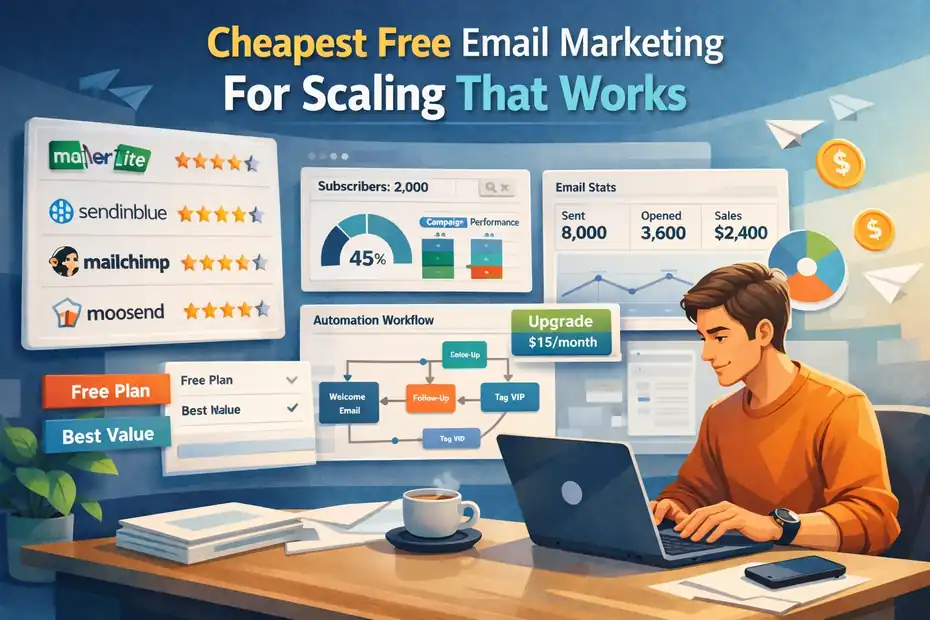
| Platform | Best Fit | Why It Stands Out | Watch Out For |
|---|---|---|---|
| MailerLite | Creators, small businesses, bloggers | Clean UI, helpful automations, affordable growth path | Some advanced needs may outgrow it |
| Brevo | Budget-conscious businesses, mixed email use | Send-based pricing can work well, good flexibility | Workflow depth varies by use case |
| Mailchimp | Beginners and familiar brands | Easy to recognize, broad integrations | Pricing can feel less friendly as list grows |
| ConvertKit | Creators and audience-first businesses | Tagging and creator workflows are strong | Can become less “cheap” at larger sizes |
| Klaviyo | Ecommerce brands | Deep store data and powerful flows | Best when your store can justify the cost |
I recommend narrowing your choice down to your actual operating model. A local law office, a digital course creator, and a fashion store should not choose the same platform just because one listicle says it is “best.”
How To Set Up A Cheap Email Marketing System That Actually Scales
This is where the strategy becomes practical. A scalable setup is usually simpler than people expect. You do not need 20 automations. You need the right few pieces connected properly.
Build One Clear Offer For Signup Growth
The first thing you need is a reason for someone to join your list. “Join my newsletter” is usually too weak unless you already have a strong audience.
A better approach is offering one specific benefit. That could be:
- A discount for first-time customers
- A free guide
- A checklist
- A mini email course
- A quiz result
- Early access to launches or events
The best lead magnets solve one small, immediate problem. I have found that narrow offers often outperform broad ones. “5 Email Subject Lines That Raised Our Open Rate” is more compelling than “marketing tips newsletter.” “Beginner Skincare Routine Under $50” is more tangible than “beauty updates.”
You are not trying to impress everyone. You are trying to attract the right person with a clear next step.
Create A Simple Welcome Flow First
If you only set up one automation, make it your welcome flow. This is where interest is warmest, and it is often the highest-leverage sequence in a young email program.
A practical welcome flow might look like this:
- Email 1: Deliver the lead magnet or promised incentive, set expectations, and introduce your brand voice.
- Email 2: Share one useful tip, one relevant story, or one common mistake your audience should avoid.
- Email 3: Present your offer, product, service, or next step with a clear reason to act.
This works because it builds trust before asking for anything significant. It also prevents the all-too-common problem where new subscribers join your list and then hear nothing useful for days.
Imagine a solo accountant offering a free tax deduction checklist for freelancers. The first email delivers the checklist. The second explains three deductions commonly missed. The third offers a paid consultation or bookkeeping package. That is cheap email marketing doing real business work.
Connect Your Signup Points To Intent
One underrated scaling tactic is matching signup sources to email intent. Not every subscriber should enter the exact same path.
For example:
- A blog reader who downloads a guide may need education
- A shopper who signs up for a discount may need product-focused emails
- A webinar registrant may need reminder and replay emails
- A past customer may need reorder or upsell messaging
Even on a small budget, you can use tags or basic segmentation to create smarter follow-up. This makes your system more relevant without adding much complexity.
In my experience, this is where cheap email marketing starts behaving like a serious growth channel. Relevance improves clicks, conversions, and subscriber retention. That means your list earns more before your software bill rises meaningfully.
Campaigns, Automations, And Segmentation That Drive Growth
Once the foundation is in place, growth comes from using email more intentionally. Most businesses do not need more emails. They need better-timed emails with better targeting.
Use Campaigns For Momentum And Automations For Consistency
Campaigns are the emails you send manually, like newsletters, promotions, updates, or announcements. Automations are triggered emails that go out based on subscriber behavior or timing.
You need both, but they play different roles.
Campaigns help you:
- Stay visible
- Promote launches
- Share timely offers
- Test messaging quickly
Automations help you:
- Convert new leads consistently
- Recover abandoned opportunities
- Nurture people while you sleep
- Increase customer lifetime value
I suggest using campaigns for what is current and automations for what should always be happening in the background. This balance keeps your email strategy from becoming too reactive.
For example, an online fitness coach might send weekly campaigns with practical training advice, but use automations to onboard new subscribers, promote a beginner program, and re-engage inactive leads. That combination creates stable growth rather than random spikes.
Start With Three Core Segments
Segmentation means grouping subscribers based on behavior, source, or intent. It sounds advanced, but you can get strong results with just a few basic segments.
The three segments I recommend starting with are:
- New subscribers: People who joined recently and need orientation
- Engaged subscribers: People opening and clicking regularly
- Inactive subscribers: People who have stopped interacting
This matters because sending the same message to everyone often reduces performance. New subscribers need trust-building. Engaged readers can handle stronger offers. Inactive subscribers may need a re-engagement angle or fewer emails.
A simple example: If 20% of your list is highly engaged, sending a product launch first to that segment can boost opens and clicks early. That early engagement can improve campaign performance overall.
You do not need complicated logic to benefit from segmentation. You just need enough structure to stop treating your audience like one giant bucket.
Optimize Around Clicks And Conversions, Not Vanity Metrics
Open rates still tell you something, but they should not be your whole strategy. Privacy changes and inbox behavior have made opens less reliable as a standalone measure.
I pay closer attention to:
- Click-through rate
- Click-to-open rate
- Conversion rate
- Revenue per email
- Revenue per subscriber
- Unsubscribe trends
For many businesses, a lower open rate with stronger clicks and better sales is healthier than a high open rate that produces no action.
Let me put that into a realistic scenario. Say Campaign A gets a 38% open rate and 1.2% click rate. Campaign B gets a 29% open rate and 3.8% click rate. Campaign B is likely doing a much better job of moving people toward the goal.
Cheapest free email marketing for scaling works when every email earns its place. That means you measure what drives business outcomes, not what only looks good in a report.
Common Mistakes That Make Cheap Email Marketing Expensive
This is where budget-friendly email programs quietly fail. The platform is not always the problem. Often, the strategy around it is what creates waste.
Chasing Subscriber Count Instead Of Subscriber Quality
It is easy to obsess over list growth because it feels measurable. But a large list filled with weak-fit subscribers can cost more and perform worse than a smaller, more relevant list.
Poor list quality usually comes from:
- Broad giveaways that attract the wrong audience
- Weak lead magnets with low purchase intent
- Buying lists, which I strongly advise against
- Keeping disengaged subscribers forever
A bloated list hurts performance in two ways. First, you may pay more as your platform tier increases. Second, lower engagement can drag down deliverability over time.
I believe a smaller, responsive list is one of the best assets a growing business can have. It is cheaper to maintain, easier to understand, and more likely to convert.
Sending Too Many Generic Emails
Another expensive habit is over-sending low-value content. This often happens when brands feel pressure to “stay consistent” but have not built a meaningful email strategy.
Generic emails tend to include:
- Vague updates with no clear benefit
- Promotions without context
- Recycled advice with no audience relevance
- Too many calls to action in one message
Consistency matters, but relevance matters more. I would rather see a brand send one genuinely useful email each week than four forgettable ones that train subscribers to ignore future campaigns.
For many of us, inbox fatigue is real. If your message does not help, entertain, clarify, or persuade, it adds cost without adding value.
Ignoring List Cleaning Until It Hurts Performance
List cleaning sounds unglamorous, but it is one of the cheapest ways to protect scaling. Keeping dead weight on your list can increase your bill and reduce your results at the same time.
A simple list hygiene routine might include:
- Identifying subscribers who have not engaged in 60 to 120 days
- Sending a re-engagement sequence
- Removing or suppressing those who remain inactive
- Monitoring bounce and complaint rates
I recommend being more ruthless here than most beginners expect. Not every subscriber deserves to stay forever. Healthy lists perform better, cost less, and make your reporting easier to trust.
This is especially important once you leave the free tier. Paying for inactive contacts is one of the fastest ways to make cheap email marketing stop feeling cheap.
Advanced Ways To Scale Without Letting Costs Spiral
Once your basics are working, the next step is improving efficiency. This is where advanced optimization matters more than adding complexity for its own sake.
Increase Value Per Subscriber Before Increasing Spend
The smartest scaling move is often earning more from your current list before chasing more leads. That keeps your email economics healthy.
You can do that by improving:
- Welcome sequence conversion
- Product recommendation emails
- Upsell timing
- Reorder reminders
- Promotional positioning
- Email-to-landing-page alignment
Imagine an online coffee brand with 4,000 subscribers. Instead of spending heavily to grow to 8,000 immediately, the brand improves its welcome flow and post-purchase cross-sell emails. If revenue per subscriber rises from $0.60 to $0.95 per month, that change alone can justify future growth spend much more comfortably.
This is one of the most practical lessons I have learned in email marketing: optimize what you already have before assuming growth requires a bigger audience.
Use Behavioral Triggers To Improve Relevance
Behavioral triggers are actions people take that tell you what they might want next. These can include page views, product interest, clicks, purchases, or inactivity.
Used well, triggers make email feel timely instead of intrusive.
Helpful trigger examples include:
- Sending a reminder after someone visits a sales page but does not convert
- Recommending related products after a purchase
- Following up when a lead clicks a specific topic several times
- Nudging inactive subscribers with a more targeted offer
This does not have to be overly technical. Even basic trigger-based segmentation can outperform generic batch sending because it matches the message to observed interest.
In my experience, this is often the turning point where a “cheap” email setup starts producing premium-level results.
Know When To Upgrade Or Migrate
There is a moment when staying on the cheapest free email marketing setup becomes more expensive than moving up. That moment usually shows up as friction.
Warning signs include:
- You cannot build needed automations
- Segmentation feels too limited
- Reporting is too weak to guide decisions
- Your bill jumps sharply at the next contact tier
- Deliverability or support starts becoming a risk
I suggest reviewing your platform every quarter using two simple questions: Is this helping us grow efficiently, and would moving create better economics within six to twelve months?
Do not migrate too early just because another tool looks shinier. But do not stay too long out of habit either. The best platform choice is the one that supports your current stage and your next one with the least pain.
A Simple Budget-Friendly Email Marketing Plan You Can Start This Week
By this point, the goal is action. You do not need a perfect email engine to begin. You need a lean system that starts building value now.
Your First 7-Day Action Plan
Here is a straightforward plan I would use for a small business, creator brand, or early ecommerce store.
- Day 1: Choose a platform based on your business model, not just the biggest free plan.
- Day 2: Create one focused signup offer that solves one immediate problem.
- Day 3: Build one signup form or landing page and connect it to your list.
- Day 4: Write a 3-email welcome sequence with one clear next step.
- Day 5: Tag or segment subscribers based on source or basic intent.
- Day 6: Send one useful campaign that teaches, helps, or sells clearly.
- Day 7: Review clicks, unsubscribes, and signup conversion rate to spot early issues.
That is enough to move from “I should start email marketing” to “I have an actual system.”
What Good Early Performance Usually Looks Like
Benchmarks vary by niche, traffic source, and audience quality, so I would avoid treating any single number like a law. Still, some ranges can help you sense whether you are moving in the right direction.
For many smaller lists:
- Signup form conversion rate often improves meaningfully once the offer is specific
- Welcome emails usually outperform regular campaigns
- Click rate often tells a more honest story than opens
- Unsubscribe spikes usually signal weak targeting or weak message fit
From what I have seen, early wins come less from clever design and more from message clarity. If the offer is relevant, the sequence is timely, and the emails are easy to act on, results tend to improve faster than people expect.
The Best Mindset For Long-Term Scaling
Cheapest free email marketing for scaling works best when you stop thinking like a coupon hunter and start thinking like a systems builder.
Your goal is not to avoid paying forever. Your goal is to delay unnecessary costs, build revenue first, and upgrade only when the economics make sense.
That mindset changes everything. You stop chasing shiny features. You stop overvaluing vanity growth. You stop treating email like a side channel.
Instead, you build a lean asset that compounds over time.
Final Thoughts On Choosing The Cheapest Free Email Marketing For Scaling
The best cheap email marketing setup is the one that helps you grow without trapping you in a weak system. That usually means choosing a platform with a sensible free plan, a manageable upgrade path, useful automation, and enough segmentation to keep your emails relevant.
If I were simplifying this into one piece of advice, it would be this: pick the cheapest tool that can still support your next stage of growth, then focus on list quality, welcome automation, and clean segmentation before anything else.
That is the part many people skip. They spend weeks comparing prices and almost no time building a welcome flow that converts.
You do not need the fanciest platform. You need one clear offer, one strong sequence, a few smart segments, and the discipline to measure what actually matters. When you get those pieces right, cheap email marketing stops being a compromise and starts becoming one of the highest-leverage channels in your business.
FAQ
What is the cheapest free email marketing for scaling?
The cheapest free email marketing for scaling refers to platforms that offer free plans with enough features to grow your email list while keeping upgrade costs manageable. It focuses on balancing low cost with automation, deliverability, and scalability so your system continues working as your audience expands.
Can free email marketing tools handle business growth?
Yes, many free email marketing tools can support early growth if they include automation, segmentation, and reasonable sending limits. However, as your list grows, you will likely need to upgrade. Choosing a platform with a smooth pricing structure helps you scale without sudden cost increases.
How many subscribers can I manage on a free email plan?
Most free email marketing plans allow between 500 and 2,500 subscribers, depending on the platform. Some also limit monthly email sends. The key is choosing a plan that gives enough room to test your strategy before upgrading to support larger-scale growth.
What features should I prioritize in a free email marketing tool?
Focus on automation, email deliverability, signup forms, and basic segmentation. These features help you convert subscribers into customers efficiently. Even on a free plan, having a welcome sequence and simple targeting can significantly improve performance and support long-term scaling.
When should I upgrade from a free email marketing plan?
You should upgrade when your current plan limits automation, restricts sending volume, or slows your growth. If your email list is generating consistent revenue, investing in a paid plan becomes a logical step to unlock better features and maintain performance as you scale.

Juxhin B is a digital marketing researcher and founder of JAK Digital Hub, specializing in email marketing software, marketing automation platforms, and digital growth tools. His work focuses on software testing, platform comparisons, and real-world performance analysis to help businesses choose the right marketing technology.
Related posts:
 Email Marketing Strategy for 100K Subscribers That Scales
 Email Marketing Strategy vs Paid Ads: Where to Invest
 Email Leads Cost For 20K Contacts: What Should You Pay?
 Why Is My Email Marketing Strategy Not Working Anymore?
 Better Email Marketing Strategy for Ecommerce Growth
 Free Email Marketing For 10K Subscribers: Is It Enough?