Table of Contents
Some links on JAK Digital Hub are affiliate links, meaning we may earn a small commission at no extra cost to you. Read full disclaimer.
Email leads for new ecommerce store growth can feel confusing at the beginning—especially when you’re juggling product setup, ads, fulfillment, and wondering if anyone will actually buy.
I’ve seen too many new founders obsess over traffic before building a list, and that’s usually where momentum breaks. If you get this part right early, your store won’t rely on unpredictable ads alone.
Define Who You Actually Want As Email Leads
Before you start collecting email leads for new ecommerce store growth, it helps to be really honest about who you want on that list.
A small, high-quality list will always outperform a huge, unqualified one—especially in the early stages when every subscriber feels like a tiny win.
Identify High-Intent Buyer Segments Before Driving Traffic
When I’m working with a new store owner, the first thing I ask is: Who is most likely to buy from you within the next 7–30 days?
This prevents you from building a list full of people who love your aesthetic but never pull out their card.
A high-intent buyer segment usually fits one (or more) of these criteria:
- They’re actively searching for a product like yours.
- They’ve visited multiple pages on your site.
- They’ve engaged with product-focused content (reviews, comparisons, demos).
- They’ve clicked on ads but haven’t purchased yet.
Here’s an example: If you sell premium pet supplements, a visitor reading “How to help dogs with joint stiffness” is way more valuable than a visitor checking out your blog on “Cute pet names.” Both love pets. Only one is close to buying.
When you identify these segments early, you create lead magnets and email flows that resonate immediately, instead of guessing later.
Map Customer Pain Points To Specific Lead Magnets
A mistake I see early store owners make is offering a generic discount without understanding why someone needs the product in the first place. Lead magnets work best when they solve a micro-problem.
Ask yourself: “What discomfort, fear, desire, or frustration makes someone explore my product category?”
Then match it to a specific opt-in incentive. For example:
- Skincare brands: “Find your perfect routine quiz” to reduce overwhelm.
- Coffee brands: “Brew strength guide” for people frustrated with inconsistency.
- Apparel brands: “Fit guide” to reduce return anxiety.
You’re not just exchanging an email for a freebie—you’re showing the shopper you understand their world.
When you build lead magnets around pain points rather than discounts, you attract people who are already mentally investing in your product.
Clarify Purchase Stage: Browsers Vs. Ready Buyers
Not all subscribers join your list for the same reason. Some are browsers—curious but hesitant. Others are ready buyers—they just need reassurance or the right offer.
Browsers often respond well to:
- Educational guides
- Style or fit quizzes
- Early access to collections
Ready buyers respond better to:
- First-purchase incentives
- Free shipping
- Time-sensitive nudges
When you know the stage they’re in, your first few emails feel like they were written just for them.
A simple way to tell: Look at the page they subscribed on. A homepage popup often captures browsers. A product page form usually captures ready buyers.
Tailor your welcome email tone accordingly.
Avoid Attracting Freebie Seekers With No Buying Intent
I’ll say this gently but directly: a discount is not a strategy—it’s a tool. And used the wrong way, it attracts people who will never buy unless you keep discounting.
A few signs you’re attracting freebie seekers:
- High signup volume but almost zero purchases
- Low open rates
- Subscribers who only click emails containing discounts
If you want to filter out these users, consider:
- Offering value-based incentives instead of blanket discounts
- Using tiered offers (“Spend $60, get 10% off”)
- Requiring minimal engagement (e.g., a quiz) before giving the incentive
Your list should be full of people building trust, not waiting for the next coupon.
Set Up Your Email Platform The Right Way
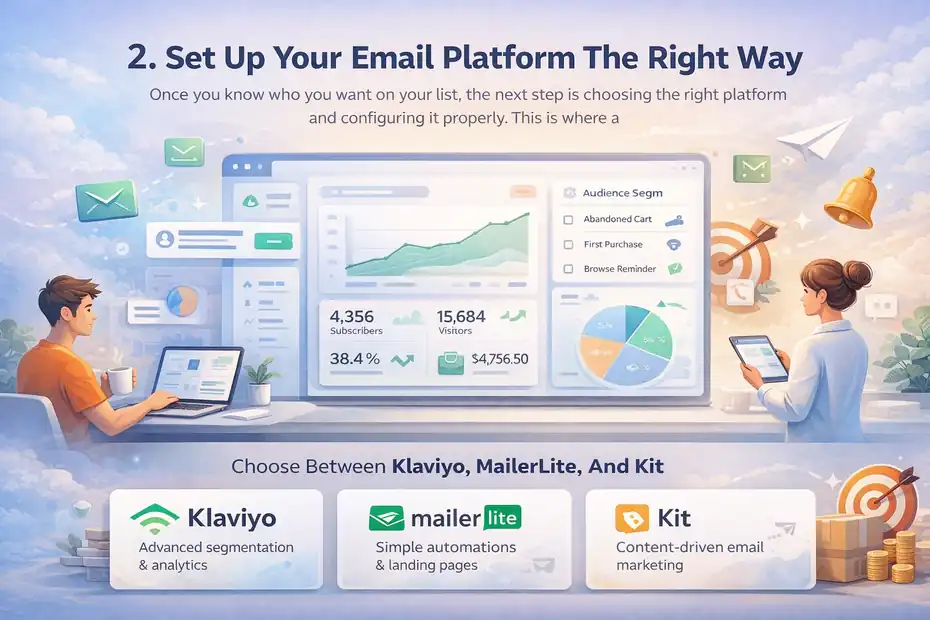
Once you know who you want on your list, the next step is choosing the right platform and configuring it properly.
This is where a lot of new ecommerce stores get overwhelmed, but it doesn’t have to be complicated.
Choose Between Klaviyo, MailerLite, And Kit
If I could simplify the choice, here’s how I explain the three big players most new ecommerce stores consider:
- Klaviyo – Best for Shopify stores wanting deep segmentation, advanced flows, and predictive analytics. It’s powerful but can feel overwhelming at first.
- MailerLite – Surprisingly strong for simple automations and landing pages, very affordable, and beginner-friendly.
- Kit – Great for creators or hybrid ecommerce brands that rely on storytelling, education, or content-driven selling.
If you asked me which to choose for a standard ecommerce build: Klaviyo wins for sheer capability and Shopify-native features. But if budget is tight and you want simplicity, MailerLite is a fantastic starting point.
Structure Lists And Tags For Ecommerce Segmentation
The #1 rule I follow when setting up a new store’s email system is: Make it impossible to confuse subscribers later.
Here’s a simple structure that works extremely well:
- One master list where every subscriber lives
- Tags that clarify how they joined (popup, quiz, giveaway, influencer link)
- Segments that group people based on behavior (viewed a product, added to cart, purchased twice, inactive 30 days)
A quick tip I wish more beginners knew: Name your segments in plain English.
Instead of:
ATC_30D_NP
Write:
Added to cart but not purchased (30 days)
It keeps your future self from crying at 1 a.m. during a big sale.
Connect Your Store To Automations And Events
This is the step most new ecommerce owners overlook—but it’s where the magic happens.
When your platform is connected properly, you get real-time data like:
- Product viewed
- Cart started
- Checkout initiated
- Purchase completed
- Repeat purchase
This lets you trigger emails automatically based on behavior instead of blasting the same message to everyone.
Here’s a quick example of how this plays out: A subscriber views a product twice → system triggers a reminder email with social proof → conversion rate jumps because the timing is perfect.
If you’ve ever wondered why big brands seem to send emails at the exact right moment—it’s this connection doing the heavy lifting.
Configure Double Opt-In Without Killing Conversions
Double opt-in means subscribers confirm their email before being added to your list. It protects deliverability but sometimes lowers signup rates.
Here’s how I recommend handling it for new ecommerce brands:
- If you’re using Klaviyo with Shopify: Stick to single opt-in; Shopify already verifies email quality well enough.
- If your audience is global: Double opt-in can help reduce fake emails from countries where bot traffic is high.
- If using MailerLite or Kit: Use double opt-in but customize the confirmation page and email so it feels like part of your brand—not a generic system message.
A small trick that works wonders: Show the discount or lead magnet after confirmation—not before. It motivates the click without feeling manipulative.
Create A High-Converting Lead Magnet
A strong lead magnet makes collecting email leads for new ecommerce store growth so much easier because people feel like they’re getting something meaningful in return.
The trick is choosing an incentive that attracts buyers—not bargain hunters—and supports your margins from day one.
Offer A Discount That Protects Your Margins
It’s easy to feel pressured into offering a huge 20–30% discount because “everyone else does it,” but I promise you—your margins will thank you for a smarter approach.
A discount should feel like a nudge, not a giveaway.
Here’s what I recommend for most new stores:
- For products under $40: Offer 10% off or free shipping, whichever costs less.
- For mid-range products ($40–$120): Test $5–$10 off, which still feels valuable without destroying your AOV (average order value).
- For premium products ($120+): Consider value-based incentives instead of price cuts.
A quick example from a store I helped: They sold $28 beauty tools and ran a 20% off lead magnet. Their margin tanked. When they switched to $5 off, the conversion rate barely changed—but profit went up 14%.
That taught me something: Shoppers care more about feeling rewarded than the exact percentage.
Build A Value-Based Lead Magnet Beyond Coupons
Sometimes the best lead magnet isn’t a discount at all. In fact, non-discount incentives often attract shoppers who value quality and education—people much more likely to become loyal customers.
Here are a few types that almost always work:
- Quizzes: “Find the perfect supplement for your dog” or “Build your ideal skincare routine.”
- Guides: Simple, well-designed PDFs like “How to choose the right coffee roast” or “3 ways to make your candles last longer.”
- Mini-size samples: Great for beauty, wellness, or fragrance brands.
- Checklists or starter kits: Quick-reference guides that help reduce decision fatigue.
A value-based lead magnet builds trust instantly because you’re helping the shopper before asking for a sale.
If you’re in a niche where product fit is important (like skincare), this approach usually converts better than discounts.
Use Early Access Or VIP Drops To Spark Urgency
Sometimes people join a list because they want to feel like insiders. That’s where VIP drops shine.
Here’s what I love about VIP lead magnets: They’re exciting. They build anticipation. And they cost nothing.
You can frame it as:
- “Join the VIP list to shop our new collection 24 hours early.”
- “Members-only early access to limited restocks.”
- “Be the first to grab our seasonal scents before they sell out.”
This approach works especially well for fashion, beauty, and lifestyle brands with trend-driven products.
A candle brand I advised grew their list from 0 to 8,000 in three months with only VIP early access—not a single percentage-off code. The exclusivity did all the work.
Align Your Incentive With Product Price Point
One of the easiest ways to choose the wrong lead magnet is to ignore your average price. A $10 off coupon sounds generous for premium products but destroys margins for low-priced ones.
Here’s a quick rule of thumb I use all the time:
- Low-price products (<$35): Free shipping or value-based guides
- Mid-price products ($35–$100): Small discount, quizzes, or early access
- High-ticket products (>$100): Personalized quizzes, comparison guides, VIP access, bundles
The goal is to make the incentive feel aligned with the product—not out of proportion.
When your lead magnet matches the buyer’s expectations, they convert faster and feel more confident in their purchase.
Comparison Table: Popular Lead Magnet Types
| Lead Magnet Type | Best For | Pros | Cons |
| Discount Code | Low-friction purchases | Fast signups, easy to implement | Can attract freebie seekers |
| VIP Early Access | Trend-driven niches | No cost, builds hype | Requires consistent product drops |
| Quizzes | Products needing personalization | Highly engaging, great segmentation | Requires setup time |
| Guides/Checklists | Education-first shoppers | Builds trust, positions expertise | Not ideal for impulse buys |
Build Email Capture Assets On Your Store
Once your lead magnet is ready, the next step is adding strategic capture points to your store.
Think of this as placing smart “entry doors” throughout your site so visitors naturally convert into subscribers.
Design A Popup That Converts Without Annoying
Popups get a bad reputation because many brands use them aggressively. But when they’re designed thoughtfully, they can convert 6–10% of visitors—sometimes more.
Here’s what I’ve seen consistently improve results:
- Delay the popup by 7–10 seconds or show after scroll depth (50%).
- Keep the copy simple and conversational.
- Use a single form field (email only) unless the incentive requires more info.
- Add a small line explaining the value: “I’ll only send you useful stuff.”
Avoid full-screen popups for first-time visitors—they feel intrusive and often spike bounce rates.
A store I worked with doubled conversions when they switched from “Join our newsletter” to:
“Want 10% off your first order? I’ll send it to you.”
Small wording shift. Big difference.
Add Embedded Forms To High-Intent Pages
While popups capture attention, embedded forms capture intent. They’re subtle but powerful because the shopper discovers them without feeling pressured.
The best places to put embedded forms are:
- Product pages
- Blog posts related to buying decisions
- Footer (but only as a backup)
- Gift guide pages
- About page (surprisingly effective)
If your products are technical—like supplements, fitness gear, or electronics—an embedded form paired with a value-based lead magnet performs extremely well.
Example: On a product page for protein powder, an embedded form saying “Get our 3-day beginner meal plan” feels relevant and practical.
Optimize Exit-Intent Without Hurting UX
Exit-intent popups can save customers who were seconds away from leaving, but they need to be used deliberately.
Here’s what I’ve found works best:
- Only trigger them on desktop (mobile exit-intent is unpredictable).
- Offer something slightly stronger than your main popup.
- Keep the design minimal so the user isn’t startled.
- Use urgency: “Grab this before you go?”
But here’s the nuance: Exit-intent shouldn’t repeat the same offer your visitor already declined. Make it a variation—not a louder version of the same message.
If your regular popup is a 10% discount, your exit-intent could be: “Get free shipping on your first order.”
It feels fresh, not desperate.
Create Dedicated Landing Pages For Paid Traffic
Paid traffic behaves differently than organic traffic—they need clarity faster. That’s why I recommend giving paid visitors their own dedicated landing pages with:
- One lead magnet
- One form
- Simple copy
- Zero distractions
This is especially useful for Facebook, TikTok, and influencer traffic because those audiences often come cold and need time to warm up before buying.
If you’re promoting a specific bundle or seasonal offer, landing pages outperform standard product pages almost every time.
A pet brand I helped increased lead capture by 47% from ads simply by shifting from “Click to shop” to “Click to unlock early access to our new calming treats.”
Paid users love a clear reason to join—give them one.
Write A Welcome Sequence That Sells Naturally
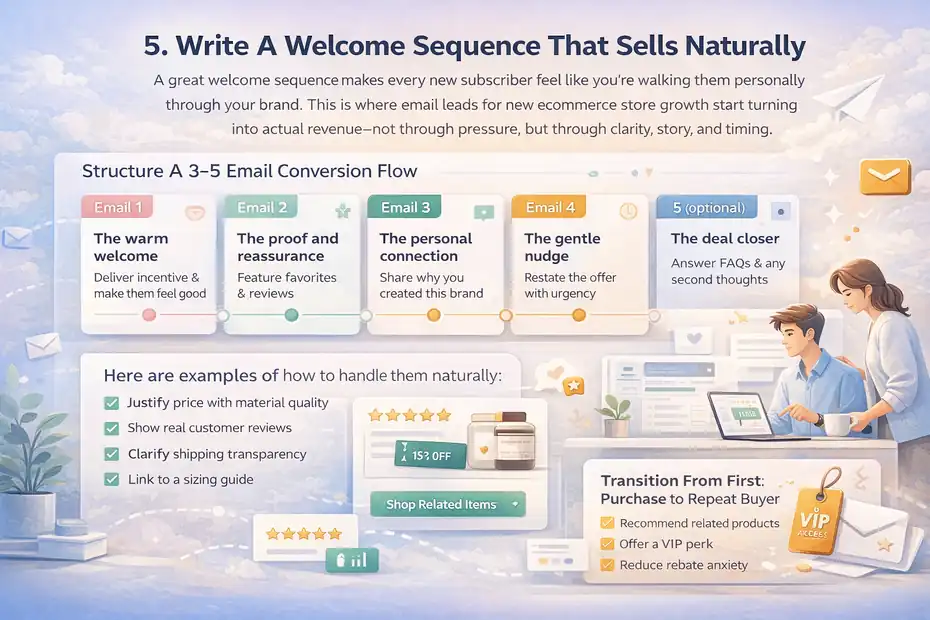
A great welcome sequence makes every new subscriber feel like you’re walking them personally through your brand.
This is where email leads for new ecommerce store growth start turning into actual revenue—not through pressure, but through clarity, story, and timing.
Structure A 3–5 Email Conversion Flow
When you’re just starting out, you don’t need a 10-email sequence. Honestly, that just overwhelms both you and your subscriber. A simple 3–5 email flow works beautifully and keeps things clean.
Here’s a structure I’ve seen convert consistently across fashion, beauty, wellness, and specialty ecommerce:
- Email 1: The warm welcome. Deliver the incentive (discount, guide, quiz results). Keep it short. Make them feel good about signing up.
- Email 2: The proof and reassurance. Show customer favorites, reviews, or the “why” behind your product choices.
- Email 3: The personal connection. A simple, honest note about why you started the brand—or what problem you’re trying to solve for people like them.
- Email 4: The gentle nudge. Highlight the main offer again with a bit of urgency, but not pressure.
- Email 5 (optional): The deal closer. This is where you answer FAQs or address second thoughts.
A fun detail: Most new ecommerce stores see the highest revenue from emails 1, 2, and 4—so don’t overthink the rest.
Introduce Your Brand Story Without Fluff
A brand story isn’t a biography. Your subscriber doesn’t need to know where your grandma grew up or how long you’ve been obsessed with candles.
Keep the story to one simple idea: What problem were you trying to solve when you created this product?
For example: “I kept buying candles that smelled amazing in the jar but disappeared when burning. It drove me insane. So I created one that actually fills the room.”
That’s relatable. That’s storytelling that sells.
If you want engagement, talk like a human—not a company brochure.
Handle Objections Before They Kill Sales
Every product category has a predictable set of objections. I like to address them quietly in the welcome sequence so the customer doesn’t feel like they’re being “sold.”
Here are examples of how to handle them naturally:
- Price objection: Share why your materials or ingredients cost more—and why that matters.
- Quality doubt: Add quick customer reviews that mention durability, scent strength, comfort, or fit.
- Shipping worry: Clarify timelines and offer tracking transparency.
- Fit concerns (for apparel): Link to your fit guide or sizing quiz.
If you don’t address objections early, your subscriber will look elsewhere for reassurance—and often end up buying from your competitor.
Transition From First Purchase To Repeat Buyer
One of my favorite moments in ecommerce is when a subscriber buys for the first time—it’s like the start of a tiny relationship. But the magic really happens when you guide that first purchase into a second or third.
Here’s what to add in your welcome sequence or right after it:
- A reminder of how to get the most out of their product
- A complementary product that enhances their experience
- A VIP-only perk like early access or surprise samples
A small story: A skincare brand I supported tripled its repeat purchase rate by simply adding a “How to use your new serum” email followed by “What to expect in the first 2–3 weeks.” Customers felt supported, not sold to.
Support creates retention. Retention creates profit.
Install Essential Automations From Day One
Automations save you from constantly writing new emails because they do the selling for you—quietly, in the background.
Even with a tiny list, the right flows can generate meaningful revenue while you focus on growing traffic.
Set Up Abandoned Cart Recovery Emails
Cart abandonment happens to everyone. Industry data shows 70% of carts get abandoned, which means you need a flow that catches those would-be customers before they completely disappear.
Here’s a simple formula:
- Email 1 (after 1 hour): Gentle reminder
- Email 2 (after 12–24 hours): Add social proof
- Email 3 (after 24–48 hours): Offer a nudge (but not always a discount)
A critical detail: Include a photo of the exact product left in the cart. Visuals dramatically increase recovery rates.
Create Browse Abandonment Triggers
Browse abandonment emails reach people who viewed a product multiple times but didn’t add it to their cart. This is your chance to say, “Hey, I noticed you were interested—want a closer look?”
These emails work because they’re subtle. No pressure. Just a gentle tap on the shoulder.
For example: “Not sure which color to choose? Here are our most popular picks.”
A few key things to include:
- Product image
- Benefit-driven copy
- Social proof or a quick review
- A link back to the exact product page
Browse abandonment often feels like magic—especially when you get sales from people who never even made it to checkout.
Build Post-Purchase Cross-Sell Flows
If you want repeat sales, post-purchase emails matter more than you think. This is where you help your customer fall in love with your brand.
A strong post-purchase flow usually includes:
- Order confirmation with personality
- Product-use tips
- A complementary product recommendation
- A follow-up asking about their experience
For example: If someone buys a French press, recommend coffee beans, a grinder, or a cleaning brush.
This isn’t upselling. It’s helping them get the most out of what they just bought.
Activate Win-Back Campaigns Early
A win-back campaign is an automated sequence that reaches out to customers who haven’t purchased in 30, 60, or 90 days (depending on your product lifecycle).
These emails often include:
- A reminder of why they bought in the first place
- A new arrival or seasonal product
- A subtle incentive to return
My tip: The tone should be warm and human. Something like, “We miss you! Here’s what’s new…” works better than “You haven’t purchased in 90 days.”
People want to feel remembered, not targeted.
Drive Targeted Traffic To Grow Quality Leads
Once your email flows are in place, the next step is filling your list with people who are genuinely interested—not random traffic that just inflates numbers.
This is where quality matters so much more than quantity.
Use Paid Ads To Capture Buyers, Not Just Clicks
Paid ads on platforms like Meta or TikTok can grow your email list quickly, but only if you design campaigns that optimize for buyers.
A few things I’ve seen shift results dramatically:
- Send ad traffic to a landing page with a single lead magnet.
- Use creatives that highlight the problem you solve—not just your product.
- Run “lead form ads” sparingly; they usually lower quality.
An example that worked extremely well for a clothing boutique: Instead of running ads saying “Shop our new summer collection,” they ran “Get early access to our limited summer drop.”
The list grew fast—and those subscribers bought at a higher rate.
Leverage Influencer Traffic With Custom Opt-Ins
Influencers already have the trust you’re trying to build. If you give them a custom opt-in page, the results can be incredible.
For example: “Use Sarah’s link to get 15% off your first order + VIP access.”
This does two things:
- Strengthens the influencer’s connection with their audience
- Helps you track conversions clearly
I’ve seen brands get 500–2,000 new subscribers in a weekend from just one creator partnership when the incentive felt unique and personal.
Turn Organic Social Followers Into Subscribers
One of the most underrated ways to grow your email list is simply asking for it—consistently—on your social platforms.
A few easy wins:
- Turn your lead magnet into a weekly reel or TikTok.
- Add the signup link in your bio.
- Use Stories to promote early access drops.
- Share behind-the-scenes content available “only to subscribers.”
Followers already like you. They just need a reason to join your world more deeply.
Add QR And Offline Collection For Local Brands
If you have a physical component to your business—pop-up shops, markets, retail shelves—QR codes are your best friend.
All you need is:
- A simple printed sign
- A compelling incentive (“Scan to get 10% off today’s purchase!”)
- A mobile-friendly landing page
I worked with a local candle maker who added QR codes to her booth. Her list grew by 1,200 subscribers in two months—mostly people who smelled the candles in person and wanted more later.
Offline customers tend to become some of your most engaged email subscribers because they’ve already touched your product.
Track Metrics That Actually Predict Revenue
If you want your email leads for new ecommerce store growth to translate into predictable revenue, you’ve got to track the numbers that actually matter.
Not vanity metrics—real signals that show whether your list is converting and becoming more valuable over time.
Monitor Lead-To-Customer Conversion Rate
This is one of the most overlooked metrics for new ecommerce owners. Lead-to-customer conversion tells you exactly how many subscribers actually buy—which is the whole point of growing your list.
A healthy conversion rate for new stores is usually: 2%–5% within the first 30 days.
Higher-ticket products might convert slower; lower-ticket items convert faster.
Here’s why this number matters so much: If your conversion rate is low, it’s normally not a “traffic problem.” It’s a messaging, incentive, or offer problem.
A quick scenario to illustrate: If 1,000 people join your list and only 1% buy, something is off in your welcome flow or your lead magnet is attracting the wrong people. If 1,000 people join and 6% buy, you know your system is working—even before you scale.
This metric keeps you grounded in reality instead of guessing.
Calculate Cost Per Lead Across Traffic Sources
Not all traffic sources produce the same quality of leads. Knowing your CPL (cost per lead) helps you decide where to reinvest or pull back.
For example:
- Meta ads might cost $1.20 per lead
- TikTok ads might cost $0.60 per lead
- Influencer collabs might bring leads for $0.20 or free
- Organic traffic might bring leads at $0 (but with time investment)
But here’s the nuance most beginners miss: Cheaper leads don’t always convert better. I’ve seen $2 leads convert higher than $0.30 leads because the audience intent was different.
Tracking CPL by source helps you avoid the trap of chasing cheap traffic that never buys.
Measure Email Revenue Per Subscriber
This is one of my absolute favorite metrics because it tells you the true value of your list. The formula is simple:
Total email revenue ÷ total active subscribers = value per subscriber
If you find that each subscriber is worth $1–$3+ per month (which is common for optimized ecommerce stores), you suddenly understand why growing your list is a long-term asset.
For example: If each subscriber is worth $1.50 per month and you add 1,000 new leads… That’s $1,500/month in predictable future revenue.
Understanding this number helps you decide how aggressively you can spend on ads or creators to acquire leads.
Identify Segments That Drive Repeat Purchases
Your email list isn’t one big group—it’s made up of micro-audiences who behave differently. The segments that matter most are usually:
- Repeat purchasers
- High-AOV customers
- Subscribers who buy within 7 days of joining
- Customers who respond to limited drops
- VIP members or early-access buyers
When you identify who these people are, you can create special sequences, perks, and offers that multiply their lifetime value.
A fun insight: When I analyzed a store selling wellness products, 18% of customers were responsible for 62% of the revenue. Once we isolated that group and built a VIP segment for them, revenue jumped without increasing ad spend.
That’s the power of understanding your segments.
Avoid Early Mistakes That Kill Email Growth
Growing your email list is exciting—but some mistakes can quietly erode your results before you even notice.
I’ve seen these happen again and again with new ecommerce stores, so think of this section like a friendly warning from someone who’s tripped over these before.
Sending Campaigns Without Segmentation
Sending the same email to your entire list is like shouting into a crowded room and hoping the right person hears you. It usually leads to:
- Lower open rates
- Higher unsubscribe rates
- More spam complaints
- Lower revenue per send
Segmentation solves all of this. Even something as simple as dividing your list into new subscribers, one-time buyers, and repeat customers can double your results.
If you want a quick, super-simple segmentation rule, use this: Match the message to the subscriber’s stage. It’s not complicated—it’s just respectful of where they are in their journey.
Offering Heavy Discounts Too Soon
I get it—you want sales, and you want them fast. But big discounts early on can:
- Train your audience to wait for sales
- Attract people who never intended to buy full price
- Hurt your margins before you have momentum
- Make your brand feel less premium
If you’re going to offer a discount, make it strategic.
Leading with a value-based incentive (guide, quiz, sample, VIP access) brings in better-quality subscribers and protects your brand value.
Your future self will thank you for this one.
Ignoring Deliverability And Spam Signals
This is the invisible monster in email marketing. You can have great copy, beautiful designs, and strong offers—but if your emails land in spam, none of it matters.
Watch out for:
- High bounce rates
- Sudden spikes in unsubscribes
- Using link-heavy templates early
- Low open rates on welcome emails
A quick tip: Warm up your list slowly. Don’t blast a huge campaign to your entire list until you’ve set a solid foundation with welcome flows and behavior-based emails.
Email providers (like Gmail) want to see consistency—not chaos.
Relying Only On Ads Instead Of Owned Audience
Ads are powerful, but they’re also unpredictable and expensive. Your email list is the only asset you truly own.
If you rely too heavily on ads, you’ll feel:
- Anxiety when CPAs (cost per acquisition) climb
- Panic when tracking breaks
- Stress when ad fatigue kicks in
Your email list, on the other hand, gives you:
- Stability
- Predictable revenue
- Control over your messaging
- Lower acquisition costs over time
Think of email as the safety net that supports your entire ecommerce growth.
Traffic is rented. Your list is yours.
Scale Email Leads Into Long-Term Revenue
Once you have a healthy list and solid automations, you can start scaling into a long-term revenue engine.
This is where your email list turns from “something you should probably do” into one of the strongest assets in your business.
Introduce Tiered Offers For Higher AOV
Tiered offers give customers a reason to spend more without feeling pressured. You’re simply rewarding them for buying in a more intentional way.
Some examples that work extremely well:
- Spend $50 → Get free shipping
- Spend $75 → Free shipping + bonus sample
- Spend $100 → Free shipping + sample + exclusive gift
People love feeling rewarded.
And the beauty is that tiered offers increase your average order value naturally, without big discounts.
You can build this into your campaigns, automations, and even your welcome sequence.
Launch Limited-Time Campaigns Strategically
Limited-time campaigns are powerful because they compress decision making. But they only work when you use them sparingly and with intention.
My favorite types of limited campaigns:
- Seasonal drops
- Restock alerts
- Flash bonuses (not discounts—bonuses)
- VIP-only hours
Think of these as little “energy spikes” that activate your list.
When you do them right, subscribers start expecting that being on your list actually means something.
Build Loyalty And Referral Loops Through Email
When your customers love your product, they’re happy to talk about it—you just need to give them an easy way to do it.
You can use your email flows to:
- Invite customers to share referral links
- Reward them with store credit or samples
- Create a simple loyalty system with points
- Encourage user-generated content through challenges
Referrals compound.
One happy customer can bring in three more—and those three will trust you before they even land on your site.
Email is the perfect channel to make this a natural part of your business.
Use Data To Refine Acquisition And Retention
The longer you run your ecommerce store, the more data you collect. And that data is pure gold.
Look at:
- Which lead magnets convert best
- Which audiences give you the highest LTV (lifetime value)
- Which campaigns produce consistent revenue
- Which traffic sources bring the most profitable buyers
Then do more of what works—and retire what doesn’t.This is how your email list becomes not just a marketing tool but a strategic advantage.
You stop guessing. You start optimizing with intention.
FAQ
What is the first step to getting email leads for a new ecommerce store?
The first step is defining who you want as subscribers—focus on high-intent shoppers who are already interested in your product category. This ensures your email leads for a new ecommerce store are buyers, not just freebie seekers.
What’s the fastest way to collect qualified email leads for a new ecommerce store?
Create a simple, irresistible lead magnet (like a small discount or VIP access) and place optimized popups or embedded forms on high-intent pages such as product pages and cart pages.
How do I turn new email leads into actual customers?
Send a 3–5 email welcome sequence that delivers value first, introduces your brand clearly, addresses buying objections, and ends with a direct but gentle call to purchase.

Juxhin B is a digital marketing researcher and founder of JAK Digital Hub, specializing in email marketing software, marketing automation platforms, and digital growth tools. His work focuses on software testing, platform comparisons, and real-world performance analysis to help businesses choose the right marketing technology.
Related posts:
 How To Build A Better Email Campaign Strategy For Ecommerce
 How To Generate Email Leads For Ecommerce Fast
 Should I Switch Email Leads Software? Read This First
 Email Leads Not Converting? Fix It With This Framework
 Email Leads Cost For 20K Contacts: What Should You Pay?
 Email Marketing Jobs For Startups Hiring Remote Talent