Table of Contents
Some links on JAK Digital Hub are affiliate links, meaning we may earn a small commission at no extra cost to you. Read full disclaimer.
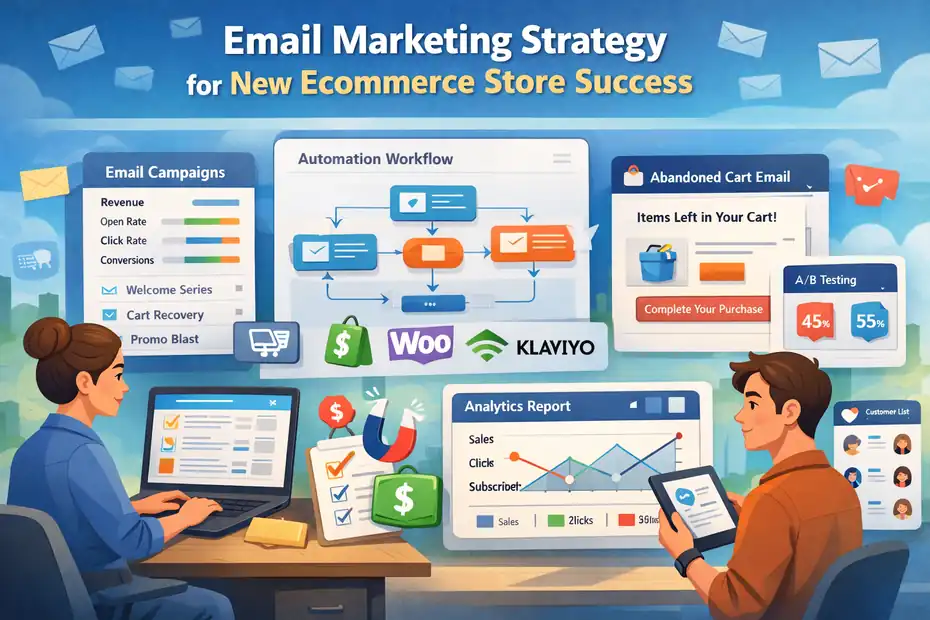
An email marketing strategy for new ecommerce store growth is one of the fastest ways to turn first-time visitors into subscribers, subscribers into buyers, and buyers into repeat customers.
I’ve seen new stores obsess over ads, logos, and product pages while ignoring the one channel they actually own. That usually slows growth.
When you build email the right way from day one, you create a system that captures demand, recovers lost sales, and compounds over time without depending completely on paid traffic.
Understand What Email Marketing Needs To Do For A New Store
For a new store, email is not just a promotion channel. It is your retention engine, trust builder, and recovery system.
What Email Marketing Actually Means For Ecommerce
When most people hear “email marketing,” they think about newsletters and discount blasts. In ecommerce, that is only a small part of the picture. A real email marketing strategy for new ecommerce store growth includes list building, automated flows, campaign planning, segmentation, measurement, and ongoing optimization.
The key difference is this: Campaigns are scheduled sends, while flows are behavior-based emails triggered by what a shopper does. That matters because automated emails usually outperform regular campaign sends by a wide margin.
Recent benchmark data shows automated emails can drive a disproportionate share of revenue compared with their send volume, and automated message clickers are far more likely to purchase than campaign clickers.
In practical terms, your email strategy should answer five questions:
- How will you collect subscribers?
- What will new subscribers receive first?
- Which shopper behaviors will trigger emails automatically?
- How often will you send campaigns?
- How will you know whether email is producing revenue, not just opens?
I believe this is where many new brands get lost. They treat email like a content calendar when it should really be designed as a revenue system. If you start with that mindset, every email has a job.
Why New Ecommerce Stores Need Email Earlier Than They Think
A new store usually has three big problems: low trust, low repeat traffic, and low conversion efficiency. Email helps with all three.
First, it gives you a second chance with people who do not buy on visit one. That matters because cart abandonment is still extremely common across ecommerce.
Shopify cites recent data showing average shopping cart abandonment around 74.7%. If your store has no follow-up system, most of that demand simply disappears.
Second, email lets you educate people who are interested but not ready. Maybe your product is new, premium priced, or slightly unfamiliar.
A strong welcome sequence can explain the problem you solve, answer objections, and introduce your offer in steps rather than trying to force everything onto one product page.
Third, email becomes more valuable as your traffic grows. The first 500 subscribers may not look exciting, but those early subscribers teach you what people click, what they ignore, and what messaging converts.
In my experience, this is where a small store builds its real marketing advantage. You do not need massive volume at first. You need clean feedback and a repeatable system.
The Core Goal: Build A Revenue Loop, Not Just A List
A list by itself is not an asset. A responsive list with a conversion path is.
Your goal is to create a loop:
- Attract traffic.
- Capture email addresses.
- Convert subscribers with welcome and recovery flows.
- Turn first-time buyers into repeat buyers.
- Use what you learn to improve acquisition and product messaging.
That loop is why email punches above its weight for ecommerce. Klaviyo’s 2026 benchmarks show average campaign open rates around 31%, while automated email flow click rates are much higher than campaign click rates. Their benchmark hub also highlights materially higher revenue per recipient from flows than campaigns.
So yes, list size matters. But list quality, automation coverage, and message relevance matter more. I would rather see a new store with 800 engaged subscribers and tight flows than 8,000 random email addresses collected with weak offers and no segmentation.
Build The Foundation Before You Send Anything
You do not need a huge tech stack to start. You do need a clean foundation so your future emails actually work.
Define Your Offer, Audience, And Buying Journey
Before writing a single email, get clear on three things: who you sell to, why they buy, and what slows them down.
A lot of email problems are not email problems. They are offer clarity problems. If your positioning is fuzzy, your welcome emails will be fuzzy too. Start by writing simple answers to these questions:
- Who is your best-fit customer?
- What pain point or desire brings them to your store?
- Why would they choose your product instead of doing nothing?
- What objection might stop the purchase?
- What promise can you realistically make?
Imagine you sell minimalist travel backpacks. One shopper wants carry-on convenience. Another wants better organization for commuting. Another cares about aesthetics. Those are not minor differences. They shape your email angles, subject lines, and examples.
I suggest mapping your customer journey in plain English. Something like: “They discover us on Instagram, browse two products, hesitate over price, leave, return later, then compare shipping and reviews.” That simple journey map helps you decide what your emails should say and when they should arrive.
When your strategy is grounded in buyer behavior, your emails stop sounding like generic announcements and start sounding useful.
Set Up Tracking, Attribution, And Deliverability Basics
Before you grow the list, make sure you can trust the data. For a new ecommerce store, that means getting basic attribution and deliverability right from the start.
At minimum, you want to track subscriber source, email-attributed revenue, sign-up form conversion rate, flow performance, and unsubscribe trends. You also want to separate vanity metrics from decision metrics. Opens can help, but clicks, placed orders, revenue per recipient, and list growth quality usually tell the real story.
Deliverability matters just as much. This is the ability to reach the inbox instead of the spam folder. The basics include authenticating your sending domain, using a branded sender identity, warming up volume gradually, and avoiding bad list practices. Do not import random contacts. Do not buy lists. Do not blast your full audience every day because you are excited.
I know that sounds obvious, but new stores do it all the time. Then they wonder why performance collapses by month two.
A simple starter scoreboard looks like this:
- List growth rate: Are qualified subscribers increasing weekly?
- Popup conversion rate: Is your main form converting traffic into leads?
- Welcome flow revenue: Are new subscribers buying within the first week?
- Cart recovery rate: Are abandoned shoppers returning?
- Repeat purchase rate: Are customers buying again after the first order?
Once those numbers are visible, strategy becomes easier because you are no longer guessing.
Choose A Simple Platform Setup Without Overcomplicating It
You do not need six apps and a fancy architecture on day one. You need one reliable ecommerce email platform connected correctly to your store.
This is one of the few moments where tool selection matters because implementation affects list syncing, event tracking, automation triggers, and reporting.
Platforms like Klaviyo and Omnisend are widely used for ecommerce because they connect product catalogs, browse behavior, carts, and orders directly into email workflows. The specific platform matters less than whether it supports your store’s needs cleanly from the start.
What I recommend is simple: Pick one platform that handles popups, segmentation, campaigns, and core automations in one place. That reduces data gaps and setup confusion.
Your minimum setup should include:
- Store integration: Products, customers, carts, and orders sync automatically.
- Signup forms: Popups, embedded forms, and landing capture options.
- Automation builder: Welcome, cart, browse, and post-purchase flows.
- Segmentation: Engaged subscribers, recent buyers, non-buyers, VIPs later on.
- Reporting: Revenue, clicks, orders, and audience-level performance.
Avoid overbuilding. A new store does not need enterprise complexity. It needs a clean system that makes it easy to launch and improve.
Grow A Subscriber List That Can Actually Convert
More subscribers are helpful only if the right people join for the right reasons.
Create A Signup Offer That Matches Purchase Intent
The fastest way to sabotage your email list is to attract subscribers who never intended to buy. That usually happens when the incentive is too broad or too disconnected from the product.
A new store often leads with “Join our newsletter,” which almost nobody cares about. Or it offers a huge discount that attracts bargain hunters who vanish after one purchase. A better approach is to align the offer with buyer intent.
Your signup incentive could be:
- 10% Off First Order for price-sensitive products with healthy margins.
- Early Access To New Drops for limited-edition or trend-driven products.
- Starter Guide Or Fit Quiz Results for products needing education.
- Bundle Recommendation for stores with multiple complementary items.
The right lead magnet depends on what blocks the sale. If your product is easy to understand but expensive, a discount may help. If your product is confusing or category-new, education may perform better.
Omnisend reported average popup conversion at 2.1% in 2025, with 5% and above considered excellent. That gives you a useful benchmark. If your form converts at 0.7%, the problem is probably not traffic alone. It may be your offer, timing, design, or page context.
I suggest testing one variable at a time: offer, headline, trigger timing, mobile design, or audience targeting. Small improvements here can lift revenue across your entire email program.
Place Forms Where Intent Is Highest
Not every form belongs in a popup, and not every popup should fire instantly.
For a new ecommerce store, form placement should follow visitor intent. A homepage visitor may need a broader value proposition. A product page visitor might be more responsive to a first-order incentive or category-specific guide. A cart visitor may need reassurance rather than another generic discount.
Here is a practical setup:
- Homepage Popup: Introduce the brand and primary incentive.
- Product Page Form: Offer category-specific help, fit guidance, or first-order savings.
- Footer Or Embedded Form: Capture slower browsers who dislike popups.
- Exit-Intent Form: Present a final offer only when someone is leaving.
On mobile, be careful. Aggressive forms can hurt the shopping experience and reduce trust. In my experience, simpler mobile popups with fewer fields almost always win. Name and email are often enough. Asking for too much too early lowers completion rates.
It also helps to match the form message to the product context. If someone is browsing organic skincare, “Get skincare tips and 10% off your first routine” will usually outperform a generic “Sign up for updates.” Specificity makes the offer feel relevant instead of intrusive.
Segment At Capture Instead Of Waiting For A Bigger List
Many new brands think segmentation can wait until later. I disagree. Even basic segmentation at sign-up improves message relevance immediately.
You do not need complex branching logic yet. You just need a few useful signals. These can include product interest, acquisition source, first-time buyer status, discount usage, or self-selected preferences.
For example, if a store sells supplements for sleep, stress, and focus, one preference question at signup can shape the entire welcome sequence. The person who clicks “sleep” should not receive the same first emails as someone browsing focus products.
Klaviyo’s segmentation benchmark data points to meaningful performance gains from more targeted sends in some industries. That lines up with what most operators see in practice: relevance improves clicks, orders, and unsubscribes all at once.
Keep it simple. You can ask one optional preference question after the email capture instead of cramming everything into the first step. That keeps form friction low while still gathering useful data.
A small, segmented list usually beats a larger undifferentiated list because the message feels closer to what the person already wants.
Set Up The Essential Automated Flows First
This is where your email marketing strategy for new ecommerce store growth starts producing reliable revenue.
Build A Welcome Flow That Sells Without Feeling Pushy
Your welcome flow is usually your highest-leverage automation because it reaches people right when attention is fresh. Klaviyo notes welcome emails average around a 51% open rate, with strong welcome series performance materially above normal campaign averages.
A good starter welcome flow usually has three to five emails:
- Email 1: Deliver the incentive, introduce the brand promise, and set expectations.
- Email 2: Explain the product’s main value and who it is for.
- Email 3: Handle objections such as quality, shipping, fit, ingredients, or ease of use.
- Email 4: Share social proof, product use cases, or bestsellers.
- Email 5: Add urgency carefully with a deadline or next step.
The biggest mistake is trying to say everything in one email. Let the sequence do the work.
Imagine a new candle brand with premium pricing. Email 1 gives the discount and positions the brand. Email 2 explains materials, burn quality, and scent philosophy. Email 3 shows real customer reviews and styling use cases. Email 4 highlights bestsellers by room or mood. That sequence educates and sells at the same time.
I recommend writing welcome emails like a guided product page tour. Each message should remove one layer of friction and move the shopper one step closer to purchase.
Launch Cart And Browse Abandonment Flows Early
If your store gets traffic, you need recovery flows almost immediately. Cart abandonment is too common to ignore, and browse abandonment helps recapture product interest before the cart stage.
According to Omnisend’s 2025 ecommerce marketing report, abandoned carts, welcome messages, and browse abandonment emails were responsible for 87% of all automated orders. That tells you where to focus first.
A simple abandoned cart structure might look like this:
- Email 1, 1–2 Hours Later: Reminder with product image, cart contents, and clear checkout link.
- Email 2, 18–24 Hours Later: Objection handling around shipping, quality, returns, or trust.
- Email 3, 36–72 Hours Later: Optional urgency or incentive if margins allow.
Browse abandonment works similarly, but the tone should be lighter because intent is lower. Focus on product benefits, use cases, or comparison guidance instead of immediate urgency.
One tip I strongly recommend: Exclude recent purchasers and sync inventory correctly. Nothing makes a new brand look disorganized faster than sending “Complete your order” emails after someone has already bought or when a product is sold out.
Add Post-Purchase Emails To Drive The Second Order
A first order is not the finish line. For a new ecommerce store, it is the start of retention.
Your post-purchase emails should help the customer get value quickly, reduce support questions, and create a path to a second purchase. This is especially important because customer acquisition is expensive, and the easiest revenue often comes from people who already trusted you once.
A practical post-purchase sequence can include:
- Order Confirmation And Shipping Updates: Transactional but still on-brand.
- Product Education: How to use, store, install, style, or get the best result.
- Cross-Sell Recommendation: A complementary product after initial usage starts.
- Review Request: Ask only after enough time has passed for a real opinion.
- Replenishment Or Repeat Reminder: Triggered by expected usage cycle.
For example, if you sell protein powder, the second email could share mixing tips, best times to use it, and a quick recipe. A later email could recommend a shaker bottle or bundle. If you sell bedding, post-purchase could focus on setup, care instructions, and matching products.
This is one of those sections where many founders leave money on the table because they think retention starts later. It starts the moment the first order is placed.
Plan Campaigns That Support The Customer Journey
Automations do the heavy lifting, but campaigns still matter. They help you create momentum, launch offers, and stay visible.
Decide What To Send Each Week Without Fatiguing The List
New stores often swing between two extremes: emailing constantly with no strategy, or disappearing for weeks because they “don’t want to annoy people.” Neither works well.
A healthier approach is to build a light campaign rhythm around intent and inventory. You do not need daily sends. You need consistent, useful communication.
A simple weekly structure might include:
- One Promotional Or Product-Focused Campaign
- One Educational, Social Proof, Or Use-Case Campaign
- Optional Third Send For Launches, Seasonal Moments, Or Urgent Offers
The real rule is relevance. If you do not have something meaningful to say, do not send filler. But if you are launching, restocking, bundling, or answering a real customer question at scale, email is one of the best ways to drive action.
Klaviyo’s benchmarks show average campaign click rates are much lower than automated flow click rates, which is exactly why campaign quality matters. Campaigns have to earn attention because they are not triggered by behavior in the same way.
I recommend planning sends around a mix of sales intent and relationship building. That keeps revenue moving while protecting engagement.
Use Content Angles That Help People Buy
A campaign should not just announce products. It should help a shopper make a decision.
Useful campaign angles include founder stories, customer transformations, comparison guidance, “which product is right for you” breakdowns, restock alerts, gift guides, FAQs, routines, seasonal framing, and bundle logic. These are stronger than repetitive “Shop now” sends because they add decision-making value.
Imagine you sell coffee gear. Instead of blasting “20% off drippers,” you could send “How To Choose The Right Brew Method For Your Morning Routine.” That still supports sales, but it helps the reader self-sort. In my experience, these emails often create better downstream conversion because they lower confusion.
This is also where mini case-study thinking helps. Ask: What real situation is the customer in? Are they buying for themselves, replacing something old, solving a daily frustration, or searching for a gift? Build the campaign around that context.
The more your campaign mirrors the customer’s internal conversation, the less it feels like marketing.
Send To Segments, Not The Entire Database
Blasting everyone is usually the lazy option, not the smart one.
Even a new store can segment campaigns by engagement window, product interest, purchase history, or subscriber source. This protects deliverability and makes your messaging more relevant. Engaged subscribers can receive more frequent sends.
Cold subscribers may need fewer emails or a re-engagement sequence. Recent buyers should not receive the same push as someone who has never purchased.
One very practical model is this:
- Engaged Non-Buyers: Stronger educational and conversion-focused messaging.
- Recent Buyers: Cross-sells, usage content, and brand-building campaigns.
- Lapsed Buyers: Reactivation with product refreshes or timed offers.
- Highly Engaged VIPs Later: Early access, limited editions, and premium bundles.
The goal is not segmentation for its own sake. The goal is to make each send feel better timed and more useful.
I believe this is where email starts to feel less like broadcasting and more like guided selling. Even with a modest list, segmentation can improve clicks, reduce unsubscribes, and make your campaign calendar much more efficient.
Measure The Right Metrics And Improve What Matters
You do not need fifty dashboards. You need a handful of numbers that reveal where the system is leaking.
Focus On Revenue Metrics Before Vanity Metrics
Open rate still has directional value, but it should not be the main scorecard for a new ecommerce store. A high open rate with weak sales is not a win.
The most important metrics usually are revenue per recipient, placed order rate, click rate, click-to-conversion rate, signup conversion rate, and repeat purchase behavior.
Klaviyo’s 2026 benchmark data highlights average campaign placed order rates around 0.16% overall, while automated flows tend to perform much higher on order rate and revenue per recipient.
Omnisend also reported stronger purchase efficiency from automations versus regular campaigns.
Here is how I think about it:
- Open rate tells you whether the subject line and sender identity earned attention.
- Click rate tells you whether the message created curiosity or intent.
- Conversion rate tells you whether the traffic was qualified and the offer matched.
- Revenue per recipient tells you whether the email created commercial value at scale.
A store with modest opens but strong revenue per recipient is often healthier than one with flashy opens and weak buying intent. Keep your eye on the cash impact.
Audit Each Flow Like A Funnel, Not A Single Email
When a flow underperforms, founders often rewrite one email and hope for magic. That is rarely enough.
Instead, audit the flow like a funnel. Look at trigger quality, delay timing, message sequencing, offer strength, click distribution, landing page continuity, and exclusion rules. A weak welcome flow may actually be caused by poor form intent. A weak cart flow might be a pricing or shipping problem, not an email copy problem.
A simple audit process looks like this:
- Check trigger volume and audience quality.
- Review each email’s open, click, and order contribution.
- Look for sharp drop-offs after specific messages.
- Compare email promise with landing page experience.
- Test one high-impact variable at a time.
For example, if Email 1 in the welcome flow gets strong opens but poor clicks, the issue may be message clarity or offer visibility. If clicks are solid but orders are weak, the product page may be the bottleneck.
Shopify’s guidance on email audits also recommends testing workflows in real conditions because analytics alone can miss practical glitches. That is excellent advice. I always like to run through my own flows as a customer would.
Create A Testing Routine You Can Sustain
Testing matters, but random testing burns time. You want a routine.
Start with the biggest leverage points:
- Signup Form: Offer, headline, timing, and mobile experience.
- Welcome Flow: Subject line, first-email structure, and incentive placement.
- Cart Flow: Timing, objections, and incentive logic.
- Campaigns: Subject line angle, segmentation, and primary CTA.
One thing I recommend is keeping a small testing log. Write down the hypothesis, what changed, dates, audience, and result. That sounds boring, but it prevents you from repeating tests or misreading noise as insight.
Also, test with enough volume to matter. Tiny lists can create misleading swings. That does not mean you stop testing. It means you stay humble about what the result really proves.
The best stores do not necessarily test more. They test more deliberately.
Avoid The Common Mistakes That Hurt New Stores
Most email problems are fixable, but some are easier to prevent than clean up later.
Mistakes That Damage Trust And Deliverability
The first big mistake is over-emailing unengaged subscribers. When too many people ignore your messages, mailbox providers notice. Engagement drops, inbox placement can suffer, and future sends become harder to land.
The second mistake is poor expectation setting. If someone signs up for a discount and then gets daily content they did not anticipate, unsubscribes rise fast. Tell subscribers what they are joining and deliver on that promise.
The third mistake is messy identity. Sending from inconsistent names, using generic design, or writing emails that sound disconnected from the website creates friction. Brand trust is cumulative. Small mismatches matter more than many founders realize.
Other avoidable mistakes include:
- Using Too Many Discounts: This can train buyers to wait.
- Ignoring Mobile Layouts: A huge share of ecommerce email opens happen on mobile.
- Sending The Same Message To Buyers And Non-Buyers: This lowers relevance quickly.
- Skipping Plain-Language Objection Handling: Confused shoppers do not convert.
From what I’ve seen, trust is the hidden multiplier in email. It affects clicks, conversions, repeat orders, and how forgiving people are when you get something slightly wrong.
Mistakes That Waste Revenue Even When Opens Look Fine
Some stores get decent opens but still struggle to make email profitable. Usually, one of three things is happening.
First, the emails create curiosity but not buying momentum. This happens when the copy is clever but vague, or when the CTA is weak. The subscriber opens, skims, and leaves without a clear next step.
Second, the email and landing page do not match. Maybe the email promises a simple bundle recommendation, but the click lands on a crowded collection page. That disconnect kills conversion.
Third, the store relies too heavily on campaign sends and neglects automations. This is a major missed opportunity because automations tend to convert much more efficiently. Omnisend’s reporting on automated messages driving outsized sales share from low send volume is a strong reminder here.
I suggest treating every low-performing email as a system clue. Ask where intent is being lost: inbox, message, click, or page. That mindset turns frustration into usable diagnosis.
Scale The Strategy As Your Store Grows
Once the fundamentals work, you can layer in more sophistication without losing clarity.
Add Smarter Segmentation, Personalization, And Lifecycle Logic
As order volume grows, your email marketing strategy for new ecommerce store growth should evolve from basic flows into lifecycle marketing. That means sending different messages based on where the customer is in the relationship, not just what page they viewed.
Useful next-stage segments include first-time buyers, repeat buyers, high average-order-value customers, bundle buyers, discount shoppers, likely churn customers, and category-specific purchasers. Personalization can also expand beyond first name. You can use last product viewed, replenishment timing, category affinity, and predicted next-best product.
For example, a skincare store could separate customers who bought cleanser only from those who bought full routines. The cleanser-only segment may need education and an upsell path. Routine buyers may be better candidates for replenishment reminders or subscription invitations.
The key is restraint. Personalization should clarify the decision, not make the email feel creepy or over-engineered. In most cases, behavior-based relevance beats gimmicky customization.
A lot of founders assume scaling means more complexity. I think it usually means better timing and better customer matching.
Expand Beyond Discounts And Build A Stronger Retention Engine
Discounts are useful, especially early, but they should not become the only reason people buy from you.
Long-term retention comes from value, habit, identity, convenience, and product satisfaction. Email can support all of those. As your store grows, start building campaigns and flows around replenishment timing, customer education, usage habits, loyalty benefits, referrals, launches, and community participation.
You can also create higher-value retention assets such as:
- Product Education Series
- Seasonal Buying Guides
- Reorder Reminders
- VIP Early Access
- Bundles Based On Previous Purchases
This matters because a store that relies only on discounts often ends up compressing margins and weakening brand strength. A store that uses email to deepen product adoption creates more durable revenue.
I have seen smaller brands outperform larger competitors simply because their emails made customers feel understood, not just targeted.
Know When To Add More Tools And Channels
Eventually, email will connect with broader lifecycle marketing. That may include SMS, loyalty, subscriptions, customer reviews, direct mail, or on-site personalization. But do not rush this before your core email system works.
A simple rule I like is this: add a new channel only when you can clearly explain what problem it solves. If email capture is weak, fix that before adding SMS. If your welcome flow is underperforming, improve that before layering in loyalty campaigns. If post-purchase repeat rate is poor, solve product adoption before buying more software.
According to Omnisend’s 2025 report, automated messaging across channels can contribute significant sales when used strategically, but the foundation still matters most.
The stores that scale well usually do the boring parts really well: clean data, useful automations, disciplined testing, and messages that match real customer intent. That may not sound flashy, but it is how sustainable growth is built.
Final Thoughts
A strong email marketing strategy for new ecommerce store success is not about sending more emails. It is about building a system that captures interest, earns trust, recovers lost demand, and increases customer value over time.
If you are just starting, focus on the essentials first: a clear signup offer, a smart welcome flow, cart and browse recovery, post-purchase follow-up, simple segmentation, and revenue-based measurement. That alone can take you much further than most new stores expect.
I believe email is one of the few channels where a small brand can still look remarkably smart, personal, and profitable without a giant budget. Build it early, keep it useful, and let it compound.
FAQ
What is an email marketing strategy for a new ecommerce store?
An email marketing strategy for a new ecommerce store is a structured plan to capture leads, nurture subscribers, and convert them into customers using automated flows and campaigns. It focuses on building relationships, recovering abandoned carts, and increasing repeat purchases to drive consistent revenue.
How do I start email marketing for a new ecommerce store?
Start by choosing an email platform, setting up signup forms, and creating essential flows like welcome emails and cart recovery. Focus on capturing quality subscribers, sending relevant messages, and tracking performance metrics like clicks, conversions, and revenue to guide improvements.
What emails should a new ecommerce store send first?
A new ecommerce store should begin with a welcome series, abandoned cart emails, browse abandonment emails, and post-purchase follow-ups. These automated emails target high-intent actions and typically generate the highest revenue compared to regular promotional campaigns.
How often should ecommerce stores send marketing emails?
Most new ecommerce stores benefit from sending one to two emails per week, depending on audience engagement. The key is consistency and relevance. Sending too frequently can lead to unsubscribes, while infrequent emails may reduce brand visibility and missed sales opportunities.
Why is email marketing important for ecommerce success?
Email marketing is important because it allows ecommerce stores to own their audience, reduce reliance on paid ads, and increase customer lifetime value. It helps recover lost sales, build trust, and create repeat buyers, making it one of the highest ROI channels available.

Juxhin B is a digital marketing researcher and founder of JAK Digital Hub, specializing in email marketing software, marketing automation platforms, and digital growth tools. His work focuses on software testing, platform comparisons, and real-world performance analysis to help businesses choose the right marketing technology.
Related posts:
 Better Email Marketing Strategy for Ecommerce Growth
 Email Leads For New Ecommerce Store: What To Do First
![An informative illustration about Email Automation Software Comparison For Ecommerce [Best]](https://jakdigitalhub.com/wp-content/uploads/2026/03/Email-Automation-Software-Comparison-For-Ecommerce-Best-120x120.webp "Email Automation Software Comparison For Ecommerce [Best] 5") Email Automation Software Comparison For Ecommerce [Best]
Email Automation Software Comparison For Ecommerce [Best]
 Email Leads Not Converting? Fix It With This Framework
 Email Leads Cost For 20K Contacts: What Should You Pay?
 Email Marketing Jobs For Solopreneurs That Scale Fast