Table of Contents
Some links on JAK Digital Hub are affiliate links, meaning we may earn a small commission at no extra cost to you. Read full disclaimer.
Free email marketing vs paid is one of those decisions that looks simple until you actually have to grow a list, send consistently, and make the numbers work. I’ve seen a lot of businesses stay on free too long, and I’ve also seen people pay too early for features they never touch.
The truth is, both options can be the right choice depending on your list size, goals, and how serious you are about segmentation, automation, and revenue tracking.
Let me break it down in a practical way so you can choose what’s actually worth it now.
What Free Email Marketing Vs Paid Really Means
Choosing between free and paid email marketing is not just about monthly cost. It is really a decision about how much control, speed, automation, and reporting you need as your audience grows.
What Counts As “Free” In Email Marketing
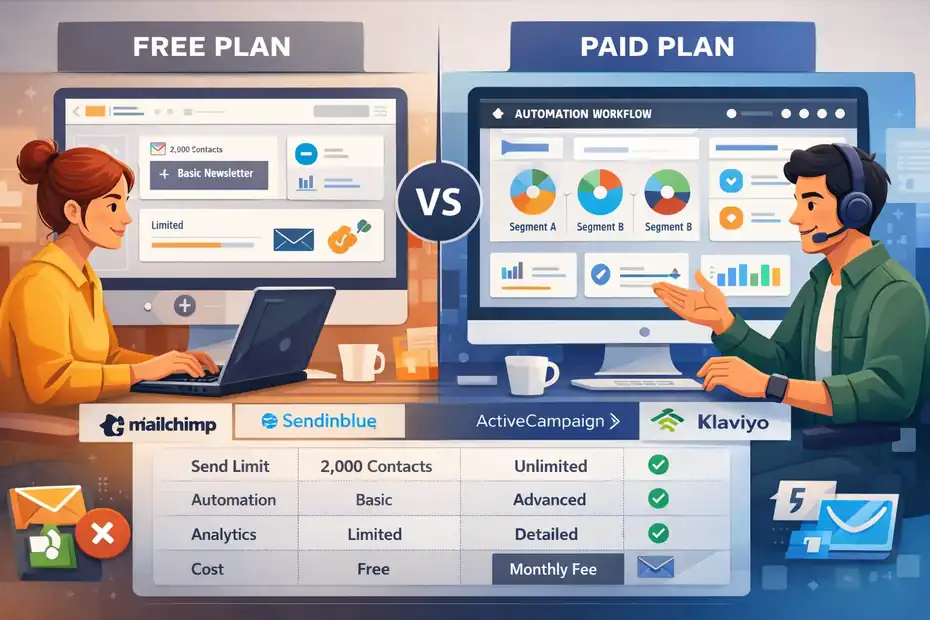
Free email marketing usually means you can send newsletters, build a basic form, and manage a small subscriber list without paying a monthly fee. The catch is that free plans often limit sends, contacts, branding control, or advanced automations.
For example, MailerLite’s free plan allows up to 500 subscribers and 12,000 monthly emails, while Brevo’s free plan allows sending up to 300 emails per day. Kit’s free Newsletter plan goes up to 10,000 subscribers, but feature depth still changes once you move into paid tiers.
That matters because “free” can look generous on the surface, but your real constraint might be somewhere else. Maybe you can store enough subscribers, but not automate a proper welcome flow. Maybe you can send enough emails, but the platform logo stays on your forms and emails. Maybe reporting is basic enough that you cannot tell which segment is actually driving sales.
In practice, free works best when you are still proving your offer, building your first list, or publishing a simple newsletter with light segmentation.
What You’re Actually Paying For On A Paid Plan
Paid email marketing is not just paying to send more emails. You are usually paying for leverage. That includes automation, cleaner branding, better testing, stronger segmentation, deeper reporting, improved support, and in some tools, better multichannel features.
Here is where the difference gets practical:
- Automation: Trigger emails based on signups, clicks, purchases, or inactivity.
- Segmentation: Send different messages to different subscriber groups instead of blasting everyone.
- Testing: Run subject line or content tests to improve open and click rates.
- Reporting: Track device usage, click heatmaps, revenue, and journey performance.
- Brand Control: Remove platform branding and present a cleaner business image.
Brevo’s paid tiers, for instance, add marketing automation, A/B testing, advanced reporting, send-time optimization, and web or event tracking. MailerLite’s paid plans add features like AutoResend, logo removal, custom HTML editing, and more advanced website tools.
Kit’s paid plans add unlimited visual automations, email sequences, subject-line testing, and deliverability reporting.
That is why I usually tell people this: free helps you start, paid helps you scale.
Why This Decision Matters More In 2026
Email is still one of the highest-ROI marketing channels. Litmus says email delivers an average ROI of 36:1 or more, and Mailchimp notes that daily email volume is projected to reach 392.5 billion by 2026.
In other words, email is still powerful, but the inbox is crowded. That means better segmentation, stronger creative, and more precise automation matter more than they did a few years ago.
I believe that is the real reason this debate matters now. In a quieter inbox, a basic free plan could carry you further. In a crowded inbox, relevance wins. Relevance usually comes from paid-level features.
How Free And Paid Plans Work In The Real World
On paper, plan comparisons look neat. In real life, the difference shows up when you try to run an actual campaign calendar, launch a product, or recover abandoned leads.
Where Free Plans Usually Feel Good At First
Free plans are genuinely useful at the start. You can validate whether people want your newsletter, test lead magnets, and learn basic email habits without taking on another software bill.
This is especially valuable if you are:
- Starting from zero: No list, no automation, no product yet.
- Publishing simple content: Weekly updates, blog roundups, or personal newsletters.
- Learning the fundamentals: Forms, subject lines, basic metrics, unsubscribe hygiene.
- Working with low risk: A side project, local service business, or creator brand still proving demand.
Imagine you run a small Etsy shop and collect 150 email subscribers from a printable giveaway. A free plan is probably enough for that stage. You can send a welcome email, a product roundup, and a holiday promotion without paying anything. That is a smart use of free.
The mistake is assuming that what works at 150 subscribers will still work at 1,500.
Where Free Plans Start Slowing You Down
The pain usually shows up in one of four places: list growth, automation depth, reporting, or brand credibility.
Here is a common scenario. You offer a free checklist, people subscribe, and they get one email. That seems fine. But then you realize new subscribers need a 5-email welcome series, buyers need post-purchase education, inactive readers need re-engagement, and high-intent leads should receive a different pitch. Now basic free email marketing starts feeling cramped.
The deeper issue is not just convenience. It is revenue leakage.
If you cannot separate cold leads from warm ones, you send generic campaigns. If you cannot trigger emails based on behavior, you miss easy conversions. If you cannot see what actually drives clicks, you keep guessing. HubSpot’s 2026 marketing statistics page cites email conversion rates of 2.8% for B2C and 2.4% for B2B, which means even small improvements in targeting and timing can translate into real money over time.
That is why free can become expensive in a hidden way. You save on software, but lose on efficiency.
Why Paid Plans Often Feel “Cheaper” Once Revenue Starts Moving
This is the part many people miss. A paid plan can look expensive until you compare it with the value of one recovered sale, one booked client, or one better-performing launch.
Let’s say your email list has 2,000 subscribers and your average product sale is $60. If better segmentation or a welcome sequence helps just 10 extra people buy in a month, that is $600. Suddenly a $20 to $80 tool bill does not look like a cost problem. It looks like operating leverage.
MailerLite’s Growing Business plan starts at $10 per month, while its Advanced plan starts at $20 per month. Brevo’s Starter plan begins at $9 per month. Kit’s Creator plan starts at $33 per month for up to 1,000 subscribers. Those prices are not trivial, but they are also not huge if email is tied to actual revenue.
In my experience, the better question is not “Can I keep this free?” It is “What is the cost of staying limited?”
When Free Email Marketing Is Absolutely Enough
Free is not just a placeholder. For the right use case, it is the correct answer. The key is being honest about your current stage.
Best-Fit Use Cases For Free Plans
Free email marketing usually makes sense when your strategy is still simple and your downside is low.
You are a good fit for free if:
- You have a small list: Usually under 500 subscribers, sometimes a bit more depending on the platform.
- You send basic campaigns: One newsletter, one offer, maybe one simple welcome email.
- You do not need advanced branching: No complicated customer journeys yet.
- You are validating an idea: Testing message-market fit before investing more.
A solo writer, local coach, nonprofit volunteer group, or early-stage shop can do a lot with a free plan. You can still learn good habits: writing better subject lines, cleaning your list, watching clicks, and building sign-up forms that convert.
That learning is valuable. I actually recommend free for many beginners because it keeps you focused on the fundamentals instead of drowning in features.
The Stage Where Free Is A Strategic Choice, Not A Budget Constraint
There is a healthy version of staying free. It happens when you deliberately protect your cash flow while building signal.
For example, let’s say you are launching a niche newsletter about home coffee roasting. You have 220 subscribers, no paid product yet, and you send one email every Sunday. In that case, paying for complex automation is probably premature. What you really need is consistency, content quality, and a reason for subscribers to stay engaged.
That is a strategic use of free. You are keeping your stack lean while building audience trust.
I suggest using that stage to answer three questions:
- Which signup source brings the best subscribers?
- What subject lines get the strongest opens?
- What topics consistently drive clicks or replies?
Once you know those answers, a paid upgrade becomes much easier to justify.
How To Get More Out Of A Free Plan Before Upgrading
You can stretch a free plan surprisingly far if you are disciplined.
- Build one strong welcome email: Give subscribers a clear next step right away.
- Create one core segment: At minimum, separate buyers, leads, and inactive subscribers if the platform allows it.
- Use click tracking: Learn what content and offers create interest.
- Watch unsubscribe trends: A rising unsubscribe rate often means your content promise is drifting.
MailerLite reported a 43.46% average open rate and 2.09% average click rate in 2025 across its benchmark dataset, with unsubscribe rates averaging 0.22%. Even if your platform numbers differ, those ranges are useful as a directional check.
If your free plan is helping you hit solid engagement and you are not yet blocked by automation or branding limits, there is no shame in staying there a bit longer.
When Paid Email Marketing Is Clearly Worth It
There comes a point when paying is not an upgrade for convenience. It is a business decision.
You Need Paid The Moment Segmentation Starts Affecting Revenue
Once your list includes different audience types, generic blasts become a problem. New leads need onboarding. Customers need retention or upsell messaging. Cold subscribers need re-engagement. VIPs need something else entirely.
That is where segmentation changes from “nice to have” to “money issue.”
Mailchimp’s benchmarks page suggests aiming for around a 34.23% average open rate overall, while MailerLite’s broader benchmark report showed a 43.46% average open rate in 2025. Those numbers vary by industry and methodology, but the bigger takeaway is this: engagement differs a lot based on relevance and audience type.
If you are sending the same thing to everyone, you are probably depressing your own results.
Automation Becomes Essential Faster Than Most People Expect
I think automation is the biggest reason people move from free to paid. Not because automation is fancy, but because it protects consistency.
A few examples where automation matters:
- Welcome Series: New subscribers learn who you are and what to do next.
- Abandoned Lead Flow: People who clicked but did not buy get a follow-up.
- Post-Purchase Education: Customers get onboarding, care tips, or cross-sells.
- Re-Engagement: Inactive readers get a final “still interested?” sequence.
Kit’s paid plans include unlimited visual automations and unlimited email sequences, while Brevo’s Standard tier adds automation workflows and send-time optimization.
That matters because manual email marketing usually breaks at the exact moment your business starts getting interesting.
You Want Better Data, Not Just More Features
Most people say they want more features. What they actually need is better decision-making.
Paid plans are often worth it because they answer questions like:
- Which sequence produces the most sales?
- Which segment clicks the most?
- What device or geography changes performance?
- Which signup source creates the highest-value subscribers?
Those answers help you stop guessing. And once you stop guessing, even a small list can become more profitable.
Brevo highlights advanced reporting, click heatmaps, geography and device reports, plus web and event tracking in its higher tiers. Kit adds deliverability reporting and subscriber engagement scoring in paid levels.
I believe this is where paid starts pulling away from free in a serious way: not in sending, but in learning.
A Practical Cost Breakdown: What You Pay And What You Get
This is where the debate gets real. Let’s strip away the marketing language and look at what you usually gain as you move from free to paid.
A Simple Comparison Table
| Plan Type | Best For | Typical Limits | Main Strength | Main Weakness |
|---|---|---|---|---|
| Free | Beginners, side projects, list validation | Lower send caps, smaller lists, limited automation | Zero cost, easy setup | Growth ceilings show up fast |
| Low-Cost Paid | Small businesses, creators, service providers | More sends, stronger branding, basic automation | Best value stage for most users | Still may limit deeper reporting |
| Mid-Tier Paid | Growing stores, teams, active funnels | Better segmentation, testing, event tracking | Real optimization becomes possible | Monthly costs rise with list size |
| Advanced Paid | Mature brands, larger funnels, teams | Deeper analytics, advanced workflows, multiple users | Better performance control at scale | Can be overkill early on |
This table is simple, but it matches how most businesses actually evolve.
Current Examples From Popular Platforms
Here is the practical snapshot from current public pricing pages:
- MailerLite: Free plan includes up to 500 subscribers and 12,000 monthly emails. Paid starts at $10 per month for Growing Business, with Advanced starting at $20 per month.
- Brevo: Free plan is available with sending up to 300 emails per day after account approval. Starter begins at $9 per month, and higher tiers add automation, A/B testing, and advanced reporting.
- Kit: Free Newsletter plan includes up to 10,000 subscribers, unlimited broadcasts, forms, and one basic automation. Creator starts at $33 per month for up to 1,000 subscribers, and Pro starts at $66 per month for up to 1,000 subscribers.
- Mailchimp: Free availability remains part of its plan structure, while paid tiers scale by contacts and features, including Standard, Essentials, and Premium. Its pricing page currently shows a limited free trial send allowance on some flows, and more advanced features sit in paid plans.
Pricing changes, so I would always check the official page before committing. But the pattern is stable: free gets you started, paid unlocks growth mechanics.
The Hidden Costs People Forget To Count
This is the part I care about most.
The real cost of email marketing is not just the software invoice. It is also:
- Lost sales from weak onboarding
- Time spent sending manually
- Lower engagement from poor segmentation
- Slower testing because you lack A/B tools
- Messy handoffs if multiple people touch campaigns
For many businesses, these hidden costs are bigger than the platform bill.
How To Decide What’s Worth It For Your Business Right Now
You do not need a perfect framework here. You need one that is honest enough to match your stage.
Ask These Four Questions Before You Choose
I use these four questions because they cut through most of the fluff:
- How big is your list right now, and how fast is it growing?
- Do you sell something directly from email, or is email mainly support content?
- Do you need automation beyond a single welcome flow?
- Are you making decisions from data, or mostly sending and hoping?
If your answers are “small list, slow growth, simple newsletter, no direct revenue yet,” free is probably fine.
If your answers are “growing list, offers tied to email, multiple audience types, and limited reporting,” paid is probably overdue.
A Simple Decision Matrix
Use this logic:
- Stay Free: You have fewer than 500 to 1,000 subscribers, simple campaigns, and no complex funnel.
- Upgrade Soon: Your list is growing, you want branded forms, and one or two automation gaps are hurting results.
- Upgrade Now: Email directly supports sales, launches, appointments, or retention, and segmentation matters.
- Invest Deeper: You already know email works and now need testing, tracking, team workflows, and optimization.
That is the no-drama version.
The “Upgrade Trigger” I Recommend Most
If I had to pick one signal, it would be this: upgrade when you can clearly name the feature that will either save time or make money.
Good upgrade triggers look like this:
- “I need a 5-email welcome sequence.”
- “I need to separate buyers from non-buyers.”
- “I need A/B testing because subject lines are unstable.”
- “I need revenue tracking tied to email clicks.”
Bad upgrade triggers look like this:
- “Everyone says this tool is better.”
- “I feel like I should be on a paid plan.”
- “The dashboard looks more professional.”
I recommend upgrading for operational reasons, not emotional ones.
Common Mistakes People Make With Free And Paid Plans
This is where a lot of wasted money and lost momentum happens. The platform itself is rarely the biggest problem. The decision logic usually is.
Mistake 1: Staying Free Too Long Because “It Still Works”
This is the classic trap. Your emails technically send, so you assume everything is fine. Meanwhile, your welcome flow is weak, your list is unsegmented, and subscribers are getting generic messages that do not match intent.
The problem is not that free stopped working. The problem is that your business outgrew it quietly.
I have seen this happen with service businesses a lot. They stay on a free plan because they only send one newsletter a week. But they miss quote-request follow-ups, lead warming, and reactivation campaigns that would have made the channel actually perform.
Mistake 2: Paying For Advanced Features Before You Have A Basic Strategy
The reverse mistake is just as common. Someone buys an advanced plan, builds ten automations, tags everything, and still has weak emails.
No pricing tier fixes poor positioning, unclear offers, or boring copy.
Before you pay for complexity, get these basics right:
- Signup Promise: Why should someone join your list?
- Welcome Message: What happens right after they subscribe?
- Core Cadence: How often will you email?
- Primary Goal: Clicks, replies, bookings, purchases, or retention?
If those are fuzzy, paid tools will just help you execute fuzzy strategy faster.
Mistake 3: Comparing Platforms Instead Of Comparing Business Needs
A lot of people search “best email marketing platform” when the more useful question is “what do I need this channel to do over the next 90 days?”
That shift changes everything.
For many of us, the smartest move is not chasing the “best” tool. It is choosing the simplest tool that covers the next meaningful stage of growth without forcing another migration too soon.
Advanced Optimization: How Paid Plans Earn Their Keep
Once you know email matters, paid plans stop being about access and start being about optimization.
Use Segmentation To Improve Relevance, Not Just Organization
Segmentation is often explained like filing cabinets. That is too shallow. Good segmentation is really a relevance engine.
You can segment by:
- Signup source
- Product interest
- Purchase history
- Click behavior
- Inactivity window
- Customer lifecycle stage
Imagine you sell skincare. Someone who downloaded an acne guide should not get the same campaign as someone who bought an anti-aging serum last week. That sounds obvious, but many brands still email both groups the same way.
Relevance tends to lift opens, clicks, and conversions over time because subscribers feel understood instead of broadcasted at.
Use Testing In Focused, High-Impact Places
A/B testing is only useful when it is tied to a meaningful variable. I suggest testing in this order:
- Subject line
- Offer angle
- CTA wording
- Send time
- Email length or layout
Do not test everything at once. That just creates noise.
Start with the pages or sequences that matter most, like your welcome series or launch emails. Brevo and Kit both include testing or optimization features in paid tiers that make this easier to run consistently.
Track Revenue Signals, Not Vanity Metrics Alone
Open rates still have value, but they are not enough by themselves. A strong open rate with weak clicks or weak sales can fool you into thinking the campaign worked.
Watch these metrics together:
- Open Rate: Did the subject line and sender earn attention?
- Click Rate: Did the body create action?
- Conversion Rate: Did the landing page and offer finish the job?
- Unsubscribe Rate: Did the message match subscriber expectations?
That full chain matters more than any single number. It is also why paid plans with deeper tracking often pay for themselves once email becomes tied to revenue.
The Bottom Line: What’s Worth It Now?
Free email marketing vs paid is not really a battle between good and bad. It is a timing question.
Free Is Worth It When You Are Building Proof
Free is worth it now if you are still validating your list, testing your content rhythm, and learning how your audience responds. It is especially useful when the business is young and every software bill matters.
I would stay free if your setup is simple, your list is small, and your bottleneck is not feature depth but consistency.
That is a smart decision, not a cheap one.
Paid Is Worth It When Email Starts Influencing Revenue
Paid is worth it now when email is no longer just a broadcasting channel. The moment it starts touching lead conversion, repeat purchases, launches, appointments, or customer retention, the value of automation and segmentation rises fast.
At that stage, paying for better workflows and reporting is usually more rational than trying to squeeze more life out of a limited free setup.
And because email continues to deliver strong ROI, even modest gains can cover the monthly cost. Litmus still cites average ROI around 36:1, which is exactly why businesses keep investing here.
My Honest Recommendation
Here is my honest take.
- Start free if you are early.
- Upgrade the moment a missing feature is clearly blocking growth.
- Do not upgrade just to feel more advanced.
- Do upgrade when better automation, segmentation, or reporting can realistically save time or produce revenue.
That is what is worth it now.
FAQ
What is the difference between free email marketing vs paid?
Free email marketing vs paid mainly differs in features, limits, and scalability. Free plans offer basic sending and small list support, while paid plans unlock automation, segmentation, branding control, and advanced reporting that help improve performance and revenue as your list grows.
When should I switch from free email marketing to paid?
You should switch when your list grows, automation becomes necessary, or email starts driving revenue. If you need segmentation, better reporting, or multiple email sequences to support conversions, a paid plan becomes more efficient and often pays for itself.
Is free email marketing enough for beginners?
Yes, free email marketing is usually enough for beginners who are building their first list, testing content, or sending simple newsletters. It allows you to learn fundamentals without financial risk, but limitations appear as your audience and strategy become more advanced.
Does paid email marketing increase conversions?
Paid email marketing can increase conversions because it enables better targeting, automation, and testing. By sending relevant messages to specific segments and optimizing campaigns, businesses often see higher engagement and improved sales compared to basic free setups.
Is paid email marketing worth the cost in 2026?
Paid email marketing is worth the cost when email contributes to sales, lead generation, or customer retention. Even small improvements in automation or segmentation can generate enough revenue to offset the monthly fee, making it a strong investment for growing businesses.

Juxhin B is a digital marketing researcher and founder of JAK Digital Hub, specializing in email marketing software, marketing automation platforms, and digital growth tools. His work focuses on software testing, platform comparisons, and real-world performance analysis to help businesses choose the right marketing technology.
Related posts:
 Is Email Marketing Strategy Worth It for Real Growth?
 Better Email Marketing Strategy for Ecommerce Growth
 Free Email Marketing For 10K Subscribers: Is It Enough?
 Is GetResponse Worth the Price? A No-Fluff Breakdown for Real Users
 Email Marketing Jobs For Startups Hiring Remote Talent
 Email Marketing Strategy for New Ecommerce Store Success