Table of Contents
Some links on JAK Digital Hub are affiliate links, meaning we may earn a small commission at no extra cost to you. Read full disclaimer.
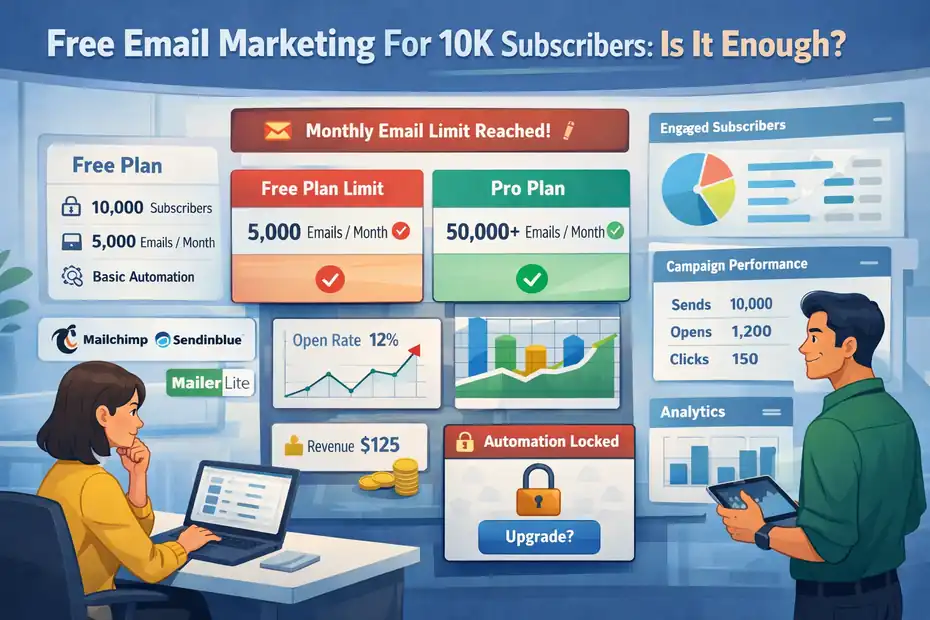
Free email marketing for 10k subscribers sounds amazing on paper because it suggests you can grow a real audience without adding another monthly bill.
I get why that’s appealing. When your list hits five figures, though, “free” stops being a simple yes-or-no question and turns into a tradeoff between send limits, automation, branding, deliverability, and time.
In most cases, the free plan itself is not enough for fully active email marketing at 10,000 subscribers, but it can still be enough for specific business models, slower send schedules, or early-stage validation.
What “Free Email Marketing For 10K Subscribers” Really Means
When people search this phrase, they usually mean one of three things: “Can I store 10,000 subscribers for free?”, “Can I send to 10,000 people for free?”, or “Can I run a serious business on a free email platform?”
Those are very different questions.
Can A Platform Hold 10,000 Contacts For Free?
Some platforms let you store a large number of contacts while heavily limiting how many emails you can actually send. Brevo is the clearest example right now: its free plan allows up to 100,000 contacts, but sending is capped at 300 emails per day. That means the list size looks generous, while actual campaign volume stays restricted.
This is where many people get tripped up. A free plan may technically support your database size, but not your marketing goals. If you have 10,000 subscribers and want to send even one weekly newsletter, that is roughly 40,000 sends per month.
A plan with 300 daily sends gives you about 9,000 sends in a 30-day month, which is not enough to email the full list once. That is why I suggest separating “contact storage” from “usable sending capacity” every time you compare email tools.
A practical way to think about it is this: Contact limits tell you whether a platform can hold your audience; sending limits tell you whether it can serve your audience.
Free Usually Means Free To Start, Not Free To Scale
Most major email platforms have tightened free plans over time rather than expanded them. Mailchimp’s free plan now allows only 250 contacts and 500 monthly sends, while MailerLite’s free plan is 500 subscribers, and both EmailOctopus and Sender cap their free plans at 2,500 subscribers.
That matters because “10k subscribers” puts you well past the testing phase. At that level, you are not just building a list anymore. You are managing segmentation, re-engagement, deliverability, suppression rules, signup sources, and possibly sales attribution.
Free plans are usually designed to help you validate your channel, not to support mature lifecycle marketing.
In my experience, the question is not “Can I stay free?” It is “Which parts of my email system can stay free the longest without hurting growth?” That framing leads to better decisions.
The Real Cost Of “Free” Is Usually Hidden Elsewhere
A free plan can still cost you money indirectly. You might lose time handling manual sends. You might be forced to batch subscribers awkwardly because of send caps.
You may also lose conversions because advanced automations, branding removal, A/B testing, or more detailed reporting are behind paid tiers.
Imagine you run a small course business with 10,000 subscribers and one core offer. If your welcome sequence is limited, your abandoned checkout sequence is missing, and your segmentation is basic, you may save $30 to $70 per month while quietly losing hundreds in revenue opportunity. That tradeoff rarely shows up on a pricing page, but it shows up in results.
So yes, “free email marketing for 10k subscribers” can exist in a limited technical sense. But whether it is enough depends on what you need your email channel to do.
Is It Actually Enough For 10,000 Subscribers?
For most businesses that send regularly, no. For a narrow set of low-frequency or creator-style use cases, maybe.
It Depends On Your Sending Frequency
Here is the math that makes this topic much easier to understand. If you have 10,000 subscribers:
- One monthly newsletter = about 10,000 sends per month
- One weekly newsletter = about 40,000 sends per month
- Two weekly sends = about 80,000 sends per month
- Weekly newsletter plus automations = often 50,000 to 100,000+ sends per month
Once you look at volume this way, most free plans stop qualifying immediately. Sender gives 15,000 emails per month for up to 2,500 subscribers. EmailOctopus gives 10,000 emails per month for up to 2,500 subscribers. MailerLite’s free tier allows up to 500 subscribers and 12,000 monthly emails. Brevo’s free plan focuses on daily send caps rather than broad monthly sending freedom.
So if your full list is active and you plan to email it normally, a fully free setup is rarely enough at 10k.
It Can Be Enough For Low-Volume Or Highly Segmented Sends
Now the nuance. A free plan may still work if your 10,000 subscribers are not all mailed equally.
For example, say you run a local events newsletter and only send to small geographic segments. Or maybe you have 10,000 stored contacts, but only 1,500 highly engaged readers get the regular newsletter while the rest are archived, sunsetted, or waiting inside an onboarding path. In that case, your list size is 10k, but your active sending volume is much smaller.
This is where some founders and creators can stretch a free plan longer than expected. They use tight segmentation, suppress cold subscribers, and send only to the readers most likely to open and click. That reduces both cost and deliverability risk.
I believe this is the only realistic “yes” case for free email marketing at 10,000 subscribers: your database can be large, but your actual monthly sending behavior must remain disciplined and limited.
Your Business Model Changes The Answer
A media newsletter, ecommerce store, coach, SaaS business, and nonprofit all use email differently.
A weekly content newsletter can sometimes survive with lighter automation. An ecommerce brand usually cannot, because revenue depends on flows like welcome, browse abandonment, post-purchase, and win-back.
A SaaS company may need behavior-based messaging tied to product actions, onboarding milestones, and retention triggers. The more email acts like infrastructure instead of simple broadcasting, the less viable free becomes.
That is why I would not answer this topic with a blanket yes or no. I would answer it like this: free email marketing for 10k subscribers is enough for storing, testing, or lightly emailing a large list, but not enough for running a fully optimized revenue channel in most businesses.
Where Free Plans Break First
This is usually the most helpful part for readers, because the problem is not just “subscriber cap.” It is which ceiling you hit first.
Send Limits Become The Immediate Bottleneck
The biggest issue is usually send volume, not contact count. A platform can advertise a free tier, but if the plan only supports 500 sends, 10,000 sends, or 300 emails per day, you hit the wall long before the list becomes useful. Mailchimp’s free plan is especially restrictive now, and Brevo’s free plan is more generous on storage than on sends.
This matters because email marketing does not just include newsletters. Every welcome email, lead magnet delivery, product update, confirmation, reminder, and nurture message eats into your sending pool.
A founder might think, “I only send one newsletter a week.” But once you add a three-email welcome series and one promotional push, your monthly volume can jump quickly. That is why I advise estimating your real sends before picking a plan. Your list size alone is not enough.
Automation Limits Hurt More Than Most People Expect
The second break point is automation. Some platforms reserve advanced automation for paid plans, while others allow a free version with tight constraints. That sounds manageable until you realize automation usually creates the highest ROI emails.
Welcome emails, abandoned signup flows, onboarding nudges, and reactivation campaigns often outperform generic broadcasts because they arrive when intent is highest.
Even when benchmarks vary by industry, email remains one of the most measurable owned channels, and benchmark reports still track strong opens and clicks relative to many other digital channels.
Dotdigital’s 2026 benchmark cites a 55.4% global open-rate benchmark and 3.7% click-through benchmark, while Klaviyo continues publishing industry-level email performance benchmarks for revenue and order rate.
When automation is weak, you end up doing manual work that does not scale. At 10,000 subscribers, that manual work becomes the real bill.
Reporting, Branding, And Deliverability Controls Start To Matter
The third wall is quality control. Free plans often keep platform branding in your emails, limit A/B testing, reduce segmentation depth, or offer lighter analytics. On a small list, that may be annoying but tolerable. On a 10k list, it affects performance.
You want to know which segments engage, which subject lines lift opens, which signup sources produce buyers, and which dormant contacts should be suppressed. Without that visibility, you are basically flying by instinct.
And I’ll be honest: instinct is useful in copywriting, but not enough for list management at scale.
The Best Free-Plan Scenarios For A 10K Audience
There are still valid cases where free works surprisingly well. You just need to know what kind of setup you’re building.
Storing A Large List While Mailing A Small Active Segment
This is the most realistic approach. Keep the whole database, but send only to your most engaged segment.
For instance, imagine you have 10,000 subscribers collected from content downloads over two years. Only 1,800 opened something in the past 90 days. Instead of blasting the full list, you run a “recently engaged” segment and send only there. Your deliverability improves, your open rates look healthier, and your free or low-cost plan stretches further.
This is not just a budget hack. It is often better email strategy. Cold contacts drag down performance and can hurt sender reputation over time. Many businesses should be mailing less of their list, not more.
Running A Creator Newsletter With Minimal Automation
A simple creator business can sometimes stay free longer than a product-heavy business. If your revenue comes from sponsorships, premium content, consulting, or occasional launches, you may not need deep automation on day one.
In that case, your priority is consistent publishing, clear positioning, and list hygiene. A stripped-down setup can be enough while you validate topic-market fit.
I suggest this route if your newsletter itself is the product. But if the newsletter is supporting a funnel, then automation becomes more important much earlier.
Using Free To Validate Before A Planned Upgrade
This is probably the smartest use of free at 10k: use it deliberately as a bridge.
Example: You import your audience, set up forms, publish one lead magnet, warm the list, and track engagement for 30 to 60 days. During that period, you learn which segments matter and what cadence the audience can handle. Then you upgrade based on real behavior instead of guesswork.
That approach turns free into a testing phase, not a permanent operating model. I think that is the healthiest mindset.
Platform Reality In 2026
This is where the phrase “free email marketing for 10k subscribers” meets actual pricing pages.
Most Popular Free Plans No Longer Fit 10K Directly
Current official free-plan limits are well below 10,000 subscribers on most mainstream tools. Mailchimp is capped at 250 contacts and 500 monthly sends.
MailerLite’s free plan supports up to 500 subscribers.
Sender and EmailOctopus allow up to 2,500 subscribers for free.
Brevo is the outlier on contact storage with up to 100,000 contacts, but the 300-emails-per-day cap makes it unsuitable for full-list sends to 10,000 people.
That means the literal answer to the title question is usually no, not if you mean “a true free tier that fully supports marketing to all 10,000 subscribers.”
Paid Pricing At 10K Is Often Cheaper Than People Expect
The good news is that 10k subscribers is no longer an enterprise-level email problem. Third-party pricing comparisons in early 2026 put approximate 10k-list monthly costs around $40 for Sender, $40 for EmailOctopus, $73 for MailerLite, about $97 to $110 for Mailchimp, and volume-based Brevo pricing varies depending on send volume rather than raw list size.
I would not treat every comparison article as gospel, but the directional lesson is reliable: once you reach 10k, the jump from “free” to “usable” may be a modest operating expense rather than a painful one.
For many businesses, one extra conversion per month covers the software.
“Cheapest” And “Best Value” Are Not The Same
This matters a lot. A platform can be cheaper and still cost more in hidden friction.
You should not judge only by monthly plan price. Look at:
- Whether automation is included
- Whether branding can be removed
- Whether segmentation is usable
- Whether support is accessible
- Whether analytics show enough detail
- Whether send limits fit your real cadence
In my experience, a platform that saves you two hours per month and lifts conversions slightly is already the better value, even if it is not the lowest sticker price.
How To Decide Whether Free Is Enough For You
This is the practical decision framework I would use if I were in your shoes.
Start With A Simple Volume Audit
Before choosing any platform, calculate four numbers:
- Total subscribers
- Active subscribers in the last 30 to 90 days
- Average campaigns per month
- Automation emails per subscriber per month
That gives you a realistic send forecast.
Example: 10,000 subscribers, but only 2,200 are active. You send 4 newsletters monthly plus a welcome sequence averaging 1,500 sends. Your real monthly volume might be closer to 10,300 than 40,000. That could make a low-cost or credit-based plan viable, even if a broad “10k subscriber plan” sounds expensive.
Without this math, people either overspend or cling to free too long.
Decide Whether Email Is A Core Channel Or A Support Channel
This is the strategic fork.
If email is your main growth engine, free is usually not enough. You need reliability, automation, segmentation, and reporting. If email is a supporting channel that only sends occasional updates, free may hold longer.
A quick rule I like:
- Core revenue channel: pay sooner
- Side channel or test channel: stretch free carefully
- Large stored list but small active segment: free or low-cost can work temporarily
That one distinction clears up a lot of confusion.
Put A Dollar Value On Time And Missed Revenue
A free plan feels cheap because the invoice is zero. But what is your time worth? What is one extra sale worth? What is the cost of sending the wrong campaign to the wrong segment because segmentation is weak?
I recommend estimating the hidden cost this way:
- Hours lost monthly to manual work
- Likely missed conversions from weak automations
- Opportunity cost from poor analytics or slower testing
When you total that honestly, the paid plan often looks much cheaper than it first seemed.
Step-By-Step Setup If You Want To Stay Free As Long As Possible
If your goal is to stretch free or near-free email marketing responsibly, here is the setup that makes the most sense.
Keep Your List Clean From Day One
Do not treat every subscriber as equally valuable forever. Tag source, track recency, and remove or suppress cold contacts over time.
A clean list does three important things:
- Protects deliverability
- Lowers effective sending volume
- Makes free-plan limits easier to manage
I suggest creating three simple engagement buckets: active, fading, and inactive. Active might be anyone who opened or clicked in the last 60 to 90 days. Fading gets re-engagement. Inactive gets suppressed if they stay cold.
This is not harsh. It is healthy list management.
Use A Narrow Automation Stack
If your platform gives any free automation at all, use it for the highest-leverage emails first.
My order would be:
- Welcome email or short welcome series
- Lead magnet delivery
- Re-engagement sequence
- Basic offer follow-up
Do not waste limited automation capacity on low-impact experiments early. Use it where intent is strongest.
A lot of people jump straight into fancy branching logic. I would keep it boring and profitable first.
Segment By Engagement Before You Segment By Demographics
Demographic segmentation sounds sophisticated, but engagement segmentation usually produces faster wins.
Instead of building ten audience slices based on interests, start with:
- Opened in last 30 days
- Opened in last 90 days
- Clicked offer emails
- Never engaged after signup
This keeps your volume focused and your sender reputation healthier. Once you grow into a paid plan, then deepen segmentation.
Common Mistakes People Make At 10K Subscribers
This is where many “free email marketing” setups quietly fail.
Treating A Big List As A Healthy List
A list of 10,000 subscribers sounds impressive, but size alone is a vanity metric. What matters is active reach.
I have seen businesses with 2,000 engaged subscribers outperform businesses with 20,000 stale contacts. A smaller engaged list often gets better opens, more clicks, fewer spam complaints, and stronger conversion rates.
So when you evaluate whether free is enough, ask whether your list is genuinely active. That changes the answer more than the raw number.
Staying Free Too Long Out Of Principle
This one is common. People become emotionally attached to “free” and start designing around the platform’s limits instead of the business’s needs.
That leads to awkward send schedules, skipped automations, messy workarounds, or under-mailing the list. None of those are strategic advantages.
I believe free is a tool, not a philosophy. When the constraints start affecting growth, upgrade.
Ignoring Deliverability Until It Drops
Deliverability problems rarely announce themselves dramatically at first. You just notice fewer opens, weaker clicks, or inconsistent performance.
The causes are often simple:
- Mailing cold subscribers too often
- Low engagement across the list
- Weak list hygiene
- Importing old contacts without warming properly
- Sending all segments the same campaigns
At 10k subscribers, these issues become visible enough to matter. And when your platform gives limited diagnostics, fixing them takes longer.
Advanced Ways To Make A 10K List More Profitable
Once you stop asking “Can I stay free?” and start asking “How do I make this list earn its keep?” the strategy improves fast.
Focus On Revenue Per Subscriber, Not Just Plan Cost
A cheap plan with low monetization is not actually efficient. A slightly more expensive plan that improves segmentation and automation may dramatically increase revenue per subscriber.
Even simple changes can move the needle:
- Better welcome sequence
- Resend to non-openers
- Engaged-only campaigns
- Offer timing based on clicks
- Re-engagement before suppression
That is why I like revenue-per-subscriber as a north-star metric. It helps you decide whether a software bill is justified by business outcomes.
Build A Two-Tier Sending Strategy
Here is a practical model that works well:
- Tier 1: Active segment gets your regular newsletter and promos
- Tier 2: Fading segment gets reduced frequency and re-engagement
This gives you better engagement metrics, lower complaint risk, and more efficient use of limited sends. It also creates a clearer path for deciding who stays in your main audience.
For many of us, this is the bridge between “free forever” wishful thinking and disciplined email operations.
Upgrade Based On Trigger Points, Not Emotion
Set specific thresholds now so you do not make reactive platform decisions later.
Useful upgrade triggers:
- You need to send to the full list more than once monthly
- Manual work exceeds 2 to 3 hours monthly
- Welcome flow limitations are costing conversions
- You need A/B testing or better attribution
- Active segment exceeds free-plan sending limits consistently
This keeps the decision objective. You are not “giving up” on free. You are upgrading because the math tells you to.
Final Verdict: Is Free Email Marketing For 10K Subscribers Enough?
For most businesses, free email marketing for 10k subscribers is not enough if you want to email the full list consistently, use meaningful automation, and treat email as a serious growth channel. Current free plans across major platforms are generally too limited on subscriber caps, monthly sends, daily sends, or feature access to support that level comfortably.
But there is a more useful answer.
It can be enough when your 10,000-subscriber list is mostly stored rather than actively mailed, when you send only to engaged segments, when your automation needs are minimal, or when you are using free as a short-term validation phase before upgrading. In those cases, free is not a fantasy. It is a tactical choice.
My honest take is this: at 10k subscribers, the goal should not be to stay free at all costs. The goal should be to keep your email system lean, measurable, and profitable. If a free setup helps you do that for a while, great. If a $30 to $70 monthly upgrade unlocks better automation and stronger returns, that is usually the smarter move.
At this stage, “enough” is not about whether the invoice says $0. It is about whether your email setup can support the audience you worked hard to build.
FAQ
What does free email marketing for 10k subscribers actually include?
Free email marketing for 10k subscribers usually means you can store contacts but not send to all of them freely. Most platforms limit monthly or daily emails, which restricts how often you can reach your entire list. Full functionality typically requires a paid upgrade.
Can you send emails to 10,000 subscribers for free?
In most cases, you cannot send emails to 10,000 subscribers for free on a regular basis. Free plans often cap monthly or daily sends, making it difficult to email your entire list even once per week. You may need segmentation or reduced frequency to stay within limits.
Is free email marketing enough for a growing business?
Free email marketing is usually not enough for a growing business with 10k subscribers. As your list grows, you need better automation, analytics, and sending capacity. Free plans are best for testing or early stages, not for scaling a consistent email marketing strategy.
How can I use a free plan with 10,000 subscribers effectively?
You can use a free plan effectively by sending emails only to your most engaged subscribers. Segment your list, remove inactive contacts, and reduce sending frequency. This helps you stay within limits while maintaining better deliverability and engagement rates.
When should I upgrade from free email marketing?
You should upgrade when send limits prevent consistent communication, automation is restricted, or manual work becomes time-consuming. If email is a key revenue channel, upgrading earlier often improves performance and saves time compared to staying on a limited free plan.

Juxhin B is a digital marketing researcher and founder of JAK Digital Hub, specializing in email marketing software, marketing automation platforms, and digital growth tools. His work focuses on software testing, platform comparisons, and real-world performance analysis to help businesses choose the right marketing technology.
Related posts:
 Why Is My Email Marketing Strategy Not Working Anymore?
 Email Marketing Strategy for 100K Subscribers That Scales
 Should I Stop Using Free Email Marketing Right Now?
 Best Email Automation System That Scales Affordably
 Best Email Automation Tool For Affiliate Marketers
 Better Email Marketing Strategy for Ecommerce Growth