Table of Contents
Some links on JAK Digital Hub are affiliate links, meaning we may earn a small commission at no extra cost to you. Read full disclaimer.
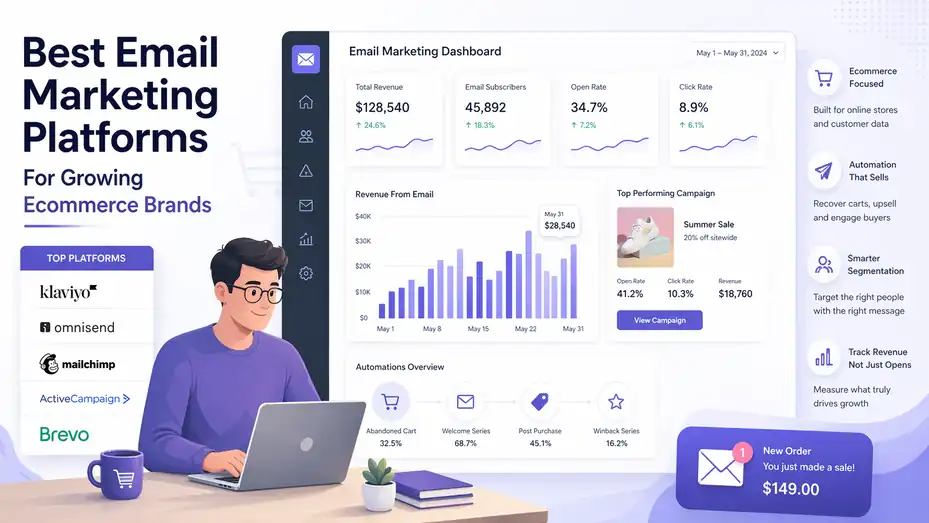
Email marketing platforms for growing ecommerce brands can look surprisingly similar at first, and that is exactly why so many stores pick the wrong one. You see a few templates, some automation claims, maybe an SMS add-on, and it all starts blending together.
But once your list grows, your catalog gets bigger, and your campaigns need to drive real revenue, the differences become very real.
In this guide, I’ll walk you through what actually matters, how the leading platforms compare, and which option tends to fit different stages of ecommerce growth best.
What Growing Ecommerce Brands Actually Need From An Email Platform
As your store grows, your email platform stops being a newsletter tool and becomes part of your revenue engine.
The right platform should help you capture subscribers, segment customers, automate lifecycle messaging, and turn behavior data into timely campaigns.
Ecommerce Features Matter More Than Generic Email Features
A lot of brands outgrow general email software because ecommerce marketing depends on live store data. You do not just need a campaign builder. You need product feeds, order events, customer behavior tracking, revenue attribution, and automations tied to actions like viewed product, started checkout, purchased, or went inactive.
That is why ecommerce-first platforms keep winning attention from growth-focused brands. Klaviyo positions itself around real-time ecommerce integrations and personalized email and SMS based on customer, product, and order data.
Omnisend focuses on ecommerce-native email and SMS with built-in templates, automations, and platform integrations for Shopify, WooCommerce, and more. Shopify also offers its own email and automation tools directly inside the admin, which can be enough for simpler setups.
In my experience, this is where many teams make the biggest mistake: they compare platforms by editor design instead of data depth. A nice drag-and-drop builder is helpful, but it will not save a weak segmentation engine.
A growing brand usually needs these capabilities most:
- Product and order sync in near real time
- Customer segmentation based on behavior and purchase history
- Automated flows for welcome, cart, browse, post-purchase, and win-back
- Revenue reporting tied to campaigns and automations
- Onsite capture tools like popups and forms
- SMS or other retention channels when the brand is ready
If a platform cannot handle those well, you will feel it fast once your revenue depends on retention instead of first-purchase acquisition.
Why Email Still Matters So Much For Ecommerce Growth
Email remains one of the highest-leverage owned channels because you are not renting attention the way you do with paid ads. HubSpot’s 2026 marketing statistics cite a 2.8% conversion rate for B2C email marketing, and recent benchmark summaries point to average open rates above 40% across industries.
At the same time, automation tends to outperform one-off campaigns by a wide margin. Omnisend says automated emails converted 2,361% better than campaign emails in its 2026 statistics roundup.
That tracks with what most ecommerce operators already feel in the numbers. A strong welcome flow, cart recovery flow, and post-purchase flow often outperform social content and broad promotional blasts because the intent is already there.
Imagine you run a skincare brand doing $80,000 a month. Paid ads bring in first-time buyers, but your margins are getting squeezed. Once you add proper email segmentation and lifecycle flows, you can lift repeat purchase rate without paying again for the click.
That is why platform choice matters so much: the software shapes how easily you can turn customer data into repeat revenue.
How Email Marketing Platforms For Ecommerce Differ
The market is crowded, but the platforms do not all compete on the same thing. Some are built around ecommerce retention. Others are broader marketing tools that can support ecommerce with extra setup. A few are best when cost control is your main priority.
The Four Main Platform Types
I find it helpful to group platforms into four buckets.
1. Ecommerce-first platforms: Klaviyo, Omnisend, and Drip are the clearest examples. These tools are built to sync store data deeply, support revenue-focused automations, and make product-driven campaigns easier. Drip describes itself as a platform for B2C businesses selling physical or digital goods online, while Klaviyo and Omnisend both lead with ecommerce and multichannel retention.
2. General email platforms with ecommerce support: Mailchimp and Brevo fit here. They can absolutely work, especially for lean teams, but their core identity is broader than ecommerce retention. You can build campaigns and automations, but the experience may feel less purpose-built once your segmentation gets more advanced.
3. Automation-heavy platforms: ActiveCampaign sits in an interesting middle ground. It is not as ecommerce-native in positioning as Klaviyo or Omnisend, but it is very strong in automation logic, CRM-style workflows, and complex customer journeys. It also connects with over 1,000 apps.
4. Native store tools: Shopify Email is the cleanest example. It is inexpensive, tightly connected to Shopify, and convenient inside the admin. But it is usually best for brands that want simplicity over depth.
This distinction matters because “best” depends on what is breaking first in your business: complexity, budget, team size, or growth ceiling.
The Real Tradeoffs Behind Features, Pricing, And Ease Of Use
Most growing brands are balancing three things at once: better automation, affordable pricing, and a team that can actually use the tool well.
Klaviyo tends to be the benchmark for ecommerce depth. Omnisend is often the value-driven ecommerce alternative. Mailchimp is widely known and easy to start with, but costs and list structure can become frustrating as stores scale. Shopify Email is cheap and simple, but not as deep.
ActiveCampaign is attractive when you want stronger automation logic and broader CRM capabilities. Brevo is interesting for brands that prefer send-volume-based economics over contact-heavy pricing.
From what I’ve seen, the hidden cost is rarely the monthly subscription alone. It is the operational drag. If your team struggles to build segments, trusts reporting less, or cannot launch flows quickly, the platform gets expensive even before the invoice does.
A cheaper tool that takes twice as long to use is not actually cheaper.
Best Platforms Compared At A Glance
This section gives you the fast answer. Then I’ll break each platform down in more detail.
| Platform | Best For | Core Strength | Main Limitation | Pricing Signal |
|---|---|---|---|---|
| Klaviyo | Scaling DTC and retention-led brands | Deep ecommerce data, segmentation, attribution | Can get expensive as contacts grow | Free plan available; paid pricing scales by contacts and channels |
| Omnisend | Growth brands wanting ecommerce depth with strong value | Ecommerce-native email + SMS, templates, automation | Less “industry default” mindshare than Klaviyo | Free plan available; standard pricing publicly listed on site |
| Shopify Email | Shopify stores wanting simplicity | Native setup, low cost, easy launch | Shallower than dedicated platforms | First 10,000 emails/month free, then usage-based pricing |
| Mailchimp | Small brands wanting a familiar starter tool | Known interface, broad feature set | Ecommerce specialization is weaker | Free tier with low contact cap; paid plans scale by contacts and sends |
| ActiveCampaign | Teams needing advanced automation | Deep workflow logic, CRM-style automation | Less ecommerce-first feel | Plans start from publicly listed tiers and tailored packages |
| Drip | DTC brands focused on lifecycle retention | Ecommerce-oriented automation and segmentation | Less mainstream ecosystem visibility | Sales-led pricing emphasis; positioned for B2C sellers online |
| Brevo | Cost-conscious teams with bigger send needs | Send-volume pricing, multichannel basics | Less ecommerce-native than leaders | Starter plan begins from 5,000 emails/month |
My Honest Take On The Shortlist
If you want the simplest shortlist, here is how I would frame it.
Klaviyo is still the default answer for many serious ecommerce teams because it combines deep data, mature segmentation, and strong reporting.
Omnisend is the platform I would look at closely if you want many of the same ecommerce essentials with a more value-conscious approach.
Shopify Email is a good fit when your store is still operationally simple and you want to avoid overbuying.
ActiveCampaign is powerful when your customer journeys need more complex logic.
Mailchimp can work for smaller brands, but I would be careful about long-term fit for fast-growing ecommerce
Drip is still relevant for lifecycle-focused DTC brands, especially those that like a retention-first mindset.
That does not mean one platform wins for everybody. It means each has a “best use case,” and your job is to match the tool to your next 12 to 24 months, not just your current subscriber count.
Klaviyo: Best For Data-Driven Ecommerce Retention
Klaviyo has become the benchmark for a reason. It is built around customer data, store events, and personalization at the level most ecommerce brands eventually want.
Where Klaviyo Stands Out
Klaviyo’s core advantage is how tightly it connects ecommerce data to campaigns and automations. Its ecommerce integrations are designed to pull in platform and historical data, and Klaviyo highlights native integrations with platforms like Shopify plus connectors for payments, analytics, messaging, and AI tools. That creates a strong foundation for behavioral segmentation and revenue attribution.
For a growing brand, that means you can build segments like:
- Customers who bought twice in 90 days but skipped the new collection
- First-time buyers with high average order value
- Browsers of a specific category who have not purchased
- VIP customers at risk of churn
That kind of segmentation is where ecommerce email starts feeling less like “sending newsletters” and more like portfolio management for customer value.
Klaviyo also publishes 2026 benchmarks using data from more than 183,000 customers, which matters because benchmarking is most useful when the sample is large and ecommerce-specific. For teams that care about measurement, that makes the platform especially attractive.
Where Klaviyo Can Feel Expensive Or Heavy
The downside is not that Klaviyo is bad. It is that it can be more than some brands need, especially early on. Pricing scales by contacts and channel usage, and while there is a free plan, costs rise with list growth. That is reasonable given the depth, but it is still something to model before migrating.
I suggest being especially careful if your list hygiene is messy. A platform built around contact-based pricing rewards disciplined suppression, pruning, and segmentation. If your database is bloated with inactive subscribers, the invoice can become a wake-up call.
Klaviyo is best when you know you will use the depth. If you are planning advanced lifecycle marketing, product-led segmentation, and revenue reporting tied to flows, the tool earns its keep. If you are mainly sending two promotional campaigns a week and a basic cart reminder, it may be overkill.
Omnisend: Best Value For Ecommerce Brands That Want Fast Results
Omnisend has become one of the strongest options for brands that want ecommerce-specific functionality without immediately stepping into the most premium-feeling pricing curve.
Why Omnisend Is So Appealing To Growth Brands
Omnisend positions itself directly around ecommerce email and SMS, and its messaging is very clear: this is built for online stores, not adapted for them later. It emphasizes deep integrations with Shopify, WooCommerce, BigCommerce, and Wix, plus product sync and automation templates for ecommerce use cases.
Omnisend also claims returns of $79 for every $1 spent, which is a strong headline metric, even if your own results will vary.
What I like about Omnisend for growth-stage brands is the operational speed. Many ecommerce teams do not need the most complex theoretical automation engine. They need something the team can launch this month. Omnisend leans into templates, forms, popups, campaign building, and automations designed around real store workflows.
This matters if you are a lean team. Imagine a two-person marketing department running a home decor store. You probably do not want to spend weeks designing a retention system from scratch. You want welcome, cart, browse, post-purchase, and win-back flows live quickly, then refined over time.
Where Omnisend Fits Best And Where It Does Not
Omnisend is especially compelling for Shopify and WooCommerce merchants who want a strong ecommerce feature set with a practical setup experience. Its public pricing page also makes it easier to estimate costs early.
The main question is whether your team needs the absolute deepest ecosystem and “default-market-leader” perception that Klaviyo carries. Some larger brands or agencies still standardize around Klaviyo because of familiarity, hiring availability, or process maturity. That does not make Omnisend weaker for every store. It just means perception and ecosystem gravity still matter in some organizations.
For many growing stores, though, Omnisend hits a sweet spot: ecommerce-native, relatively accessible, multichannel, and easier to justify on value.
Shopify Email: Best For Brands That Need Simplicity First
Shopify Email is easy to underestimate because it feels basic compared to dedicated retention platforms. But for the right brand, basic is not a weakness. It is the reason the tool works.
When Shopify Email Is The Smart Move
Shopify Email is tightly integrated into Shopify, which removes a lot of friction. You are already working in the admin, your customer and product data are there, and your first 10,000 emails each month are free.
After that, pricing is usage-based, starting at $1 per 1,000 additional emails up to certain thresholds, then dropping at higher volumes.
For a newer or smaller store, that can be extremely attractive. You avoid another tool, another integration layer, another training curve, and another monthly bill structure based on contacts.
I believe Shopify Email is most attractive when all of these are true:
- You are on Shopify already
- Your team is small
- Your campaign calendar is simple
- Your automations are still fairly basic
- Your main goal is getting consistent, not getting fancy
There is a lot of wisdom in choosing the tool you will actually use well.
Where Shopify Email Starts To Show Its Limits
As your retention program matures, Shopify Email can start feeling narrow. Shopify itself frames its broader automation stack as a suite of marketing automation tools to help personalize and automate workflows, which hints at the reality: native simplicity is useful, but dedicated platforms often provide more depth for segmentation, multichannel orchestration, and advanced reporting.
A common scenario looks like this: A brand starts on Shopify Email, gets the basics in place, and then migrates once subscriber growth, catalog complexity, or lifecycle ambitions expand. That is not failure. It is normal progression.
I would not dismiss Shopify Email. I would just treat it honestly. It is a strong early-stage option, not always the best long-term platform for aggressive ecommerce retention.
Mailchimp, ActiveCampaign, Drip, And Brevo: Who They Are Best For
Not every growing brand should default to Klaviyo or Omnisend. The broader field still has good options, especially if your business model or team structure is a little different.
Mailchimp: Familiar And Easy, But Watch Long-Term Fit
Mailchimp remains one of the most recognizable names in email marketing. Its pricing page shows a free option with a small contact cap and paid plans that scale with contacts and send limits. It also supports automation flows and SMS add-ons on some plans.
That familiarity helps. New teams can get started quickly, agencies know the product, and the learning curve is usually manageable.
The problem for growing ecommerce brands is not that Mailchimp cannot send emails. It is that as you need more ecommerce-native segmentation and cleaner retention reporting, it can feel less purpose-built. ActiveCampaign’s 2026 comparison guide also notes that Mailchimp pricing scales significantly with list size, which matches a common complaint from brands that grow faster than expected.
Mailchimp fits best when your store is still relatively light on lifecycle sophistication and your team values brand familiarity.
ActiveCampaign: Strong For Automation-Centric Teams
ActiveCampaign is best for brands that think in workflows, branching logic, CRM actions, and complex customer journeys. It highlights over 1,000 integrations and publicly positions plans around automation and scaling. Its comparison pages also show example entry pricing for 1,000 contacts and higher tiers that unlock broader omnichannel capabilities.
If your brand sells through more than one path, say ecommerce plus lead nurture plus wholesale follow-up, ActiveCampaign gets more interesting. The platform is not as “ecommerce-only” in feel, but that broader automation DNA can be a real advantage.
I would lean toward ActiveCampaign when your retention strategy is tightly connected to CRM-style logic rather than pure catalog merchandising.
Drip: Still A Solid DTC Retention Choice
Drip continues to position itself as a marketing automation platform for B2C brands selling physical or digital goods online. That is a good fit for stores that care deeply about lifecycle messaging, customer journeys, and retention-driven growth.
Drip is often respected by operators who want a tool aligned with DTC thinking. It may not have the same level of mainstream momentum as the top two ecommerce-first players right now, but it still deserves a place on the shortlist for brands that want a retention-centric platform.
Brevo: Good For Budget-Sensitive Teams With Bigger Send Volume
Brevo’s pricing starts from 5,000 emails per month on its Starter tier, which makes it appealing for teams that think more in terms of send volume than stored contacts.
That can be a real advantage if your list is broad but your sending cadence is controlled. Brevo is often a smarter fit for cost control than for advanced ecommerce-native retention. So I would put it in the “budget-efficient generalist” category rather than the “ecommerce growth leader” category.
How To Choose The Right Platform For Your Brand Stage
This is the part most comparison articles skip. You are not choosing software in a vacuum. You are choosing based on stage, team, and growth direction.
Match The Tool To Your Next Bottleneck
Here is the simplest decision framework I know.
If your bottleneck is getting started: Shopify Email or Mailchimp may be enough. Ease matters more than sophistication at this stage.
If your bottleneck is retention growth: Klaviyo or Omnisend usually make more sense because they are built around ecommerce behavior, segmentation, and lifecycle automation.
If your bottleneck is automation complexity across channels: ActiveCampaign deserves a hard look.
If your bottleneck is budget efficiency: Brevo or Shopify Email may give you a softer cost structure.
The mistake is buying for your ego instead of your bottleneck. A smaller brand does not need the most advanced system just to look serious. A fast-scaling brand should not cling to a starter tool just because migration sounds annoying.
A Practical Selection Checklist
I recommend scoring each platform against these questions:
- Does it integrate deeply with your store platform and stack?
- Can it handle the automations you need in the next year?
- Is segmentation strong enough for behavior-based campaigns?
- Can your team launch and maintain campaigns without outside help?
- Is pricing sustainable as contacts grow?
- Does reporting clearly connect email activity to revenue?
That last point matters more than people think. Good reporting changes behavior. When your team can see what welcome flows, cart recovery, replenishment, and win-back sequences are actually generating, the channel gets more investment and better execution.
Step-By-Step Setup For Winning With Any Ecommerce Email Platform
The platform matters, but setup matters more than most people want to admit. Even the best software underperforms when the foundation is weak.
Step 1: Clean Your Data And Connect Your Store Properly
Before you build a single campaign, make sure the integration is syncing customer, order, product, and event data correctly. Klaviyo and Omnisend both emphasize real-time ecommerce data connections. Shopify’s native tools obviously reduce this setup friction if you stay inside Shopify.
Then clean your list. Remove fake signups, suppress long-term inactive profiles where appropriate, and make sure you understand consent rules by region.
I suggest doing this before you migrate templates or launch automations. Otherwise, you risk bringing old problems into a new platform.
Step 2: Build The Core Flows Before Sending More Campaigns
This is where real revenue usually starts.
Your first automation set should include:
- Welcome series
- Abandoned cart
- Browse abandonment
- Post-purchase follow-up
- Win-back or reactivation
Omnisend’s own 2026 statistics highlight just how much stronger automated emails can perform compared with campaign sends. That is why I usually tell brands not to obsess over weekly newsletters until these flows are in place.
A realistic example: If your cart recovery flow converts even a small fraction of abandoned checkouts and your welcome flow lifts first-purchase conversion from subscribers, those systems can outperform several standard campaigns every month.
Step 3: Segment By Behavior, Not Just Demographics
Most underperforming programs segment too softly. They group people by broad audience traits instead of shopping behavior.
Better segments usually include:
- New subscribers with no purchase
- First-time buyers
- Repeat buyers
- High AOV customers
- Discount-sensitive shoppers
- Lapsed customers
- Category-specific interest groups
Shopify’s 2026 enterprise content on segmentation reinforces the value of smarter segmentation for higher-volume ecommerce stores. That lines up with the broader 2026 trend toward behavior-based personalization and automation.
This is where growing brands move from broadcasting to relevance.
Common Mistakes That Hold Ecommerce Brands Back
Even a good platform cannot protect you from bad execution. Most weak results come from a handful of repeated mistakes.
Choosing Based On Price Alone
Cheap software can get expensive in other ways. If your tool limits segmentation, slows campaign production, or makes reporting vague, you will feel that cost in lost revenue.
I have seen stores save a few hundred dollars per month on software and lose thousands in performance because the team stopped using advanced lifecycle messaging. That is not a bargain. That is a hidden tax on growth.
Pricing still matters, of course. Shopify Email’s usage-based structure and Brevo’s volume-based entry point can make a lot of sense. But the platform should match your growth model, not just your current budget anxiety.
Sending Too Many Campaigns And Ignoring Lifecycle
A lot of ecommerce teams overspend energy on batch campaigns because they are visible and immediate. But automated lifecycle email is often where the highest intent lives.
HubSpot’s recent email stats and Omnisend’s automation data both reinforce the same idea: performance improves when messages are more relevant and better timed.
If your calendar is packed with promotions but your welcome flow is weak, your priorities are upside down.
Keeping Weak Segments And Bloated Lists
List quality affects cost, engagement, and deliverability. A bloated list does not just waste money on contact-based platforms. It also teaches inbox providers that people are ignoring you.
That is why list hygiene is not housekeeping. It is performance strategy.
Optimization Strategies After You Pick A Platform
Once your platform is live, the real work begins. Winning brands keep refining the machine instead of assuming setup alone is enough.
Focus On Revenue Per Recipient, Not Just Open Rate
Open rate still has directional value, and benchmark roundups remain useful for context. But revenue per recipient, click rate, conversion rate, and flow-specific revenue tell a clearer story.
HubSpot’s 2026 email marketing stats cite average revenue per recipient around $2.05 in benchmark discussions, which is more commercially useful than open rate alone.
Here is how I think about it:
- Open rate tells you whether the message earned attention
- Click rate tells you whether the content created interest
- Conversion rate tells you whether the landing and offer worked
- Revenue per recipient tells you whether the email actually mattered to the business
A platform that makes those metrics visible will help your team improve faster.
Improve One Flow At A Time
Do not optimize everything at once. Pick one high-impact flow, usually welcome or cart recovery, and improve it methodically.
Test:
- Subject lines
- Delay timing
- Offer structure
- Product blocks
- Social proof
- Plain text vs designed emails
- Segment-specific variants
This sounds simple, but it compounds. A 10% lift in a high-volume flow can outperform a month of campaign tinkering.
Build For Mobile And Accessibility
Shopify’s 2026 email trend roundup highlights mobile-first design and accessibility as practical priorities. That is not just a design preference. It affects readability, click behavior, and subscriber experience.
I recommend short paragraphs, clear buttons, fast-loading creative, and layouts that still make sense when images are blocked.
Advanced Tips For Scaling Beyond The Basics
Once your core flows and campaigns are stable, your next gains usually come from smarter orchestration and deeper customer value strategy.
Layer In Channel Coordination Carefully
Many of the leading platforms now pair email with SMS or broader multichannel options. Klaviyo, Omnisend, Mailchimp, and Brevo all promote multichannel functionality in different ways.
That said, I would not rush into every channel at once. Add SMS when you have:
- Clear consent processes
- Strong email foundations
- A good reason for urgency or timing
- A team that can maintain message quality
Otherwise, you just create more noise across more channels.
Use Benchmarks Without Becoming Average
Benchmarks are useful, but they can also make teams complacent. Klaviyo publishes industry benchmarks from a large ecommerce sample, and broad market summaries give directional targets for opens and clicks. Use them to spot weakness, not to cap ambition.
If your category average says 42% opens, that does not mean 43% is success. It means you now know where “normal” sits. Your goal is to beat normal through stronger relevance, better segmentation, and better offers.
Think In Terms Of Customer Lifetime Value
The best ecommerce email programs are not just recovering abandoned carts. They are increasing repeat purchase rate, average order value, purchase frequency, and retention window.
That is why I believe the right email platform should be evaluated partly on how well it supports customer lifetime value strategy. Good segmentation and automation help you stop treating every shopper the same. And once that happens, the brand starts to feel more personal without needing more manual work.
Final Verdict: Which Email Marketing Platform Is Best For Growing Ecommerce Brands?
For most growing ecommerce brands, the best email marketing platforms are the ones that combine strong ecommerce data, solid automation, clear reporting, and pricing you can still justify six months from now.
If you want the strongest all-around ecommerce retention platform, Klaviyo is still one of the safest recommendations because of its data depth, integrations, and mature ecosystem.
If you want an ecommerce-native platform with a very strong value proposition and faster time to execution, Omnisend is one of the best options on the market.
If you are early-stage and want simplicity, Shopify Email is the easiest low-friction starting point. If your business needs heavier automation logic, ActiveCampaign deserves serious attention. And if budget structure matters more than ecommerce specialization, Brevo can be a smart alternative.
My practical advice is simple: Choose the platform that matches your next stage of growth, not just today’s comfort zone. The winner is not the tool with the longest feature page. It is the one your team can use to turn subscriber attention into repeat revenue, consistently.
FAQ
What are the best email marketing platforms for growing ecommerce brands?
The best email marketing platforms for growing ecommerce brands include tools built for store data, automation, and segmentation. Platforms like Klaviyo and Omnisend are strong for retention, while Shopify Email works for simpler needs. The right choice depends on your growth stage, budget, and how advanced your email strategy needs to be.
How do I choose the right ecommerce email marketing platform?
To choose the right platform, focus on your current bottleneck. If you need better automation and segmentation, pick an ecommerce-first tool. If simplicity matters, go with a native or basic platform. Consider integrations, pricing as your list grows, and how easily your team can use the system daily.
Why is email marketing important for ecommerce growth?
Email marketing helps ecommerce brands increase repeat purchases without paying for new traffic. It allows you to build relationships, send targeted offers, and recover lost sales through automation. Since you own your email list, it becomes a reliable revenue channel compared to paid ads or social platforms.
What features should ecommerce email platforms have?
Ecommerce email platforms should include customer segmentation, automation flows, product syncing, and revenue tracking. Features like abandoned cart recovery, post-purchase emails, and personalized campaigns are essential. These tools help you send relevant messages based on behavior, improving conversions and long-term customer value.
Is it worth switching email platforms as my ecommerce store grows?
Yes, switching email platforms can be worth it if your current tool limits growth. As your store scales, you may need better automation, deeper segmentation, and clearer reporting. Migrating can improve performance, but it is important to plan carefully to avoid losing data or disrupting campaigns.

Juxhin B is a digital marketing researcher and founder of JAK Digital Hub, specializing in email marketing software, marketing automation platforms, and digital growth tools. His work focuses on software testing, platform comparisons, and real-world performance analysis to help businesses choose the right marketing technology.
Related posts:
 7 Better Email Marketing Tools For Ecommerce Growth
 Moosend Alternatives for Small Business: What Works Better?
 Is AWeber Worth The Price Or Are There Better Value Email Tools?
 Free Email Marketing For Ecommerce: 7 Tools That Sell
 Email Marketing Platforms Comparison For Ecommerce: Real Winners
 How To Choose Email Marketing Platforms For Ecommerce Smartly