Table of Contents
Some links on JAK Digital Hub are affiliate links, meaning we may earn a small commission at no extra cost to you. Read full disclaimer.
Finding the best email automation tool for affiliate marketers can completely change how your affiliate business grows. Email is still one of the highest-ROI marketing channels—according to the Data & Marketing Association, email marketing generates an average return of $36 for every $1 spent.
But here’s the challenge most affiliate marketers face: sending manual emails quickly becomes impossible once your list starts growing.
That’s where an email automation tool for affiliate marketers becomes essential.
Instead of sending campaigns manually, automation tools allow you to:
- Automatically send welcome sequences
- Promote affiliate products through automated funnels
- Segment subscribers based on behavior
- Track clicks, sales, and engagement
In this guide, I’ll walk you through the best email automation tools for affiliate marketers, how they work, how to set them up, and how to choose the right one depending on your business stage.
What Is an Email Automation Tool for Affiliate Marketers?
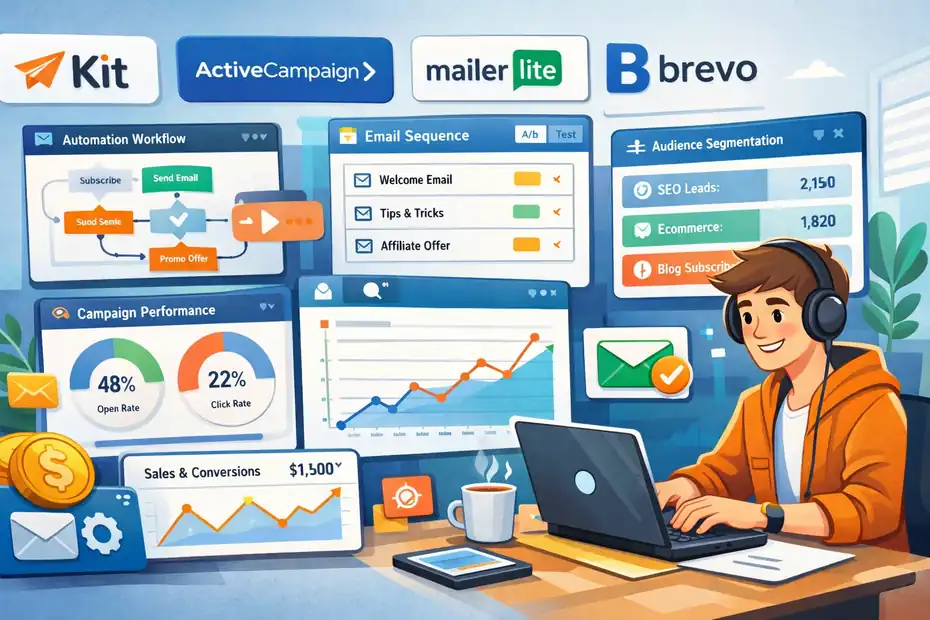
An email automation tool for affiliate marketers is software that automatically sends targeted emails to subscribers based on triggers, behavior, or schedules. Instead of sending each email manually, the system runs campaigns for you in the background.
Affiliate marketers rely heavily on automation because affiliate income often comes from long-term nurturing, not just one email promotion.
How Email Automation Works in Affiliate Marketing
At a basic level, automation tools use triggers and sequences.
A trigger is an action taken by a subscriber. Examples include:
- Joining your email list
- Clicking an affiliate link
- Downloading a lead magnet
- Visiting a specific page
Once a trigger happens, the automation platform sends a pre-written sequence of emails.
For example:
- A user downloads a free guide about SEO.
- They automatically receive a 5-email sequence.
- The sequence teaches SEO strategies.
- The final email promotes an affiliate SEO tool.
This process runs automatically for every new subscriber.
In my experience, the biggest advantage is consistency. Even if you stop writing emails for a week, your automated sequences continue nurturing and promoting affiliate offers.
Why Email Automation Is Essential for Affiliate Revenue
Many beginners rely on social media traffic or blog posts alone. The problem is simple: you don’t control those platforms.
Email gives you direct access to your audience.
Here’s why automation is particularly powerful for affiliate marketers:
- Scalable promotions: A single sequence can promote affiliate products to thousands of subscribers.
- Personalized targeting: You can send different offers based on subscriber interests.
- Higher conversions: Automated nurture emails build trust before presenting offers.
- Passive revenue potential: Once your funnel works, it generates commissions automatically.
For example, imagine you promote a $50 software product with a 30% commission. If your email sequence converts just 2% of 5,000 subscribers, that’s:
100 sales × $15 commission = $1,500 from one sequence.
That’s why choosing the right email automation tool for affiliate marketers matters so much.
Key Features Affiliate Marketers Need in an Email Automation Tool
Not all email platforms are affiliate-friendly. Some tools are designed mainly for ecommerce stores or newsletters.
Affiliate marketers should prioritize features that support automation funnels, segmentation, and tracking.
Automation Sequences and Drip Campaigns
Automation sequences are the core feature of any email automation tool for affiliate marketers.
A drip campaign is a series of pre-scheduled emails sent automatically over time.
Typical affiliate email sequences include:
- Welcome sequence
- Educational email series
- Product recommendation funnel
- Case study sequence
- Re-engagement campaigns
Here’s a simple example of a 5-email affiliate funnel:
| Purpose | |
|---|---|
| Email 1 | Welcome + lead magnet delivery |
| Email 2 | Educational content |
| Email 3 | Personal story or case study |
| Email 4 | Soft product recommendation |
| Email 5 | Strong affiliate promotion |
From what I’ve seen, affiliate marketers who build structured sequences often see 2–5x higher conversions than single promotional emails.
Subscriber Segmentation and Tagging
Segmentation allows you to send emails only to specific groups of subscribers.
Instead of emailing your entire list, you can target based on behavior.
Common segmentation methods include:
- Click behavior
- Purchase intent
- Interests
- Traffic source
- Engagement level
For example, imagine someone clicks a link about SEO tools in your email.
You can automatically tag them as “SEO Interest”.
Later, you can send:
- SEO tool reviews
- SEO course promotions
- Affiliate SEO software offers
This level of targeting increases conversion rates significantly.
Affiliate Link Tracking and Click Analytics
Affiliate marketers rely heavily on link tracking.
The best automation tools provide detailed analytics such as:
- Email open rates
- Click-through rates
- Link performance
- Subscriber activity
- Conversion tracking
This data helps you answer questions like:
- Which email generated the most clicks?
- Which affiliate product converts best?
- Which subject lines increase open rates?
For instance, if Email #3 consistently drives most clicks, you can test placing affiliate promotions earlier in the sequence.
Best Email Automation Tools for Affiliate Marketers in 2026
Now let’s look at the platforms that affiliate marketers commonly rely on today. Each tool serves slightly different needs depending on your experience level and budget.
Kit (Formerly ConvertKit)
Kit is widely considered one of the most affiliate-friendly email platforms available today.
The platform was originally built for bloggers and creators, which makes it particularly popular among affiliate marketers.
Some of its most useful features include:
- Visual automation builder
- Subscriber tagging and segmentation
- Landing page and form builder
- Email sequences
- Affiliate-friendly policies
What I personally like about Kit is the simplicity of its automation builder. You can visually map your funnels without needing technical knowledge.
Pricing typically starts around $15/month for beginners, scaling as your list grows.
If you’re running a blog, YouTube channel, or niche site, Kit is often one of the easiest platforms to start with.
ActiveCampaign
ActiveCampaign is one of the most powerful automation platforms available.
It’s best suited for affiliate marketers who want advanced automation workflows and segmentation.
Key capabilities include:
- Advanced automation builder
- Behavioral tracking
- Conditional email logic
- Deep segmentation
- CRM integration
For example, you can build complex workflows like:
- If subscriber clicks affiliate link → tag as “interested”
- If they open three emails → send special bonus offer
- If they ignore emails → move to re-engagement sequence
This level of automation can dramatically increase conversion rates.
However, the platform is more complex than beginner tools.
Pricing usually starts around $29/month depending on features.
Brevo (Formerly Sendinblue)
Brevo is a popular budget-friendly email automation tool.
Unlike many competitors, Brevo prices its plans based on emails sent rather than list size, which can make it cheaper for growing lists.
Useful features include:
- Email automation workflows
- SMS marketing integration
- Visual campaign builder
- Advanced reporting
- Transactional email capabilities
For affiliate marketers running multiple sites or funnels, Brevo’s flexible pricing can make it appealing.
However, its automation builder is slightly less intuitive than some competitors.
MailerLite
MailerLite is often recommended for beginners because it combines simplicity with powerful automation features.
The platform includes:
- Visual automation workflows
- Landing page builder
- Email campaign builder
- Subscriber segmentation
- Affiliate-friendly policies
One reason many new affiliate marketers start with MailerLite is its generous free plan, which supports up to 1,000 subscribers.
This allows beginners to test email funnels before committing to paid plans.
How to Set Up Email Automation for Affiliate Marketing
Setting up automation might sound technical at first, but once you understand the process it’s surprisingly straightforward.
Let me break it down step-by-step.
Step 1: Create a Lead Magnet
A lead magnet is something valuable you give away in exchange for an email address.
Examples include:
- Free ebook
- Checklist
- Mini course
- Template
- Resource list
For affiliate marketing, your lead magnet should naturally connect to the product you plan to promote.
Example:
If you promote SEO tools, your lead magnet might be: “10-Step SEO Checklist for New Bloggers.”
This attracts subscribers already interested in SEO software.
Step 2: Build an Email Funnel
Once subscribers join your list, they should enter an automated email funnel.
A simple affiliate funnel might look like this:
- Day 1: Welcome email
- Day 2: Educational email
- Day 4: Personal experience story
- Day 6: Affiliate product introduction
- Day 8: Case study or testimonial
- Day 10: Final promotion email
I’ve found that storytelling works particularly well in affiliate funnels.
Instead of saying “Buy this tool,” you explain how you personally solved a problem using it.
Step 3: Add Affiliate Offers Naturally
This is where many affiliate marketers go wrong.
Sending constant promotional emails often leads to:
- Low open rates
- Unsubscribes
- Spam complaints
A better approach is the 80/20 value rule.
Roughly:
- 80% helpful content
- 20% promotional content
For example, if you’re promoting an SEO tool:
- Email 1: SEO strategy tips
- Email 2: Keyword research tutorial
- Email 3: Personal SEO case study
- Email 4: Introduce the SEO tool you use
This builds trust before asking readers to buy.
Common Mistakes Affiliate Marketers Make with Email Automation
Even experienced marketers sometimes misuse automation.
Avoiding these mistakes can significantly improve your results.
Promoting Too Many Products
Promoting dozens of affiliate products often weakens your authority. Subscribers begin to feel like every email is a sales pitch.
Instead, focus on a small number of trusted products.
In my experience, most successful affiliate marketers rely on 5–10 core products rather than hundreds of random offers.
Ignoring Email List Segmentation
If every subscriber receives the same promotions, conversions suffer.
Someone interested in blogging tools may not care about:
- eCommerce software
- social media automation
- crypto platforms
Segmenting subscribers ensures they only receive relevant offers.
This improves engagement and reduces unsubscribe rates.
Over-Automating Without Personal Emails
Automation should support your email marketing—not replace your voice.
Some marketers rely entirely on automated sequences and stop sending personal broadcasts.
I’ve noticed that audiences respond much better when automation is combined with occasional personal emails such as:
- updates
- new blog posts
- personal experiences
- behind-the-scenes insights
This keeps your brand feeling human instead of robotic.
Advanced Email Automation Strategies for Affiliate Marketers
Once your basic funnels are running, you can start optimizing for higher conversions.
Behavioral Email Automation
Behavioral automation triggers emails based on subscriber actions.
Examples include:
- Clicking affiliate links
- visiting product review pages
- watching webinar replays
- abandoning checkout pages
These signals reveal high purchase intent.
Sending targeted follow-up emails to these users often produces much higher conversions.
Affiliate Bonus Funnels
A bonus funnel offers an extra incentive for subscribers who buy through your affiliate link.
Examples include:
- exclusive training
- templates
- private communities
- bonus guides
This strategy works because it gives readers a reason to purchase through your link instead of someone else’s.
Evergreen Affiliate Funnels
An evergreen funnel continuously promotes an affiliate product to new subscribers.
Instead of launching promotions manually, the sequence runs automatically.
For example:
- Subscriber joins list.
- They enter a 7-day educational sequence.
- The final emails promote the affiliate product.
Once optimized, these funnels can generate consistent monthly affiliate commissions.
Final Thoughts
Choosing the right email automation tool for affiliate marketers can dramatically impact how your affiliate business grows.
The best platforms make it easy to:
- build automated email funnels
- segment subscribers
- track affiliate link performance
- scale promotions without manual work
If you’re just getting started, beginner-friendly platforms like MailerLite or Kit are often the easiest entry point.
If you want advanced automation and deeper segmentation, ActiveCampaign offers powerful capabilities for scaling affiliate funnels.
What matters most isn’t just the tool—it’s the system you build with it.
A well-designed email funnel can quietly generate affiliate commissions for months or even years after you create it.
And from what I’ve seen, that’s where email automation becomes one of the most powerful assets an affiliate marketer can build.
FAQ
What is an email automation tool for affiliate marketers?
An email automation tool for affiliate marketers is software that automatically sends targeted emails to subscribers based on triggers such as sign-ups, clicks, or behavior. It helps affiliates promote products, nurture leads, and generate commissions without manually sending every email.
Why do affiliate marketers need email automation?
Affiliate marketers use email automation to build relationships with subscribers, deliver educational content, and promote affiliate offers automatically. Automated email funnels can generate consistent commissions while saving time and scaling marketing efforts as the email list grows.
What features should an email automation tool for affiliate marketers have?
The best email automation tool for affiliate marketers should include automation workflows, subscriber segmentation, tagging, email sequences, and click tracking. These features help marketers personalize campaigns, track performance, and send relevant affiliate promotions to targeted audiences.
Which email automation tool is best for affiliate marketing beginners?
Beginner affiliate marketers often choose tools like Kit or MailerLite because they are easy to use and offer visual automation builders. These platforms allow new marketers to create email funnels, manage subscribers, and promote affiliate products without technical complexity.
How does email automation increase affiliate sales?
Email automation increases affiliate sales by sending strategic email sequences that educate subscribers, build trust, and introduce affiliate products naturally. Automated funnels nurture leads over time, making subscribers more likely to click affiliate links and purchase recommended products.

Juxhin B is a digital marketing researcher and founder of JAK Digital Hub, specializing in email marketing software, marketing automation platforms, and digital growth tools. His work focuses on software testing, platform comparisons, and real-world performance analysis to help businesses choose the right marketing technology.
Related posts:
 Cheaper Email Automation System For Growing List Fast
 Email Automation Tools for 100k Subscribers: Best Value Picks
 Best Email Automation System That Scales Affordably
 Email Automation Tools for New Ecommerce Store: What to Start With
 Email Automation Tools Not Triggering? Fix the Issue Fast
 Best Email Automation Platform For Scaling Business Fast