Table of Contents
Some links on JAK Digital Hub are affiliate links, meaning we may earn a small commission at no extra cost to you. Read full disclaimer.
Email marketing has evolved far beyond simple newsletters. If you’re running advanced sales journeys, webinars, product launches, or multi-step lead nurturing systems, choosing the right email automation platform for complex funnels becomes critical. The wrong platform can slow down your campaigns, break automation logic, or limit personalization when your funnel grows.
I’ve seen this happen many times: a business starts with a basic email tool, builds a few simple sequences, and everything works fine—until the funnel gets complicated. Suddenly you need conditional logic, advanced segmentation, CRM integration, behavioral triggers, and deep analytics. That’s where many basic platforms start to struggle.
In this guide, I’ll walk you through the best email automation platforms for complex funnels in 2026, how they work, what features actually matter, and how to choose the right system based on your funnel complexity and business stage.
We’ll also look at pricing, automation capabilities, and real-world use cases so you can confidently pick the platform that won’t limit your growth later.
What Makes an Email Automation Platform Suitable for Complex Funnels
Not every email marketing tool is built for complex automation. Many platforms are designed for simple newsletters or basic autoresponders, but advanced funnels require deeper automation logic and segmentation capabilities.
When we talk about an email automation platform for complex funnels, we’re usually referring to software that can handle multi-step customer journeys with conditional decision-making.
Advanced Automation Logic and Conditional Workflows
Complex funnels rely heavily on automation logic, which means the system must respond dynamically to subscriber behavior.
For example, imagine this funnel structure:
- A user downloads a lead magnet.
- If they open Email #1 → send advanced educational content.
- If they don’t open → resend with a different subject line.
- If they click a product link → move them into a sales sequence.
- If they purchase → remove them from promotional emails.
This type of funnel requires if/then branching logic, behavioral triggers, and event-based automation.
In my experience, the difference between a basic tool and a true automation platform is how flexible this logic becomes. High-end systems allow you to stack multiple conditions like:
- Page visits
- Link clicks
- Purchase history
- CRM data
- Lead scoring thresholds
- Time-based triggers
This flexibility lets you create funnels that behave more like a dynamic customer journey rather than a fixed sequence of emails.
Behavioral Segmentation and Dynamic Personalization
Complex funnels work best when messages adapt to each subscriber. That’s where behavioral segmentation becomes powerful.
Instead of sending the same email to your entire list, advanced platforms allow you to segment users based on actions such as:
- Content they clicked
- Products viewed
- Tags applied during signup
- Purchase behavior
- Website browsing activity
For example, imagine running an ecommerce funnel.
If someone browses running shoes but doesn’t buy, you can trigger a follow-up sequence that highlights:
- Customer reviews
- Limited-time discounts
- Comparison guides
Meanwhile, another user who browsed backpacks enters an entirely different sequence.
This type of personalization dramatically increases conversions. According to research from Campaign Monitor, segmented campaigns can drive up to 760% higher revenue than non-segmented campaigns.
Funnel Tracking, Attribution, and Analytics
A powerful automation platform should also help you understand what’s actually working inside your funnel.
Basic tools often stop at open rates and click rates. But complex funnels require deeper tracking, such as:
- Conversion attribution
- Funnel drop-off points
- Revenue per email
- Lead score progression
- Automation performance
For example, if a funnel has 15 emails across multiple branches, analytics should reveal:
- Which email causes the biggest drop-off
- Which branch generates the most sales
- Which audience segment converts best
Without this level of visibility, optimizing complex funnels becomes guesswork.
Best Email Automation Platforms for Complex Funnels in 2026
Not all email marketing software can handle sophisticated automation. Some tools are designed for beginners, while others are built specifically for businesses running advanced funnels.
Below are the platforms that consistently perform best when automation complexity increases.
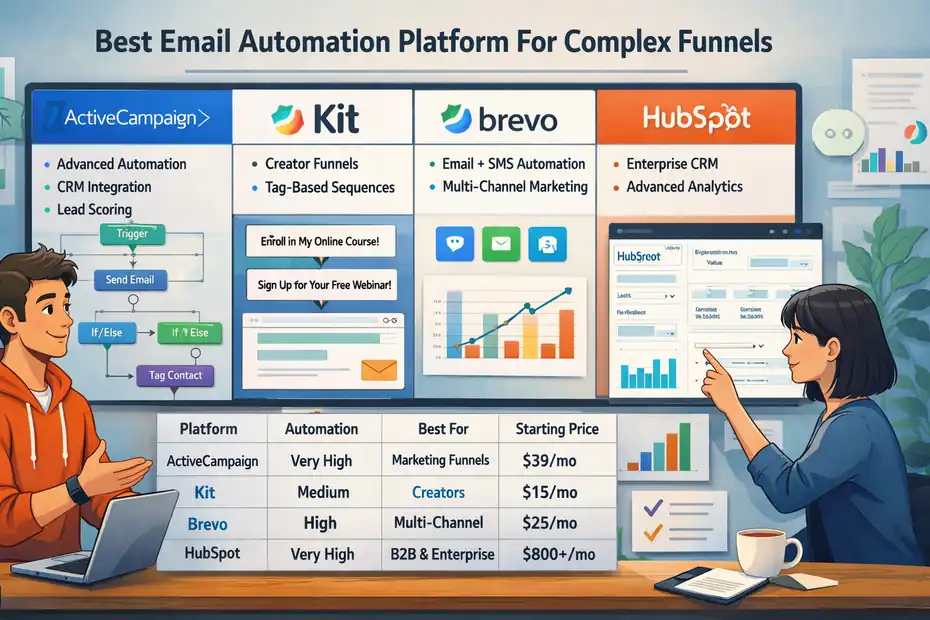
ActiveCampaign – Best for Advanced Automation and Behavioral Funnels
ActiveCampaign has become one of the most widely used automation platforms for businesses that need powerful funnel logic without enterprise-level pricing.
The platform’s automation builder uses a visual workflow system that allows you to design extremely detailed funnels.
Some standout capabilities include:
- Advanced if/then conditions
- Event-based triggers
- CRM integration
- Lead scoring automation
- Website behavior tracking
- SMS and email automation combined
In practice, this means you can build funnels that react to nearly every customer action.
For example, imagine running a SaaS trial funnel.
Your automation might look like this:
- Step 1: User signs up for a free trial.
- Step 2: Send onboarding email series.
- Step 3: If user logs in within 48 hours → send feature tutorial.
- Step 4: If user doesn’t log in → trigger reminder campaign.
- Step 5: If trial reaches day 10 without upgrade → send incentive offer.
ActiveCampaign handles these workflows smoothly because its automation engine supports dozens of conditional triggers inside a single funnel.
Pricing typically starts around $39/month depending on list size, which makes it accessible for growing businesses.
Kit (Formerly ConvertKit) – Best for Creator Funnels
Kit has evolved significantly and now supports much more advanced automation than many creators expect.
While it started as a simple email tool for bloggers, it now supports sophisticated funnel systems designed for creators selling:
- Online courses
- Digital products
- Membership programs
- Coaching services
One feature I particularly like is its tag-based automation system.
Instead of managing complex list structures, subscribers move through funnels based on tags triggered by actions like:
- Email clicks
- Purchases
- Form submissions
- Course enrollments
For example, a creator selling a course might run this funnel: Lead magnet → educational emails → webinar invite → sales sequence.
If someone attends the webinar, they receive a different sales sequence than someone who didn’t attend.
Kit’s automation builder makes this logic relatively simple to build while still giving you strong segmentation.
Pricing starts around $15/month for small lists, which makes it one of the most accessible automation platforms available.
Brevo – Best for Multi-Channel Automation
Brevo (formerly Sendinblue) stands out because it combines email automation with additional communication channels.
This is important for complex funnels where email alone may not be enough to move prospects forward.
Brevo allows automation across:
- Email campaigns
- SMS messaging
- WhatsApp communication
- Transactional email
- CRM triggers
For example, an ecommerce funnel could work like this:
- Step 1: Customer abandons cart.
- Step 2: Send reminder email.
- Step 3: If unopened after 24 hours → send SMS reminder.
- Step 4: If still no purchase → send discount offer email.
This multi-channel approach can significantly improve conversion rates, especially for time-sensitive offers.
Brevo also provides strong workflow automation and segmentation tools, making it a solid option for businesses that want to integrate multiple communication channels into their funnels.
HubSpot – Best Enterprise-Level Funnel Automation
HubSpot is often considered the gold standard for businesses running large-scale marketing automation systems.
It combines:
- Email marketing
- CRM
- Marketing automation
- Sales pipelines
- Customer support tools
into one ecosystem.
For companies running long sales cycles, this integration becomes extremely valuable.
For example, a B2B funnel might involve:
- Lead magnet downloads
- Automated nurturing emails
- Lead scoring
- Sales team notifications
- Meeting booking
- Follow-up sequences
HubSpot allows all of these steps to happen inside a single platform.
The biggest drawback is cost. HubSpot’s marketing automation tools can start around several hundred dollars per month, which places it more firmly in the mid-size business or enterprise category.
How to Choose the Right Email Automation Platform for Your Funnel
Choosing the best platform isn’t just about features. It’s about selecting a tool that fits your funnel complexity, team size, and business model.
Match the Platform to Your Funnel Complexity
One of the biggest mistakes I see is businesses choosing overly complex tools for simple funnels—or simple tools for extremely advanced automation.
Let me break this down.
Simple funnels usually include:
- Lead magnet delivery
- 3–5 email nurture sequence
- Basic product promotion
These can run smoothly on many platforms.
But complex funnels often include:
- Multiple lead magnets
- Conditional email branches
- Webinar automation
- CRM integration
- Sales pipelines
- Behavioral tracking
- Retargeting triggers
If your funnel includes these elements, you’ll want a platform built specifically for automation logic.
Otherwise, you may hit limitations once your funnel grows.
Evaluate Automation Flexibility
When testing a platform, I recommend looking closely at the automation builder interface.
Ask yourself:
- Can I create multiple conditional branches?
- Can the automation react to website activity?
- Can I trigger workflows based on purchases?
- Can I update subscriber data automatically?
The best automation platforms allow you to design workflows visually, which makes it easier to understand complex funnels.
In my experience, platforms with visual automation maps help marketers build better funnels because you can literally see how each path connects.
Consider CRM and Ecommerce Integrations
Many complex funnels rely on integrations with other systems.
For example:
- Ecommerce platforms
- CRM systems
- Webinar software
- Membership platforms
- payment processors
If your email platform integrates directly with these tools, automation becomes much more powerful.
For instance, a purchase event can automatically trigger:
- Onboarding emails
- Upsell sequences
- Customer loyalty campaigns
- Support onboarding
This type of automation removes a huge amount of manual work.
Common Mistakes When Building Complex Email Funnels
Even with the best platform, funnel performance can suffer if the automation strategy is flawed.
Let’s look at a few common mistakes.
Overcomplicating Funnel Logic
Many marketers assume complex funnels require dozens of branches and conditions.
But in reality, overly complicated automation often leads to:
- Broken workflows
- Hard-to-maintain systems
- Confusing analytics
In my experience, the most successful funnels usually follow a simple structure:
- Awareness
- Education
- Trust building
- Conversion
- Post-purchase engagement
You can still personalize messaging without building 50 different automation paths.
Ignoring Deliverability Factors
Deliverability is often overlooked when building automation-heavy funnels.
Sending too many emails too quickly can hurt your sender reputation.
Some best practices include:
- Gradually warming up new email domains
- Avoiding spam-trigger words
- Keeping lists clean
- Removing inactive subscribers
According to Mailchimp research, average email open rates across industries hover around 21–28%, but poor deliverability can cut that in half.
Not Tracking Funnel Conversion Metrics
Many businesses track email metrics but ignore funnel-level performance.
Instead of focusing only on opens and clicks, monitor:
- Lead-to-customer conversion rate
- Revenue per subscriber
- Time-to-conversion
- Funnel drop-off points
These metrics reveal where automation improvements can increase revenue.
Advanced Strategies for Scaling Email Automation Funnels
Once your automation system is working well, there are several ways to scale performance.
Implement Lead Scoring Systems
Lead scoring assigns points to subscribers based on behavior.
For example:
- Email open: +5 points
- Link click: +10 points
- Product page visit: +15 points
- Webinar attendance: +25 points
Once a lead crosses a certain threshold, they can automatically enter a high-intent sales sequence.
This approach helps prioritize subscribers who are most likely to convert.
Build Multi-Stage Customer Journeys
Advanced funnels don’t end with the first sale.
Instead, they continue through multiple stages:
- Acquisition
- Activation
- Conversion
- Retention
- Upsell
- Referral
Each stage can have its own automation system.
For example:
- New customer onboarding
- Product education sequences
- Cross-sell offers
- Loyalty rewards
This lifecycle-based automation can dramatically increase customer lifetime value.
Use Automation Data to Improve Content Strategy
One of the most underrated benefits of email automation is the data it generates.
Your funnel analytics can reveal:
- Which topics drive engagement
- Which offers convert best
- Which audience segments respond to certain messaging
You can use this information to improve:
- Blog content strategy
- Product positioning
- Sales messaging
- Ad targeting
In many cases, email funnel insights become one of the most valuable sources of marketing intelligence.
Final Thoughts
Choosing the right email automation platform for complex funnels can dramatically impact how efficiently your marketing operates.
A powerful platform doesn’t just send emails—it orchestrates the entire customer journey, responding to behavior, personalizing communication, and guiding leads toward conversion.
For most businesses:
- ActiveCampaign offers the best balance of power and affordability.
- Kit works extremely well for creators and digital product funnels.
- Brevo excels in multi-channel automation.
- HubSpot dominates enterprise-level funnel systems.
The key is selecting a platform that supports the automation complexity your business needs today while still scaling with you tomorrow.
When email automation is implemented correctly, it becomes one of the most powerful growth engines in digital marketing—quietly nurturing leads, driving conversions, and generating revenue around the clock.
Email Automation Platform Comparison for Complex Funnels
Choosing the right email automation platform for complex funnels becomes much easier when you can see the key differences side by side. The table below compares the most important factors—automation power, best use cases, pricing entry point, and standout capabilities—so you can quickly identify which platform fits your funnel strategy.
| Platform | Best For | Automation Complexity | Key Strengths | Starting Price |
|---|---|---|---|---|
| ActiveCampaign | Advanced marketing funnels, SaaS, ecommerce | Very High | Visual automation builder, behavioral triggers, lead scoring, CRM integration | ~$39/month |
| Kit | Creators, bloggers, digital product sellers | Medium–High | Tag-based automation, creator-focused funnels, simple automation setup | ~$15/month |
| Brevo | Multi-channel marketing funnels | High | Email + SMS + WhatsApp automation, transactional emails, strong segmentation | Free plan available / Paid from ~$25/month |
| HubSpot | Enterprise businesses, B2B sales funnels | Very High | Full CRM integration, advanced workflow automation, deep analytics | ~$800+/month (Marketing Hub) |
FAQ
What is an email automation platform for complex funnels?
An email automation platform for complex funnels is software that manages multi-step customer journeys using triggers, conditions, and behavioral data. It automatically sends personalized emails based on actions like clicks, purchases, or page visits to guide leads through advanced sales funnels.
Which email automation platform is best for complex funnels?
The best email automation platform for complex funnels depends on your needs. ActiveCampaign is strong for behavioral automation, Kit works well for creator funnels, Brevo supports multi-channel automation, and HubSpot provides enterprise-level funnel management with CRM integration.
Why do complex funnels require advanced email automation?
Complex funnels require advanced automation because leads move through different paths based on behavior. Conditional workflows, segmentation, and triggers allow marketers to personalize emails, track engagement, and guide prospects toward conversion without manually managing every stage.
How does email automation improve funnel conversions?
Email automation improves funnel conversions by delivering the right message at the right time. Behavioral triggers, segmentation, and personalized sequences nurture leads gradually, increasing engagement and trust while moving prospects through the funnel more efficiently.
What features should an email automation platform for complex funnels include?
An email automation platform for complex funnels should include visual workflow builders, behavioral triggers, advanced segmentation, analytics tracking, and CRM integrations. These features allow businesses to build dynamic customer journeys and optimize funnel performance based on real engagement data.

Juxhin B is a digital marketing researcher and founder of JAK Digital Hub, specializing in email marketing software, marketing automation platforms, and digital growth tools. His work focuses on software testing, platform comparisons, and real-world performance analysis to help businesses choose the right marketing technology.
Related posts:
 Best Email Automation Platform For Advanced Segmentation
 Best Email Automation System That Scales Affordably
 Email Automation Tool With Advanced Workflows: Top Picks
 Best Email Automation Platform For Scaling Business Fast
 Best Email Automation Software For Performance Marketers
 Best Email Automation Tool For High Volume Sending