Table of Contents
Some links on JAK Digital Hub are affiliate links, meaning we may earn a small commission at no extra cost to you. Read full disclaimer.
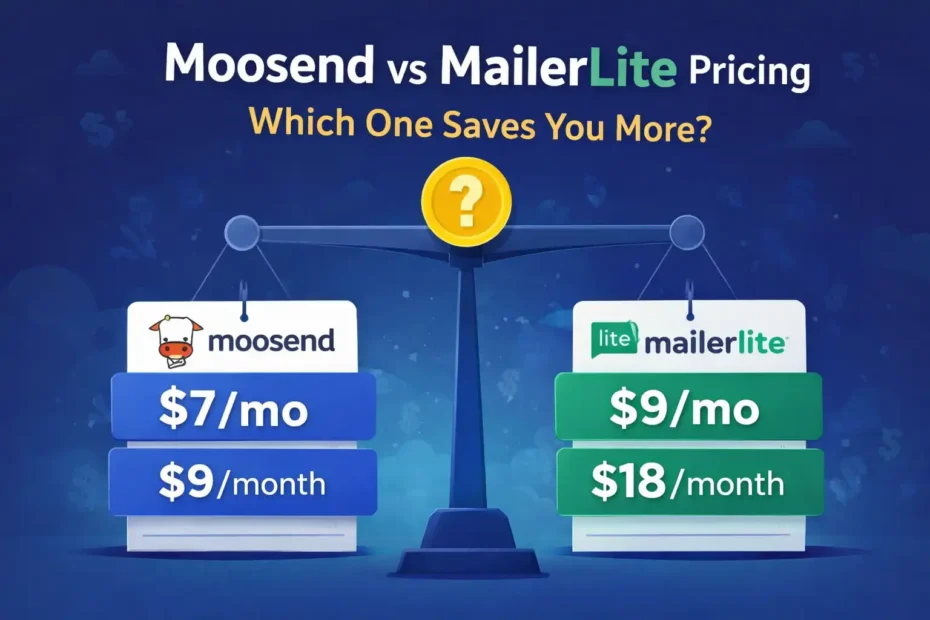
When people compare Moosend vs MailerLite pricing, they’re usually trying to answer one simple question: Which platform actually saves me money once my email list grows?
I’ve been in that same spot, staring at pricing tables that look straightforward at first… until you realize the real costs come from features hidden in the fine print.
In this guide, I break down the pricing differences in a way that feels practical, honest, and rooted in real user intent — especially if you’re trying to keep costs low while scaling.
Moosend vs MailerLite Pricing Overview For 2026
When people compare Moosend vs MailerLite pricing, they’re usually trying to understand how each platform grows with their business.
Let me walk you through how both tools structure their plans so you can see where costs sneak in—or where savings stack up.
Moosend Pricing Structure And How Plans Scale
Moosend keeps its structure simple on the surface, but each tier hides different upgrade triggers. The Pro plan is the entry point, priced per subscriber count and offering core features like email automation, landing pages, and an SMTP server.
But when your needs shift into transactional emails, SSO, custom reports, or priority support, you enter Moosend+—a custom-priced tier.
The biggest thing to know here: Moosend’s pricing jumps primarily when you add advanced features, not just subscribers.
For example, agencies or ecommerce brands often hit paywalls for transactional emails faster than expected, forcing an upgrade earlier. In my experience, this “feature lock” becomes the real cost driver as you scale.
MailerLite Pricing Structure And Key Cost Drivers
MailerLite offers a more traditional tiered structure: Free, Growing Business, and Advanced. Each plan unlocks a clear set of features, and pricing increases predictably as subscriber counts climb.
From what I’ve seen, MailerLite’s biggest cost drivers are:
- Moving from the free plan to paid tiers when you need automation
- Unlocking unlimited users and the website builder
- Adding advanced automation and customer support options
Because the tiers are more clearly defined, it’s easier to predict long-term costs. However, some features users assume are included—like advanced workflows or promotional pop-ups—are locked behind Advanced, which surprises beginners.
Why These Two Tools Are Compared Most By Budget-Focused Marketers
Both tools target creators, solopreneurs, and growing small businesses that care deeply about budget forecasting. They also offer generous free trials, lightweight automation, and reasonable entry-level prices.
But here’s why they’re always head-to-head:
- They serve the same audience segment.
- Their pricing tiers look similar but behave differently as you grow.
- They both market themselves as “affordable alternatives” to more expensive platforms like Klaviyo or HubSpot.
If you want predictability, MailerLite feels safer. If you want flexibility, Moosend can be cheaper—until you hit those feature paywalls.
Direct Cost Comparison At 500 Subscribers (Real Numbers)
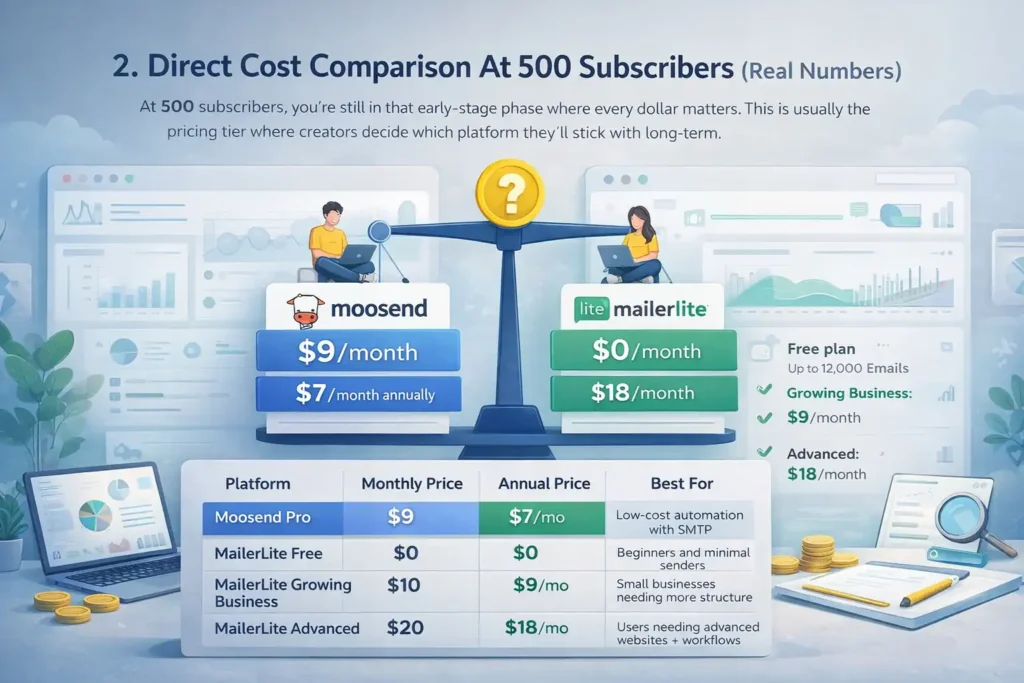
At 500 subscribers, you’re still in that early-stage phase where every dollar matters. This is usually the pricing tier where creators decide which platform they’ll stick with long-term.
Moosend’s 500-Subscriber Monthly And Annual Costs
Moosend charges $9/month on the monthly plan and $7/month when paid annually for up to 500 contacts. You get unlimited emails, automation, landing pages, subscription forms, and SMTP access—all solid for the price.
But you don’t get:
- Transactional emails
- SSO & SAML
- An account manager
If you need those, the cost jumps into the Moosend+ custom tier. I’ve seen users pay anywhere from $100–$500/month depending on complexity, but it varies heavily.
MailerLite’s 500-Subscriber Pricing Based On Plan Tiers
MailerLite breaks the 500-subscriber pricing down like this (billed yearly):
- Free plan: $0 for up to 12,000 monthly emails
- Growing Business: $9/month
- Advanced: $18/month
What stands out here is MailerLite’s free plan—arguably one of the most generous in the industry. But once you start needing automation or website features, you’ll outgrow it quickly.
The Growing Business tier is the closest match to Moosend’s Pro plan at this subscriber level.
Which Platform Offers More Value At This Entry Level?
If you’re staying under 500 subscribers and want the best deal:
- MailerLite wins if you can operate inside the free plan’s limitations.
- Moosend wins if you want premium features at a lower paid-plan cost.
At the 500-subscriber mark, I personally lean toward MailerLite unless you need SMTP or more flexible automation right away—then Moosend becomes the better deal.
Here’s a quick visual:
| Platform | Monthly Price | Annual Price | Best For |
| Moosend Pro | $9 | $7/mo | Low-cost automation with SMTP |
| MailerLite Free | $0 | $0 | Beginners and minimal senders |
| MailerLite Growing Business | $10 | $9/mo | Small businesses needing more structure |
| MailerLite Advanced | $20 | $18/mo | Users needing advanced websites + workflows |
Cost Breakdown At 5,000 Subscribers (Growth-Stage Pricing)
Once you hit 5,000 subscribers, your pricing conversation changes fast. This is the point where most businesses start evaluating upgrades more seriously because email volume and automation demands jump.
How Moosend’s Pricing Jumps At Mid-Tier List Sizes
Moosend’s price increase between 500 and 5,000 subscribers is noticeable but not extreme. What is extreme is how quickly people realize they’ve hit feature limitations that push them toward Moosend+.
Typical mid-tier pricing often looks like:
- $32–$40/month depending on billing frequency
But remember: this still excludes transactional emails, custom reports, SSO, and priority support.
In real-world use, here’s what often happens: A small ecommerce store hits 4,000 subscribers, wants transactional order emails, and suddenly Moosend+ becomes necessary. That instantly shifts pricing from roughly $39/month to a custom plan that may cost 5–10x more.
From what I’ve seen, this is the tipping point where Moosend becomes significantly more expensive unless your feature needs stay basic.
How MailerLite’s Pricing Shifts As Features Unlock
MailerLite is more predictable at 5,000 subscribers:
- Growing Business: ~$39/month
- Advanced: ~$79/month
MailerLite’s structure is cleaner—you pay more primarily because your list is growing, not because you suddenly need a basic feature like transactional email or advanced reporting.
For most users, the Growing Business plan is enough at this stage. Agencies and ecommerce stores typically move into Advanced.
The Platform That Minimizes Cost Spikes During Rapid List Growth
If your subscriber list grows faster than expected, here’s the honest breakdown:
- Moosend minimizes subscriber-based cost increases but punishes you with large jumps when you need “advanced” features.
- MailerLite has predictable, linear scaling, where you can reliably budget your next price tier months in advance.
If your list is scaling aggressively and your workflows are becoming more complex, MailerLite usually ends up saving more money over 12–24 months because you avoid custom-plan surprises.
Comparing Moosend Pro vs MailerLite Growing Business Plan
When most people compare Moosend vs MailerLite pricing, this is the matchup that matters most. These two plans sit in the “affordable but serious” tier—where you’re willing to pay, but only if you’re getting real value back.
Let me walk you through how they stack up feature-for-feature, and where the real cost differences come from.
Feature-To-Feature Pricing Value Analysis
On paper, Moosend Pro and MailerLite Growing Business look similar. Both give you automation, landing pages, forms, and unlimited email sends. But once you dig in, the differences become clearer.
Here’s a simplified comparison table:
| Feature / Value Area | Moosend Pro | MailerLite Growing Business |
| Email sends | Unlimited | Unlimited |
| Automations | Full workflows | Full workflows |
| Landing Pages | Included | Included |
| SMTP Server | Included | Not included |
| User Seats | Limited | 3 seats |
| Support Level | Standard | 24/7 email support |
| Advanced Reports | Add-on | Basic analytics included |
| Price at 500 subs | $7/mo annual | $9/mo annual |
If you rely on SMTP (sending through your own server), Moosend wins hands-down. If you care more about user seats, collaboration, and stability, MailerLite starts feeling like the safer choice.
Personally, I think Moosend Pro delivers more raw features per dollar, but MailerLite delivers more stability per dollar — and that matters as you scale.
Which Platform Delivers More Automations Per Dollar
Let me put this simply: If you want the most automation flexibility for the lowest cost, Moosend Pro usually wins.
Here’s why:
- Moosend’s automation builder allows deeper branching without requiring an upgrade.
- MailerLite starts limiting certain workflow triggers and conditions unless you move into the Advanced tier.
But here’s the trade-off I’ve seen in real use: MailerLite’s automation builder is cleaner, more intuitive, and less buggy, especially when running large workflows. I’ve had Moosend workflows stall under heavy segmentation loads — nothing catastrophic, but worth mentioning.
So the question becomes:
- If you’re budget-sensitive → Moosend gives you more automation power per dollar.
- If you value system stability → MailerLite wins, even if it costs slightly more.
The Hidden Costs Most Users Don’t See Until Later
This is where things get interesting — because neither platform puts these costs front and center.
Moosend hidden costs:
- Transactional emails require Moosend+ (aka a custom-priced plan).
- SSO (single sign-on) forces you to upgrade even if you don’t need anything else.
- Priority support is locked behind higher tiers.
I’ve seen many businesses move from Pro to Moosend+ unexpectedly because they outgrow basic transactional needs.
MailerLite hidden costs:
- Website builder features are only partially available on Growing Business.
- Advanced automation conditions require moving to Advanced.
- The moment your team grows beyond 3–5 members, the upgrade becomes almost unavoidable.
Both platforms look cheap at the 500–2,000 subscriber range. But once you start building real systems, the invisible paywalls start revealing themselves.
Enterprise Pricing: Moosend+ vs MailerLite Advanced
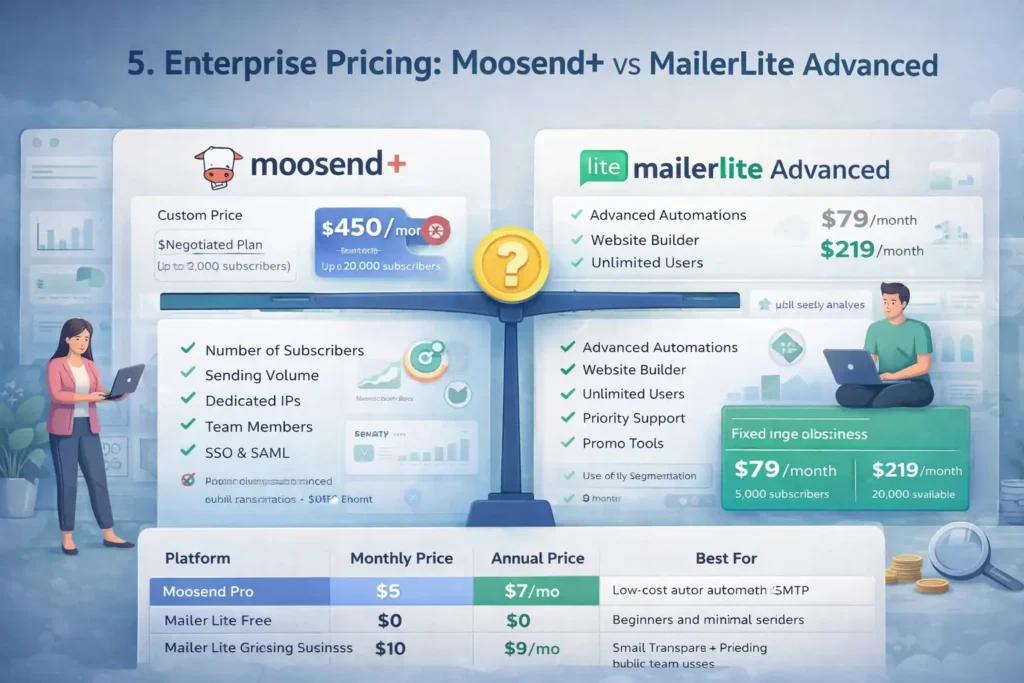
Once you reach this tier, you’re no longer choosing based on a few dollars — you’re choosing based on long-term infrastructure, reliability, and support.
Think ecommerce, SaaS teams, agencies, and brands sending tens of thousands of emails per week.
How Moosend+ Custom Plans Work And What Influences Total Cost
Moosend+ is fully custom, which can be either a blessing or a headache.
Your price depends on:
- Number of subscribers
- Required sending volume
- Whether you need dedicated IPs
- How many team members need access
- Whether you need priority or premium support
- Required compliance (SSO & SAML)
I’ve seen Moosend+ quotes anywhere from $150/month for a small ecommerce brand to $800/month for a multi-store operation with strict deliverability requirements.
Moosend’s biggest advantage at this level is flexibility. If you negotiate well, you can undercut MailerLite’s Advanced pricing with more features included.
But the downside? You must talk to sales, and pricing lacks transparency. Not everyone loves that.
What MailerLite Advanced Actually Includes At Scale
MailerLite Advanced is not a custom plan — and that’s the beauty of it. You know exactly what you’re paying for, and the price increases are predictable.
Key advantages:
- Advanced automation with more triggers and custom fields
- Better website and blog-building features
- Unlimited users
- Priority support
- Built-in promotional tools
- Better segmentation controls
Pricing grows linearly with your list, which is fantastic for forecasting. A 5,000-subscriber list might cost around $79/month, but even at 20,000 subscribers, you’re still in the low hundreds — not thousands.
If you hate surprises, MailerLite Advanced is the safer long-term play.
Who Each Enterprise Plan Makes Financial Sense For
If I had to simplify it:
Choose Moosend+ if:
- You need SMTP at scale
- You’re running large transactional email volume
- You prefer negotiating custom pricing
- You want to bundle multiple brands or stores into one account
Choose MailerLite Advanced if:
- You want predictable budgeting
- You need unlimited users for team collaboration
- You care about intuitive UI at scale
- You prefer transparent, no-surprise pricing
For many high-growth small businesses, MailerLite Advanced ends up being more cost-efficient over 12–24 months simply because there are fewer “forced upgrades.”
Feature Paywalls: What You Lose (Or Pay Extra For) On Each Platform
Feature paywalls are the hidden villains in Moosend vs MailerLite pricing. This is where users get blindsided — something works great during the trial, but suddenly requires an upgrade once you’re committed.
Here’s exactly where each platform hides the big paywalls.
Moosend Limitations That Require Upgrading (SSO, Account Manager, Transactional Emails)
Moosend’s most restrictive paywalls are tied to Pro → Moosend+ upgrades.
You must upgrade if you need:
- Transaction emails: Critical for ecommerce; triggers a custom plan.
- SSO & SAML: Required for security-focused teams.
- Account manager: Not included in Pro, even at higher subscriber counts.
- Custom reports: Surprising for data-heavy teams.
- Audience discovery tools: Useful, but locked behind Moosend+.
These upgrades often force users into paying 5–10x more than the Pro plan.
A real-world example: A Shopify store I worked with moved from $32/month to a $450/month custom plan just because they needed automated transactional emails during checkout.
MailerLite Features Locked Behind Higher Tiers (Website Builder, Unlimited Users, Advanced Automations)
MailerLite’s paywalls are more predictable, but they still exist.
You must upgrade to Advanced for:
- Unlimited users: Growing teams hit this wall fast.
- Website builder enhancements: Advanced features are locked.
- Advanced automation conditions: More granular triggers require upgrading.
- Extended customer support: Faster responses come with higher tiers.
The difference here is MailerLite doesn’t jump you to a custom contract — the upgrade is always a flat, published price.
The Pricing Impact Of Hitting Feature Walls Too Early
This is the part I always emphasize because it affects long-term costs more than subscriber count:
- Moosend’s paywalls create sharp pricing cliffs.
- MailerLite’s paywalls create gentle pricing slopes.
If your business is rapidly evolving, Moosend’s feature restrictions can push you into enterprise pricing before you’re actually an enterprise.
MailerLite’s structured tiers make budgeting more predictable, even when upgrading.
Quick tip: If you expect to outgrow basic features quickly, MailerLite is usually the safer long-term bet. If you plan to stay lean and want maximum functionality for the lowest price, Moosend Pro shines.
Deliverability & Infrastructure Costs Compared
Deliverability is one of those behind-the-scenes areas where pricing can get sneaky. Even if Moosend and MailerLite look affordable on the surface, the infrastructure behind your sending can dramatically change what you pay.
Let’s look at how each platform handles these costs.
How Moosend Handles SMTP Servers And Dedicated IP-Related Costs
One thing I genuinely appreciate about Moosend is that it gives you access to an SMTP server right inside the Pro plan. You don’t have to connect a third-party provider or pay extra just to send custom system emails. It’s a small detail, but if you’re running ecommerce or SaaS, it’s gold.
But here’s the part most users don’t see early on:
- Dedicated IPs are not included in Pro.
- High-volume transactional sending pushes you into Moosend+.
- Deliverability consulting or reputation management becomes add-on territory.
To put it plainly: Moosend starts cheap, but the moment you want deliverability control at scale, you’ll be negotiating a custom plan.
I’ve seen stores go from $39/month to $300+/month overnight once they needed dedicated IPs and stable transactional sending.
How MailerLite Structures Email Deliverability Resources
MailerLite takes a different approach. Instead of selling SMTP flexibility upfront, they prioritize platform-managed infrastructure. That means:
- You don’t get SMTP sending unless you integrate a third-party service.
- You don’t need to manage deliverability settings manually.
- Dedicated IPs are available, but typically at higher list sizes.
This model works beautifully for creators, newsletters, and agencies who don’t want to worry about the technical side of email. MailerLite manages warm-up, reputation, and IP health automatically.
From what I’ve seen, MailerLite’s shared IP pools have some of the lowest spam placement rates for small senders. It’s reliable, consistent, and painless.
Which Platform Saves More On High-Volume Sending
Here’s the honest breakdown:
| Business Type | Cheaper Option | Why |
| Ecommerce with lots of transactional emails | Moosend (initially) | SMTP included, flexible sending setup |
| Newsletter-first brands with heavy automations | MailerLite | No need for custom IPs or special infrastructure |
| Businesses scaling to 50k+ subs | MailerLite | Predictable pricing and fewer custom-plan surprises |
| Brands needing a dedicated IP early | Moosend | Negotiable custom pricing |
So who wins? If you send extremely high volumes, MailerLite usually ends up cheaper long-term because you avoid enterprise-level jumps.
But if you want SMTP freedom on a budget, Moosend is the standout.
Real-World Pricing Scenarios For Small Businesses
Every platform looks affordable on a pricing page. The real test is how it behaves when your business has specific needs.
Let me walk you through three real-world scenarios, based on the kinds of clients I’ve worked with.
Best Choice For Solopreneurs With Tight Budgets
If you’re growing slowly, sending a weekly newsletter, or testing your first funnel, budget really matters. And honestly?
MailerLite wins here almost every time.
Why:
- The free plan is generous: Up to 500 subscribers and 12,000 emails/month.
- The UI is beginner-friendly and saves hours of setup time.
- You avoid early paywalls you might not expect in Moosend.
A real example: A fitness coach I worked with saved about $180/year by staying in MailerLite’s free plan until she hit 1,200 subscribers.
If cost control is your #1 priority, MailerLite is simply the safer choice.
Best Choice For Ecommerce Stores Sending High Volumes
Ecommerce brands are a completely different story.
You’re sending:
- Transactional emails
- Order confirmations
- Abandoned cart sequences
- Promotional blasts
Here’s where Moosend shines, mainly because SMTP is included without forcing an upgrade to a more expensive plan. Ecommerce platforms send a lot of automated emails, and Moosend’s infrastructure handles them efficiently.
But here’s the catch: If you need advanced transactional logic or extremely high deliverability, Moosend+ becomes unavoidable—and the price can jump fast.
For smaller ecommerce stores, Moosend is often cheaper. For larger stores, MailerLite ends up more stable and predictable.
Best Choice For Agencies Managing Multiple Client Accounts
Agencies need:
- Multi-account management
- Additional user seats
- Strong collaboration tools
- Predictable pricing across clients
This is where MailerLite takes the lead.
Why:
- Unlimited users on Advanced plans
- Cleaner, more scalable account permissions
- More stable deliverability across diverse client niches
- Better workflow consistency
Moosend can work for agencies, but onboarding becomes trickier, especially once SSO or account structure gets complicated.
If you’re an agency wanting fewer headaches, MailerLite is almost always the smoother path.
Discount Structures: Annual Savings, Trials, And Free Plans
Discounts matter more than people realize. A platform that looks cheaper monthly can actually cost more annually, depending on contract terms.
Here’s what I’ve learned from comparing the two closely.
Moosend Annual Discounts And Long-Term Contract Considerations
Moosend offers a fairly straightforward 20% discount when you pay annually. That means:
- $9/month becomes $7/month
- $39/month becomes roughly $32/month
It’s a good deal, but here’s the thing I always tell people:
Moosend pricing can change significantly if your feature needs change. Committing to annual billing makes sense only if:
- You know your sending volumes
- You won’t need transactional emails soon
- Your business model is stable
If you expect to scale quickly, monthly billing may be safer, even if it costs slightly more.
MailerLite Free Tier Value And What It Actually Covers
MailerLite’s free plan is one of the most underrated advantages in the Moosend vs MailerLite pricing discussion.
Here’s what you get for $0:
- Up to 500 subscribers
- 12,000 monthly emails
- 1 user seat
- Landing pages & basic forms
- Limited automation
It’s enough to launch a newsletter, run your first lead magnet, and validate your business idea without spending a single dollar.
If you’re early-stage, this is easily $100–$300/year in savings.
Which Platform Saves More Money When Committing Yearly
Let’s break it down:
| Situation | Winner | Why |
| Staying under 500 subscribers | MailerLite | Free plan covers everything early on |
| Running basic automations at 1–3k subscribers | Moosend | Cheaper Pro plan with more automation flexibility |
| Needing long-term scaling clarity | MailerLite | Predictable pricing and fewer unexpected upgrades |
| Ecommerce with transactional emails | Moosend initially | SMTP included without extra costs |
If your business is stable and predictable, MailerLite saves more over the long run.
If you value maximum functionality per dollar in the early and mid stages, Moosend saves more.
Migration Cost Considerations Between Moosend And MailerLite
Switching email platforms always comes with hidden costs — not just in money, but in time, setup effort, and workflow rebuilding.
If you’re weighing Moosend vs MailerLite pricing, understanding these migration costs is a huge part of making the right decision.
The Cost Of Switching From Moosend To MailerLite
Moving from Moosend to MailerLite is usually the cheaper direction, mostly because MailerLite has more generous onboarding options and fewer enterprise-only features.
Here are the costs users often don’t expect:
- Rebuilding automation workflows (Moosend uses more branching logic)
- Recreating landing pages (layouts don’t always transfer cleanly)
- Importing transactional logic into a new system
- Possible deliverability dips during warm-up
The good news? MailerLite’s migration tools are simple, and the UI is easier for teams to adopt. I’ve seen small businesses complete the switch for $0 out-of-pocket—just time invested.
A real example: A coaching business moved from Moosend to MailerLite in one weekend, and ended up saving $348/year by relying on MailerLite’s free tier for three months before upgrading.
The Cost Of Switching From MailerLite To Moosend
Going the other direction tends to cost more upfront, mainly because:
- Moosend requires more manual automation setup
- Importing landing pages is almost always a rebuild
- Some features you expect in lower tiers might require Moosend+
- Deliverability tuning is more hands-on
However, once you’re set up, Moosend’s Pro plan can be cheaper than MailerLite’s Growing Business plan, especially if you’re automation-heavy.
But here’s the catch I’ve seen repeatedly: Teams underestimate how much they rely on MailerLite’s collaboration features. Losing unlimited users (unless you upgrade Moosend+) can create hidden upgrade pressure.
Situations Where Migration Provides Immediate Savings
There are moments where switching platforms isn’t just smart — it’s financially obvious.
Migration makes sense if:
- You’re paying for Moosend+ but your needs are simple → Move to MailerLite to save hundreds.
- You’re outgrowing MailerLite automation limits → Move to Moosend for more flexibility at a lower cost.
- You’re consolidating multiple client accounts → MailerLite becomes dramatically cheaper and easier.
- You’re launching an ecommerce store → Moosend’s SMTP access can cut transactional email costs immediately.
In my experience, migration usually pays off when your tool no longer matches the stage of your business—not just your budget.
Total Cost Of Ownership: Which Platform Truly Saves You More?
Now that we’ve walked through the plan tiers, feature limitations, and migration concerns, it’s time to zoom out. Total cost of ownership is where you can see which platform really saves you more over time.
Comparing Total Cost Over 12 And 24 Months
To make this easier, here’s a simplified comparison table for typical business growth:
| Business Stage | 12-Month Cost (Moosend) | 12-Month Cost (MailerLite) | Notes |
| 500 subs | ~$84/year | $0–$108/year | MailerLite wins if free tier fits |
| 5,000 subs | ~$384–$480/year | ~$468–$948/year | Moosend cheaper unless upgrading to Moosend+ |
| 20,000 subs | $Custom pricing | ~$1,500–$2,000/year | MailerLite more predictable |
| High-volume ecommerce | $150–$800/month | $??? (requires third-party SMTP) | Moosend wins early, not always long-term |
If you want predictability, MailerLite almost always comes out ahead.
If you want the most features for the lowest cost (at least initially), Moosend wins those early-stage battles.
Long-Term Savings For Low-Budget Marketers
If you’re a creator, freelancer, or solo business owner, long-term savings usually look like this:
- MailerLite’s free plan delays your first bill
- Upgrades are predictable as your list grows
- You avoid custom pricing unless you’re massive
- Deliverability is handled for you, reducing third-party costs
Across 24 months, most low-budget users save $200–$600 by sticking with MailerLite.
Long-Term Savings For Scaling And Automation-Heavy Businesses
If your business depends on complex workflows, multiple funnels, or deep segmentation, Moosend becomes surprisingly cost-efficient.
Why:
- Advanced automation is included at lower tiers
- SMTP access eliminates reliance on external providers
- High-volume sends don’t spike pricing as sharply
But here’s the flip side: The moment you need transactional emails, SSO, or an account manager, Moosend+ resets the entire value equation. That’s when MailerLite Advanced often becomes the cheaper long-term choice because its pricing remains transparent.
So the real answer? It depends on whether you hit those Moosend+ triggers.
Final Verdict: When Moosend Wins And When MailerLite Wins
Now for the part people usually scroll to: Which platform actually saves you more money? I’ll break it down as clearly and honestly as possible, based on everything we’ve covered.
Cases Where Moosend Is The Cheaper, Smarter Choice
Moosend wins when:
- You want maximum automation flexibility without paying for higher tiers
- You rely heavily on SMTP or transactional-style emails
- You’re in ecommerce and send lots of system emails
- You want more power per dollar in the early growth stages
- You don’t need team collaboration features or SSO
If your business is lean and automation-driven, Moosend Pro can be one of the best deals on the market.
Cases Where MailerLite Delivers Better Value For Money
MailerLite wins when:
- You want predictable pricing without sudden “enterprise” jumps
- You care about UI simplicity and onboarding ease
- You need multiple user accounts without paying extra
- You don’t want to manage deliverability or IP reputation
- You rely on website and landing page integrations
MailerLite is almost always the better choice for creators, coaches, newsletters, consultants, and agencies.
The Best Budget-Friendly Platform Based On Your Stage Of Business
Here’s the simplest way I can break it down, based on real-world behavior:
- Early-stage (0–2k subscribers): MailerLite wins — the free plan is unbeatable.
- Growth-stage (2k–10k subscribers) needing strong automations: Moosend wins — more power at a lower price.
- Scaling-stage (10k–100k subscribers) needing stability and team access: MailerLite wins — transparent scaling and fewer upgrade surprises.
- High-volume ecommerce: Moosend wins early, MailerLite wins later — depends on how quickly you need enterprise features.
If I had to give a single sentence verdict? Moosend is cheaper when your workflows are complex but your feature needs are simple — MailerLite is cheaper when your workflows are simple but your business needs are growing.
FAQ
Which is cheaper: Moosend or MailerLite?
MailerLite is cheaper for small lists because of its free tier, while Moosend becomes cheaper for automation-heavy users who need advanced workflow features at lower plan levels.
Does Moosend or MailerLite offer better value as your list grows?
MailerLite offers more predictable long-term pricing, while Moosend can spike in cost once you need transactional emails or enterprise features.
What’s the best platform for budgeting between Moosend vs MailerLite pricing?
MailerLite is best for predictable scaling and tight budgets, while Moosend offers better value for complex automations if you don’t need enterprise add-ons.

Juxhin B is a digital marketing researcher and founder of JAK Digital Hub, specializing in email marketing software, marketing automation platforms, and digital growth tools. His work focuses on software testing, platform comparisons, and real-world performance analysis to help businesses choose the right marketing technology.