Table of Contents
Some links on JAK Digital Hub are affiliate links, meaning we may earn a small commission at no extra cost to you. Read full disclaimer.
Is there better email automation software for ecommerce? If you’re asking that question, chances are your current email platform feels limiting. Maybe your automations are too basic, your segmentation isn’t driving sales, or you’re worried about switching platforms and breaking something that already works.
I’ve seen this situation many times. Ecommerce businesses often start with a simple email tool, but as the store grows, the cracks begin to show. Revenue from email stalls, automation flows become messy, and personalization feels impossible.
The good news is that there absolutely are better email automation software options for ecommerce in 2026. But the right choice depends on your store size, automation complexity, and how deeply you want email to integrate with your ecommerce stack.
Let’s walk through how ecommerce email automation works, what separates average tools from truly powerful platforms, and which software solutions are worth considering if you’re thinking about upgrading.
Understanding Email Automation in Ecommerce
Before choosing a platform, it helps to understand what ecommerce email automation actually does and why it matters for revenue growth.
Email automation is essentially a system that sends targeted emails based on customer behavior, purchase history, and engagement signals. Instead of sending generic newsletters, automation tools allow you to send the right message to the right customer at exactly the right time.
What Ecommerce Email Automation Software Actually Does
At its core, ecommerce email automation software connects your store data with automated messaging workflows. These workflows react to customer behavior in real time.
For example, imagine someone visits your online store, adds a product to their cart, but leaves without purchasing. A good automation system will trigger a cart recovery email sequence automatically.
The first email might remind them about the product. The second might include reviews. The third could offer a limited-time discount.
That entire process happens without you lifting a finger.
Here’s what modern ecommerce automation platforms typically handle:
- Behavior-triggered emails: Abandoned carts, browse abandonment, product views.
- Customer lifecycle automation: Welcome sequences, post-purchase follow-ups, loyalty emails.
- Segmentation and targeting: Different messages for new customers, repeat buyers, or high-value shoppers.
- Revenue tracking: Attribution showing exactly how much revenue email generates.
According to multiple ecommerce marketing studies, automated email flows can generate 30–45% of total email revenue, even though they make up a small portion of total emails sent. That’s why choosing the right automation software matters so much.
Why Basic Email Tools Often Fail Ecommerce Stores
Many ecommerce businesses initially start with generic email marketing tools. They work fine for newsletters, but they struggle once automation becomes the focus.
In my experience, the biggest problems usually show up in four areas.
1. Limited ecommerce data integration
Basic platforms might connect to your store, but they often don’t track detailed behavioral data like product views, browsing activity, or predicted lifetime value.
Without that data, automation becomes shallow.
2. Weak segmentation
Advanced ecommerce marketing requires segmentation like:
- Customers who purchased twice in the last 60 days
- Subscribers who viewed a product but never purchased
- VIP customers spending over $500 per year
Many email tools simply can’t handle that level of targeting.
3. Poor automation workflows
Simple tools allow basic triggers, but advanced platforms allow multi-step logic like:
“If a customer clicks product A but not product B, send follow-up email C.”
That level of behavioral automation dramatically increases conversion rates.
4. Revenue attribution gaps
One of the biggest frustrations I hear from store owners is not knowing whether email actually drives revenue.
Better ecommerce automation platforms solve this by tracking exactly how much money each automation flow generates.
What Makes Email Automation Software “Better” for Ecommerce
Not all email marketing platforms are built the same. When people ask if there is better email automation software for ecommerce, they usually mean platforms that go beyond newsletters and offer deeper automation capabilities.
Let’s break down the features that truly separate high-performing tools from basic ones.
Advanced Behavioral Triggers
Behavior-based triggers are the backbone of modern ecommerce automation. The best platforms monitor dozens of real-time customer signals and use them to trigger automated messages.
Some of the most powerful triggers include:
- Cart abandonment: When someone adds items but leaves before checkout.
- Browse abandonment: When a visitor views a product but doesn’t add it to the cart.
- Product replenishment: Perfect for consumable goods like supplements or skincare.
- Back-in-stock alerts: Automatically notify interested shoppers.
- Price drop alerts: Encourage purchase when items go on sale.
Here’s a simple example scenario.
Imagine you run an online skincare store. A customer views a vitamin C serum twice but doesn’t purchase. A smart automation platform detects that behavior and sends a follow-up email featuring:
- Product benefits
- Before-and-after results
- Customer reviews
This type of behavior-based messaging often converts much better than generic promotional emails.
Deep Customer Segmentation
Segmentation is where email automation becomes truly powerful.
Instead of sending the same email to everyone, advanced ecommerce platforms allow you to segment customers using dozens of data points.
Some useful segmentation examples include:
| Segment Type | Example Use Case |
|---|---|
| Purchase history | Promote refill products |
| Engagement behavior | Re-engage inactive subscribers |
| Customer lifetime value | Reward VIP customers |
| Product interest | Send personalized recommendations |
In my experience, segmentation is one of the fastest ways to increase email revenue without increasing your subscriber list.
For example, sending a targeted promotion to previous buyers of a specific product often converts 3–5x higher than sending the same promotion to your entire list.
Revenue Attribution and Analytics
Another feature that separates average platforms from great ones is revenue attribution.
Better ecommerce email automation software shows you exactly how much revenue each automation flow generates.
This typically includes:
- Revenue per email
- Conversion rates
- Customer lifetime value tracking
- Automation flow performance
For instance, you might discover that your abandoned cart flow alone generates $8,000 per month.
Once you have that data, you can optimize the flow by testing subject lines, adding SMS reminders, or improving product recommendations.
Without proper analytics, you’re basically flying blind.
Better Email Automation Software for Ecommerce in 2026
If you’re considering switching platforms, these are some of the most widely used and effective ecommerce automation tools available today.
Each one excels in slightly different areas depending on your store size and automation needs.
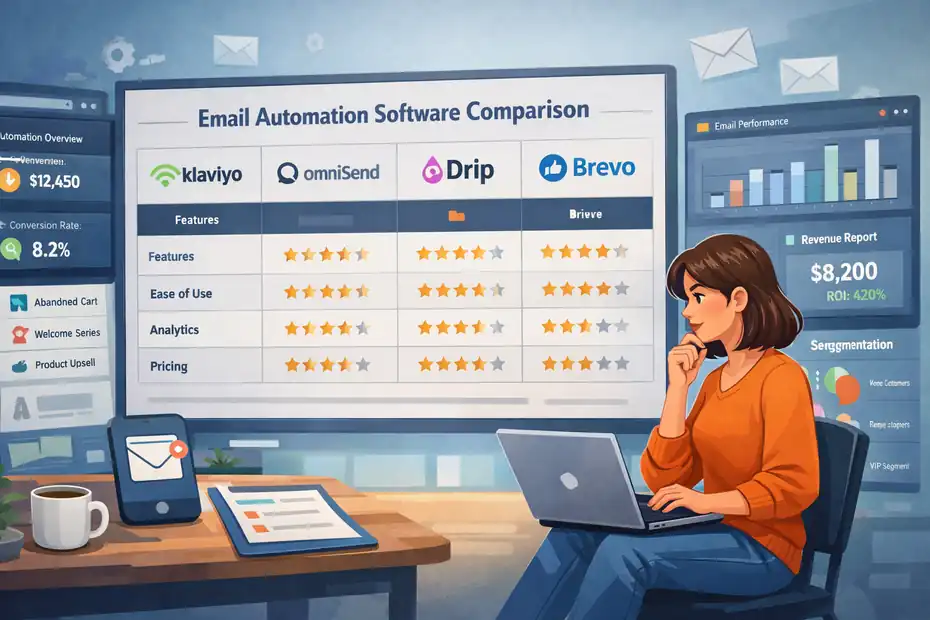
Klaviyo
Klaviyo has become one of the most popular email automation platforms for ecommerce brands, especially for stores running on Shopify or WooCommerce.
What makes Klaviyo powerful is its deep ecommerce data integration. The platform tracks customer behavior across your store and uses that data to power highly targeted automation flows.
Some standout capabilities include:
- Advanced segmentation using purchase behavior
- Predictive analytics (expected next purchase date)
- Multi-channel automation with email and SMS
- Real-time revenue attribution
I’ve seen many ecommerce stores move to Klaviyo after outgrowing simpler tools. One of the biggest improvements they usually notice is the ability to build extremely detailed customer segments.
For example, you can target customers who:
- Purchased twice in the past 90 days
- Viewed a specific product category
- Have not purchased in the last 30 days
That level of targeting can dramatically improve campaign performance.
The downside is pricing. Klaviyo can become expensive as your subscriber list grows.
Omnisend
Omnisend is another strong ecommerce-focused automation platform. It’s particularly popular with small and mid-sized online stores.
What makes Omnisend appealing is its balance between power and simplicity.
Many ecommerce owners find it easier to set up compared to more advanced tools while still offering robust automation capabilities.
Key features include:
- Pre-built ecommerce automation workflows
- Email and SMS automation
- Product recommendation blocks
- Built-in reporting and revenue tracking
Omnisend also offers many ready-made automation templates like:
- Welcome series
- Abandoned cart recovery
- Product review requests
- Re-engagement campaigns
This makes it easier for newer ecommerce businesses to launch automation quickly without building complex workflows from scratch.
Pricing is generally more affordable than some enterprise-level platforms, which is why many growing stores choose it.
Drip
Drip is another automation platform specifically built for ecommerce businesses.
Where Drip stands out is in its automation workflow flexibility. The platform allows you to create complex customer journeys with conditional logic and multi-step triggers.
For example, you can build workflows that adjust based on:
- Purchase history
- Email engagement
- Website browsing behavior
- Product interests
This type of automation allows you to create very personalized marketing sequences.
Imagine this scenario.
A customer buys running shoes from your store. Drip could automatically trigger a sequence that sends:
- Running tips and training guides
- Product recommendations for socks or accessories
- A replenishment email after 60 days
That type of lifecycle marketing helps increase customer lifetime value without constant manual work.
Drip is often favored by ecommerce brands that want more control over complex automation flows.
Brevo
Brevo (formerly Sendinblue) has evolved into a multi-channel marketing platform with email automation, SMS campaigns, and customer relationship management features.
One reason some ecommerce businesses choose Brevo is pricing flexibility. Unlike many platforms that charge primarily based on subscriber count, Brevo pricing is largely based on email volume.
This can be helpful for stores with large subscriber lists but lower email frequency.
Brevo also includes features like:
- Transactional emails (order confirmations, receipts)
- Marketing automation workflows
- SMS marketing
- Built-in CRM functionality
For ecommerce businesses that want both marketing automation and customer relationship management in one platform, Brevo can be a practical solution.
However, compared to platforms like Klaviyo, its ecommerce-specific segmentation capabilities may feel slightly less advanced.
How to Choose the Right Ecommerce Email Automation Platform
Choosing better email automation software for ecommerce isn’t just about features. It’s about finding a platform that fits your store’s stage of growth and marketing strategy.
Let me break down the factors that matter most.
Store Size and Growth Stage
The right tool for a small store may not be the right one for a rapidly scaling ecommerce brand.
Here’s a simple way to think about it.
| Store Stage | Recommended Platform Type |
|---|---|
| New ecommerce store | Simple automation tools |
| Growing store | Mid-level ecommerce platforms |
| High-revenue brand | Advanced behavioral automation |
For example:
- A new store might prioritize simplicity and affordability.
- A scaling store may need deeper segmentation and automation.
- A larger brand might require predictive analytics and advanced personalization.
I always suggest choosing a platform that can support your next stage of growth rather than just your current needs.
Integration With Your Ecommerce Platform
One of the most important factors is how well the email automation software integrates with your ecommerce system.
The best integrations allow the platform to access data like:
- Purchase history
- Product catalog
- Customer behavior
- Order values
Without these data points, automation becomes much less powerful.
Most leading platforms integrate smoothly with major ecommerce platforms like Shopify, WooCommerce, BigCommerce, and Adobe Commerce.
Before switching tools, always confirm that the integration supports the automation triggers you actually want to use.
Automation Complexity You Actually Need
It’s tempting to choose the most advanced platform available, but that isn’t always necessary.
In many cases, ecommerce stores generate the majority of email revenue from a few core automations.
The most important flows usually include:
- Welcome email series
- Abandoned cart sequence
- Post-purchase follow-up
- Customer reactivation campaigns
If your current platform handles these well, upgrading might not be urgent.
But if your automation feels rigid or your segmentation is limited, moving to a more advanced system could unlock significant growth.
Common Mistakes When Switching Email Automation Platforms
Switching email platforms can be powerful, but it also introduces risk if done incorrectly.
Here are a few mistakes I often see ecommerce businesses make during migration.
Migrating Without Cleaning Your Email List
One of the biggest missed opportunities during a platform migration is failing to clean your subscriber list.
Over time, most email lists accumulate inactive subscribers who never open emails.
Migrating them to a new platform increases costs and hurts deliverability.
Before importing your list, I suggest removing:
- Subscribers inactive for 12+ months
- Hard bounce addresses
- Spam complaints
Many stores see immediate improvements in open rates after cleaning their lists.
Rebuilding Automation Flows Incorrectly
Another mistake is recreating automation flows without reviewing their performance.
Instead of copying everything exactly as it was, use the migration as a chance to improve your system.
Ask questions like:
- Which flows actually generate revenue?
- Which emails have the highest conversion rates?
- Where do customers drop off in sequences?
You might discover that only a handful of automations drive most of your email revenue.
Optimizing those flows can produce better results than simply replicating the old setup.
Ignoring Deliverability During Migration
Email deliverability is often overlooked during platform switching.
When you move to a new platform, your sending domain and IP reputation may change. If you suddenly send high volumes of email, it can trigger spam filters.
A safer approach is to gradually ramp up sending volume over several weeks.
This process, sometimes called IP warming, helps maintain good deliverability and ensures your emails reach the inbox.
Advanced Ecommerce Email Automation Strategies
Once you’ve chosen the right platform, the real growth comes from how you use automation.
These advanced strategies are often what separate average email programs from highly profitable ones.
Predictive Customer Segmentation
Some modern platforms use machine learning to predict customer behavior.
These predictions can include:
- Expected next purchase date
- Probability of churn
- Customer lifetime value
For example, if the system predicts a customer will likely reorder within two weeks, you can trigger a reminder email before that purchase window closes.
This type of predictive marketing helps increase repeat purchases without relying on constant promotions.
Cross-Channel Automation (Email + SMS)
Many ecommerce brands are now combining email and SMS automation.
A typical cross-channel workflow might look like this:
- Customer abandons cart
- Email reminder after one hour
- SMS reminder after six hours
- Final discount email after 24 hours
From what I’ve seen, combining email and SMS can significantly increase recovery rates for abandoned carts.
The key is using SMS sparingly so customers don’t feel overwhelmed.
Product Recommendation Automation
Another powerful strategy involves automated product recommendations.
These emails use store data to suggest products based on:
- Previous purchases
- Browsing behavior
- Customer preferences
For example, if someone purchases a coffee machine, the automation might recommend:
- Coffee beans
- Cleaning kits
- Replacement filters
This type of personalization often increases average order value while improving the customer experience.
Final Thoughts: Is There Really Better Email Automation Software for Ecommerce?
Yes, there absolutely is better email automation software for ecommerce. But “better” doesn’t always mean the most expensive or most complex platform.
In my experience, the best platform is the one that allows you to:
- Use real customer data for segmentation
- Build automation flows based on behavior
- Track exactly how much revenue email generates
If your current email platform limits those capabilities, upgrading could unlock a major growth opportunity for your ecommerce store.
For many businesses, email remains one of the highest ROI marketing channels available. Some studies estimate that email marketing generates $36–$42 for every $1 spent.
With the right automation software and strategy, email can become a predictable revenue engine rather than just another marketing task on your list.
FAQ
What is better email automation software for ecommerce?
Better email automation software for ecommerce is a platform designed to send behavior-based emails triggered by customer actions such as cart abandonment, browsing, or purchases. These tools connect directly to your store data, allowing personalized campaigns, advanced segmentation, and automated workflows that increase repeat purchases and overall ecommerce revenue.
Why do ecommerce stores need advanced email automation software?
Ecommerce stores need advanced email automation software because automated emails generate significantly more revenue than manual campaigns. Platforms with behavioral triggers, product recommendations, and customer segmentation allow stores to send targeted messages at the right moment, which improves conversion rates, customer retention, and overall email marketing performance.
Which email automation software is best for ecommerce in 2026?
Popular email automation software for ecommerce in 2026 includes Klaviyo, Omnisend, Drip, and Brevo. These platforms provide advanced automation workflows, real-time ecommerce data integration, and detailed revenue analytics. The best option depends on your store size, marketing complexity, and whether you need deep segmentation or simple automation templates.
How does ecommerce email automation increase sales?
Ecommerce email automation increases sales by sending personalized emails based on customer behavior. Automated flows like abandoned cart reminders, post-purchase follow-ups, and product recommendations re-engage shoppers at critical moments. This targeted messaging often converts better than generic newsletters and can generate a large share of total email revenue.
When should you switch email automation platforms for ecommerce?
You should consider switching email automation platforms when your current tool limits segmentation, automation workflows, or revenue tracking. Many ecommerce stores upgrade when their subscriber list grows, automation becomes complex, or they want deeper integration with their ecommerce platform to improve personalization and marketing performance.

Juxhin B is a digital marketing researcher and founder of JAK Digital Hub, specializing in email marketing software, marketing automation platforms, and digital growth tools. His work focuses on software testing, platform comparisons, and real-world performance analysis to help businesses choose the right marketing technology.
Related posts:
 How To Build A Better Email Campaign Strategy For Ecommerce
 Email Automation Tools for New Ecommerce Store: What to Start With
 Best Email Tools to Turn Subscribers Into Sales
 Best Email Marketing Tools (Tested & Compared)
 Email Automation Systems That Drive Revenue
 Email Automation Tools Not Triggering? Fix the Issue Fast