Table of Contents
Some links on JAK Digital Hub are affiliate links, meaning we may earn a small commission at no extra cost to you. Read full disclaimer.
If you’re trying to understand email marketing platforms cost for 20k subscribers, the annoying truth is that the advertised starting price usually tells you almost nothing.
At this list size, pricing starts to depend on how a platform counts contacts, how many emails you send each month, which automation features you need, and whether “subscribers” really means active, billable, or total stored contacts.
I’ve gone through the current pricing structures and help docs so you can compare the real costs, spot the traps early, and choose a platform that still makes sense when your list grows.
Why 20K Subscribers Changes The Pricing Conversation
Once you hit 20,000 subscribers, you’re no longer shopping like a beginner. You’re usually paying for more than a newsletter tool now.
You’re paying for segmentation, automations, reporting depth, list management, and sometimes ecommerce tracking or CRM features too.
Why 20K Is A Real Pricing Threshold
At smaller list sizes, almost every platform looks affordable. At 20K, the pricing model starts to matter more than the homepage headline. Some tools charge by contact count, some by active profiles, and some mainly by monthly send volume.
That changes everything. Brevo, for example, is primarily email-send based and allows large contact storage on paid tiers, while Omnisend says your price can change based on billable contacts, which may include subscribers plus non-subscribers. Klaviyo also frames pricing around active profiles and sends rather than a simple flat “subscriber” number.
That’s why two businesses with “20K subscribers” can end up with wildly different bills. Imagine one company emailing once a week with basic campaigns, while another sends daily promos, abandoned cart flows, and win-back sequences. Same list size, very different platform cost.
This is also where bad-fit software gets expensive fast. If your platform includes features you never use, you overpay. If it lacks automation or segmentation you actually need, you lose revenue even if the monthly fee looks low. In my experience, 20K is where “cheap” and “good value” become two different things.
Why Deliverability And Compliance Matter More Now
A 20K list also pushes you closer to bulk-sender territory. Google says bulk senders are those sending close to 5,000 messages or more to personal Gmail accounts in a 24-hour period, and recommends proper SPF, DKIM, and DMARC authentication to improve delivery. Yahoo also urges DMARC publishing and authentication best practices.
That matters because pricing isn’t just about the software bill. If deliverability drops, you can end up paying more to send emails that fewer people see. Litmus reported that for many companies, email ROI falls in the 10:1 to 36:1 range, which is exactly why small differences in inbox placement and automation quality can outweigh a $50 or even $150 monthly pricing gap.
So before you compare platforms, compare the pricing model, the feature depth, and the kind of business you’re running. That’s the real game at 20K.
Real Pricing Snapshot For 20K Subscribers
This is the part most people actually want first: the rough real-world comparison. The catch is that not every provider publishes a clean 20,000-contact sticker price on a public page.
Some show starting prices, some rely on calculators, and some tie cost to usage bands.
Real Pricing Table For 20K Subscribers
Here’s the clearest side-by-side view based on current official pricing pages, help docs, and provider-published comparisons.
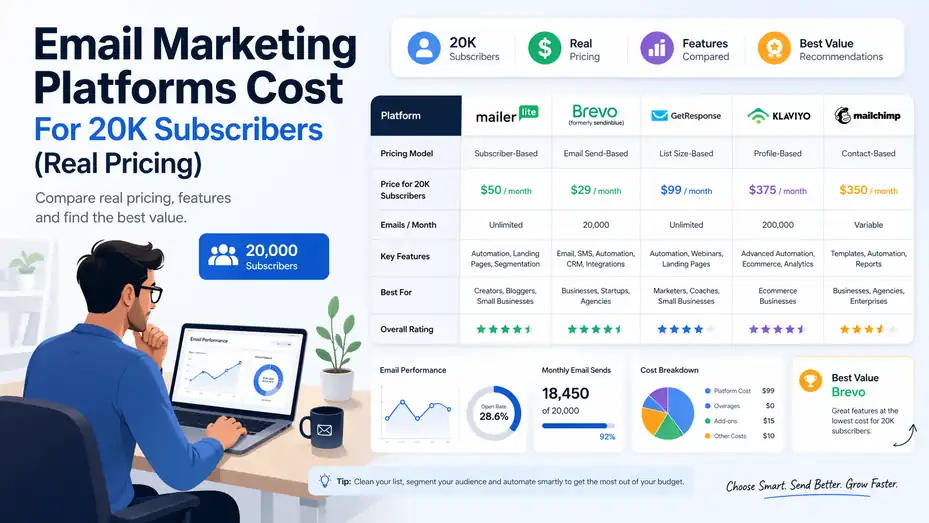
| Platform | Main Billing Logic | 20K Subscriber/Contact Reality | Notable Pricing Detail |
|---|---|---|---|
| Mailchimp | Contact-based with send limits by plan | Premium tier example shown at $350/mo for 15,001–20,000 contacts on pricing page view; Standard/Essentials vary and may apply overages | 12x monthly send limit on Standard, overages can apply |
| Brevo | Monthly email sends, not classic subscriber pricing | 20,000 emails/month has been published at $29/mo in provider comparison content; paid tiers allow up to 500,000 contacts storage on many send bands | Starter starts at $9, Standard starts at $18, storage can far exceed send volume |
| MailerLite | Subscriber-tier pricing | Public comparisons show $50/mo at 10,000 subscribers; pricing rises by subscriber count from there | Growing plan starts at $10, Advanced at $20 |
| GetResponse | Subscriber/list-size band pricing | Official pricing supports 25K list-size tier rather than exact 20K public slot, so 20K usually means buying within the 25K band | Starter from €16/mo monthly, 18% annual discount shown |
| Klaviyo | Active profiles + send volume | Provider comparison content cites $375/mo for 20,000 contacts on Email plan with 200,000 emails/month | Free tier is 250 active profiles and 500 sends/month; active profiles drive cost logic |
| Omnisend | Billable contacts with email credits | Exact 20K figure requires calculator, but pricing auto-adjusts by billable contacts and Standard includes 12x contact count in emails | Standard starts at $16/mo; subscribers + non-subscribers may affect billable count |
| Constant Contact | Contact count + monthly send allowance | No simple public 20K quote shown on pricing page; plan price depends on contacts and sends, with overage potential | Lite/Standard/Premium start at $12/$35/$80; send allowance 10x/12x/24x contacts by plan |
| ActiveCampaign | Tailored pricing by contact band and plan | Public site now pushes custom packages for larger bands like 10K–25K contacts instead of a clear 20K sticker | Starter begins at $15 for 1,000 contacts; 20K usually requires quote/custom package |
What This Table Really Means
The first thing to notice is that “20K subscribers” is not apples to apples. Klaviyo at 20K active profiles is not the same pricing logic as Brevo at 20K sends. Omnisend may count non-subscribers toward billing. Constant Contact can add overage pressure through send allowances. GetResponse groups you into a 25K bracket rather than an exact 20K one.
The second thing is that the cheapest line item is not always the cheapest system. A platform that looks more expensive can still win if it improves automation revenue, saves team time, or gives better segmentation.
I believe that’s the single biggest mistake people make with email software. They compare invoice numbers and ignore revenue mechanics.
How The Main Pricing Models Actually Work
Before you choose a platform, you need to know what kind of billing logic you’re stepping into. This is where most “why did my bill jump?” stories begin.
Contact-Based Pricing
This is the classic model. You pay based on how many contacts or subscribers live in your account, usually with plan tiers. MailerLite and GetResponse still fit this style fairly closely, and Mailchimp largely does too, although plan limits and overage rules complicate it.
The good part is predictability. If your list is 20,000 today, you can usually estimate next month’s bill without too much drama. The bad part is that you may pay for inactive subscribers who rarely open.
A realistic example: If you run a content newsletter and keep old subscribers forever, subscriber-tier billing can punish you for carrying dead weight. Your list might look impressive, but your cost per engaged reader quietly gets worse every quarter.
This is why list hygiene matters so much at 20K. Removing cold contacts can lower costs and improve deliverability at the same time.
Send-Based Pricing
Brevo is the best-known example here. Instead of charging mainly for contact count, it centers pricing on monthly email sends, while allowing large contact storage limits on many tiers.
Official Brevo help content says Starter includes from 20,000 to 100,000 monthly email sends with 500,000 contacts storage, and Standard includes from 20,000 to 1 million monthly email sends with 500,000 contacts storage.
This works really well if you have a big database but mail selectively. It works less well if you blast frequently.
Imagine a B2B company with 20,000 contacts but only one newsletter and one nurture email per week. Send-based pricing can be a bargain there. Now imagine a daily ecommerce calendar plus automations. Suddenly a “cheap” send-based plan stops looking cheap.
This model rewards efficient segmentation. You pay less when you avoid emailing everybody all the time.
Active-Profile Or Billable-Contact Pricing
Klaviyo and Omnisend push a more nuanced model. Klaviyo talks in terms of active profiles and sends. Omnisend says billing can reflect billable contacts, including subscribers plus non-subscribers, with only unsubscribers excluded.
This matters a lot for ecommerce brands. Checkout visitors, synced customer records, and partial leads may all shape your bill depending on the platform’s rules. So the number inside Shopify or WooCommerce may not match the number on your software invoice.
I suggest reading this part of any pricing doc more carefully than the feature list. At 20K, a vague definition of “contact” can cost you more than a premium automation upgrade.
What You Really Get At The 20K Level
Once you move past beginner plans, pricing differences usually reflect feature depth more than basic sending access.
Automation, Segmentation, And Reporting
This is where higher-priced platforms often justify themselves. Constant Contact’s higher tiers expand automation templates and segmentation. Mailchimp differentiates across plan levels with testing, automation, and support. Brevo Standard adds unlimited automation contacts, A/B testing, advanced reporting, and send-time optimization over Starter.
If you only send a weekly broadcast, you may not need much of that. But if you run a store, lifecycle automations can easily recover more revenue than the software upgrade costs.
A simple scenario: A brand with 20K subscribers might upgrade from a basic plan to unlock stronger segmentation and browse-abandon flows. If that adds even 20 extra orders a month, the software price delta often becomes irrelevant.
That’s why I rarely recommend choosing only on base cost. At 20K subscribers, you should ask: what extra revenue can this feature set realistically unlock?
Team Access And Operational Depth
Larger lists usually mean more people touching email. A founder may start alone, but a 20K list often involves marketing, design, ecommerce, maybe support, and sometimes an agency too.
Brevo’s Standard allows up to 3 users as an add-on path and its Professional plan expands further. Constant Contact and MailerLite also differentiate by higher-tier operational flexibility. GetResponse’s packages specify user counts by plan, with Starter allowing 3 users and Marketer allowing up to 5.
That sounds boring until you need approvals, reporting access, or someone to build automations without sharing one login. Then it becomes a real operational issue.
In practice, platform cost at 20K is partly a staffing decision. The right tool either reduces manual work or makes collaboration cleaner. Both are worth money.
Which Platform Usually Fits Which Business
There is no universal winner here. The right platform depends on the business model behind the list.
Best Fit For Creators, Publishers, And Simpler Newsletters
If your list is primarily newsletter-driven and your monetization is content, courses, coaching, or sponsorships, simpler subscriber-based pricing is often easier to live with. MailerLite and GetResponse usually feel more predictable here, and Kit is often considered by creator businesses even though public 20K pricing is less transparent from the sources I reviewed.
MailerLite’s public comparisons show it staying cheaper than Mailchimp at lower bands, and its pricing structure remains relatively straightforward.
For many creators, complexity is the enemy. You want forms, automations, landing pages, and decent analytics without paying ecommerce-enterprise prices for features you may never use.
If that sounds like you, I’d lean toward a platform that keeps subscriber billing simple and doesn’t punish you for every little workflow.
Best Fit For Ecommerce Brands
Ecommerce is where Klaviyo and Omnisend make the strongest case. They are built around automation depth, segmentation, and customer behavior. Omnisend includes all features across plans according to its help center, while Klaviyo’s value often shows up when purchase data and flows are central to revenue.
The tradeoff is cost. These tools usually stop looking “affordable” at 20K compared with lightweight newsletter platforms. But if email is responsible for a serious percentage of store revenue, the more relevant question is not “What is the monthly fee?” but “What is the return on this fee?”
That sounds obvious, but it changes buying behavior. A store doing strong repeat-purchase revenue can justify a more expensive platform much more easily than a media newsletter can.
Best Fit For Mixed B2B Or CRM-Heavy Setups
If your email program sits close to sales workflows, lead scoring, or CRM activity, ActiveCampaign becomes more relevant. Its public pricing is less transparent at larger list sizes now, with tailored packages emphasized for bigger contact bands, but that tells you something by itself: the product is increasingly sold as a broader automation system, not just an email sender.
That can be worth it for B2B teams. It can also be overkill for a basic newsletter.
I’d only pay that complexity tax if the business actually uses it.
Hidden Costs That Catch People Off Guard
The platform fee is only the clean part of the bill. The messy part is everything the pricing page keeps small.
Overage Fees, Send Caps, And Contact Definitions
Mailchimp notes that overages apply if contact or email send limits are exceeded. Constant Contact also states that plan price is based on contacts and email sends, and overage fees may apply. Omnisend warns that pricing tiers change automatically based on billable contact count.
That means your “20K subscribers” plan may still not behave like a fixed monthly number.
Here’s a realistic example. Let’s say you have 20,000 subscribers and send a weekly newsletter. Fine. Then Black Friday arrives, you add campaigns, resends, win-back flows, and product alerts. Suddenly your send volume spikes, or your synced customer records push billable contacts higher. Your pricing jumps right when your team is busiest.
That’s not a small annoyance. It makes budgeting harder and can distort platform comparisons if you only look at list size.
Migration, Cleanup, And Warmup Costs
There’s also the cost of switching. Even if the new platform is cheaper on paper, migration often includes list cleanup, template rebuilding, automation recreation, and authentication setup. Google explicitly recommends SPF, DKIM, and DMARC, and if you switch sending infrastructure without planning, deliverability can wobble.
I’ve seen brands switch to save $100 a month and then lose far more in performance during a messy migration month.
So yes, price matters. But switching cost matters too. Especially at 20K, when your email program is probably already producing meaningful revenue.
How To Estimate Your Real Monthly Cost
The best way to compare tools is to model your actual behavior, not your subscriber count in isolation.
Use A 3-Part Cost Formula
Here’s the simple version I recommend:
- Base platform fee.
- Usage risk. Think sends, billable contacts, or overages.
- Revenue value. Think automation depth, segmentation, and team efficiency.
A tool that costs $80 but saves hours and drives more sales may be cheaper than a $40 tool that creates manual work and weaker targeting.
For a 20K list, I suggest estimating these operational numbers before you buy:
- Average campaigns per month
- Average automation volume
- Percentage of inactive contacts
- Number of users who need access
- Ecommerce vs newsletter vs B2B use case
- Whether non-subscribers or synced contacts may count toward billing
Those last two are especially important with Klaviyo and Omnisend-style billing logic.
A Realistic Budgeting Example
Imagine a small ecommerce store with 20K subscribers sending 8 campaigns a month plus automations. A cheaper newsletter-first tool might save money upfront but underperform on segmentation and lifecycle flows. An ecommerce-focused tool may cost more, but if it lifts repeat purchases, the net result can still be better.
Now flip that example. A writer with 20K readers sending one weekly issue and a welcome sequence does not need ecommerce pricing logic. In that case, paying for deep store automation would be wasteful.
That’s why I suggest choosing your platform based on business model first, price second.
Common Buying Mistakes At 20K Subscribers
By the time a list reaches 20K, the buying mistakes get more expensive and harder to reverse.
Mistake 1: Choosing Based On Starting Price
This is the most common one. People see “starts at $9” or “starts at $16” and anchor on it. But Brevo’s $9 Starter is a starting tier, not a universal answer for every 20K-list business, and Omnisend’s $16 Standard is also just the entry point, not the guaranteed 20K bill.
Starting price is useful only for understanding the floor. It tells you almost nothing about the ceiling.
Mistake 2: Ignoring Contact Hygiene
If you keep disengaged contacts forever, subscriber-tier tools get more expensive and deliverability can get worse. If you sync every possible profile into an active-profile or billable-contact system, your invoice can drift upward without a matching revenue gain.
In my experience, a leaner 16K engaged list often outperforms a bloated 20K list anyway. MailerLite even highlights the practical truth that a smaller, more engaged list can be more profitable than a huge low-engagement one.
That’s not just good marketing advice. It’s pricing advice.
How To Reduce Cost Without Hurting Revenue
This is the fun part, because you usually do not need to accept the first scary quote.
Clean Your List And Segment Harder
The cheapest way to lower platform cost is to stop paying for people who are not helping your business. Remove cold subscribers, suppress dead segments, and separate active buyers from inactive leads.
With send-based billing, tighter segmentation reduces waste. With subscriber-based billing, cleanup lowers your tier. With billable-contact models, smarter syncing prevents invisible profile creep.
A lot of businesses treat list cleanup as a deliverability task only. I think of it as a pricing strategy too.
Match The Tool To The Revenue Model
Here’s the simplest rule in this whole article: do not buy ecommerce depth for a newsletter business, and do not buy a lightweight newsletter platform for an automation-heavy store.
That sounds obvious, but it’s where a lot of wasted money comes from. Newsletter publishers often overbuy. Ecommerce brands often underbuy and then bolt on manual workarounds.
When email delivers strong returns, which it often does, it is smarter to optimize profit per subscriber than obsess over the smallest platform bill. Litmus reported that many companies see email ROI in the 10:1 to 36:1 range, and some go higher.
The goal is not “lowest software cost.” The goal is “best margin after software cost.”
10. Final Verdict: Which Platform Is The Best Value?
There is no single cheapest answer to email marketing platforms cost for 20k subscribers because the term itself hides too much. Some platforms charge by subscribers, some by active profiles, some by send volume, and some by a billable-contact definition that is broader than most buyers expect.
That said, here’s the practical takeaway I’d give most readers:
- For simple newsletters and creator-style businesses, MailerLite or GetResponse usually make more financial sense because pricing is easier to predict and you are less likely to pay for ecommerce-heavy complexity.
- For ecommerce brands, Klaviyo and Omnisend can justify higher cost if segmentation and automation directly drive store revenue.
- For large databases with selective sending, Brevo can be cost-effective because its pricing is centered on send volume and allows large contact storage.
- For broader marketing plus CRM workflows, ActiveCampaign may fit better, but you should expect more custom pricing discussion at the 20K level.
- For businesses considering Mailchimp or Constant Contact, watch the send allowances, overages, and plan-level feature differences carefully, because those can reshape the “real” cost fast.
If I were choosing today, I would not start with the platform homepage price. I would start with three questions: how often do you send, what kind of business are you running, and how many of your 20K contacts are actually engaged. Get those right, and the best-value platform becomes much easier to spot.
FAQ
What is the average email marketing platforms cost for 20k subscribers?
The average cost ranges from $50 to $400 per month depending on the platform, features, and pricing model. Subscriber-based tools are usually cheaper, while ecommerce-focused platforms cost more due to advanced automation and segmentation capabilities that directly impact revenue generation.
Why do email marketing platforms charge differently for 20k subscribers?
Pricing varies because platforms use different billing models such as subscriber count, email sends, or active profiles. Some tools also include non-subscribers in billing. This means two businesses with the same list size can pay very different amounts based on usage and data structure.
Which email marketing platform is cheapest for 20k subscribers?
Platforms like MailerLite and Brevo are often the cheapest options for 20k subscribers, especially for simple newsletters. However, the lowest cost depends on how often you send emails and whether you need advanced features like automation, segmentation, or ecommerce integrations.
Is it better to choose a cheaper email platform or a more advanced one?
It depends on your business model. Cheaper platforms work well for basic newsletters, while advanced platforms can generate more revenue through automation and targeting. In many cases, a higher monthly cost can deliver better overall returns if it improves engagement and conversions.
How can I reduce email marketing costs at 20k subscribers?
You can reduce costs by cleaning inactive subscribers, segmenting your audience, and sending emails more strategically. Choosing a pricing model that matches your usage, such as send-based or subscriber-based billing, can also significantly lower your monthly expenses without affecting results.

Juxhin B is a digital marketing researcher and founder of JAK Digital Hub, specializing in email marketing software, marketing automation platforms, and digital growth tools. His work focuses on software testing, platform comparisons, and real-world performance analysis to help businesses choose the right marketing technology.
Related posts:
 Should I Leave Moosend or Stick With It? Clear Criteria
 Is AWeber Worth The Price Or Are There Better Value Email Tools?
 Email Marketing Tools Cost For 20K Subscribers Revealed
 Email Marketing Tools For 100K Subscribers That Scale
 Cheaper Email Automation System For Growing List Fast
 Email Automation Software Cost For 20K Subscribers