Table of Contents
Some links on JAK Digital Hub are affiliate links, meaning we may earn a small commission at no extra cost to you. Read full disclaimer.
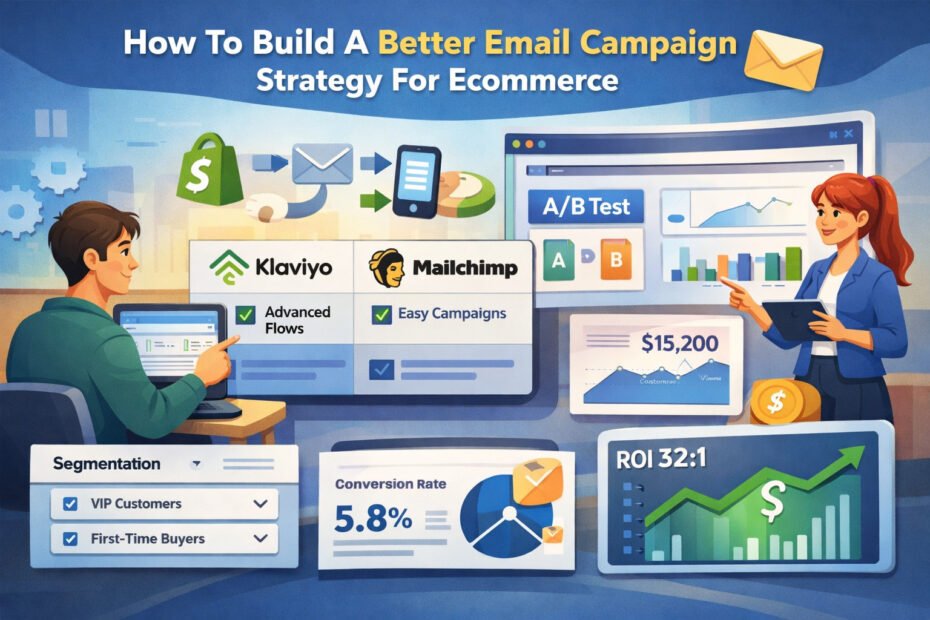
Building a better email campaign strategy for ecommerce isn’t about sending more emails — it’s about sending smarter ones. If you run an online store, manage retention, or handle lifecycle marketing, this guide is for you.
We’re answering one core question: How do you design an email strategy that actually drives revenue, not just opens?
Define Your Revenue Goals Before Sending Emails
If you want a better email campaign strategy for ecommerce, you have to start with numbers — not templates, not design, not subject lines. Revenue clarity changes everything. When you know exactly what email is responsible for, decisions become obvious instead of emotional.
Set Clear Revenue And Retention Targets
Most ecommerce brands say, “We want more revenue from email.” That’s not a goal — that’s a wish.
Instead, define targets like:
- Email should drive 30% of total monthly revenue
- Automated flows should generate 60% of email revenue
- Increase repeat purchase rate from 22% to 30%
- Lift customer lifetime value (CLV) by 15% in 6 months
Let me give you a practical example.
If your store makes $100,000/month and email drives $18,000, your first clear milestone might be pushing that to $30,000. That’s not unrealistic. Well-optimized ecommerce brands using tools like Klaviyo commonly see 25–40% of total revenue coming from email when flows are properly structured.
Retention matters even more than top-line email revenue. Acquiring a new customer often costs 5–7x more than retaining one. So if you improve repeat purchase behavior, your margins expand quietly in the background. That’s where the real compounding happens.
Revenue clarity forces strategic thinking. Without it, you’re just sending campaigns because it’s Tuesday.
Align Email KPIs With Storewide Business Goals
Your email metrics should directly reflect what the business cares about.
If leadership focuses on:
- Profit margin → You track revenue per subscriber and AOV from email
- Inventory turnover → You build campaigns to move slow stock
- New customer growth → You optimize welcome flows and lead capture
Too many teams obsess over open rates. But iOS privacy updates changed that game. Open rates are directional at best.
What actually matters?
- Revenue per recipient (RPR)
- Conversion rate per campaign
- Average order value (AOV) from email traffic
- Email-driven customer lifetime value
Inside platforms like Shopify, you can track revenue attribution directly. Pair that with your email platform analytics and you get a clearer picture of what email truly drives.
Here’s a simple alignment check: If your company goal is increasing AOV from $65 to $75, your email strategy should include:
- Product bundles in campaigns
- Cross-sell blocks in post-purchase flows
- Threshold-based free shipping incentives
That’s strategic alignment. Not just pretty newsletters.
Separate Acquisition, Conversion, And Retention Metrics
Not all revenue behaves the same. And your metrics shouldn’t either.
Think of email performance in three buckets:
Acquisition Metrics
- Subscriber growth rate
- Cost per email subscriber (from paid ads)
- Welcome flow conversion rate
Conversion Metrics
- Cart abandonment recovery rate
- Campaign conversion rate
- Revenue per campaign
Retention Metrics
- Repeat purchase rate
- Time between purchases
- Reactivation success rate
When brands mix these together, they lose visibility.
For example: Your campaigns might perform well, but if your welcome flow converts only 2% of new subscribers, you’re leaking early revenue.
A healthy ecommerce setup often looks like:
- Welcome flow conversion: 8–15%
- Cart abandonment recovery: 10–20%
- Repeat purchase rate: 25–40% (depending on niche)
Separating these metrics gives you diagnostic clarity. You can see exactly where the strategy needs attention instead of assuming “email isn’t working.”
Map Email Contribution To Customer Lifetime Value
This is where things get interesting.
Customer Lifetime Value (CLV) is the total revenue a customer generates over their relationship with your store.
Email directly impacts:
- Frequency of purchases
- Average order value
- Retention duration
Let’s run a quick scenario:
If your average customer:
- Spends $60 per order
- Buys twice per year
- Stays for 2 years
CLV = $240
Now imagine your post-purchase flow encourages just one additional order per year. That small improvement turns CLV into $360.
That’s a 50% increase — without acquiring a single new customer.
Tools like Klaviyo and Mailchimp allow you to build segments based on predicted lifetime value and purchase frequency. That’s powerful because you can:
- Reward high-CLV customers with exclusives
- Prevent churn from medium-value buyers
- Avoid overspending on low-engagement segments
A better email campaign strategy for ecommerce isn’t about blasting promotions. It’s about engineering long-term value.
And that requires knowing what long-term value actually is.
Map The Full Ecommerce Customer Journey First
Email doesn’t operate in isolation. It supports the buying journey. If you don’t map that journey, your campaigns feel random.
Let’s walk through it strategically.
Identify High-Intent Touchpoints In The Buying Cycle
High-intent moments are where money is closest to changing hands.
These include:
- Product page visits
- Add-to-cart events
- Checkout started
- Returning visitor behavior
- Post-purchase product browsing
These events can be tracked through platforms like Shopify and synced into email tools.
Here’s what this means in practice:
If someone:
- Views a product twice
- Spends 4+ minutes on a product page
- Returns within 48 hours
That’s not casual browsing. That’s buying consideration.
A triggered browse abandonment flow targeting that product can convert 5–12% of those users depending on niche.
High-intent targeting beats generic campaigns every time.
Break Down Awareness, Consideration, And Purchase Stages
Every subscriber sits somewhere in this progression:
Awareness: They just discovered you. They need brand trust and clarity.
Consideration: They’re comparing options. They need differentiation and proof.
Purchase: They’re close. They need reassurance and urgency.
Your emails should match these stages.
For awareness:
- Educational welcome sequences
- Brand story positioning
- Problem-solution messaging
For consideration:
- Product comparisons
- Reviews and social proof
- FAQs that remove objections
For purchase:
- Scarcity messaging
- Abandoned cart reminders
- Incentive-based nudges
Many ecommerce brands jump straight to discounts. That’s lazy marketing. If someone is still in awareness mode, a 10% discount won’t fix lack of trust.
When you match message to stage, conversion rates improve naturally.
Spot Friction Points That Email Can Fix
Friction kills revenue quietly.
Common ecommerce friction points:
- Confusing return policies
- Shipping cost surprises
- Product sizing uncertainty
- Payment security concerns
Email can pre-handle these objections before they become deal breakers.
For example: A welcome flow email titled “Everything You Need To Know Before Ordering” can reduce support tickets and improve conversion rates.
Or: A cart abandonment email that clearly restates return guarantees and shipping timelines can lift recovery by 5–10%.
One brand I’ve seen added a simple comparison chart in their consideration-stage email. That single addition increased product page click-through by 18%.
Sometimes the fix isn’t flashy. It’s clarity.
Prioritize Moments That Directly Impact Revenue
Not all emails deserve equal energy.
If you have limited time, focus on flows that typically drive the highest ROI:
- Welcome Flow
- Abandoned Cart
- Post-Purchase Upsell
- Win-Back Campaign
For most ecommerce stores:
- Abandoned cart alone can represent 20–30% of email revenue
- Welcome flows often drive 10–20%
If those aren’t optimized, weekly campaigns won’t save you.
Here’s the mental shift: Campaigns create spikes. Flows create stability.
A better email campaign strategy for ecommerce builds predictable revenue from automated systems first. Then campaigns amplify.
When you map the journey and align it with revenue targets, email stops being “marketing noise” and starts becoming a profit engine.
And once that foundation is set, optimization becomes a science instead of guesswork.
Build High-Converting Ecommerce Email Flows
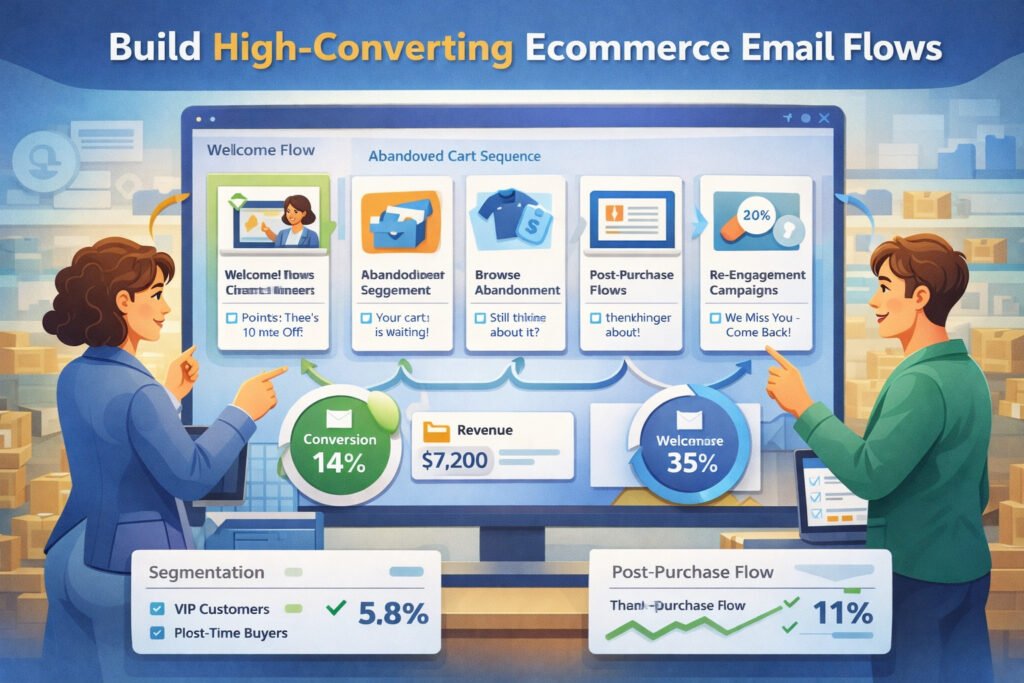
If you want a better email campaign strategy for ecommerce, automated flows are the backbone. Campaigns create spikes. Flows create predictable revenue every single day whether you’re online or not.
In most healthy ecommerce accounts, flows generate 50–70% of total email revenue. If that’s not happening in your store, this is where the opportunity lives.
Let’s break them down properly.
Welcome Flow That Converts First-Time Visitors
Your welcome flow is your first impression — and first impressions compound.
This isn’t just a discount email. It’s a structured conversion path.
A high-performing welcome flow usually includes 3–5 emails:
- Email 1 (Immediately): Deliver incentive + set expectations
- Email 2 (1–2 days later): Brand story + differentiation
- Email 3: Social proof + product education
- Email 4: Objection handling (shipping, returns, FAQs)
- Email 5: Urgency reminder before incentive expires
Inside Klaviyo, you can trigger this flow when someone joins a list and segment based on source. Someone coming from a paid ad often converts differently than someone who joined from a blog.
Real numbers: Strong ecommerce brands see 8–15% conversion rates from welcome flows. If you’re sitting at 3%, it’s usually because:
- You rely only on a discount
- You don’t explain why your product is different
- You don’t remove friction early
Quick tactical shortcut: Add a “How It Works” section in Email 2. Clarity alone can lift conversions by 10–20% because confusion silently kills sales.
Abandoned Cart Sequence That Recovers Revenue
Cart abandonment is where money is sitting on the table.
Industry data shows average cart abandonment rates around 70%. That sounds bad — but it’s normal. Your job is to recover as much of that as possible.
A solid cart sequence usually has 3 emails:
- 1 hour later: Reminder with product image
- 24 hours later: Objection handling (shipping, returns)
- 48 hours later: Incentive or urgency (if margins allow)
In Shopify, cart tracking integrates directly with email platforms so triggers fire automatically.
Small optimization that makes a huge difference: Add dynamic product blocks. This means the email automatically shows the exact item left in cart. It sounds basic, but I still see stores sending generic “You forgot something” emails with no product visuals.
Recovery benchmarks:
- 10–20% cart recovery rate is strong
- Cart flows often drive 20–30% of email revenue
If your cart emails are underperforming, check this first: Are you answering the real buying objection? Price is rarely the only issue. Sometimes it’s trust.
Browse Abandonment Emails That Capture Intent
Browse abandonment is more subtle — and often overlooked.
This triggers when someone views a product but doesn’t add to cart.
Why this matters: A returning product viewer is a high-intent signal.
You can set this up inside Klaviyo by tracking “Viewed Product” events and filtering for users who didn’t add to cart.
Conversion rates here are lower than cart flows (usually 3–8%), but the volume can be high.
Best practice:
- Wait 4–8 hours before sending
- Include product benefits, not just the image
- Add reviews or UGC (User-Generated Content, meaning real customer photos or testimonials)
One brand I worked with added a short comparison chart in their browse email — showing why their product outperformed competitors. Click-through rate jumped 18%.
Intent without pressure. That’s the balance.
Post-Purchase Flow That Increases Repeat Orders
This is where most ecommerce brands leave money behind.
Post-purchase isn’t just “Thanks for your order.”
It should do three things:
- Reinforce confidence
- Educate usage
- Introduce the next logical purchase
Let’s say you sell skincare.
Your flow might look like:
- Email 1: Order confirmation + expectation setting
- Email 2: How to use product properly
- Email 3: Cross-sell complementary product
- Email 4: Review request
- Email 5: Replenishment reminder based on usage cycle
Platforms like Mailchimp and Klaviyo allow conditional splits. That means if someone buys Product A, they automatically receive content tailored to Product A.
Small insight most people miss: Timing matters more than discounting.
If your average product lasts 30 days, don’t send a reorder reminder at day 14. Send it at day 25–28 when need is rising.
Even adding one extra purchase per year can increase customer lifetime value by 30–50% depending on margin structure.
Retention is quieter than acquisition — but far more powerful.
Re-Engagement Campaigns That Win Back Inactive Buyers
Every list decays. That’s normal.
The mistake is ignoring inactive subscribers until deliverability drops.
Re-engagement campaigns target users who haven’t opened or purchased in 60–120 days.
Structure example:
- Email 1: “Still Interested?”
- Email 2: Value reminder or product update
- Email 3: Strong incentive or exit confirmation
Why this matters: Inactive subscribers hurt sender reputation. If Gmail sees low engagement, your emails hit promotions or spam.
Re-engagement flows can recover 5–15% of inactive buyers.
Pro move: Add a preference center link. Instead of losing them completely, let them reduce frequency.
Cleaning your list is strategic, not emotional. Smaller engaged lists outperform large dead ones.
Segment Your List Based On Buying Behavior
If you send the same message to everyone, you’re choosing average results.
Segmentation is what turns a decent email strategy into a better email campaign strategy for ecommerce. It lets you match offer to intent instead of guessing.
Let’s get specific.
Segment By Purchase Frequency And Order Value
Not all customers behave equally.
Inside Shopify or Klaviyo, you can create segments like:
- Purchased 1 time
- Purchased 2–3 times
- Purchased 4+ times
- Average order value above $150
Now you can tailor messaging.
Example:
- One-time buyers → Education + trust reinforcement
- Repeat buyers → Loyalty perks
- High AOV buyers → Early product access
If someone spends $300 per order, sending them the same 10% discount blast as a first-time buyer is lazy segmentation. Instead, give them exclusivity. High spenders value access more than discounts.
Create VIP Segments For High-Spending Customers
VIP doesn’t mean “Anyone who bought twice.”
Define it clearly. For example:
- Spent over $500 lifetime
- Purchased 5+ times
- Bought within last 60 days
Then treat them differently.
Ideas that actually work:
- Early access to product drops
- Limited inventory previews
- Free shipping codes without public promotion
- Surprise loyalty rewards
Psychology matters here. Recognition drives retention.
Brands using VIP segmentation often see:
- 20–40% higher email conversion rates
- 2x repeat purchase frequency
Inside Klaviyo, you can create a “Predicted High Lifetime Value” segment using predictive analytics (AI-based forecasting of expected customer spend). That’s powerful for scaling.
Target First-Time Buyers Differently From Repeat Buyers
First-time buyers still need reassurance.
Repeat buyers need momentum.
For first-time buyers:
- Reinforce brand trust
- Highlight guarantees
- Showcase reviews
For repeat buyers:
- Introduce bundles
- Offer subscription options
- Suggest complementary products
I’ve seen brands increase repeat purchase rate by 12% simply by creating a separate post-purchase track for second-time buyers versus first.
Different mindset. Different messaging.
Use Engagement Data To Refine Targeting
Engagement isn’t just opens. It’s:
- Click behavior
- Time since last purchase
- Browsing frequency
- Email interaction patterns
If someone clicks every product launch but never purchases, they may need social proof instead of urgency.
If someone hasn’t clicked in 90 days, reduce frequency or move them into re-engagement.
Here’s a simplified segmentation logic framework:
| Segment Type | Criteria | Strategy Focus |
| Highly Engaged | Opened or clicked last 30 days | Promote new arrivals |
| Warm | Engaged within 60 days | Education + reminder |
| Cold | No engagement 90+ days | Re-engagement sequence |
| VIP | High CLV + recent purchase | Exclusive access |
The point isn’t complexity. It’s relevance.
A better email campaign strategy for ecommerce doesn’t rely on volume. It relies on precision.
When your flows are structured and your segments are intentional, email stops feeling like guesswork — and starts behaving like a predictable growth channel.
Optimize Email Timing, Frequency, And Cadence
Even the best creative won’t save a poorly timed email. A better email campaign strategy for ecommerce isn’t just about what you send — it’s about when and how often you send it.
Timing and cadence directly affect revenue, engagement, and deliverability. Get this wrong, and you either leave money on the table or burn out your list.
Let’s dial this in properly.
Determine Ideal Send Frequency Per Segment
There’s no universal “best” frequency. Anyone who tells you “send 3 emails per week” without context is guessing.
Instead, segment by behavior:
- Highly engaged buyers: 2–4 emails per week can work
- Warm subscribers: 1–2 emails per week
- Cold subscribers: 2–4 emails per month max
Inside Klaviyo, you can create engagement-based segments automatically (for example: “Opened or clicked in last 30 days”). That gives you control over frequency per segment.
Quick practical benchmark: If unsubscribe rates spike above 0.3–0.5% per campaign, you’re likely pushing too hard — or sending irrelevant content.
One ecommerce brand I observed reduced email frequency for cold subscribers and saw:
- 18% improvement in open rates
- 9% increase in revenue per recipient
Less noise. More precision.
Use Behavioral Triggers Instead Of Batch Blasts
Batch campaigns (emails sent to everyone at once) still matter. But behavior-based triggers outperform them almost every time.
Triggered emails respond to user actions:
- Viewed product
- Added to cart
- Completed purchase
- Reached a certain lifetime spend
Behavioral emails convert higher because they match intent.
For example:
- A triggered browse email might convert at 6%.
- A generic promotional blast might convert at 0.8%.
That’s not subtle.
Platforms like Shopify sync real-time customer data into email tools. When someone takes action on your store, your automation reacts instantly.
My honest take: If you’re relying heavily on batch sends and your flows are underdeveloped, you’re working harder than necessary.
Automation isn’t about being robotic. It’s about being timely.
Avoid Subscriber Fatigue With Smart Suppression
Subscriber fatigue is real. You’ll notice it when:
- Open rates slowly decline
- Click rates drop
- Spam complaints rise
Smart suppression solves this.
Suppression means temporarily excluding certain users from campaigns based on rules like:
- Purchased within last 3 days
- Already received 4 emails this week
- Currently in a flow
Inside Klaviyo or Mailchimp, you can build suppression logic so users aren’t overwhelmed.
Example rule: “If subscriber received 5 emails in last 7 days, exclude from next campaign.”
One ecommerce store implemented frequency caps and saw:
- 22% reduction in unsubscribe rate
- 11% lift in revenue per send
Counterintuitive truth: Sending fewer emails can increase total revenue.
Test Time Zones And Peak Buying Windows
Send time optimization isn’t magic — but it matters.
Instead of guessing, look at your purchase data inside Shopify analytics:
- What days drive the most revenue?
- What hours show the highest conversion rate?
Then test intentionally.
Quick experiment structure:
- Send Segment A at 10 AM
- Send Segment B at 6 PM
- Measure revenue per recipient
Don’t judge by open rate alone. Revenue decides.
Advanced tip: Some platforms offer “send time optimization” (AI-based predictive delivery). Test it against manual timing. Sometimes the algorithm wins. Sometimes your niche behaves differently.
The key is not assuming. Testing removes ego from the equation.
Craft Ecommerce Emails That Drive Conversions
Design matters. Copy matters more. Structure matters most.
If your emails look pretty but don’t convert, they’re decoration — not revenue drivers.
Let’s make them perform.
Write Subject Lines That Trigger Curiosity And Intent
Subject lines decide whether your email even gets a chance.
Three types that consistently work in ecommerce:
- Curiosity-based: “You Left Something Behind…”
- Benefit-focused: “Smoother Skin In 7 Days”
- Specific and concrete: “20% Off Ends Tonight”
Avoid vague hype. Specificity wins.
Quick rule: If your subject line could apply to any brand, it’s too generic.
Example comparison:
- Weak: “Don’t Miss Out!”
- Stronger: “Your Cart Expires In 3 Hours”
Use preview text strategically. Think of it as a second subject line.
Aim for:
- Open rates above 25% (varies by niche)
- Strong click-through rate relative to opens
And always A/B test. Not once. Continuously.
Structure Emails For Fast Scanning And Mobile Reading
Over 60% of ecommerce emails are opened on mobile.
That means:
- Short paragraphs
- Clear headers
- Plenty of white space
- One primary CTA (Call To Action — the button you want clicked)
A high-converting structure often looks like:
- Hook
- Visual product image
- 2–3 benefit bullets
- Social proof snippet
- Clear CTA
Avoid clutter.
If your email feels like a landing page squeezed into a tiny screen, simplify it.
Personal opinion: Clean and focused beats fancy and crowded every time.
Use Product Blocks Strategically To Increase AOV
Product blocks are dynamic sections that automatically pull products from your store.
Inside Klaviyo, you can set logic like: “Show related items from same category as purchased product.”
This increases AOV (Average Order Value).
Example: If someone buys running shoes, show socks or insoles in the post-purchase flow.
Advanced move:
Use conditional splits:
- If AOV < $50 → Promote bundle
- If AOV > $150 → Promote premium add-on
This makes your email strategy feel intelligent rather than static.
Simple upsells can increase revenue per customer by 10–20% without increasing traffic.
That’s leverage.
Design Clear Calls-To-Action That Reduce Friction
Your CTA should feel obvious and low resistance.
- Weak CTA: “Click Here”
- Stronger CTA: “Complete My Order”
Even Better: “Get My 20% Discount”
Specificity lowers friction.
Placement matters too:
- Above the fold (visible without scrolling)
- After benefit explanation
- Repeated if email is longer
One brand improved conversions by 14% simply by changing button text from “Shop Now” to “See Available Sizes.”
Clarity converts.
Use Automation Platforms To Scale Performance
Technology is the engine behind a better email campaign strategy for ecommerce. The right tools don’t replace strategy — they amplify it.
Let’s compare how to use them effectively.
Build Advanced Flows Inside Klaviyo
Klaviyo is built specifically for ecommerce.
Why it’s powerful:
- Deep Shopify integration
- Predictive analytics (like expected next purchase date)
- Advanced segmentation logic
- Dynamic product recommendations
Pricing starts around $20/month for small lists and scales with subscriber count.
Advanced tactic: Use “Conditional Split” based on predicted lifetime value. High-LTV customers get premium messaging. Low-LTV customers get bundle incentives.
That’s strategic personalization at scale.
Leverage Shopify Data For Smarter Personalization
Shopify holds your most valuable data:
- Purchase history
- Order value
- Product category behavior
- Geographic location
Sync this into your email platform.
Example: If someone purchased winter gear and lives in a cold region, promote matching accessories before peak season.
Behavior + context = higher relevance.
Personalization isn’t just “Hi [First Name].” It’s behavioral alignment.
Use Mailchimp For Structured Campaign Management
Mailchimp is often easier for smaller stores.
Strengths:
- Simple automation builder
- Built-in templates
- Clear reporting dashboard
Pricing starts with free tiers (limited features), then scales.
Mailchimp works well for:
- Structured newsletters
- Basic automations
- Smaller product catalogs
If you need heavy segmentation and predictive modeling, Klaviyo might edge ahead. But for straightforward campaign management, Mailchimp keeps things simple.
Integrate SMS And Email For Cross-Channel Impact
Email is powerful. SMS (text messaging) adds urgency.
When integrated properly:
- Cart email → SMS reminder 2 hours later
- Product drop email → VIP SMS early access
- Flash sale → SMS urgency trigger
SMS open rates often exceed 90%. But use it carefully. Overuse feels intrusive.
Many brands integrate SMS directly inside Klaviyo so flows coordinate automatically.
Simple comparison:
| Channel | Strength | Best For |
| Detailed storytelling | Education, upsells | |
| SMS | Urgency and immediacy | Cart recovery, flash sales |
Together, they reinforce each other.
Used strategically, automation platforms turn your ecommerce email marketing from reactive to predictive.
And once your timing, creative, segmentation, and tools align, your email channel stops feeling like guesswork — and starts operating like a controlled growth machine.
Test And Improve Campaign Performance Continuously
A better email campaign strategy for ecommerce is never “finished.” It evolves. What worked three months ago might underperform today because your audience, inventory, or acquisition channels changed.
Testing is how you replace opinions with data.
Run Structured A/B Tests On Revenue Drivers
Most people A/B test subject lines and stop there. That’s surface-level.
If you want real growth, test variables that impact revenue:
- Offer type (10% off vs. free shipping)
- CTA wording
- Product bundle vs. single product
- Email length (short vs. long-form)
- Discount threshold (“$20 Off $100” vs. “15% Off”)
Inside Klaviyo and Mailchimp, you can split traffic automatically and measure results beyond opens.
Important rule: Test one variable at a time. Otherwise, you won’t know what caused the change.
Example scenario:
An ecommerce brand selling supplements tested:
- Version A: “Buy One Get One 50% Off”
- Version B: “Free Shipping Over $75”
Revenue per recipient increased 23% with free shipping — even though the BOGO offer looked more exciting.
Perception doesn’t always match behavior. Data wins.
Analyze Revenue Per Subscriber Instead Of Opens
Open rates are noisy. Privacy changes made them unreliable.
Revenue per subscriber (RPS) is cleaner. It answers one question: “How much money does each person on my list generate?”
Formula: Total Email Revenue ÷ Total Active Subscribers
If your RPS is $2 per month and you have 20,000 active subscribers, that’s $40,000 in monthly email revenue.
Now improvements become measurable: Increase RPS from $2 to $2.50 → $10,000 extra revenue.
That’s leverage.
Inside Shopify analytics and your email dashboard, you can compare campaign revenue directly. Tie everything back to dollars, not vanity metrics.
Optimize Based On Cohort Behavior, Not Guesswork
A cohort is a group of customers who share a common behavior — like purchasing in the same month.
Instead of looking at overall averages, examine patterns:
- Do customers acquired in Q4 purchase less frequently?
- Do paid ad subscribers convert slower than organic ones?
- Do customers from a specific product category repeat more?
You can build cohort reports inside Shopify and export data to tools like Klaviyo for segmentation.
Mini example:
One apparel brand discovered that customers acquired during discount-heavy Black Friday campaigns had 35% lower lifetime value compared to full-price customers.
Solution: They adjusted welcome flows for discount-heavy cohorts to focus on brand value rather than constant promotions.
Within two quarters, repeat purchase rate improved by 14%.
That’s the power of cohort analysis. It reveals behavioral truth.
Document Winning Variations For Scalable Growth
Testing without documentation creates chaos.
Build a simple internal “Email Testing Log”:
| Test Date | Variable Tested | Winning Version | Revenue Impact | Notes |
This turns experimentation into institutional knowledge.
Over time, you’ll notice patterns:
- Certain urgency phrases consistently outperform
- Specific offer types work better for certain segments
- Long-form storytelling converts better for high-ticket items
Testing isn’t about chasing novelty. It’s about building a repeatable performance playbook.
Track The Metrics That Actually Matter For Growth
Data should clarify decisions, not overwhelm you. A better email campaign strategy for ecommerce focuses on metrics tied directly to profit and long-term sustainability.
Let’s simplify what really matters.
Monitor Revenue Per Email And Campaign ROI
Every campaign should answer:
Did this email generate more revenue than it cost?
Basic ROI formula: (Revenue – Cost) ÷ Cost
Costs include:
- Email platform subscription
- Creative production time
- Discounts given
Most ecommerce brands see extremely high ROI from email — often 30:1 or higher — when flows are optimized.
But don’t assume. Measure.
Track:
- Revenue per campaign
- Revenue per recipient
- Conversion rate
If a campaign drives high opens but low revenue, something’s misaligned.
Measure List Growth Versus Subscriber Churn
Growth without retention is pointless.
Track monthly:
- New subscribers added
- Unsubscribes
- Hard bounces
Healthy ecommerce list growth typically ranges from 2–5% per month depending on traffic volume.
If churn equals growth, you’re standing still.
Example: You add 1,000 subscribers but lose 950. That’s not growth — that’s treadmill marketing.
Focus on acquisition quality, not just quantity.
Evaluate Customer Lifetime Value Impact
We talked earlier about CLV (Customer Lifetime Value). Now measure how email influences it.
Key questions:
- Do email subscribers have higher CLV than non-subscribers?
- Do subscribers receiving flows purchase more frequently?
- Does segmentation increase repeat order rate?
Inside Shopify, you can compare lifetime value of customers who opted into email versus those who didn’t.
Many ecommerce stores find email subscribers generate 2–4x higher lifetime value.
That’s not a small difference. That’s structural advantage.
Identify Leading Indicators Of Long-Term Profitability
Leading indicators are early signals that predict future revenue.
Examples:
- Click-through rate trends
- Repeat purchase rate
- Time between purchases
- Engagement decay rate
If repeat purchase rate starts declining, that’s a warning signal before revenue drops.
Think of these metrics like health indicators. You don’t wait for a heart attack to check your blood pressure.
Proactive monitoring keeps your strategy stable.
Scale Your Better Email Campaign Strategy For Ecommerce
Scaling isn’t about sending more emails. It’s about increasing precision, automation, and integration.
Once your foundation works, you expand intelligently.
Automate Based On Customer Lifecycle Stages
Your lifecycle stages typically look like:
- New subscriber
- First-time buyer
- Repeat customer
- Loyal/VIP
- At-risk
- Lapsed
Inside Klaviyo, you can build lifecycle segments that automatically update based on purchase behavior.
Each stage gets tailored messaging:
- New subscribers → Education + trust
- First-time buyers → Usage tips + cross-sell
- Repeat customers → Bundles + loyalty
- At-risk → Win-back incentives
Lifecycle automation ensures no one receives irrelevant messaging.
It also prevents revenue gaps.
Expand Into Advanced Personalization Tactics
Basic personalization is inserting a first name.
Advanced personalization includes:
- Dynamic product recommendations
- Predictive next purchase date
- Location-based offers
- Category-specific campaigns
Klaviyo’s predictive analytics can estimate when a customer is likely to reorder. That allows you to send replenishment reminders before churn happens.
Personal opinion: Personalization isn’t about being clever. It’s about reducing decision friction.
The more relevant the message, the less thinking required from the customer.
Align Email With Paid Ads And Organic Channels
Email shouldn’t operate in isolation.
Align it with:
- Paid ads (retargeting campaigns)
- Social media launches
- Influencer drops
- Product launches
Example strategy:
- Run Facebook ads for a product drop
- Send early access to VIP email segment
- Retarget non-purchasers with dynamic ads
This creates reinforcement across channels.
Consistency multiplies impact.
Build A Sustainable Retention Engine Over Time
Acquisition is exciting. Retention is profitable.
A sustainable retention engine includes:
- Automated lifecycle flows
- Regular segmentation refinement
- Consistent testing
- Ongoing list health monitoring
- Cross-channel coordinatio
When done correctly, email becomes predictable.
You know roughly:
- How much revenue flows generate
- How much campaigns add
- How list growth translates into revenue
That’s when you move from reactive marketing to controlled scaling.
A better email campaign strategy for ecommerce isn’t about flashy tactics. It’s about disciplined optimization, thoughtful segmentation, and systems that quietly compound revenue month after month.
That’s how you turn email from “just another channel” into one of your most reliable growth assets.

Kristjano is a contributor at JAK Digital Hub, focused on email marketing tools, automation platforms, and digital growth systems. He helps simplify complex software into clear, actionable insights.
Related posts:
 Best Email Tools to Turn Subscribers Into Sales
 Best Email Marketing Tools (Tested & Compared)
 Email Automation Systems That Drive Revenue
 Email Leads Not Converting? Fix It With This Framework
 AWeber vs MailerLite Pricing: Which Email Tool Truly Saves You More?
 Best AWeber Alternatives For Small Business That Cut Costs Fast