Table of Contents
Some links on JAK Digital Hub are affiliate links, meaning we may earn a small commission at no extra cost to you. Read full disclaimer.
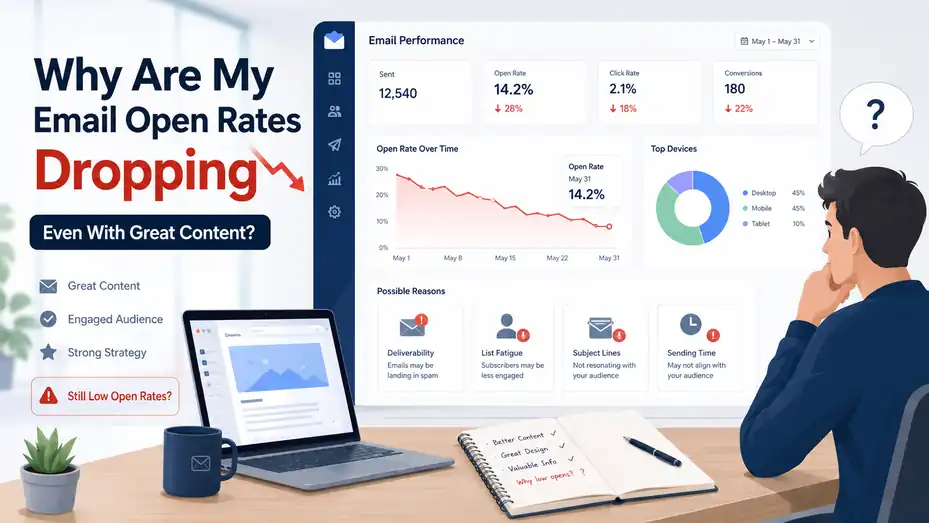
Why are my email open rates dropping? If you’ve been asking that lately, you’re not overreacting. It’s frustrating to spend real time writing thoughtful emails, only to watch the numbers slide anyway.
In my experience, a drop in opens usually has less to do with content quality and more to do with deliverability, list fatigue, inbox placement, tracking changes, or sending habits that quietly drifted off course.
Let me break it down for you in a practical way, so you can figure out what changed, fix what matters, and stop guessing.
What A Falling Open Rate Usually Means
A drop in opens feels personal, but it usually points to a system problem, not a writing problem. Before you rewrite every subject line you’ve ever sent, it helps to understand what open rate is actually measuring now.
Open Rates Measure Visibility, Not Just Quality
Open rate sounds simple, but it’s messier than most of us want to admit. At a basic level, it tells you how many delivered emails were opened. The problem is that “opened” does not always mean “read,” and “not opened” does not always mean “ignored.”
- What open rate can tell you: Whether your email was enticing enough to get attention in the inbox.
- What open rate cannot tell you: Whether the reader actually consumed the message, trusted it, or took action.
- What often gets missed: Inbox placement, image loading, privacy settings, and filtering all affect the number.
I believe this is where many solid email strategies go off track. A marketer sees open rates fall and assumes the content got weaker. Sometimes that’s true. But just as often, the issue is upstream. Your emails may be landing in Promotions instead of Primary. Your list may be aging. You may be sending to too many passive subscribers. Or privacy protections may be muddying the signal.
Imagine you run a weekly newsletter and your open rate drops from 38% to 27% over three months. That doesn’t automatically mean your writing got worse. It may mean your list grew quickly from a giveaway, your sending cadence increased, or a larger share of your audience now uses Apple Mail. The number matters, but the reason behind it matters more.
Privacy Changes Have Made Open Data Less Reliable
This is the uncomfortable truth: open rates are not as clean as they used to be. Privacy features, especially on Apple devices, changed email tracking in a big way. That means the metric can become inflated, inconsistent, or harder to compare over time.
When this happens, you can get two misleading stories at once. One campaign may look healthier than it is because of automated image preloading. Another may look weaker because inbox visibility changed while your real readers still care about your content.
Here’s how that plays out in practice:
- Inflated opens: Some privacy protections can trigger email “opens” even when the person did not actively read the message.
- Messy trendlines: A change in device mix can make this month’s open rate hard to compare with last year’s.
- False conclusions: You might optimize the wrong thing because the metric itself shifted.
From what I’ve seen, the smartest move is to treat open rate as an early-warning metric, not a final verdict. It still has value. You just should not let it make every decision for you. Pair it with click rate, click-to-open rate, replies, conversions, and revenue per email. That gives you a more honest picture of whether your emails are actually working.
The Most Common Reasons Open Rates Start Falling
There are usually a few repeat offenders behind declining opens. Most of them have nothing to do with whether your email content is “good” in the abstract.
Your Inbox Placement Got Worse
You can write a great email and still lose if it never reaches the main inbox. This is one of the first things I would check. If your emails drift from Primary to Promotions, or from inbox to spam, your open rate can drop fast even though your copy stayed strong.
A few quiet issues tend to cause this:
- Authentication gaps: Missing or misaligned SPF, DKIM, or DMARC records weaken trust.
- Complaint signals: More spam complaints tell mailbox providers your messages are less wanted.
- List hygiene problems: Too many inactive or invalid contacts can hurt sender reputation.
- Irregular sending patterns: Sudden spikes in volume can look suspicious.
Think of deliverability like a credit score for your sending domain. You may not notice the decline immediately, but mailbox providers do. If you suddenly ramp up from 5,000 emails a week to 50,000 after a launch, that change alone can cause trouble.
This is especially important if you send through platforms like MailerLite, ActiveCampaign, Brevo, Mailchimp, or HubSpot Email Marketing. These platforms can help with compliance and reporting, but they cannot fully protect you from poor sending practices. The strategy still has to be clean.
Your List Is Bigger But Less Engaged
A growing list looks exciting in a dashboard, but bigger is not always better. In many cases, open rates drop because the audience got broader, colder, or less qualified.
I’ve seen this happen after:
- Lead magnet overexpansion: A freebie attracts people who wanted the download, not your ongoing emails.
- Discount-driven growth: Subscribers join for the coupon, then tune out.
- Loose opt-in forms: You collect names from people with weak intent.
- No cleanup process: Dead weight stays on the list for months.
Imagine you run an ecommerce store on Shopify or WooCommerce. You launch a giveaway that brings in 8,000 new subscribers. Sounds great. But if most of those people never cared about your product category in the first place, your future campaigns get diluted. Your list grows, your open rate falls, and your actual revenue may barely move.
That’s why I suggest caring more about engaged subscribers than total subscribers. A smaller list of people who consistently open, click, and buy will outperform a bloated list almost every time.
Your Audience Is Experiencing Email Fatigue
Sometimes your list is not broken. It’s just tired.
Even strong subscribers can stop opening if they are seeing too many emails, similar angles, or too little novelty. This is classic fatigue. It shows up when readers still know your brand, but your messages no longer feel urgent or distinct.
Common patterns include:
- Over-sending: The same people hear from you too often.
- Predictable framing: Every subject line starts to sound alike.
- Constant promotion: Readers stop expecting value and start expecting pitches.
- Weak segmentation: Everyone receives everything.
I recommend paying attention to the feeling your audience likely has when your email lands. Do they think, “I want this,” or “another one already”? That emotional reaction matters more than most marketers realize.
A helpful fix is to reduce frequency for colder segments while protecting consistency for warmer ones. Not everyone needs the same cadence. Your most engaged readers may welcome three emails a week. A lukewarm segment might perform better with one highly relevant message every ten days.
How To Diagnose The Real Cause Before You Change Anything
The fastest way to make open rates worse is to “fix” the wrong problem. Before changing your copy, sending times, or platform, spend a little time diagnosing what actually shifted.
Compare Segments, Not Just Your Account Average
Account-wide open rate averages hide the story. They blend your hottest subscribers with your coldest ones, your welcome flow with your broadcast campaigns, and your best offers with your weakest sends.
Start by breaking performance into smaller groups:
- New subscribers vs. older subscribers
- Campaigns vs. automated flows
- Buyers vs. non-buyers
- Engaged last 30 days vs. inactive 90+ days
- Traffic source A vs. traffic source B
This matters because a drop may be isolated. Your overall open rate could fall because one segment deteriorated while everything else stayed healthy. That is a much easier problem to solve.
For example, let’s say your weekly newsletter went from 34% to 24%, but your welcome sequence still opens at 58%. That points away from brand trust and toward newsletter relevance, list fatigue, or segmentation problems. On the other hand, if every segment falls at once, deliverability becomes a stronger suspect.
In my experience, this single step saves a lot of wasted energy. Broad averages create broad panic. Segments create clarity.
Check Deliverability Signals Before Rewriting Subject Lines
Subject lines get blamed first because they are visible. Deliverability issues get missed because they are quieter. I would reverse that order.
Look for warning signs such as:
- Higher bounce rates
- Rising spam complaints
- More unsubscribes from normal campaigns
- Lower click rates at the same time as lower opens
- Sudden drops after a list import or major campaign spike
If you use a dedicated sending service such as Postmark for transactional mail, keep an eye on whether your marketing and transactional reputations are separated cleanly. If a business mixes too many message types or sends from domains with inconsistent standards, mailbox providers can lose trust faster than expected.
I also suggest checking your domain authentication, suppression lists, and recent acquisition sources before you touch your messaging. If deliverability is the root issue, better subject lines will not solve it. They may even create false hope for a campaign or two before the underlying decline returns.
Review Changes In Timing, Frequency, And Audience Source
Email performance often drops right after an operational change that seemed harmless at the time. That is why a simple timeline audit is so useful.
Ask yourself:
- Did we increase send volume recently?
- Did we add a new pop-up, giveaway, or lead source?
- Did we switch domains, subdomains, or sender names?
- Did we start mailing older inactive contacts again?
- Did we send more sales emails than usual this month?
Here’s a simple scenario. You add a new discount pop-up and double your email signups. Two weeks later, open rates slide. The real issue may not be the email copy at all. It may be lower-intent subscribers entering the system and dragging down your engagement baseline.
This is why I like to treat declining open rates like a timeline puzzle. Most causes reveal themselves when you compare the drop with what changed operationally around the same time.
The Metrics You Should Watch Instead Of Open Rate Alone
Open rate still matters, but it should not run the whole strategy. A healthier email program uses a small group of metrics that tell you what happened after the inbox.
Focus On Clicks, Conversions, And Reply Signals
The best email is not the one that gets opened. It is the one that creates the action you actually care about.
Here are the metrics I would track alongside open rate:
- Click rate: Shows whether the email drove action from total recipients.
- Click-to-open rate: Helps you judge message relevance after the open.
- Reply rate: Useful for newsletters, B2B emails, and relationship-based sends.
- Conversion rate: Tells you whether the email created the desired result.
- Revenue per recipient: Especially useful for ecommerce and product launches.
If your open rate drops slightly but clicks and sales hold steady, that’s a very different situation from a broad engagement collapse. In some cases, a lower open rate with a higher click-to-open rate actually means your list is becoming more qualified.
I recommend using Google Analytics or your email platform’s attribution tools to connect campaign traffic with on-site behavior. That helps you see whether readers who do open are spending time, converting, and returning.
Here’s the practical mindset: opens tell you whether you got attention; clicks tell you whether the email delivered value; conversions tell you whether the campaign mattered.
Build A Better Dashboard For Email Health
You do not need a massive analytics stack. You just need a dashboard that reflects reality.
A useful weekly dashboard might include this:
| Metric | What It Tells You | Why It Matters |
|---|---|---|
| Open Rate | Inbox visibility and curiosity | Helpful, but less reliable alone |
| Click Rate | Post-open engagement | Strong signal of relevance |
| Click-To-Open Rate | Message quality after the open | Great for comparing content angles |
| Unsubscribe Rate | Audience tolerance | Flags fatigue or mismatch |
| Spam Complaint Rate | Trust and consent quality | Impacts deliverability |
| Conversion Rate | Business outcome | The metric most teams actually need |
| Revenue Per Recipient | Financial efficiency | Excellent for ecommerce |
I believe this table is where many teams mature. Once you stop obsessing over one top-line number, your decisions get calmer and smarter. You can spot whether the issue is inbox visibility, content relevance, offer fit, or audience quality.
How To Improve Open Rates Without Gaming The System
The goal is not to trick people into opening. The goal is to become easier to notice, easier to trust, and easier to prioritize in a crowded inbox.
Tighten Your List Hygiene And Engagement Rules
List hygiene is not glamorous, but it works. If your list has too many unengaged subscribers, your open rates and deliverability can both suffer.
Here’s how to clean things up:
- Define inactivity clearly: For example, no opens, clicks, or purchases in 60 to 120 days.
- Create a re-engagement segment: Send a short sequence asking whether they still want to hear from you.
- Suppress non-responders: Stop mailing people who remain inactive after the sequence.
- Review acquisition sources: Cut sources that bring weak subscribers.
This can feel scary because you may remove a lot of contacts. But in many cases, removing disengaged subscribers improves results almost immediately. You send fewer emails, reach more real readers, and protect sender reputation.
I suggest being ruthless with disengaged contacts and gentle with warm ones. A healthy list is not the longest list. It is the most responsive one.
Improve Sender Identity And Subject Line Clarity
Readers often decide whether to open in two seconds or less. That decision is shaped by recognition first, then curiosity.
Focus on these elements:
- From name: Make it familiar and human.
- Subject line: Promise something clear, useful, or timely.
- Preview text: Support the subject line instead of repeating it.
- Consistency: Let readers know what kind of value to expect from you.
One mistake I see often is trying too hard to be clever. Clever can work, but clarity usually wins. “A Quick Fix For Your Cold Traffic Problem” will often outperform something vague and witty because the benefit is immediate.
Here’s a simple before-and-after:
- Weak: Thoughts for today
- Better: 3 Reasons Your Last Campaign Underperformed
- Stronger: 3 Fixes To Try Before Sending Your Next Campaign
The best subject lines do not scream. They make a relevant promise and sound like they came from someone worth hearing from.
Match Frequency To Engagement Level
Not everyone on your list wants the same amount of email. This is one of the biggest open-rate levers available, and it is surprisingly underused.
A simple model looks like this:
- Highly engaged: Send more often because they have shown appetite.
- Moderately engaged: Keep a steady, lower cadence.
- Cold subscribers: Reduce frequency or move them into a win-back flow.
This is especially useful in ecommerce platforms like Klaviyo and Omnisend, where segmentation around browsing, purchase history, and recency is easier to build. But the principle matters more than the software itself.
When frequency matches interest, readers are less likely to tune out. You also reduce the risk of training mailbox providers to see your emails as low-engagement clutter.
Tools And Platforms That Help You Spot The Problem Faster
Tools matter most when they help you diagnose patterns, not when they distract you with more dashboards. The right platform depends on your business model, list size, and automation needs.
Email Platforms Worth Considering For Different Use Cases
You do not need to switch platforms every time open rates dip. But if your current setup makes segmentation, automation, or deliverability management hard, the platform may be part of the bottleneck.
| Platform | Best Fit | Why It Helps |
|---|---|---|
| MailerLite | Creators, small businesses | Simple automation and solid reporting |
| Brevo | Cost-conscious teams | Email plus CRM-style features |
| ActiveCampaign | Advanced automation | Strong segmentation and logic |
| Mailchimp | General small business use | Familiar interface and broad adoption |
| Klaviyo | Ecommerce brands | Deep customer-event segmentation |
| Omnisend | Ecommerce teams | Built for retail-style messaging |
| HubSpot Email Marketing | B2B and CRM-heavy teams | Tighter contact and sales alignment |
I would not choose a platform based only on headline features. I would choose based on whether you can easily segment engaged users, monitor suppression logic, run re-engagement flows, and connect email performance to actual business outcomes.
What To Look For In Your Reporting Stack
A reporting stack should help you answer three questions fast: Are we landing? Are we getting engagement? Are we driving outcomes?
Useful reporting elements include:
- Audience filters: So you can compare engaged vs. unengaged segments
- Automation reporting: To separate flows from campaigns
- Deliverability indicators: To catch reputation or bounce issues early
- Revenue attribution: To tie email to actual performance
- Behavioral segmentation: To see what different subscriber groups respond to
In my experience, the biggest win is not fancy reporting. It is clean reporting. If your team cannot quickly identify whether the drop came from source quality, segmentation, cadence, or inbox placement, you will keep reacting emotionally instead of strategically.
Common Mistakes That Quietly Kill Open Rates
Most open-rate declines are not caused by one dramatic mistake. They come from small habits that stack up over time.
Sending The Same Message To Everyone
Mass sends feel efficient, but they often reduce relevance. When everyone gets the same email, a big portion of your list receives something that is only loosely connected to what they care about.
That leads to three problems:
- Lower opens: Because the subject line is less relevant to more people
- Lower clicks: Because the body does not match their needs
- Higher fatigue: Because subscribers learn your emails are hit or miss
Let’s say you sell skincare. A loyal repeat customer and a first-time lead should not receive the same campaign sequence every week. One may need education and trust. The other may respond better to replenishment timing or product bundles.
Segmentation does not need to be complicated to work. Even simple groups like new subscribers, repeat buyers, recent clickers, and cold leads can make a noticeable difference.
Treating Every Campaign Like A Promotion
When every email feels like a launch, a countdown, or a sale, people stop opening out of self-defense. They assume there is nothing new, only pressure.
I suggest aiming for a healthier balance:
- Value emails: Teach, explain, or entertain
- Trust emails: Share proof, stories, or perspective
- Promotional emails: Ask for the click or sale
- Behavior-based emails: Respond to real actions
This balance helps train your audience to expect useful emails, not just offers. Ironically, that usually makes the promotional emails work better too.
Ignoring Re-Engagement Until It Is Too Late
A lot of brands wait too long to handle inactivity. They keep mailing cold contacts, then wonder why open rates erode month after month.
A better approach is to create a simple re-engagement system:
- Identify subscribers cooling off
- Send a short value-first check-in
- Follow with a clear stay-or-go message
- Suppress people who do not respond
This protects both performance and trust. You stop forcing emails on people who are no longer interested, and you keep your metrics tied to a more honest audience.
Advanced Ways To Recover And Scale Email Engagement
Once you fix the basics, the next step is building a more resilient email system. That means designing around engagement quality, not vanity metrics.
Use Behavioral Segmentation Instead Of Static Lists
Static lists age badly. Behavioral segmentation adapts as the subscriber changes.
Useful behavior signals include:
- Recent clicks
- Purchase recency
- Category interest
- Site visits
- Cart activity
- Time since last engagement
This lets you send fewer, smarter emails. A subscriber who keeps clicking educational content may need a different sequence than someone who only responds to product drops. When your targeting gets tighter, open rates often improve as a side effect.
I believe this is the real long-term play. You stop asking, “How do I make everyone open?” and start asking, “How do I send the right message to the people most likely to care?”
Build More Evergreen Flows And Fewer Generic Blasts
Automations often outperform broadcasts because they arrive closer to intent. Welcome flows, post-purchase series, browse abandonment emails, reactivation sequences, and replenishment reminders usually feel more relevant than one-size-fits-all campaigns.
A strong email program often leans on:
- Welcome flow: Sets expectations and builds trust early
- Nurture flow: Educates before the pitch
- Post-purchase flow: Increases satisfaction and repeat purchases
- Win-back flow: Revives fading subscribers
- Behavioral reminders: Triggered by real activity
When I audit weak-performing accounts, I often find the same issue: too much effort goes into weekly blasts, not enough into evergreen systems. But evergreen flows compound. They keep delivering value even when campaign performance swings.
What To Do This Week If Your Open Rates Just Dropped
If your numbers fell recently, you do not need a full rebuild today. You need a clean first response.
A Simple 7-Step Recovery Plan
Use this plan to stabilize performance without overreacting:
- Compare the last 30 to 90 days: Look for when the decline started.
- Segment performance: Separate new leads, buyers, flows, and campaigns.
- Check deliverability basics: Verify authentication, bounce trends, and complaints.
- Audit acquisition sources: Find low-intent traffic sources fast.
- Reduce pressure on cold segments: Lower frequency or suppress them.
- Refresh sender identity: Improve from name, subject clarity, and preview text.
- Track business metrics: Watch clicks, replies, conversions, and revenue alongside opens.
That is the path I would take before making any dramatic platform move or creative overhaul. In most cases, the cause becomes much clearer once you isolate segments and review recent operational changes.
Final Thoughts
If you’re wondering why are my email open rates dropping even with great content, the most honest answer is that great content is only one part of the equation. Inbox placement, list quality, frequency, segmentation, privacy changes, and sender trust all shape whether your emails get opened in the first place.
I’d treat this as a systems issue before I’d treat it as a writing failure. Check the infrastructure, clean the list, segment more aggressively, and judge success by clicks, conversions, and revenue instead of opens alone. When you do that, you usually end up with a stronger email program overall, not just a prettier metric.

Juxhin B is a digital marketing researcher and founder of JAK Digital Hub, specializing in email marketing software, marketing automation platforms, and digital growth tools. His work focuses on software testing, platform comparisons, and real-world performance analysis to help businesses choose the right marketing technology.
Related posts:
 Why Are Your GetResponse Emails Going to Spam—and How Do You Stop It Fast?
 MailerLite Emails Going to Spam? Fix It Fast
 How To Migrate From Omnisend Without Losing Data Or Revenue
 How To Improve Deliverability In Email Marketing Platforms Today
 Email Leads Not Converting? Fix It With This Framework
 Email Leads Cost For 20K Contacts: What Should You Pay?